Rosin vs Distillate: Solventless Purity vs Lab Precision
Solventless rosin vs distillate: how each is made, terpene and potency tradeoffs, purity, cost, and which concentrate fits your sessions.

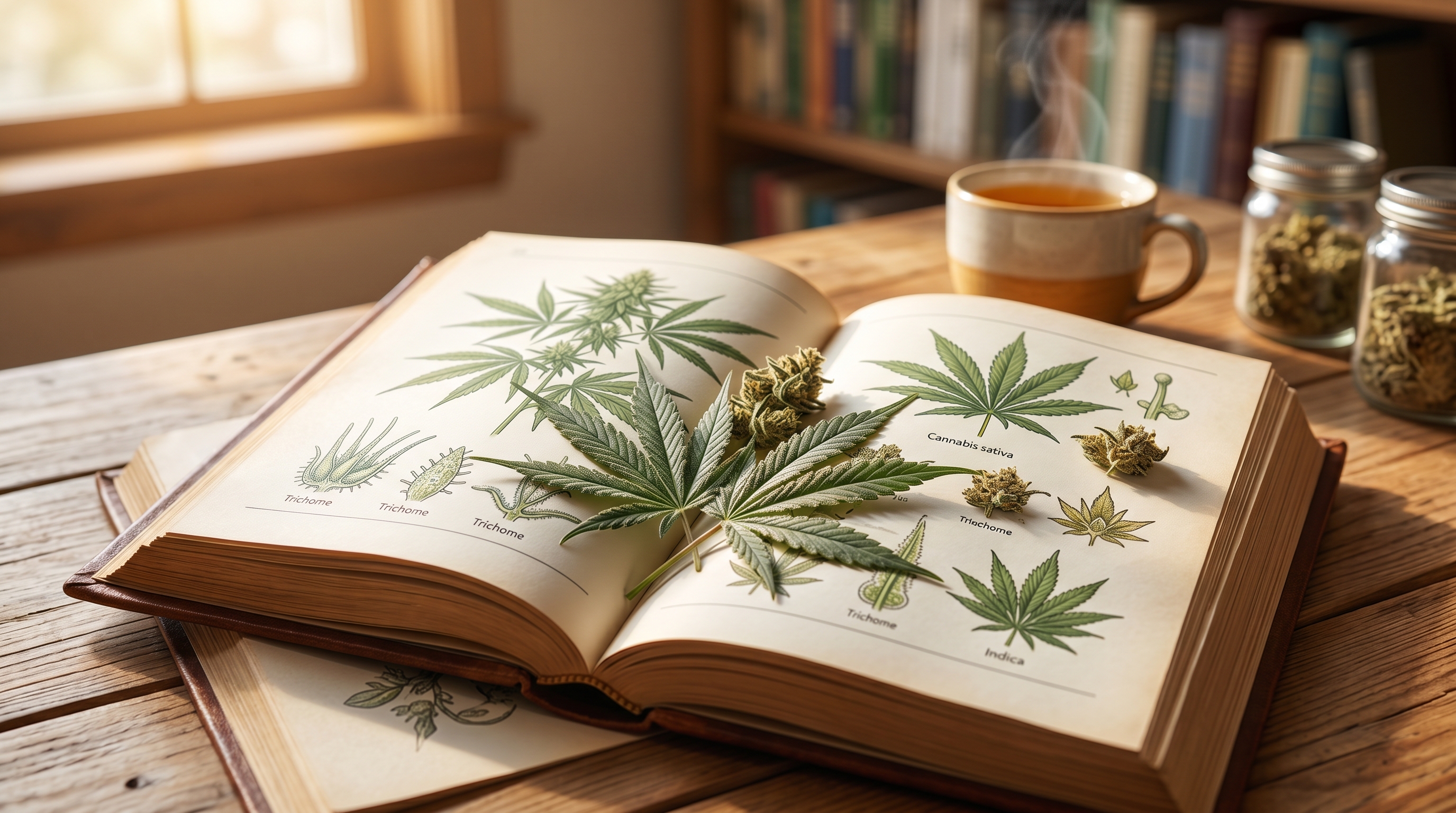
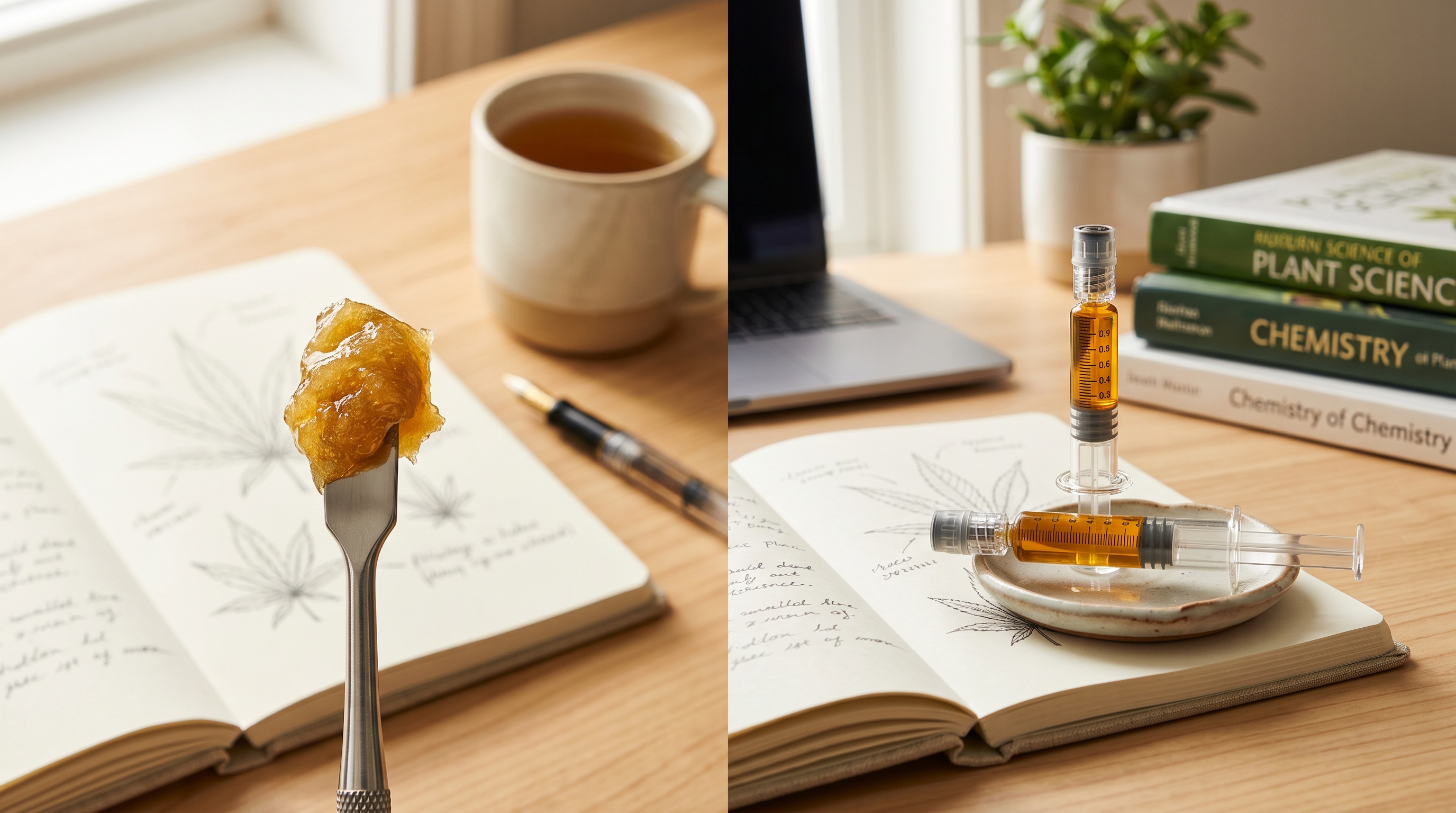
Walk up to any dispensary concentrate counter and you will see two very different philosophies sitting in the same case. On one side, golden, sappy rosin that looks like the plant got squeezed by a very strong hug. On the other, a clear, glassy syringe of distillate that could pass for honey at a farmers market. Both are concentrates. Both will get you very high. But they were made by people chasing opposite goals.
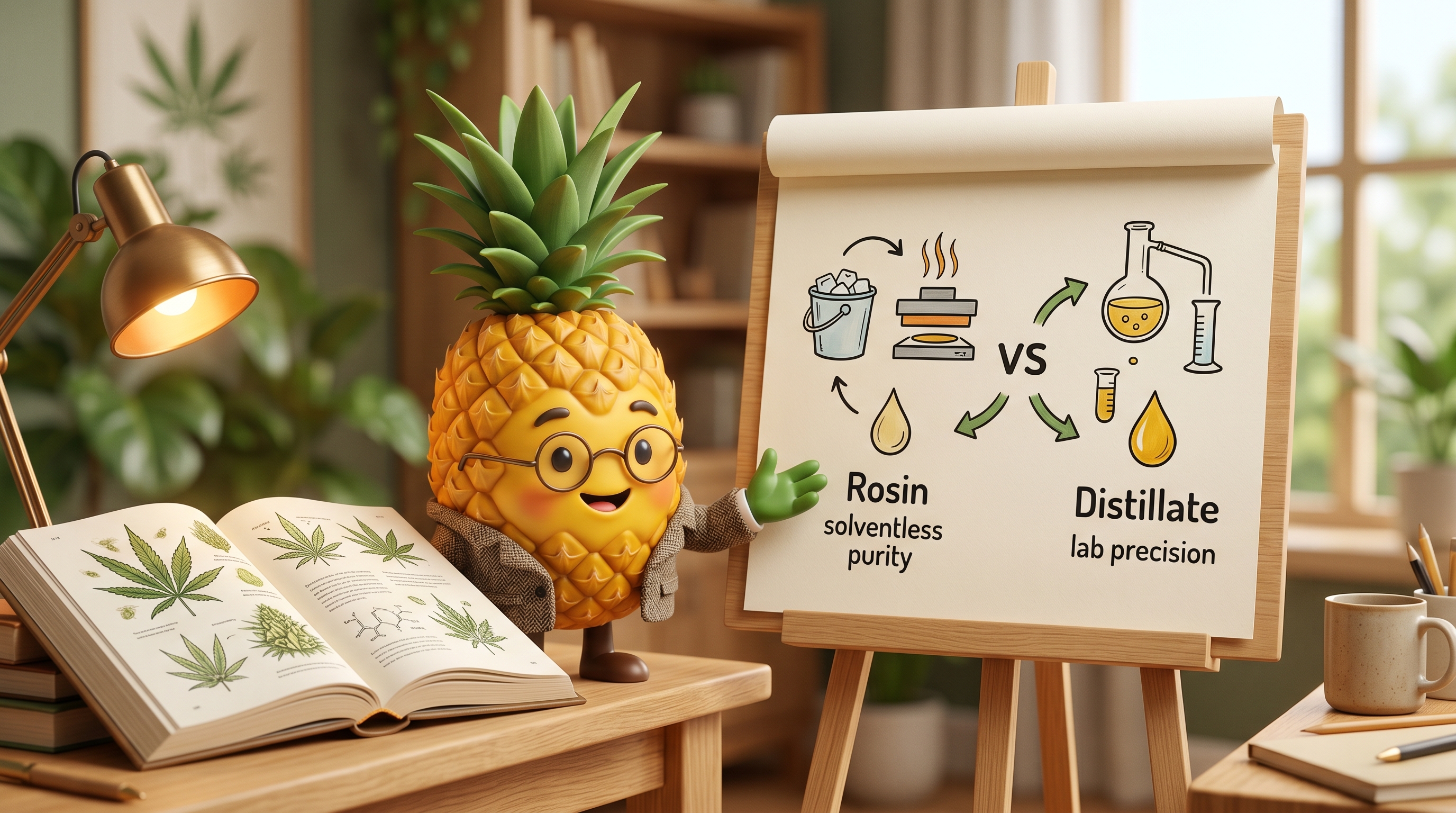
Rosin is the purist’s concentrate: pressed with nothing but heat, pressure, and ice water. Distillate is the engineer’s concentrate: refined in a lab until almost everything except the THC molecule is gone. One preserves the plant. The other perfects a single number.
I get asked which one is “better” almost every week, and the honest answer is that they are not even trying to win the same game. So let me lay them side by side, walk through how each is actually made, and help you figure out which one belongs in your session.
The criteria that actually matter
When people compare concentrates, they usually fixate on the THC number on the label. That is a mistake, and I will keep saying it until I am blue in the face. (I have a whole rant on why THC percentage is a terrible way to choose cannabis if you want the long version.)
To judge rosin against distillate fairly, you have to look at six things at once:
- How it’s made (and what that does to the plant)
- Terpene retention (flavor, aroma, and possibly effect)
- Potency ceiling (the headline THC number)
- Purity and contaminants (residual solvents, additives)
- Cost (per gram, and per “good session”)
- Best use case (dabs, carts, edibles)
Let’s take them one at a time.
How solventless rosin is made
Rosin is gorgeous in its simplicity. There is no chemistry degree required and, more importantly, no chemical solvents involved at any step.
The premium version, live rosin, starts with fresh-frozen flower. Drying and curing buds quietly evaporates the lightest terpenes. So growers flash-freeze the plant right after harvest to lock the aroma in at its peak. That frozen material gets agitated in ice water. The cold, brittle trichome heads snap off and sink. Those trichomes pass through fine mesh screens (measured in microns) to make bubble hash — basically a pile of concentrated resin glands. For the full walkthrough, see how to make bubble hash.
Then comes the press. The dried hash goes between two heated plates, and the extractor applies firm pressure at a relatively low temperature (often somewhere in the 160–220°F range, depending on the material). The resin liquefies just enough to squeeze out through filter bags, and what oozes free is rosin. Many craft producers then “cold-cure” the result, letting it sit and transform into a buttery, terpene-rich consistency.
The headline here: nothing but heat, pressure, and water ever touches the product. That is what “solventless” means, and it is the entire appeal. For the broader family of squeeze-and-sift methods, see bubble hash vs kief vs dry sift and the complete guide to cannabis concentrates.
One quick clarification budtenders love to test you on: rosin is solventless, live resin is not. They sound similar, but live resin uses hydrocarbon solvents like butane. I break down that confusing pair in live resin vs live rosin.
How distillate is made
Distillate is the opposite story — a multi-stage subtractive refinement that strips the plant down to a single target molecule.
It usually goes like this:
- Crude extraction. A solvent (ethanol, CO2, or hydrocarbons) pulls the cannabinoids, terpenes, fats, and waxes out of dried biomass into a raw “crude” oil.
- Winterization. That crude is dissolved in ethanol and chilled to around -40°C for a day or two. The fats and waxes solidify and get filtered out, leaving a cleaner oil.
- Decarboxylation. Gentle heat converts THCA into active THC.
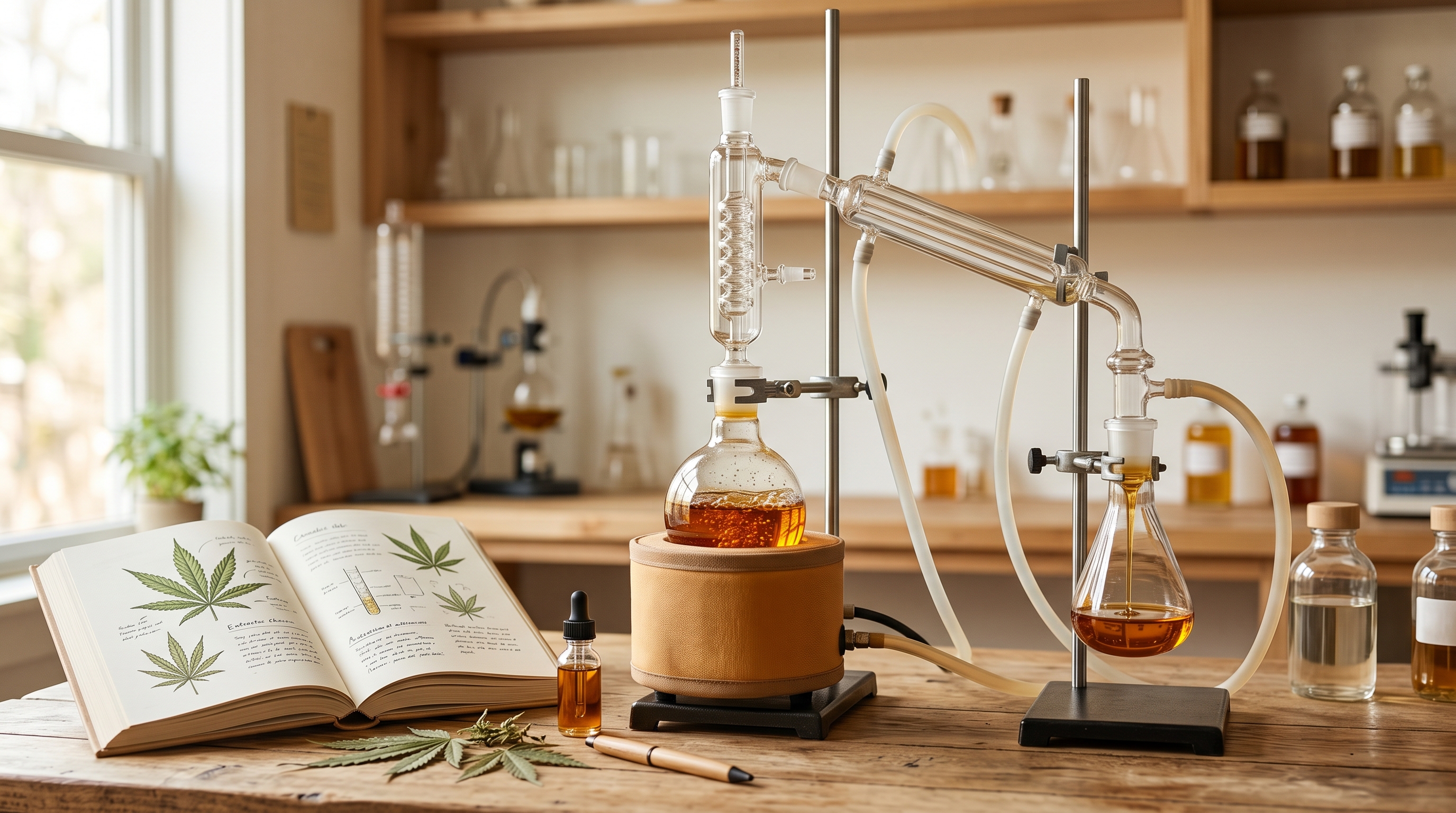
- Short-path (or wiped-film) distillation. This is the magic step. The oil is heated under deep vacuum, which lowers each compound’s boiling point so nothing scorches. Compounds vaporize one at a time based on their boiling points — terpenes flash off first, then the target cannabinoid rises, condenses on a chilled surface, and drips into a separate flask. The heavy junk stays behind.
A single distillation pass lands around 70–85% THC; a second pass pushes it to 90–99%. The catch is right there in the process: those low-boiling-point terpenes you’d want? They get boiled off and discarded early. That is why pure distillate is famously clear, odorless, and flavorless. To get flavor back, producers blend in cannabis-derived or botanical terpenes after the fact.
Side by side
Here is the whole comparison in one table. Ranges vary by producer and region, so treat these as typical, not gospel.
| Factor | Solventless Rosin | Distillate |
|---|---|---|
| Extraction | Heat + pressure + ice water (no solvents) | Solvent extraction, then winterization + distillation |
| Terpenes | High, full-spectrum, true-to-plant | Stripped out (often re-added artificially) |
| Potency (THC) | ~65–85% | ~90–99% |
| Minor cannabinoids | Preserved (CBG, CBN, CBC, etc.) | Largely removed |
| Purity / solvents | Zero residual solvents possible | Trace solvents possible; relies on lab purging |
| Taste & aroma | Rich, complex, strain-specific | Neutral unless terpenes added back |
| Cost per gram | Premium (often $60–120) | Budget-friendly (often $15–40) |
| Best for | Flavor-forward dabs, full-spectrum sessions | Carts, edibles, max THC per dollar |
The pattern is clear once you see it laid out. Distillate wins potency and price. Rosin wins flavor, full-spectrum richness, and chemical purity. Neither is objectively “stronger” — they just deliver their high differently.
The terpene and entourage question
This is where the comparison gets genuinely interesting instead of just a numbers game.
When you dab rosin, you inhale THC plus a few percent of native terpenes. Think myrcene, limonene, and caryophyllene, each with its own aroma and effect signature. You also get a supporting cast of minor cannabinoids. Researchers call the way these compounds interact the entourage effect. The working theory is that terpenes may shape how THC lands. Many experienced users say a terpene-rich rosin at 70% THC feels more rounded and less spiky than a 95% distillate, even though the distillate has the bigger number. A calming terpene like linalool survives the gentle solventless press. In distillation, it boils off and vanishes.
Lab data backs up the gap. Solventless live rosin often tests at 8 to 15 percent terpenes, while pure distillate is near zero before anything is added back [Russo, 2019]. One review found that solventless pressing preserves more than half of the starting terpene mass, and keeps over 89 percent of it through decarbing [Duminy, 2025].
I want to be careful here, though. The entourage effect is well-supported as a concept. It is not fully pinned down in controlled human trials. So I’d frame it like this: rosin may give you a more layered, plant-like experience. That comes from the compounds distillate leaves on the cutting-room floor. Distillate gives you a cleaner, more single-note hit. It is strong and predictable, but flatter. If terpene-driven nuance matters to you, that is rosin’s whole pitch. For the bigger picture, see cannabis oil vs flower.
Purity, solvents, and reading the label
Here is the part health-conscious consumers care about most.
Because rosin never meets a solvent, there is zero possibility of residual butane, propane, or ethanol in the final product. That is a real, structural advantage — not marketing.
Distillate can be exceptionally clean. But its purity is earned in the lab, not baked into the method. The solvents used early on have to be fully purged. The only way you know that happened is the Certificate of Analysis (COA). A good COA confirms potency. It shows residual solvents under the legal limit (often under 5 ppm). It also screens for pesticides, heavy metals, and microbials. If you don’t know how to decode one, read my guide on how to read cannabis lab results. Bookmark it before your next concentrate purchase, no matter which type you buy.
The takeaway: rosin is solvent-free by design; distillate is solvent-free if the lab did its job and the COA proves it.
Cost: what you’re actually paying for
Rosin is labor-intensive and lower-yield. Freezing flower, washing hash, drying it, pressing it, curing it — every step is hands-on and wastes some material. That’s why it sits at the premium end of the menu.
Distillate is built for scale and efficiency. The plant doesn’t even need to be fresh-frozen, the process runs continuously, and the output is enormous. That efficiency is exactly why distillate anchors most budget carts and nearly every edible. If you’re optimizing for THC per dollar, distillate wins, full stop.
Who should choose which
Choose solventless rosin if you:
- Care about flavor, aroma, and strain-specific character
- Want the cleanest possible extraction with zero solvents
- Value the full-spectrum, entourage-driven experience
- Mostly dab or use a high-quality solventless cart
- Don’t mind paying a premium for craft quality
Choose distillate if you:
- Want maximum potency for the price
- Need a neutral, versatile base for edibles or carts
- Prioritize consistency and repeatable dosing over flavor
- Are stocking up and the budget is the constraint
Still deciding between concentrates and other formats entirely? How to choose between flower, edibles, and concentrates zooms out to the full menu. And if you find that the same product hits you differently from session to session, remember that the format is only one variable — your ideal high is a pattern, not a product name.
The verdict
There is no universal winner, and anyone who tells you otherwise is selling something.
Rosin is the purity-and-flavor pick. It’s the closest thing to dabbing the living plant — solvent-free, terpene-rich, and full-spectrum. You pay for that craftsmanship, and connoisseurs happily do.
Distillate is the precision-and-value pick. It’s the workhorse: cheap, potent, neutral, and endlessly versatile. It powers most of the carts and edibles you’ll ever buy, and it does that job extremely well.
My honest advice? If the experience of cannabis matters to you — the taste, the aroma, the rounded high — spend up for rosin once and feel the difference for yourself. If you’re chasing a reliable effect at the best price, or building edibles, distillate is the smarter buy. The “best” concentrate is the one that fits what you actually want out of the session. Track which one leaves you feeling right, and you’ll stop guessing.
Key takeaways
If you skim one section, make it this one:
- Rosin is solventless. It uses only ice water, heat, and pressure. There is zero chance of leftover butane, propane, or ethanol.
- Distillate is refined. Solvents pull the crude oil. Then winterizing and short-path distillation strip it down to a single cannabinoid.
- Potency vs. flavor. Distillate tests higher (often 90 to 99% THC). Rosin keeps the terpenes (often 8 to 15%) for a richer, fuller experience.
- Price. Rosin is craft and premium. Distillate is cheap and scalable.
- Best use. Dab rosin for flavor. Use distillate for carts, edibles, and value.
- Always check the COA, no matter which one you buy.
FAQ
Is rosin stronger than distillate? Not on paper. Distillate tests higher in raw THC (90–99% vs roughly 65–85% for rosin). But “stronger” is subjective — rosin’s full-spectrum terpenes and minor cannabinoids can make a lower-THC product feel bigger and more complete to many users.
Does distillate have any terpenes? Pure distillate has essentially none; they’re boiled off during distillation. Most products have cannabis-derived or botanical terpenes added back afterward for flavor, but it rarely matches a strain’s native profile.
Is solventless rosin really solvent-free? Yes. The process uses only ice water, heat, and pressure, so there’s no chance of residual butane, propane, or ethanol. That’s its defining advantage.
Which is better for edibles? Distillate, almost always. Its neutral flavor and high, consistent potency make it the ideal base for gummies and infusions — no weedy taste, easy dose math.
Why is rosin so expensive? It’s labor-intensive and lower-yield. Fresh-freezing, ice-water washing, drying, pressing, and curing all take hands-on work and waste some material, which pushes the price up.
Can I dab distillate? You can, but most people don’t love it — it’s flat and flavorless on a rig. Distillate shines in carts and edibles; rosin is the dabber’s preference.
Sources
- Russo, 2019 — The Case for the Entourage Effect and Conventional Breeding of Clinical Cannabis
- Duminy, 2025 — Terpene Retention from Starting Material to Finished Product (GES Labs review)
- NugHub — Distillate vs. Live Resin vs. Live Rosin
- Elephant Garden Co. — Live Rosin vs Distillate Cartridges: Solventless Guide
- Jetty Extracts — Live Resin vs Rosin vs Distillate: How to Choose
- Root Sciences — How to Make THC Distillate: Extraction Process
- CannaLabs Consulting — Cannabis Distillation Theory: The Complete Guide
- Robust Cannabis — Rosin vs Resin vs Distillate: What’s the Difference?
Cannabis affects everyone differently, and the research on the entourage effect is still developing. This article is educational and not medical advice. Know your local laws and consume responsibly.


