

Does Weed Help a Hangover? A Symptom-by-Symptom Reality Check
Does weed help a hangover? No trial has tested it, and weed cannot rehydrate you or clear alcohol's leftovers. Here is what each symptom's cause says.

Professor High
Written by Professor High, our AI guide. See how we research and correct articles.
Weed does not cure a hangover, and no clinical trial has tested whether it eases one. A hangover comes from alcohol’s effects on your stomach, sleep, immune system and fluid balance, and no study shows weed undoing any of them. The cannabinoid evidence people point to is about chemotherapy nausea, from trials run between 1975 and 1991.
Here is the part worth screenshotting: weed adds no water and does not clear alcohol’s byproducts, and a PubMed search for cannabis and hangover trials turns up zero treatment studies. The one cannabinoid trial that does mention “hangover” is a 1985 study of the morning after smoking weed, not drinking. So when a friend swears by a morning joint, the honest answer is “nobody has checked.”
One scope note before class starts. This lesson is about the alcohol hangover. Weed can leave its own next-day fog, and High School covers that in our cannabis hangover lesson. This article reports what the evidence shows; it is not treatment advice.
What actually causes a hangover?
A hangover is several problems at once, not one. The US National Institute on Alcohol Abuse and Alcoholism (NIAAA) lists six likely contributors: mild dehydration, disrupted sleep, irritation of the stomach lining, inflammation, acetaldehyde (a toxic byproduct of breaking down alcohol), and a mini-withdrawal as alcohol leaves your system. NIAAA hangover fact sheet
Dehydration probably contributes, but it is not the whole story. A review of human blood and urine studies found that dehydration markers and electrolytes did not track how bad a hangover felt, while immune factors gave the most convincing signal. Penning et al., 2010 A 2024 review goes further and describes the hangover as sickness behavior driven by alcohol-induced inflammation and gut leakiness, with acetaldehyde and lost sleep adding to it. Turner et al., 2024
Timing matters too. NIAAA says symptoms peak when blood alcohol drops back to about zero and can last 24 hours or longer. Its bottom line is blunt: there is no cure for a hangover other than time.
Does weed cure a hangover, or even ease one?
No study has tested it, so nobody can say it eases a hangover. A 2005 systematic review of hangover trials found eight randomized trials of eight remedies, from propranolol to prickly pear, and cannabis was not among them. It found no compelling evidence that any remedy works, either before drinking or the morning after. Pittler et al., BMJ 2005
A 2022 review in Addiction pooled 21 placebo-controlled trials in 386 healthy adults. A few single trials looked positive, but none was repeated, and every efficacy result was rated very low quality. Roberts et al., 2022 That is the state of the field for remedies people have actually tested. Weed has not even reached that starting line.
The cleanest way to see why is to match each symptom to its driver and ask whether weed acts on that driver.
| Hangover symptom | What drives it (NIAAA) | Does weed act on that driver? | What the evidence shows |
|---|---|---|---|
| Thirst, fatigue, headache | Mild dehydration: alcohol makes you urinate more | No | Weed adds no fluid. No hangover test exists. |
| Nausea, stomach pain | Stomach lining irritation, extra acid, inflammation | Not directly | Pharmaceutical cannabinoids reduced chemotherapy vomiting in old trials, with more dizziness and dysphoria. Never tested after drinking. |
| Anxiety, irritability (“hangxiety”) | Mini-withdrawal as alcohol wears off | No | Very low quality evidence of a small anxiety benefit from pharmaceutical THC in medical patients. Never tested after drinking. |
| Poor sleep, tiredness | Fragmented sleep after alcohol | No | Untested for hangovers. |
| Foggy thinking, slow reactions | Inflammation, sleep loss, acetaldehyde | No; THC adds its own impairment while active | No hangover test. |
| Malaise, the “sick” feeling | Inflammation, acetaldehyde | No | No human study of cannabinoids on hangover inflammation found. |
“Untested” is the finding in four of those six rows. It is not a gap to fill with guesses.
Can weed help hangover nausea?
Nobody has tested it on alcohol nausea, and the evidence people cite comes from a very different setting. A Cochrane review gathered 23 randomized trials of cannabinoids for nausea in adults on chemotherapy. The trials ran from 1975 to 1991 and used pharmaceutical cannabinoids, not smoked flower. Smith et al., Cochrane 2015
Compared with placebo, more people on cannabinoids had no vomiting at all. Compared with an older anti-nausea drug, cannabinoids worked about the same but caused more dizziness, more dysphoria and more sedation, and more people dropped out because of side effects. The reviewers note their evidence does not reflect current chemotherapy regimens. You can read more about that research in our lesson on cannabis for chemotherapy nausea and cancer symptoms, and about what the nausea research looks at.
Alcohol nausea comes partly from an irritated stomach lining. Chemotherapy nausea comes from a drug acting on the body in other ways. A result in one does not transfer to the other. Weed can also cause vomiting: cannabinoid hyperemesis syndrome is a pattern of cyclic vomiting linked to cannabis use. Sorensen et al., 2017 And too much THC can make anyone queasy, as our lesson on greening out explains.
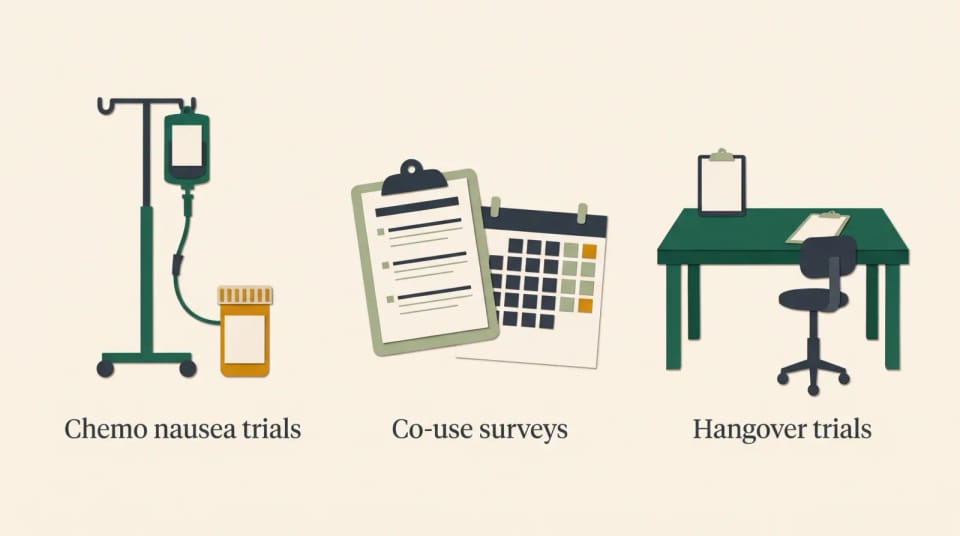
Where the evidence actually sits. The nausea data come from chemotherapy patients on pharmaceutical cannabinoids, the co-use data are surveys, and the desk for a cannabis hangover trial is empty.
Does weed help hangover anxiety?
There is no evidence that it helps hangxiety specifically. Hangover anxiety is real: a 2026 systematic review of 22 studies linked hangovers with more anxiety, stress and low mood, made worse by avoidant coping and repetitive negative thinking, and softened by social support. Rothman et al., 2026
The cannabinoid side is thin. A large 2019 meta-analysis found very low quality evidence that pharmaceutical THC slightly improved anxiety symptoms in people with other medical conditions, such as chronic pain. The same analysis found more adverse events in people taking cannabinoids, and scarce evidence for anxiety disorders. Black et al., Lancet Psychiatry 2019 None of those patients were hungover. THC can also raise anxiety in some people, which our guide to cannabis and anxiety walks through.
Can weed fix a hangover headache or dehydration?
No. Weed contains no water and no salts, so it cannot replace fluid. The dry, sticky mouth it causes is a separate effect on saliva, covered in our cannabis dry mouth lesson; it does not mean you are rehydrating or dehydrating faster. A university harm-reduction page makes the same point plainly: cannabis cannot rehydrate you or remove toxins. UC Davis Safe Party
No study has tested cannabis on hangover headache, sleep, fatigue or brain fog. The same goes for inflammation: we found no human study of cannabinoids on the inflammation behind a hangover. If you want to know what the research says about weed and rest in general, see cannabis and sleep.
Do people who use weed get fewer hangovers?
The two best observational studies point in different directions, and neither tests relief. A daily-survey study of 341 US college students who use both found hangovers were less likely on co-use days than on alcohol-only days, after accounting for how much people drank. The authors concluded that most bad outcomes on co-use days appeared to come from the alcohol. Co-use days also carried a higher chance of driving while impaired. Drohan et al., 2023
A study of 2,964 adults in a long-running US cohort found the opposite pattern across years: using alcohol and cannabis together was linked with more frequent hangovers, mostly because those people drank more. Waddell and Marszalek, 2022 Both are self-reported surveys. They describe patterns in who gets hangovers, not whether weed relieves one.
Using weed to drink less is a separate question with its own evidence. Our lesson on the California sober lab trial covers it.
Is it safe to smoke while hungover?
Nobody has studied THC in people who are hungover, so there is no evidence that it is safe or unsafe. Here is what the research does say about timing.
A lab study found that alcohol on board raised blood THC levels and made volunteers feel the high sooner and stronger. Lukas and Orozco, 2001 That study gave alcohol during smoking. A hangover peaks when blood alcohol is near zero, so the study does not model the morning after. It does show that a “hair of the dog” drink plus a joint is a different situation from a hangover alone. That is an inference from the study design, not a tested result. The full picture of mixing cannabis and alcohol lives in its own lesson.
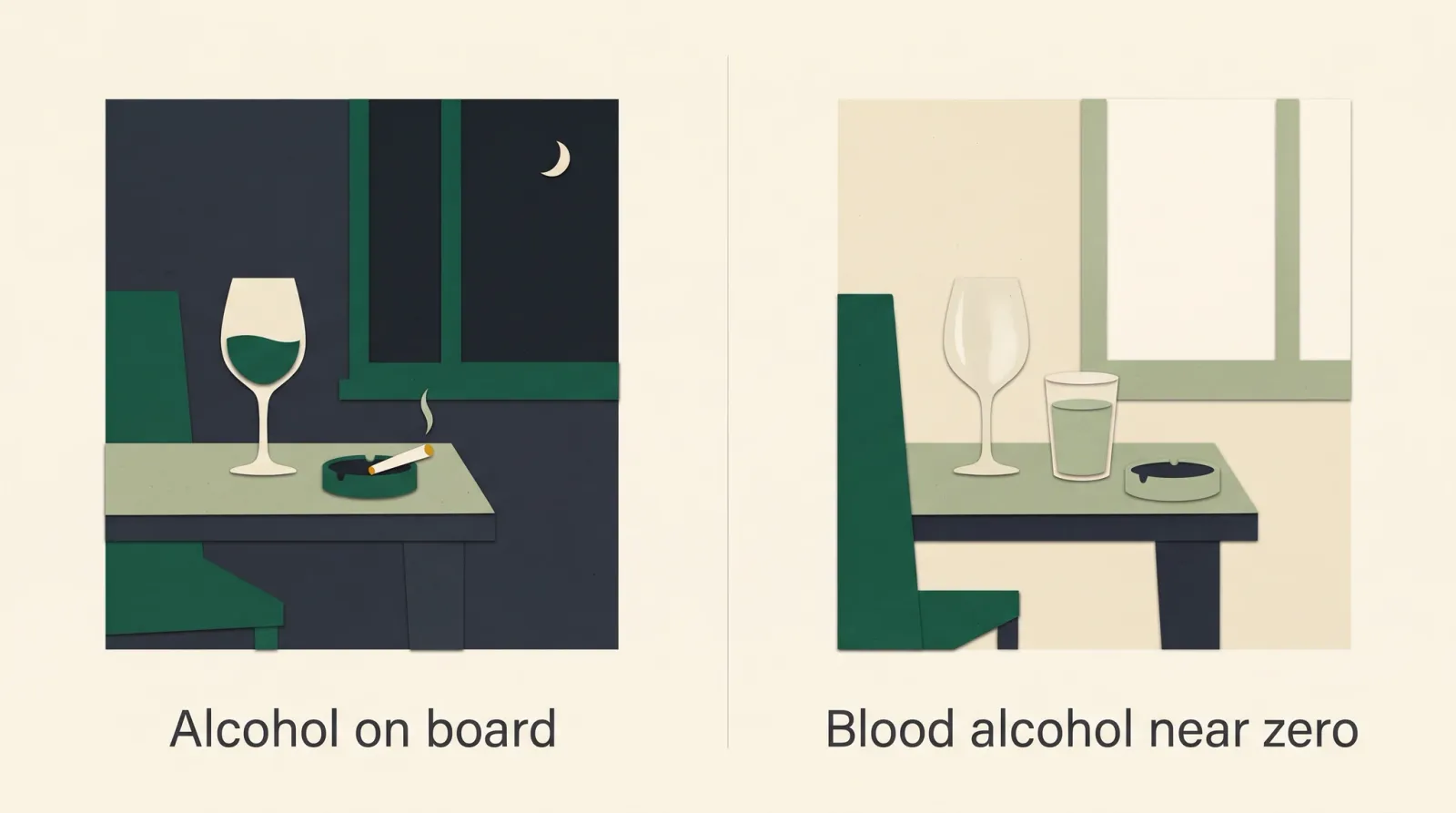
The study that found alcohol raises THC levels gave alcohol during smoking. A hangover peaks the next morning, when blood alcohol is near zero, so that result does not describe it.
Two safety facts hold regardless. People with a hangover can perform worse on thinking and visual-spatial tasks even when their blood alcohol is back to normal, which matters for driving and work. Wiese et al., 2000 And THC impairs coordination and reaction time while it is active. Stacking one on the other is not a path to a clearer head.
Weed also carries its own morning after. A small 1985 study found measurable changes the morning after smoking, though a 2023 review of 20 studies found most next-day performance tests showed no effect. Chait et al., 1985; McCartney et al., 2023 The second review’s authors disclose consulting for cannabis-industry bodies.
When to talk to a clinician
Most hangovers pass with time. Contact a clinician, a pharmacist or urgent care if you cannot keep fluids down, keep vomiting, feel confused, or your symptoms are severe, unusual or last much longer than a day. Repeated bouts of vomiting in someone who uses cannabis heavily are worth raising with a doctor, because cannabinoid hyperemesis syndrome can look like a hangover that keeps coming back. If you are struggling with how much you drink, a clinician can help with that too.
If the trouble is that you are too high rather than hungover, our guide on what helps when you are too high covers it.
Key takeaways
- No clinical trial has tested weed on an alcohol hangover.
- Weed does not touch the main drivers: fluid loss, acetaldehyde, inflammation, stomach irritation and lost sleep.
- The cannabinoid nausea evidence comes from chemotherapy trials of pharmaceutical products, 1975 to 1991, with more dizziness and dysphoria.
- Co-use surveys conflict and do not show that weed relieves or heads off a hangover.
- NIAAA’s answer still stands: time is the only cure, and drinking less is the only prevention.
FAQ
What drugs help with hangovers?
No drug has strong evidence behind it. A 2022 review of 21 placebo-controlled trials rated every efficacy result very low quality, and common painkillers such as paracetamol and aspirin had never been tested against placebo for hangovers. Ask a pharmacist before taking any medicine after drinking.
Does CBD help a hangover?
There is no evidence that it does. A PubMed search for CBD and hangover found no trial of CBD as a hangover treatment. Claims on product pages are not study results.
Will weed make my hangover worse?
It can. Cannabinoids in the chemotherapy trials caused more dizziness, dysphoria and sedation than the comparison drug, and too much THC can cause nausea or anxiety. Heavy regular use is linked to cannabinoid hyperemesis syndrome, which causes repeated vomiting.
Is a weed hangover the same as an alcohol hangover?
No. An alcohol hangover comes from dehydration, inflammation, stomach irritation, acetaldehyde, poor sleep and withdrawal. A weed “hangover” is a milder next-day fog that lab studies mostly fail to detect. Our cannabis hangover lesson explains the difference.
How long does a hangover last?
NIAAA says hangover symptoms peak when blood alcohol returns to about zero and can last 24 hours or longer. Time is the only cure NIAAA recognizes.
Sources
- National Institute on Alcohol Abuse and Alcoholism. Hangovers. NIAAA fact sheet, accessed 2026-10-29.
- Pittler MH, Verster JC, Ernst E. Interventions for preventing or treating alcohol hangover: systematic review of randomised controlled trials. BMJ, 2005.
- Roberts E, Smith R, Hotopf M, Drummond C. The efficacy and tolerability of pharmacologically active interventions for alcohol-induced hangover symptomatology. Addiction, 2022.
- Penning R, et al. The pathology of alcohol hangover. Current Drug Abuse Reviews, 2010.
- Turner BRH, et al. Inflammation, oxidative stress and gut microbiome perturbation: a narrative review of mechanisms and treatment of the alcohol hangover. Alcohol, Clinical and Experimental Research, 2024.
- Wiese JG, Shlipak MG, Browner WS. The alcohol hangover. Annals of Internal Medicine, 2000.
- Smith LA, et al. Cannabinoids for nausea and vomiting in adults with cancer receiving chemotherapy. Cochrane Database of Systematic Reviews, 2015.
- Black N, et al. Cannabinoids for the treatment of mental disorders and symptoms of mental disorders. Lancet Psychiatry, 2019.
- Rothman R, et al. A systematic review of the impact of the alcohol hangover upon negative affect. Drug and Alcohol Review, 2026.
- Drohan MM, et al. Acute consequences associated with co-use of alcohol and cannabis: a daily survey analysis. Journal of Studies on Alcohol and Drugs, 2023.
- Waddell JT, Marszalek JM. Indirect and direct effects of simultaneous alcohol and cannabis use on alcohol hangovers. Addictive Behaviors, 2022.
- Lukas SE, Orozco S. Ethanol increases plasma Delta(9)-tetrahydrocannabinol (THC) levels and subjective effects after marihuana smoking in human volunteers. Drug and Alcohol Dependence, 2001.
- McCartney D, Suraev A, McGregor IS. The “next day” effects of cannabis use: a systematic review. Cannabis and Cannabinoid Research, 2023.
- Chait LD, Fischman MW, Schuster CR. “Hangover” effects the morning after marijuana smoking. Drug and Alcohol Dependence, 1985.
- Sorensen CJ, et al. Cannabinoid hyperemesis syndrome: diagnosis, pathophysiology, and treatment. Journal of Medical Toxicology, 2017.
- UC Davis Student Affairs. Safe Party facts and myths. Accessed 2026-10-29.



