Fungus Gnats in Cannabis: The Complete Elimination Guide
Fungus gnats damaging your cannabis roots? Learn to identify, eliminate, and prevent them with BTI, nematodes, sticky traps, and smart watering.


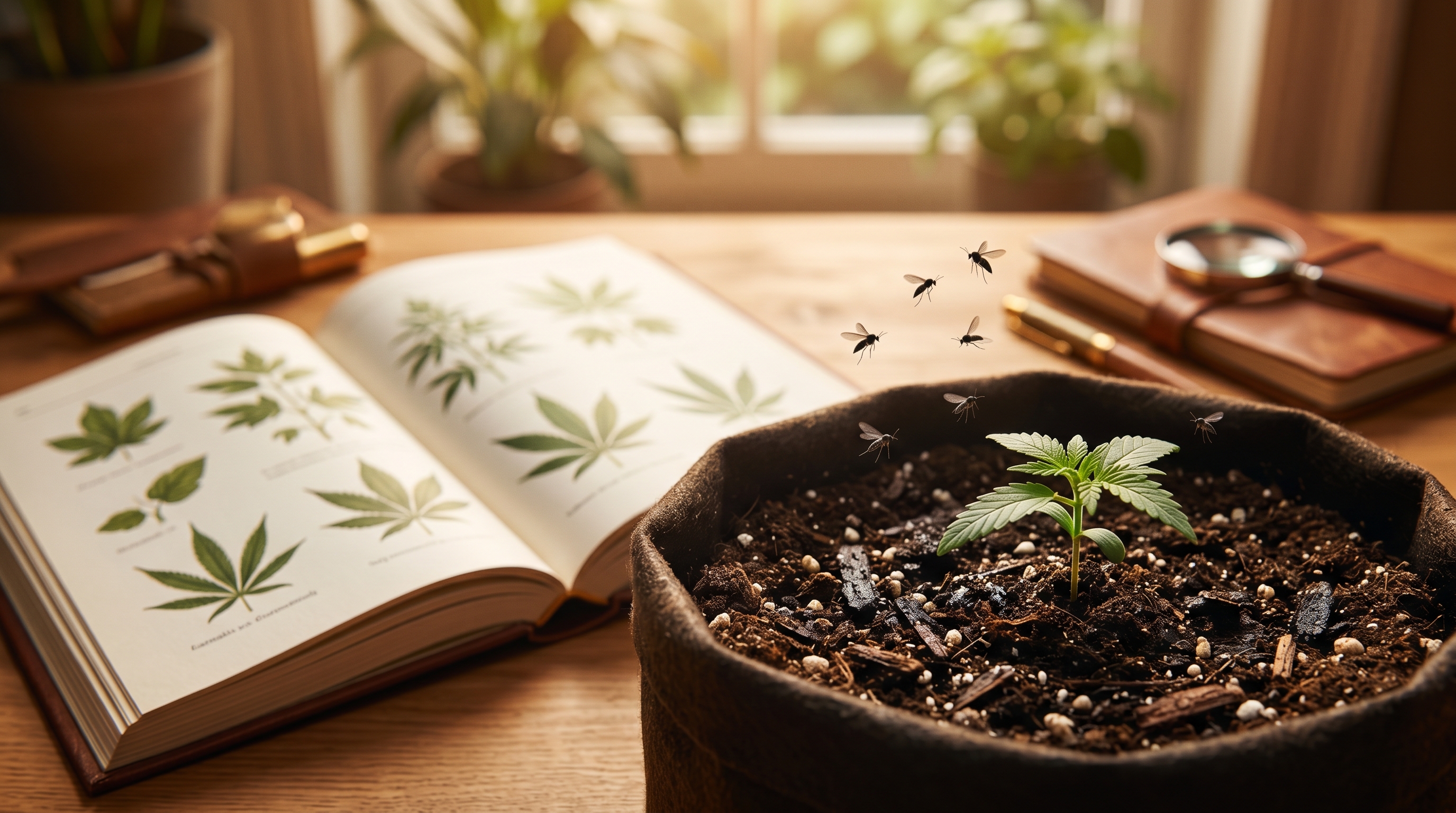
You walk over to check on your cannabis seedlings, brush the leaves, and a little cloud of tiny black flies lifts off the soil like dust shaken from a rug. They drift around aimlessly, land on the medium, crawl down the drainage holes, and generally make you feel like your tidy grow space just became a swamp. Welcome to the single most common pest problem new growers face: fungus gnats.
Here’s the reframe that matters. The adults you see flying around are annoying, but they are mostly harmless to the plant. The real damage is happening underground, where you can’t see it — and the reason they showed up at all is almost certainly something you did with your watering can. Fungus gnats are not bad luck. They are a symptom. Fix the symptom and the cause together, and they vanish for good.
This guide walks you through identifying fungus gnats, understanding their lifecycle so you can break it, recognizing the root and seedling damage they cause, and executing a layered elimination plan that actually works. No magic spray. Just biology used against itself.
What Fungus Gnats Actually Are
Fungus gnats are small, dark-bodied flies — usually black or dark gray, roughly 2mm long, with long dangly legs and a single pair of clear wings. They look like miniature mosquitoes but they don’t bite, and they’re weak, clumsy fliers. When you disturb the soil surface, they scatter in a slow, drunken way rather than zipping off like a fruit fly. That flight pattern is one of the easiest field IDs.
Don’t confuse them with their look-alikes. Fruit flies are tan or brown, hang around ripe fruit and drains rather than soil, and fly fast. Shore flies are stubbier, darker, and have short legs — they share the same damp habitat but their larvae don’t tunnel into roots the same way. If the flies are coming off the top inch of your growing medium and crawling near the base of the stem, you’re looking at fungus gnats.
The adults live only about a week. Their entire purpose is to mate and lay eggs in moist organic matter. A single female can lay 100 to 300 eggs in that short window, which is exactly why a “few harmless flies” becomes a thick haze around your pots within two or three weeks if you ignore them.
The Lifecycle (And Why It’s Your Best Weapon)
You cannot win a fungus gnat fight by swatting adults. To eliminate them you have to understand and attack the lifecycle, which moves through four stages and completes a full generation in roughly 20 to 28 days at typical grow temperatures (warmer rooms = faster cycles).
- Egg. Females lay tiny, semi-translucent eggs in the top half-inch to inch of moist medium, near decaying organic matter, fungi, and algae. Eggs hatch in about 3 to 6 days.
- Larva. This is the destructive stage. The larvae are legless, clear-to-white maggots, about 4 to 5mm long with a distinct shiny black head capsule. They live in the top 2 to 3 inches of soil and feed for roughly two weeks, moving through several instars.
- Pupa. The larvae pupate in the soil for 3 to 6 days.
- Adult. A new generation of flies emerges, lives about a week, and starts the cycle over.
The strategic insight: at any given moment, your infestation is a mix of eggs, larvae, pupae, and adults — overlapping generations. That’s why a single nuke-it treatment never finishes the job. Sticky traps catch adults but ignore larvae. A peroxide drench kills larvae but ignores eggs that hatch the next day. The only way to win is to keep pressure on the larval stage continuously for at least three to four weeks, long enough that every overlapping generation passes through a stage you’re actively killing.
The Damage: It’s Not the Flies, It’s the Larvae
Mature cannabis plants in healthy soil can usually shrug off a modest gnat population. Seedlings, clones, and freshly transplanted young plants cannot. Here’s what’s happening below the line:
Fungus gnat larvae are detritivores — they eat fungi, algae, and decaying matter. But when that food runs thin, or when there are simply too many of them, they turn to live root tissue, especially the fine root hairs that do most of the water and nutrient uptake. They rasp and tunnel through the root zone, severing those delicate hairs and creating open wounds.
That damage shows up above ground as symptoms that look like a dozen other problems: slowed or stalled growth, leaves that yellow for no obvious reason, drooping or wilting even though the soil is wet, and the classic seedling killer — damping off, where a young stem weakens at the soil line and the whole seedling topples over and dies. Because the larvae are out of sight, growers often chase a phantom nutrient deficiency or light issue while the actual culprit is chewing on the roots. (If your symptoms don’t match the gnat story, our guide to common cannabis growing problems and how to fix them can help you rule out other causes.)
There’s a second, sneakier threat: those open root wounds are an entry point for pathogens like Pythium (root rot) and Fusarium. Larvae can also carry fungal spores from pot to pot. So a gnat problem is often the opening act for a much worse disease problem.
Why You Got Them: Overwatering, Almost Always
Let’s name the cause directly, because it changes everything about prevention: overwatering is the number one reason fungus gnats appear. They evolved to breed in constantly damp, organically rich material. When you keep the top inch of your medium perpetually wet, you build them a five-star resort — moisture for the eggs, fungi and algae for the larvae to eat, and a soft surface to lay in.
Contributing factors all share that same theme:
- Watering too often, in small amounts that keep the surface damp but never let it dry.
- Poorly draining medium that holds water at the top (heavy, compacted, or peat-rich mixes).
- Pots without enough drainage so water perches near the surface.
- Rich, undecomposed organic matter — uncomposted amendments, leftover root balls, fallen leaves rotting on the surface. Living-soil grows are especially prone because the medium is, by design, full of food.
- Bringing in infested clones or bagged soil that already carried eggs or larvae.
Dial in your watering — bigger volumes, less often, letting the top dry out between — and you remove the breeding habitat. Our complete watering guidance inside the home-grow starter guide covers the wet/dry cycle in detail, and grow-room humidity and temperature control helps keep your whole environment from staying swampy.

The Layered Elimination Plan
No single tactic finishes fungus gnats. You stack several so that adults, larvae, and the environment are all under attack at once. Run this whole plan for at least three to four weeks — one full lifecycle plus margin.
Step 1 — Let the Topsoil Dry Out
This is the foundation, and it’s free. Stop watering until the top 1 to 2 inches of medium are genuinely dry to the touch — go a finger-knuckle deep to check. Dry topsoil kills eggs and young larvae outright, starves the survivors of the fungi they eat, and makes the surface unattractive for new egg-laying. For most pots that means skipping water for several days. Cannabis tolerates a dry-back far better than it tolerates a soggy root zone, so don’t panic; mature plants in particular are fine. Bottom-watering (setting the pot in a tray) keeps the lower root zone hydrated while the surface stays bone dry — a powerful combo against gnats.
Step 2 — Hang Yellow Sticky Traps
Place yellow sticky traps horizontally just above the soil surface and a few vertically around the canopy. They won’t end the infestation by themselves, but they do two important jobs: they knock down the egg-laying adult population, and they give you a real-time population gauge. Fewer new gnats stuck to the cards each day means your larval treatments are working. More means you need to push harder.
Step 3 — Hit the Larvae With BTI (Mosquito Bits)
This is the heavy hitter. BTI — Bacillus thuringiensis subsp. israelensis — is a naturally occurring soil bacterium that produces a protein toxic specifically to the larvae of gnats, mosquitoes, and black flies. It is harmless to your plants, pets, beneficial insects, and you. The most common home form is Mosquito Bits (corncob granules coated in BTI).
Two ways to use them:
- Drench method (fastest): Steep about 4 tablespoons of Mosquito Bits in a gallon of water for 30+ minutes, strain out the granules, and water your plants with the BTI-infused liquid. The toxin reaches the larvae throughout the root zone. Re-apply every watering for 3 to 4 weeks.
- Top-dress method: Sprinkle a thin layer of bits across the soil surface; each watering releases more BTI. Convenient, slightly slower to act.
Dry/granular BTI formulations tend to outperform pre-mixed liquid concentrates for this pest. BTI degrades over days, which is exactly why repeat applications across the full lifecycle are non-negotiable.
Step 4 — Deploy Beneficial Nematodes
For a biological one-two punch, add beneficial nematodes — specifically Steinernema feltiae. These microscopic roundworms hunt fungus gnat larvae in the soil, enter their bodies, and release bacteria that kill them within a day or two, then reproduce inside the carcass and go looking for more. They’re living organisms, so handle them right: mix into cool (not chlorinated, not hot) water, apply to moist medium, ideally in low light, and use them reasonably fresh. S. feltiae and BTI work well together and cover slightly different parts of the larval population. Predatory mites (Stratiolaelaps scimitus, formerly Hypoaspis miles) are another excellent soil-dwelling ally if you can source them.
Step 5 — Hydrogen Peroxide Soil Drench
For a fast knockdown when populations are heavy, a diluted hydrogen peroxide drench kills larvae on contact and oxygenates the root zone (which discourages root rot). Mix 1 part 3% hydrogen peroxide to 4 parts water, let the topsoil dry first, then water as normal. The solution fizzes as it contacts organic matter and larvae, then breaks down harmlessly into water and oxygen within a few hours. You should see larval activity drop within the first week and adult numbers fall within two. Use it as a periodic shock treatment, not a daily drench — and never use it alongside a fresh nematode application, since peroxide will kill your nematodes too.
Step 6 — Cap the Surface (Sand or Diatomaceous Earth)
Finally, make the soil surface hostile to the next generation. A half-inch layer of dry sand (or fine horticultural grit) on top of the medium creates a fast-drying barrier that adults won’t lay in and emerging adults struggle to push through. Food-grade diatomaceous earth (DE) — microscopic fossilized diatom shards — shreds the soft bodies of larvae and adults that crawl across it. DE only works while dry, so reapply after watering, and wear a mask when applying the dust. A simple oscillating fan blowing across the soil surface adds insult to injury: it dries the top layer faster and makes it hard for the weak-flying adults to land and lay.

Step-by-Step Treatment Schedule
Here’s how to sequence it over four weeks so the tactics reinforce instead of cancel each other:
- Day 0: Stop overwatering. Check moisture and let the top 1–2 inches dry. Hang yellow sticky traps and count the daily catch as your baseline.
- Day 1–2: Once topsoil is dry, do a hydrogen peroxide drench (1:4) for an immediate larval knockdown.
- Day 3: Begin BTI. Drench with Mosquito Bits tea and/or top-dress. Repeat every watering.
- Day 4–5: Apply beneficial nematodes to moist medium in low light. (Skip if you just peroxide-drenched — wait a few days.)
- Day 5: Cap the surface with dry sand or a dusting of diatomaceous earth. Set a fan blowing across the soil.
- Weeks 2–4: Keep BTI going every watering, maintain the dry-back, monitor sticky-trap counts. Reapply DE after it gets wet. Numbers should fall steadily; if they plateau, re-drench with peroxide once and refresh nematodes.
- End of week 4: Traps should be nearly empty. Keep the watering discipline permanently so they don’t return.
Prevention Checklist
Beating them once is good. Never seeing them again is better. Lock in these habits:
- ☐ Water on a wet/dry cycle — water thoroughly, then wait until the top 1–2 inches dry before watering again. Many growers find this single habit alone may stop most infestations from starting.
- ☐ Improve drainage — use a well-aerated medium (add perlite, pumice, or rice hulls) and pots with ample drainage; fabric pots dry the surface faster.
- ☐ Bottom-water when practical to keep the surface dry.
- ☐ Cap pots with a permanent sand or DE top layer in gnat-prone setups (great for living and super soil grows).
- ☐ Quarantine and inspect new clones before introducing them to your space — clones are the #1 way gnats hitchhike in. Starting from seed avoids the risk entirely; see the seed-to-harvest growing timeline.
- ☐ Use clean or pasteurized medium and store bagged soil sealed and dry.
- ☐ Keep the grow area tidy — remove fallen leaves, spilled medium, and old root balls that feed larvae.
- ☐ Run airflow across the soil surface to dry it and discourage egg-laying. Our grow tent setup guide covers ventilation.
- ☐ Keep a few sticky traps up permanently as an early-warning system.
- ☐ Don’t let runoff trays sit full of standing water.
Where This Fits in Your Grow
Fungus gnats are usually a beginner’s rite of passage, but they’re also a teacher: they’re your soil telling you it’s too wet. Growers who master the wet/dry cycle to beat gnats tend to see better root health, fewer deficiencies, and bigger yields across the board — because the same overwatering that breeds gnats also suffocates roots and invites root rot.
If you’re still early in your grow journey, work through the beginner’s complete guide to growing cannabis at home and the seed-to-harvest stage timeline to get watering, drainage, and environment dialed from the start. Pair that with the grow-room humidity and temperature guide and a solid grow tent setup, and you remove the conditions gnats need before they ever arrive.
Pests come in clusters, too. If you’re battling more than one, our spider mites identification and treatment guide covers another top-three indoor menace, and the broader common growing problems guide helps you tell pest damage from nutrient and environmental issues. Once you’re past the seedling stage, the nutrient feeding guide keeps healthy roots fed and resilient.
And of course, the whole reason you’re fighting through all this is the reward at the end. When your gnat-free plants finish strong, the when and how to harvest guide, the trichome harvest-timing guide, and the drying and curing playbook will carry you across the finish line.
Track Your Grow, Track Your Stash
A clean grow is only half the story — what matters is how the finished flower actually works for you. Once your harvest is jarred and cured, log each batch in the High IQ app: note the strain, the terpene profile, the High Family it lands in, and how it actually made you feel. Over time you’ll see your real patterns — which profiles relax you, which ones lift your mood — instead of relying on a label. Whether you grew it or bought it, the plant matters less than how you respond to it. Track what works.
Key Takeaways
- The flies aren’t the problem — the larvae are. Adults are annoying but mostly harmless; the white black-headed larvae feeding on root hairs are what damage seedlings and clones.
- Overwatering is almost always the cause. Constantly damp topsoil is a fungus gnat nursery. Fix your watering and you remove the habitat.
- Attack the lifecycle, not the moment. Overlapping generations mean you must keep continuous pressure on the larval stage for one full lifecycle — three to four weeks.
- Layer your tactics. Dry-back + yellow sticky traps + BTI (Mosquito Bits) + Steinernema feltiae nematodes + a hydrogen peroxide shock drench + a sand/DE soil cap, all running together.
- Don’t mix peroxide and nematodes on the same days — peroxide kills your beneficial worms too.
- Prevention is permanent. Keep the wet/dry discipline, improve drainage, quarantine clones, and run airflow across the soil surface so they never come back.
Sources
- GrowWeedEasy — Fungus Gnats & Cannabis: How to Identify & Get Rid of It Quickly
- FloraFlex — Fungus Gnats: Identification, Prevention, and Eradication in Cannabis Cultivation
- Cannabis Sensei — Fungus Gnats on Cannabis: Identification, Prevention, and Control
- Small Footprint Family — How To Control Fungus Gnats and Damping Off Organically
- Garden Betty — How I Got Rid of Fungus Gnats — For Good


