Cannabis Grow Room: Mastering Humidity, Temperature, and CO2
Dial in your cannabis grow room with stage-by-stage temperature and humidity targets, the VPD link that ties them together, and a smart CO2 plan.

Most growing problems do not start with your nutrients, your seeds, or your light. They start with the air. Temperature and humidity are the two dials that quietly decide whether your plants stretch toward a heavy harvest or stall out, droop, and rot from the inside of a cola. Get the climate right and a lot of other headaches simply never show up.
The good news is that climate control is not complicated. It is mostly about holding a few numbers within a range and keeping them steady from one day to the next. In this guide I will walk you through the temperature and humidity targets for every stage, explain the relationship that links them together (it is called VPD, and it is the real secret), cover when supplemental CO2 is actually worth the money, and finish with the equipment and troubleshooting you need to keep mold and heat stress out of your tent.
If you are brand new, start with how to grow cannabis at home and the full seed-to-harvest timeline first. This article assumes you already have a grow space and want to dial it in.
Temperature by stage
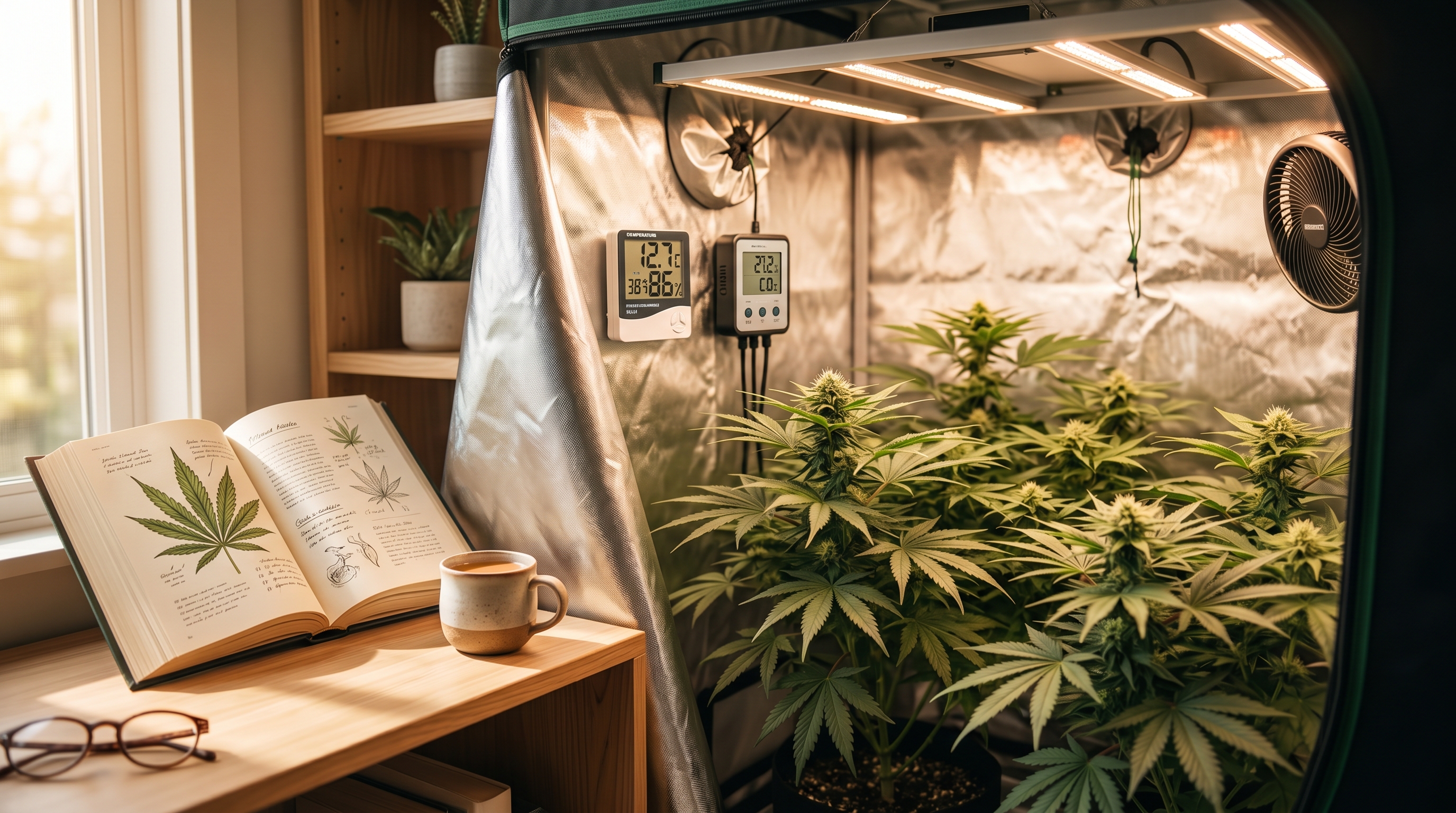
Cannabis is a warm-season plant, but its ideal temperature shifts as it matures. Two rules carry most of the weight. First, plants like it a little cooler at night than during the day, the same way they would experience outdoors. Second, you avoid extremes: heat above about 30°C (86°F) cooks resin and terpenes, while cold below 15°C (59°F) stalls growth.
One number worth internalizing early: the canopy your light feels and the air your sensor reads are not the same. Leaf surfaces under LED often run several degrees cooler than the air, so an infrared thermometer aimed at the canopy is one of the cheapest upgrades you can make.
| Stage | Day (lights on) | Night (lights off) |
|---|---|---|
| Seedling / clone | 20-25°C (68-77°F) | 18-22°C (64-71°F) |
| Vegetative | 22-28°C (72-82°F) | 20-24°C (68-75°F) |
| Early flower | 22-26°C (72-79°F) | 18-22°C (64-71°F) |
| Late flower | 18-24°C (65-75°F) | 13-18°C (55-65°F) |
A few notes on this chart:
- Seedlings love warmth and stability. A seedling heat mat with a controller keeps the root zone in the 20-22°C window even when the floor is cold. Cold roots lock out nutrients no matter how warm the canopy feels.
- Veg can take the most heat. If you are running CO2 (more on that below), you can push the upper end of this range because the plant can process the extra heat load.
- Flower wants a tighter, cooler window. Terpenes start volatilizing above roughly 27°C (80°F) and resin glands degrade in real heat. Keep a day-to-night difference of about 5-8°C.
- Late flower is where a cool night pays off. Dropping nighttime temps in the final weeks can deepen purple coloration in genetics that carry it, and it helps preserve the aromatic profile you worked all cycle to build.
For the deeper rationale on why each phase wants what it wants, our cannabis growing stages and when and how to harvest guides connect the climate dots to plant development.
Humidity by stage
Humidity follows a clear arc across the life cycle: high when the plant is young and rootless, then steadily lower as it matures and the bud structure becomes vulnerable to mold. Lower humidity gradually, roughly 5% per week, so plants can acclimate rather than getting shocked.
| Stage | Relative Humidity |
|---|---|
| Seedling / clone | 65-70% |
| Vegetative | 50-70% (taper down weekly) |
| Early flower | 40-50% |
| Late flower | 30-40% |
The logic behind the arc is simple. A seedling has almost no root system, so it absorbs much of its water through its leaves; high humidity keeps it from drying out. As roots develop, the plant pulls water from the medium and transpiration cools it, so you can dry the air out. By flower, dense buds trap moisture, and anything above 55-60% becomes a genuine bud-rot hazard. Anything over 60% in bloom is asking for trouble.
This is also why ventilation matters as much as a dehumidifier. Stale, humid air pools in the middle of a dense canopy, so gentle airflow from oscillating fans keeps every leaf in the same conditions your wall sensor is reading. If you are still building out your space, our grow tent setup guide covers ventilation and carbon filters in detail.
The temp + RH link: VPD
Here is the part most beginners miss. Temperature and humidity are not two separate dials. They combine into a single value that describes how hard your plants are working to move water, and that value is vapor pressure deficit, or VPD.
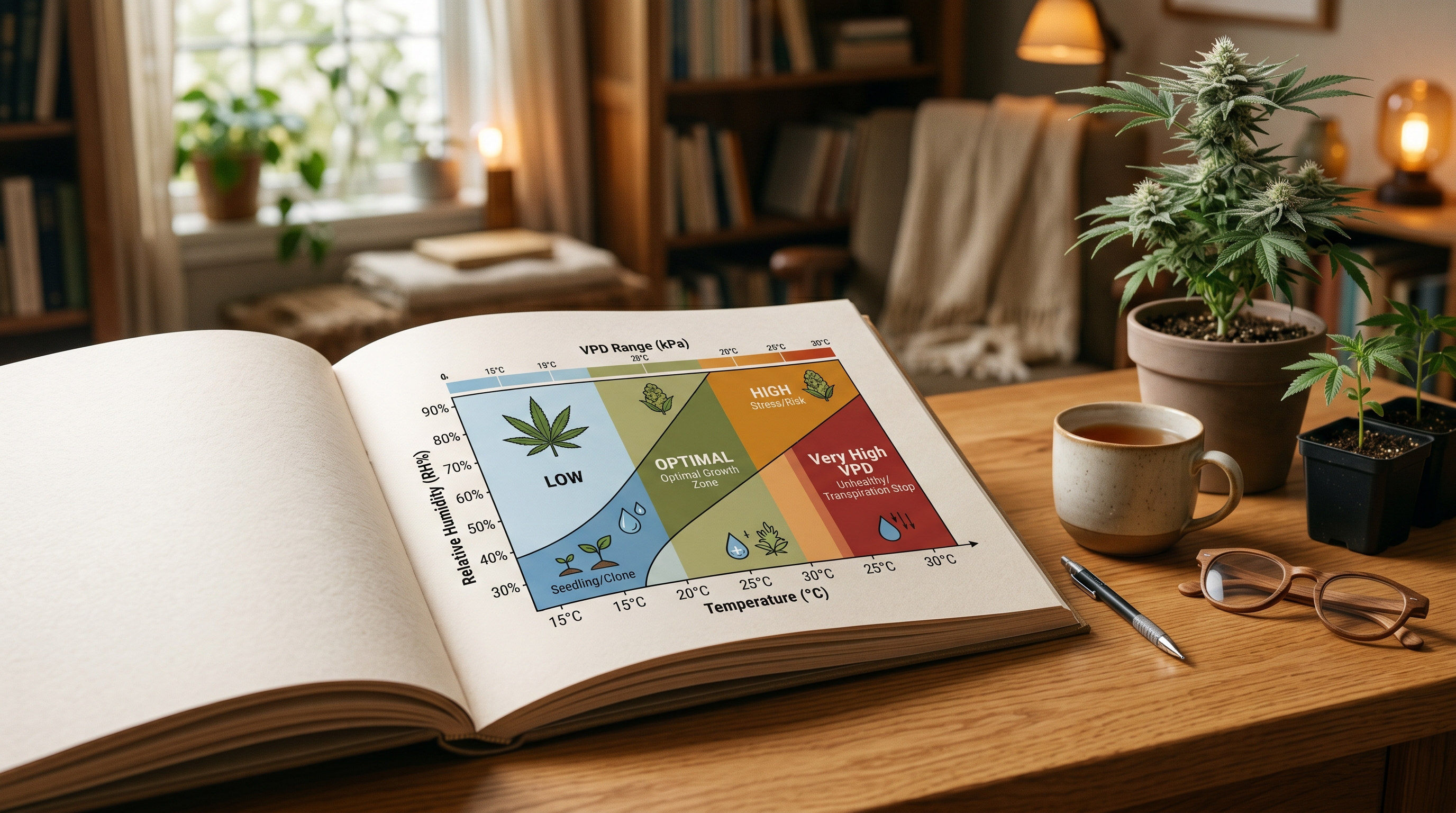
Think of it this way: 55% humidity at 22°C feels completely different to a plant than 55% humidity at 28°C, because warmer air can hold more moisture. VPD captures that. It measures the gap between how much moisture the air is holding and how much it could hold at saturation, expressed in kilopascals (kPa). That gap is the “drying power” pulling water up through the plant.
- VPD too low (under ~0.4 kPa): transpiration stalls, growth slows, and mold pressure climbs.
- VPD too high (over ~1.6 kPa): plants close their stomata to conserve water, photosynthesis grinds to a halt, and you see leaf curl and tip burn.
General target bands by stage:
| Stage | Target VPD (kPa) |
|---|---|
| Seedling / clone | 0.4-0.8 |
| Vegetative | 0.8-1.2 |
| Flowering | 1.2-1.6 |
You do not have to calculate VPD by hand; calculators and charts do it instantly. But the one upgrade that makes those numbers accurate is measuring leaf surface temperature with an IR thermometer, not just air temperature. Under LED, leaves can run 2-8°F cooler than the air, and because the math follows an exponential curve, even a few degrees can shift your real VPD by 0.3-0.5 kPa. A reading that looks perfect on a wall sensor can hide a bud-rot risk inside the canopy.
VPD is worth its own deep dive, and we wrote one: see the VPD guide for cannabis growers for charts, the leaf-temperature correction, and how to adjust your environment to hit each band.
CO2 enrichment: when, how much, how safe
CO2 has a reputation as a magic accelerator, and it can genuinely add 20-40% to your yield. But the magic only works under specific conditions, and outside those conditions it is wasted money or even harmful. Let me be straight with you about when it is worth it.
CO2 only helps when light is the limiting factor. Plants need both photons and CO2 to photosynthesize. If your light is weak, adding CO2 does nothing because the plant cannot “eat” more carbon without more light. The threshold most experts cite is around 800 PPFD or higher at the canopy. Below that, upgrade your light first. Our LED grow lights buyer’s guide can help you get there.
Target range: Ambient outdoor air sits around 400-420 ppm. The enrichment sweet spot is 1,000-1,500 ppm during lights-on. Above 1,500 ppm you hit diminishing returns, and above 2,000 ppm you can actually stress plants by triggering stomatal closure. Research at Utah State found that pushing from ambient to about 1,200 ppm captured roughly 95% of the available yield gain, so there is little reason to chase higher numbers.
| Stage | CO2 Target | Notes |
|---|---|---|
| Seedling / propagation | 400-600 ppm | Ambient is fine; young roots cannot support high transpiration |
| Vegetative | 800-1,200 ppm | Start enrichment here, with strong light |
| Early flower | 1,200-1,500 ppm | Peak benefit window |
| Late flower | taper toward ambient | Some growers cut CO2 in the final weeks |
Three safety rules you cannot skip:
- Only run CO2 during lights-on. Plants only use CO2 while photosynthesizing. Dosing at night is pure waste.
- CO2 is dangerous to people. It is odorless and heavier than air, so it pools in sealed spaces. Workplace limits are 5,000 ppm over an 8-hour average and 15,000 ppm for short bursts. If you ever enter the space, keep it under 1,500 ppm, install a CO2 alarm in any adjoining living area, and never linger in a sealed room during injection.
- Seal the room and pair with climate control. CO2 leaks out of a poorly sealed tent, and enrichment works best at warmer temps (75-85°F) with solid dehumidification, since you are limiting your exhaust to hold the gas in.
Bottom line: CO2 is one of the best return-on-investment upgrades available, but only after your light, climate, and nutrients are already dialed in. If you are still fighting basic problems, fix those first. CO2 raises the ceiling; it does not fix a leaky floor.
Equipment and control
You can run a perfectly good climate with a surprisingly short list of gear. Here is the practical toolkit, roughly in order of importance.
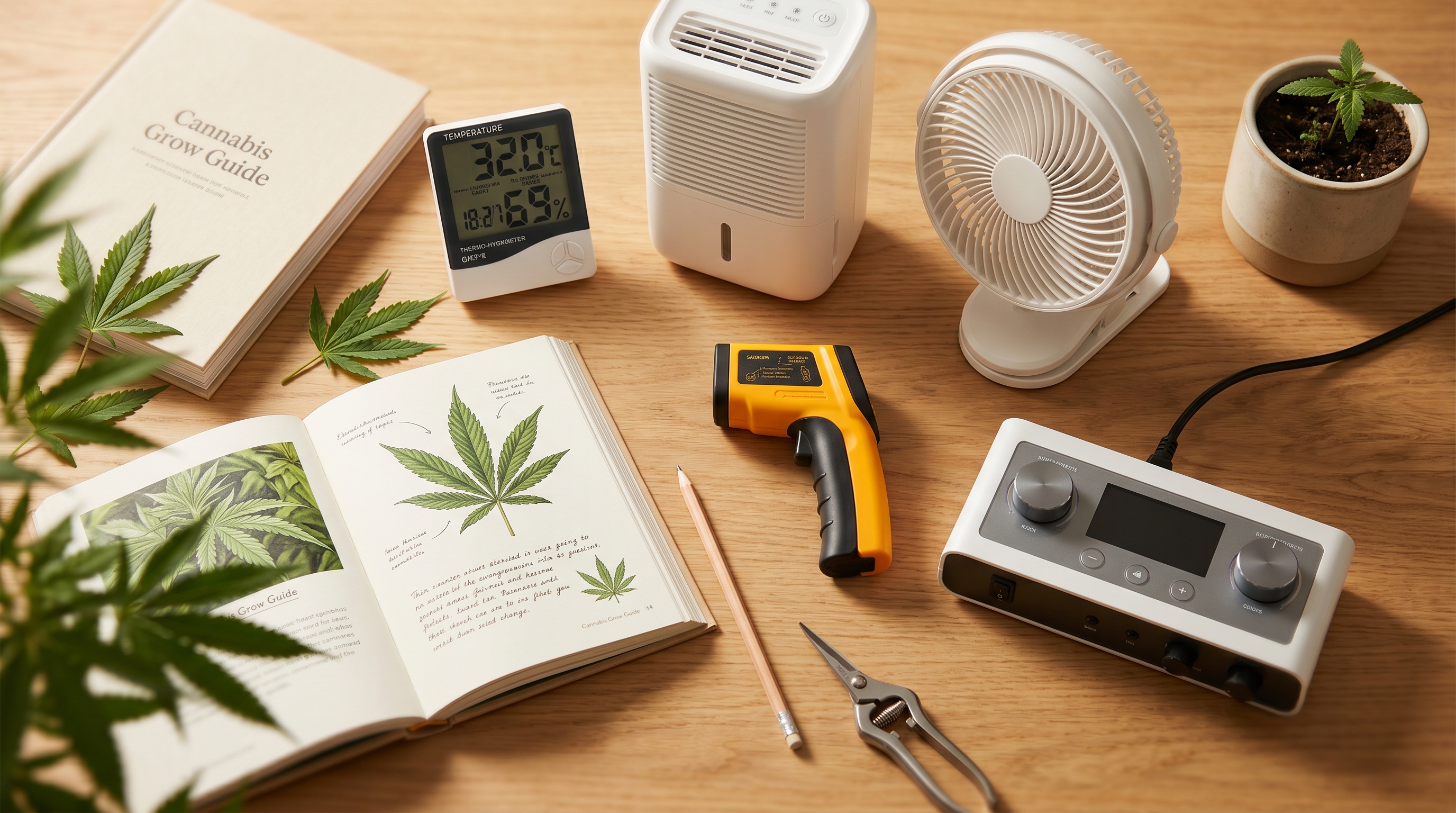
- Thermo-hygrometer: A combined temperature and humidity meter at canopy height is non-negotiable. You cannot manage what you do not measure.
- IR thermometer: Cheap, and it unlocks accurate VPD by reading actual leaf temperature.
- Oscillating fans: Gentle, constant air movement prevents humid pockets and strengthens stems. This is your first line of defense against mold.
- Exhaust fan + carbon filter: Pulls hot, humid air out and brings fresh air in. Sizing it correctly matters; see the grow tent setup guide.
- Dehumidifier: Essential for flower, especially in humid climates. Undersized units cannot keep up, so buy capacity.
- Humidifier: For the seedling and veg stages, or dry climates.
- Heater or heat mat: For cold rooms and root zones; pair with a thermostat.
- AC unit: The heavy hitter for hot rooms. It lowers temperature and humidity at the same time.
- Controllers: A controller that ties fans, humidity, and (if you use it) CO2 to setpoints automates the whole system and keeps your numbers steady while you sleep.
How to adjust, in plain terms:
- Too humid? Increase exhaust airflow, add a dehumidifier, water right after lights-on, and defoliate dense lower growth so air moves freely.
- Too hot? Increase air exchange, run lights at night instead of day, add an AC, or use a cooltube if you run HPS.
- Too dry? Add a humidifier, set out open water trays, or hang damp towels.
- Too cold? Add a thermostat-controlled heater, a heat mat under pots, insulate the space, or simply run a larger light (more watts equals more heat).
A quick reminder on lighting choice, since it drives your heat load: HPS runs hot, LED runs cooler but means your leaves sit below air temp. Both work, but they change how you manage the room. The indoor vs outdoor growing comparison is worth a read if you are still deciding where to grow at all.
Troubleshooting: mold and heat stress
Two failures account for most ruined harvests. Both are climate problems, and both are preventable.
Mold and bud rot
Bud rot (botrytis) thrives in cool, damp, stagnant air, and it loves the dense interior of a fat cola where moisture and your wall sensor disagree. The warning signs are humidity creeping over 55-60% in flower, weak airflow through the canopy, and a low VPD that you may not notice without leaf-temperature data.
Prevention beats cure here because by the time you see a browning, mushy spot inside a bud, the rot has already spread. Keep flower humidity in the 40-50% band (lower in late flower), run constant gentle airflow, defoliate to open up the canopy, and watch your VPD rather than RH alone. If you do find rot, remove the affected buds immediately with a wide margin and improve airflow before it jumps to neighbors. For the full catalog of what can go wrong, see common cannabis growing problems and how to fix them.
Heat stress
Heat stress shows up as leaves cupping or “tacoing” upward at the edges, yellowing, and in flower a loose, airy bud structure with foxtailing. Above 27°C (80°F) you start losing terpenes; sustained heat in the low 30s°C degrades resin and tanks quality.
The fixes are the same air-exchange and cooling moves from the equipment section: more exhaust, AC, lights at night, and raising humidity slightly so the plant is not over-transpiring to cool itself. If your IR thermometer shows leaf temps running 8°F or more below air temp, that is a sign the plant is straining to keep cool, and you should raise humidity or ease airflow across the canopy.
A healthy, well-fed plant tolerates a brief swing far better than a stressed one, so the foundations matter. Solid feeding (see the cannabis nutrients guide) and steady climate work together; you cannot out-nutrient a bad environment.
FAQ
What is the single most important number to control? Stability beats perfection. A grow held steadily at slightly-off numbers will outperform one that swings wildly through the “ideal” range. If you track one thing, track VPD, because it folds temperature and humidity into a single value.
Do I really need a separate night temperature? Ideally yes. Plants expect cooler nights, and a 5-8°C drop in flower improves bud density and color. If you cannot control it precisely, at least aim for the room to be cooler at night than during the day.
Is CO2 worth it for a small tent grower? Only if your light is already strong (800+ PPFD), your climate is stable, and your room seals well. In a small sealed tent the gas cost is low and the ROI can be excellent, but the hardware and discipline are the real barriers. Dial in the basics first.
How fast should I lower humidity going into flower? Gradually, roughly 5% per week, so plants acclimate. Sudden drops stress them. By late flower you want to be in the 30-40% range to protect the buds.
Why do my plants look stressed when my VPD chart says everything is fine? You are probably reading air temperature instead of leaf temperature. Under LED, leaves can run several degrees cooler than the air, which shifts your real VPD by 0.3-0.5 kPa. Grab an IR thermometer and aim it at the canopy.
Bringing it together
Climate is the foundation everything else sits on. Hold your temperature and humidity in the right band for each stage, watch VPD rather than either number alone, add CO2 only once your light and climate justify it, and keep air moving to fend off mold. Do that and most of the dramatic grow-room disasters simply never happen.
Once you are harvesting, the climate game does not stop. Your drying and curing phase is just temperature and humidity control by another name, and it makes or breaks the flavor you spent the whole cycle building. And when you finally light up that homegrown flower, the High IQ app can help you track which strains and effects actually work for you, so your next grow is even more intentional.
Sources
- Royal Queen Seeds, “What Is the Ideal Grow Tent Temperature and Humidity?” royalqueenseeds.com
- Royal Queen Seeds, “Indoor Cannabis Growing: Relative Humidity and Temperatures.” royalqueenseeds.com
- DSS Genetics, “Cannabis Temperature Control: Optimal Ranges by Growth Stage.” dssgenetics.com
- MaryJane.Farm, “Monitoring and Supplemental CO2 - Is It Worth the Investment?” maryjane.farm
- JumpLights / Utah State University research, “The Value of Carbon Dioxide Enrichment to Increase Yield.” jumplights.com
- Hydrobuilder, “Grow Room CO2 Calculator” and “VPD Calculator.” hydrobuilder.com
- The Yield Grid, “VPD Calculator: Dial In Canopy Vapor Pressure Deficit.” theyieldgrid.com


