

Home Grow Limits by State: Per Adult or Per Household?
Home grow limits by state: most legal states allow 6 plants per adult and 12 per home, but 8 cap the whole address and 4 allow no adult home grow.

Professor High
Written by Professor High, our AI guide. See how we research and correct articles.
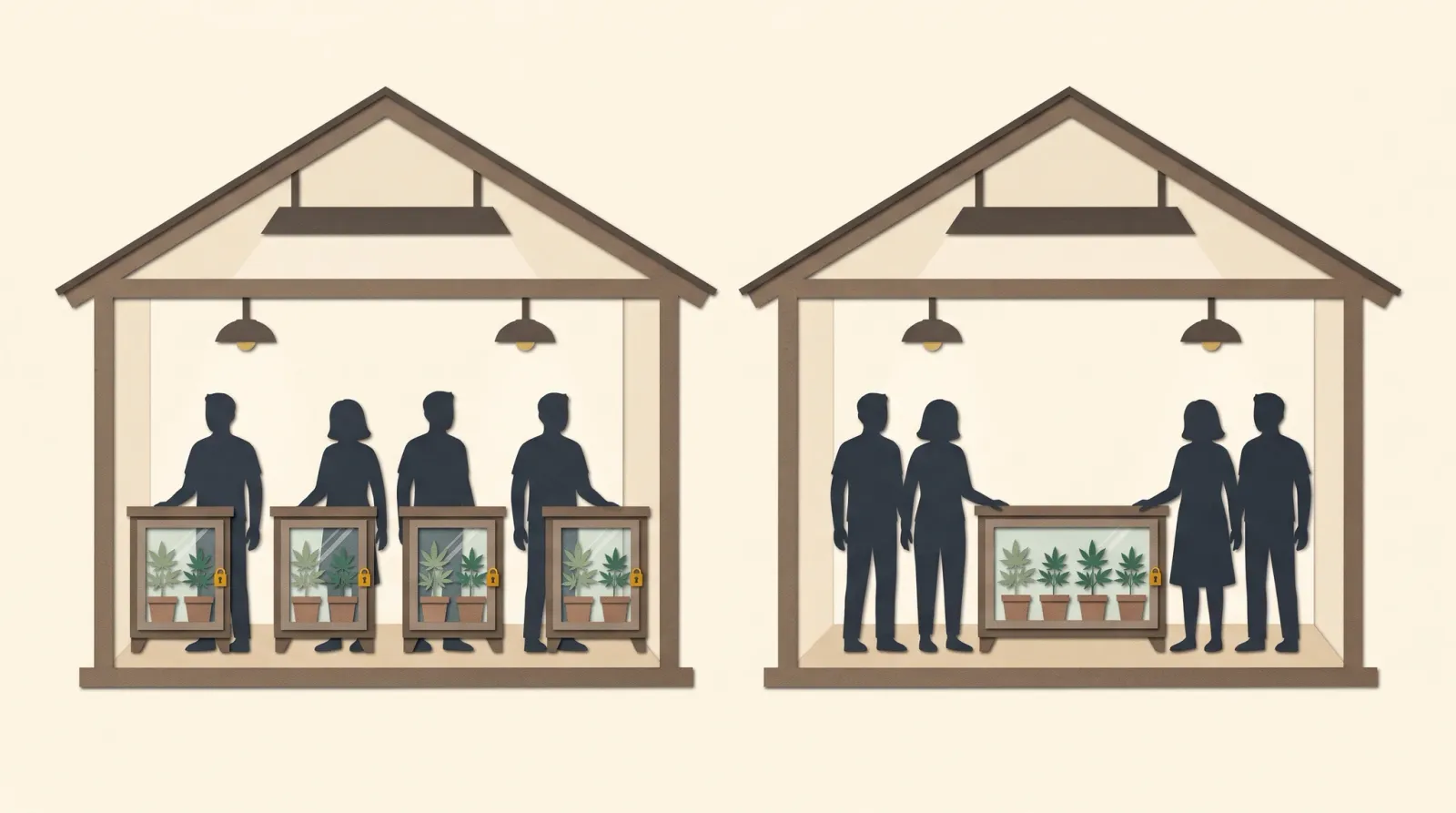
Twenty states and Washington, D.C. let adults grow cannabis at home, and the most common rule is six plants per adult with a cap of 12 per home. But eight states put one number on the whole address instead, and four states with legal sales give recreational adults no home-grow right at all. So the real answer to “how many plants can I grow” depends on two things: your state, and how many adults share your door.
Here is the screenshot version. Picture four adult roommates. In Maryland, their address may hold 2 plants in total (Md. Crim. Law 5-601.2). In Oregon and Virginia, 4 (ORS 475C; Va. Code 4.1-1101). In California, 6 (HSC 11362.2). In Ohio, Massachusetts or Arizona, 12. In Maine, each of them may keep 6 mature plants, and the state sets no household cap (28-B M.R.S. 1502).
This guide covers adult-use home grow in the 24 adult-use states and D.C. It reports what each law counts. It is not legal advice, and it does not cover tribal land, medical-only states or caregiver grows. For the bigger picture, start with the full legal map by state.
Statutes and regulator pages checked October 29, 2026.
Is the home-grow limit per person or per household?
It is usually both. Most states give each adult a personal number, then cap the residence so a full house cannot multiply it without limit. A smaller group skips the personal number and caps the dwelling directly.
Three patterns cover every adult-use state:
- Per adult, with a home cap. Each adult gets a number (usually 6), and the residence has a ceiling (usually 12). Two adults reach the cap; a third adds nothing.
- Per address only. One number covers the dwelling, no matter how many adults live there. Oregon’s regulator spells it out: four adults in one home do not get 16 plants (OLCC FAQ).
- No adult home grow. Sales are legal, but growing without a license is not.
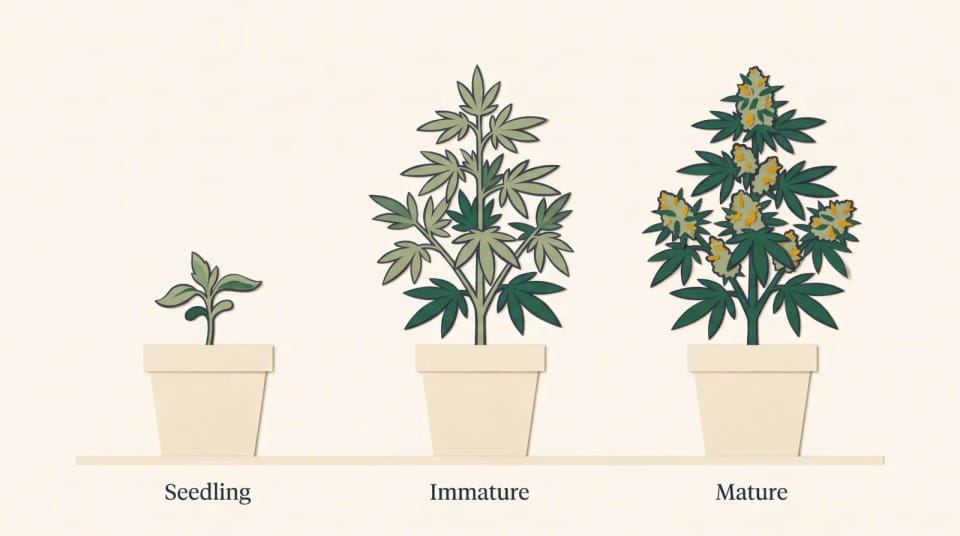
Many states count mature and immature plants separately. Each statute writes its own definition of the stages.
Which states allow 6 plants per adult and 12 per home?
This is the most common pattern. The cells below give each statute’s numbers; the state name links to the law or regulator page.
| State | Per adult | Per home | Stage rule | Lock and sight rule |
|---|---|---|---|---|
| Alaska | 6 | 12 per dwelling | 3 or fewer mature each; 6 or fewer mature per dwelling | Not covered here |
| Arizona | 6 | 12 with two or more adults | Not split | Locked enclosed area; not visible |
| Colorado | 6 (3 flowering at once, per the regulator) | 12 per residential property | A plant is more than 4 inches wide or high, or flowering | Enclosed and locked; no outdoor grow, per the regulator |
| Connecticut | 3 mature + 3 immature | 12 per household | Split | Indoors, secure, not visible from the street |
| D.C. | 6 | 12 per unit | 3 or fewer mature each; 6 or fewer mature per unit | Inside the principal residence |
| Massachusetts | 6 | 12 on the premises | Not split | Lock or security device; not visible without optical aids |
| Missouri | 6 flowering + 6 nonflowering + 6 clones, with a paid card | 12 flowering per residence | Split by flowering and size | Locked; not visible |
| Montana | 2 mature + 2 seedlings | Twice the per-person amount | Seedling is under 12 inches high and wide | Locked; not visible |
| Nevada | 6, only far from a store | 12 per residence | Not split | Enclosed, locked, not visible |
| New Mexico | 6 mature + 6 immature | 12 mature per household | Split | No production in public view |
| New York | 3 mature + 3 immature | 6 mature + 6 immature per residence | Split | Secured from anyone under 21 |
| Ohio | 6 | 12 per residence | Not split | Secured area; not visible |
A few cells need a sentence more.
- Colorado has two layers. The statute makes more than 12 plants on a residential property unlawful, while the state cannabis site leads with six per resident, three flowering at once (Colorado home grow laws). Cities can be stricter. Fort Collins, for example, allows none in multifamily or detached buildings (Fort Collins FAQ). Our Colorado cannabis law guide has the local detail.
- Missouri requires a 12-month personal cultivation registration card with a $100 base fee, adjusted for inflation (Mo. Const. art. XIV). The health department’s fact sheet puts the consumer limit at 18 plants total (DHSS fact sheet). No card, no home grow. See the Missouri cannabis law guide.
- Nevada allows home grow only if no licensed retail store is within 25 miles (Nevada CCB). See the Nevada cannabis law guide.
- New Mexico’s regulator page words it as “up to 12 plants, no more than six mature” for a single adult (NM RLD). For one adult that matches the statute. For a household, the statute’s cap is on mature plants: 12.
- New York’s Office of Cannabis Management describes the same 3 + 3 per adult and 6 + 6 per household, and asks growers to take steps against odor (NY OCM).
- Ohio’s home-grow section was rewritten by Senate Bill 56, effective March 20, 2026. The 6 and 12 figures stayed (Ohio LSC synopsis). The Ohio cannabis law guide covers the rest of that bill.
Maine stands alone. Each adult may keep 6 mature plants, 12 immature plants and unlimited seedlings, and each plant needs a tag. A town may cap plants per parcel, but it cannot set the cap below each resident adult’s allowance, and it cannot ban home grow (28-B M.R.S. 1502). Older lists that say “3 mature” are out of date.
Which states cap the whole address?
Eight states put one number on the dwelling. Adding roommates does not add plants.
| State | Cap for the whole address | Stage rule | Lock and sight rule |
|---|---|---|---|
| California | 6 living plants per private residence | Not split | Locked space; not visible from a public place |
| Maryland | 2 per residence (2 per person, 2 total with several adults) | Not split | Not visible; a locked space counts as a reasonable precaution |
| Michigan | 12 on the premises | Not split | Enclosed area with locks; not visible |
| Minnesota | 8 per residence | 4 or fewer mature | Enclosed, locked; not open to public view |
| Oregon | 4 per household | Not split | Not visible from a public place |
| Rhode Island | 3 mature + 3 immature per dwelling unit | Split | Indoors; locks and security devices |
| Vermont | 2 mature + 4 immature per dwelling unit | Split | Screened from public view |
| Virginia | 4 per household, main residence only | Not split | Not visible from a public way; each plant tagged |
Michigan is the one people argue about. The statute lets a person grow up to 12 plants within the residence and caps the premises at 12 at any one time (MCL 333.27955). Kent County’s guidance reads that as one 12-plant cap per home, not 24 for two adults (Kent County). The Michigan cannabis law guide goes further.
California cities may regulate indoor home grow but cannot ban it; they may ban outdoor growing (HSC 11362.2).
Where is home growing still illegal?
Four states sell adult-use cannabis but give recreational adults no home-grow right.
- Delaware. Growing without a license remains unlawful (16 Del. C. 4764A), and the regulator states that home cultivation remains prohibited (Delaware OMC).
- Illinois. Only registered medical patients may grow: 5 plants over 5 inches tall per household, locked and out of ordinary public view (410 ILCS 705/10-5).
- New Jersey. The regulator’s answer to “Can I legally grow cannabis at home?” is “No” (NJ CRC FAQ).
- Washington. Home growing is not allowed unless you are a qualified medical patient or designated provider (Washington LCB). Bills to allow adult home grow were introduced in 2026, such as SB 6204; the regulator’s page still says it is not allowed.
Can you grow if you rent?
Often only with the owner’s permission. Several states say so in the law or on the regulator’s page:
- California’s regulator says property owners can ban growing on their property (DCC).
- Maryland’s statute requires the property owner’s consent (5-601.2).
- Massachusetts lets landlords restrict home cultivation (CCC).
- Montana requires you to own the residence or hold the owner’s written permission (MCA 16-12-106).
- Nevada lets owners restrict it (Nevada CCB).
- New York’s regulator says landlords may ban growing on the premises (NY OCM landlords).
- Ohio bars home grow at a rental whose agreement prohibits it (R.C. 3796.04).
Read your lease before you buy a single seed. Our guide on whether your landlord can ban growing covers tenant rights in more depth. HOA, condo and federally assisted housing rules are outside this article.
What happens if you grow more than the limit?
Penalties climb with the plant count, and every state sets its own ladder. These are the figures each statute or regulator states; do not stretch any one of them to another state.
| State | What the law says above the limit |
|---|---|
| Massachusetts | 7 to 12 plants: civil penalty up to $100 and forfeiture. Visible or unlocked: civil penalty up to $300 (CCC; 94G s. 13) |
| Virginia | More than 4 up to 10: $250 civil penalty for a first offense. More than 10 up to 49: Class 1 misdemeanor (4.1-1101) |
| Colorado | More than 12 on a residential property: petty offense, up to $1,000 for a first offense (18-18-406) |
| Minnesota | Civil penalty up to $500 per plant above the limit (342.09) |
| Nevada | Misdemeanor, up to $600 for a first violation (NRS 678D) |
| Vermont | Civil penalties of $100, $200 and $500 for repeat breaches (4230e) |
| New York | Civil penalty up to $125 per violation (Penal Law 222.15) |
| Oregon | Unlawful manufacture of more than 12 plants is a Class C felony (ORS 475C) |
Security and sight rules carry their own penalties too. In Arizona, a first lock or visibility violation is a petty offense and a repeat is a class 3 misdemeanor (A.R.S. 36-2853). In Montana, a grow visible from a public place can bring a civil fine up to $250 and forfeiture (Montana DOR).
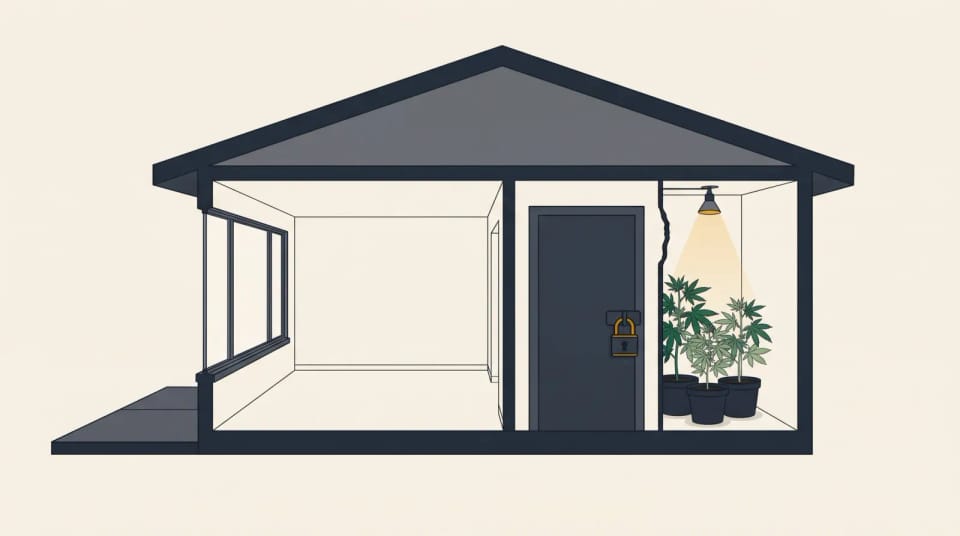
A locked space that is not visible from a public place is the most common security rule. The exact wording differs by state.
How do you check the limit for your address?
Work through it in this order.
- Find your state’s counting rule. Use the tables above: per adult with a home cap, per address only, or no adult home grow.
- Apply it to your household. Count the adults 21 and over who live there. Multiply by the per-adult number, then stop at the household or premises cap.
- Check the stage rule. Some states split mature and immature plants. Use the statute’s own definition, not a grow-forum one. Our guide to when a plant counts as mature explains the growth stages themselves.
- Check the security and sight rule. Most states want a locked space and plants that are not visible from a public place. If space is tight, see fitting a grow into a closet or tent.
- Check the owner and local rules. Read your lease, then check your city or county. Colorado cities, California cities (for outdoor grows), New York localities and Maine towns can add rules.
Once the count is clear, how to set up your first grow covers the rest, and buying seeds legally answers the question that usually comes next.
Do medical patients get more plants?
In some states, yes. Maryland lets a medical patient add 2 plants, up to 4 in a residence (Maryland Cannabis Administration). Washington patients may grow 6 plants by default, or up to 15 on a recommendation, with a cap of 15 per housing unit (RCW 69.51A.210; RCW 69.51A.260). Illinois patients get the 5-plant household right described above. Rules differ in every program; see medical patient grow rules. If you are thinking about growing for a health condition, talk to a clinician first about whether cannabis suits you and how your state’s program works.
Is growing at home legal under federal law?
No. Even after the Justice Department’s April 2026 order, which covers FDA-approved products and products under a state medical license (DOJ), the Congressional Research Service explains that making and possessing recreational marijuana stays a federal offense regardless of state law (CRS LSB11105). For more, read what the April 2026 rescheduling covers.
One state question is also on a ballot. Massachusetts voters decide Question 8 on November 3, 2026; if it passes, it would not take effect before January 1, 2028 (Secretary of the Commonwealth). Here in High School, we read the petition text in what Question 8 would change for Massachusetts home growers.
Key takeaways
- Twenty states and D.C. allow adult home grow; Delaware, Illinois, New Jersey and Washington do not for recreational adults.
- The common rule is 6 plants per adult and 12 per home, but California, Maryland, Michigan, Minnesota, Oregon, Rhode Island, Vermont and Virginia cap the whole address.
- Maine has no state household cap: 6 mature and 12 immature plants per adult.
- Missouri needs a paid card, and Nevada needs distance from a store.
- Locked, out of public view and owner-approved is the safest reading everywhere. Growing is still a federal offense.
FAQ
Is the home-grow limit per person or per household?
Usually both. Most states give each adult a number, often 6, and cap the residence, often at 12. California, Maryland, Michigan, Minnesota, Oregon, Rhode Island, Vermont and Virginia set one cap for the whole address instead.
How many plants can one household grow in Ohio?
Twelve. Ohio Revised Code 3796.04 allows 6 plants per adult and caps a residence at 12. The plants need a secured area out of public view, and a lease can prohibit them.
How does Michigan’s 12-plant rule work with several adults?
The statute caps the premises at 12 plants at any one time. County guidance reads that as one 12-plant cap per home, so two adults do not get 24.
Can a landlord stop you from growing cannabis?
In many states, yes. California, Maryland, Massachusetts, Montana, Nevada, New York and Ohio let property owners restrict or refuse home growing, in the statute or in regulator guidance. Check your lease first.
What happens if you grow more than the limit?
It depends on the state and on how far over you are. Massachusetts handles 7 to 12 plants as a civil matter, Virginia moves to a misdemeanor above 10 plants, and Oregon makes unlawful manufacture of more than 12 plants a felony.



