Edible Dosing Math Every Home Cook Needs to Know
Learn the simple math behind dosing homemade edibles: turn flower THC% into milligrams per serving, factor in decarb and infusion loss, and stay safe.

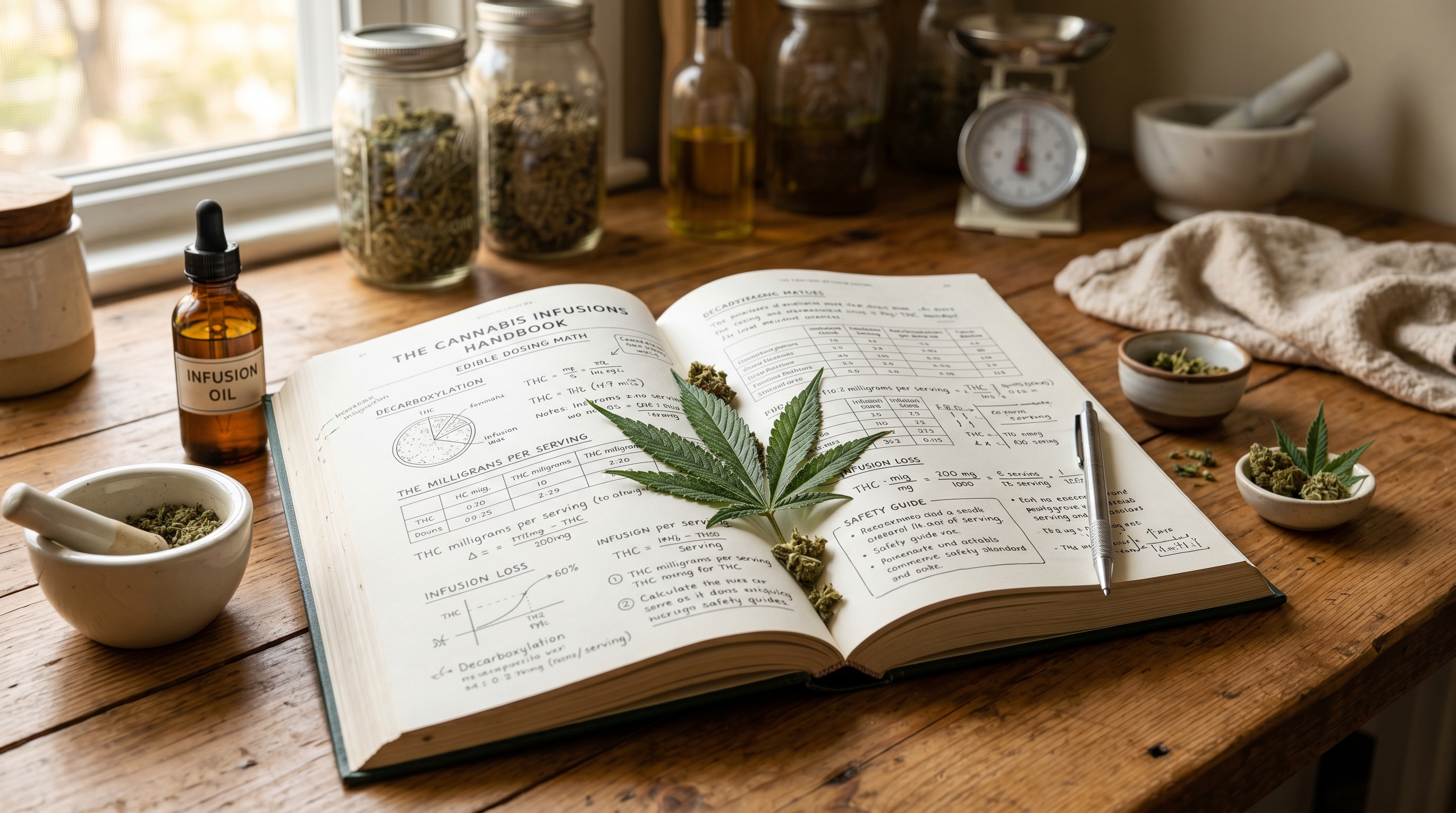
The scariest thing about homemade edibles is not that they are strong. It is that nobody knows how strong until it is far too late to do anything about it. A batch of brownies that tastes identical from corner to corner can deliver 8 mg in one square and 35 mg in the next. That gap is the difference between a pleasant evening and a long, anxious night on the couch wondering when it will end.
The good news: you do not need a chemistry degree to fix this. You need a little arithmetic and a healthy respect for the words start low, go slow. This guide walks through the exact math that turns the THC percentage on your flower label into a believable milligram-per-serving number, explains the two big places potency leaks away, and shows you how to work backwards to hit a target dose on purpose.
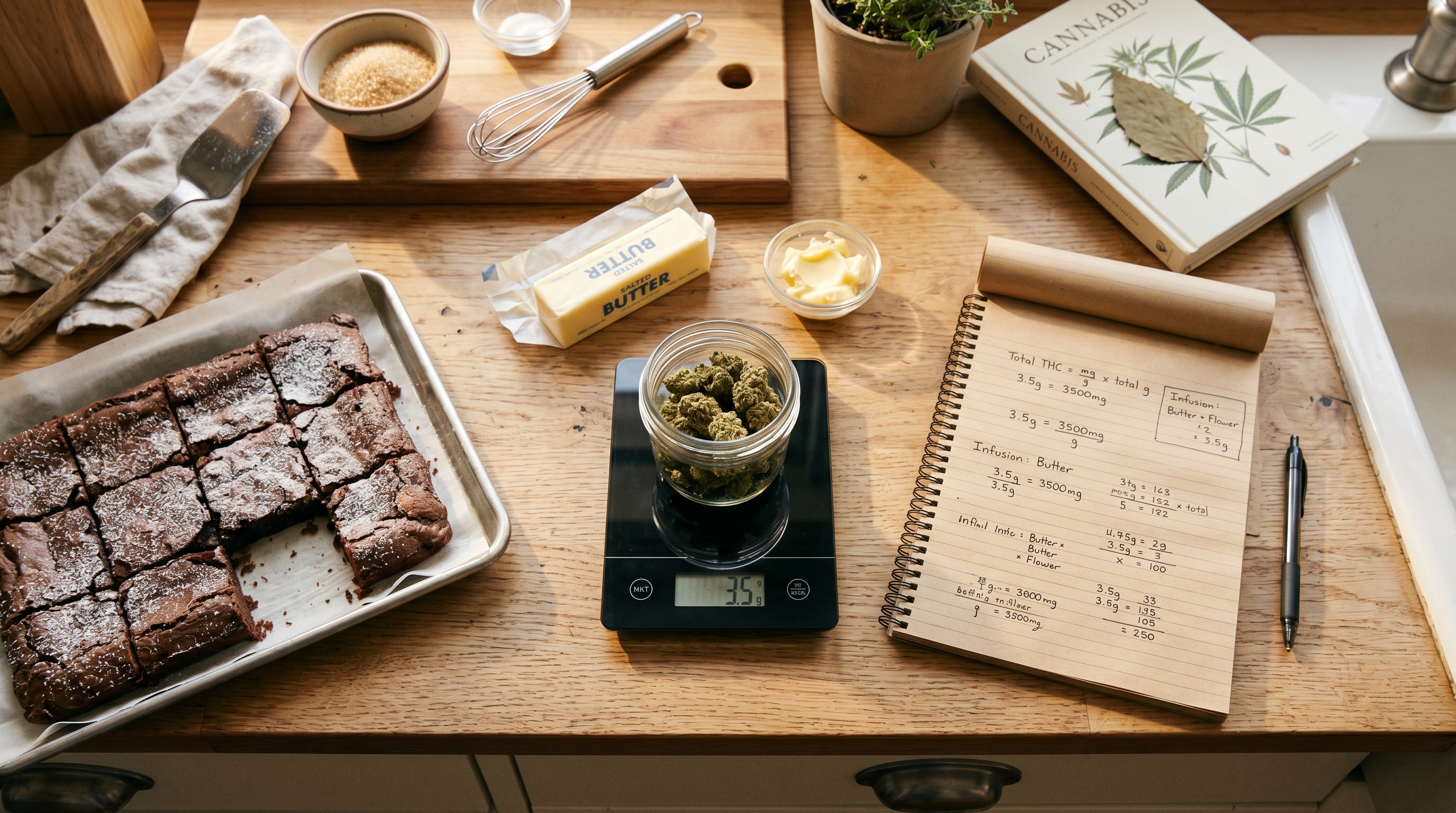
Why the math matters (it is a safety tool, not a buzzkill)
Inhaled cannabis gives you a feedback loop. You take a puff, you wait a couple of minutes, you feel something, and you decide whether to take another. Edibles remove that loop entirely. Onset can take 30 minutes to two hours, and the effects build long after you have eaten. That delay is exactly why so many people “redose” before the first dose has even arrived, then get hit by everything at once. If you have ever wondered why edibles hit harder than the same amount of smoked flower, the answer is partly chemistry and partly this timing trap.
When you do not know your dose, you are flying blind. When you do know it, even roughly, you can make a calm decision: eat one 10 mg cookie, wait the full two hours, and only then decide whether you want more. The math is what makes that decision possible. Think of it as a seatbelt, not a speed limit.
A quick and important caveat: every number below is an estimate. Cannabis is a plant, not a pharmaceutical, and homemade infusions are inherently variable. None of this is medical advice, and edibles affect everyone differently. The goal is a reasonable range you can dose against responsibly, not a guarantee.
The core formula
Here is the whole thing in one line. Everything else is just plugging in numbers.
Total THC (mg) = grams of flower × THC% (as a decimal) × 1000 × efficiency factor
mg per serving = total THC ÷ number of servings
Let us break down each piece:
- Grams of flower. Weigh it. A kitchen scale that reads to 0.1 g is worth its weight in gold here.
- THC% as a decimal. If the label says 20% THC, that is
0.20. No label? Estimate conservatively at 15–18% for average flower. - × 1000. This converts grams to milligrams, because doses are measured in mg, not grams.
- Efficiency factor. The big one. This is the fraction of THC that actually survives decarbing and infusion and ends up in your food. A realistic real-world number is somewhere around 0.70 to 0.80. We will dig into why shortly.
If you ignore the efficiency factor entirely, you get the theoretical maximum, which always overstates how much THC is really in your butter. Overestimating potency is the safer error, but it wastes flower; building in a realistic loss factor gets you closer to the truth.
A full worked example: 7 g of 20% flower to a per-cookie dose
Let us follow one batch from start to finish.
The setup: You have 7 grams of flower labeled 20% THC. You decarb it, simmer it into one cup of cannabutter, and bake 24 cookies using all of that butter.
Step 1 — Theoretical maximum THC.
7 g × 0.20 × 1000 = 1,400 mg of THC potential in the raw flower.
Step 2 — Apply an efficiency factor.
Real infusions lose THC to imperfect decarbing and imperfect extraction. A conservative working assumption is roughly 75–80% of the theoretical THC making it into the finished infusion [Cannigma, 2026]. Using 0.75 (a 25% total loss):
1,400 mg × 0.75 = 1,050 mg of active THC in the finished cup of butter.
Step 3 — Divide by servings.
1,050 mg ÷ 24 cookies = ~44 mg per cookie.
Forty-four milligrams is a very strong dose — well into “experienced user, clear your schedule” territory. For most people that single cookie is several doses. If your goal was a comfortable 10 mg cookie, this batch overshot by more than 4x, which is exactly the kind of accident that gives homemade edibles their reputation. Hold onto that number; we will fix it in the “adjusting” section below.
This is also why the foundation matters so much. If your cannabutter is made carelessly, no amount of downstream math will save you. Garbage in, garbage out.
Where the THC actually goes: decarb and infusion efficiency
That mysterious efficiency factor is really two separate losses stacked on top of each other.
Decarboxylation conversion
Raw cannabis contains very little active THC. Instead it holds THCA, an acidic precursor that does not get you high until heat knocks a carbon-dioxide group off the molecule. This is decarboxylation, and it is non-negotiable for edibles.
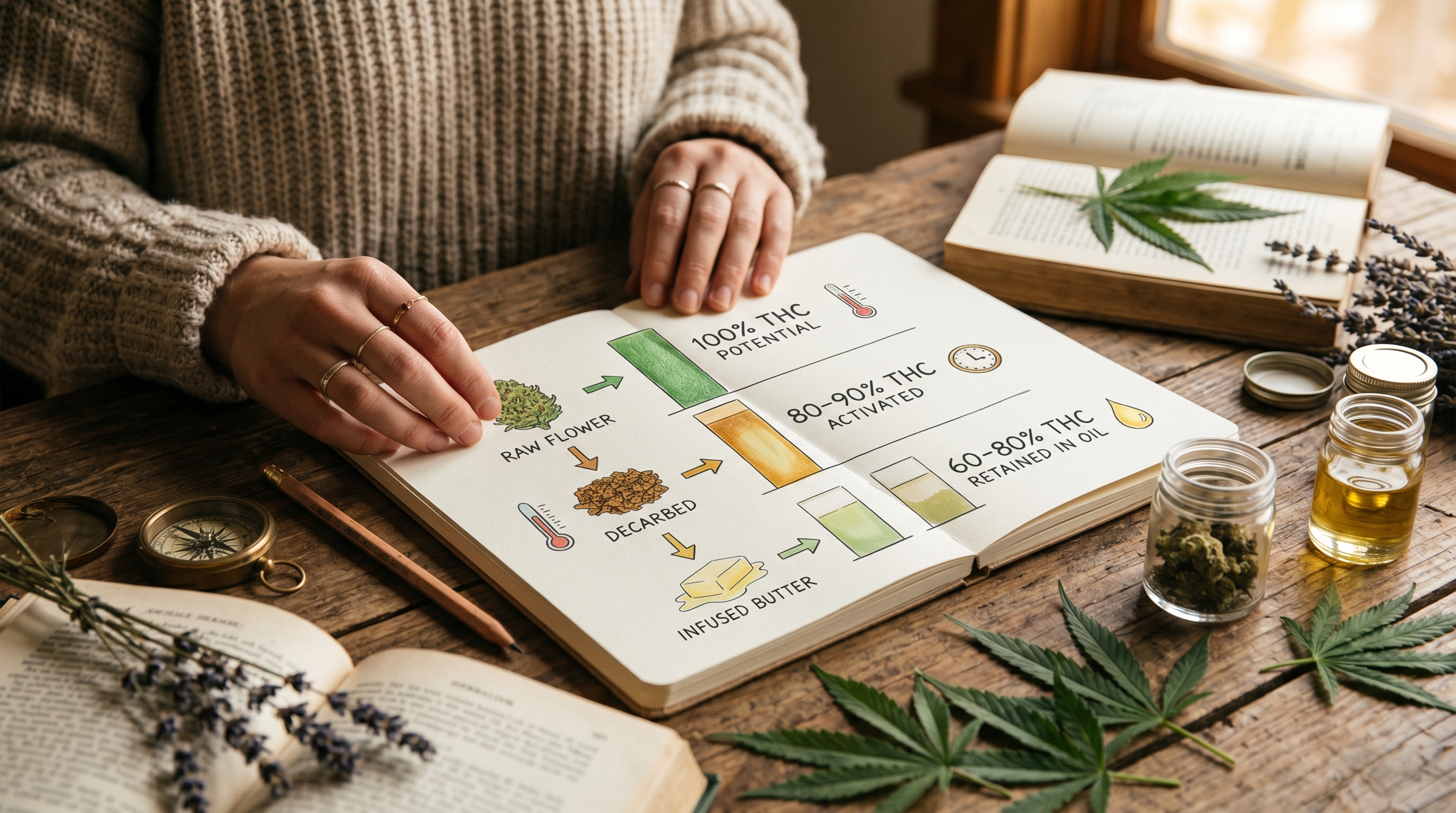
There is a built-in catch in the chemistry. THCA is a heavier molecule than THC, so when it converts, it sheds mass. The theoretical maximum conversion is about 0.877 — meaning even a perfect decarb leaves you with roughly 88% of the THCA’s weight as THC [Pacific, 2026]. In a home oven, you never hit perfect. Too little heat and THCA never fully activates; too much and you start vaporizing or degrading the THC you just created. A realistic home decarb lands somewhere in the high-80s to low-90s percent of that theoretical ceiling.
Infusion transfer
Once decarbed, the THC has to migrate out of the plant material and into your fat. Cannabinoids are lipophilic — they love fat and dissolve into butter, oil, or cream readily — which is why infusion works at all. But the transfer is never total. Some THC stays locked in the spent plant matter you strain out and throw away. Depending on time, temperature, agitation, and whether you used a fat with enough volume, infusion efficiency commonly runs 60–90% [Munch, 2026].
Stack those two losses together and you land in the 0.70–0.80 range that experienced bakers use as a working assumption. Want to maximize what you keep? A careful, low-and-slow process — the kind covered in cannabis cooking basics and in our guide to making edibles without the weedy taste — protects more of your THC than a hard, fast boil.
Adjusting for the dose you actually want
Most of the time you do not want to discover your dose after the fact — you want to design it. Flip the formula around:
Grams of flower needed = (target dose × servings) ÷ (THC% × 1000 × efficiency)
Back to our cookies. Suppose you want a friendly 10 mg per cookie across 24 cookies, using 20% flower at 0.75 efficiency:
Target total = 10 mg × 24 = 240 mg
Grams needed = 240 ÷ (0.20 × 1000 × 0.75) = 240 ÷ 150 = 1.6 g
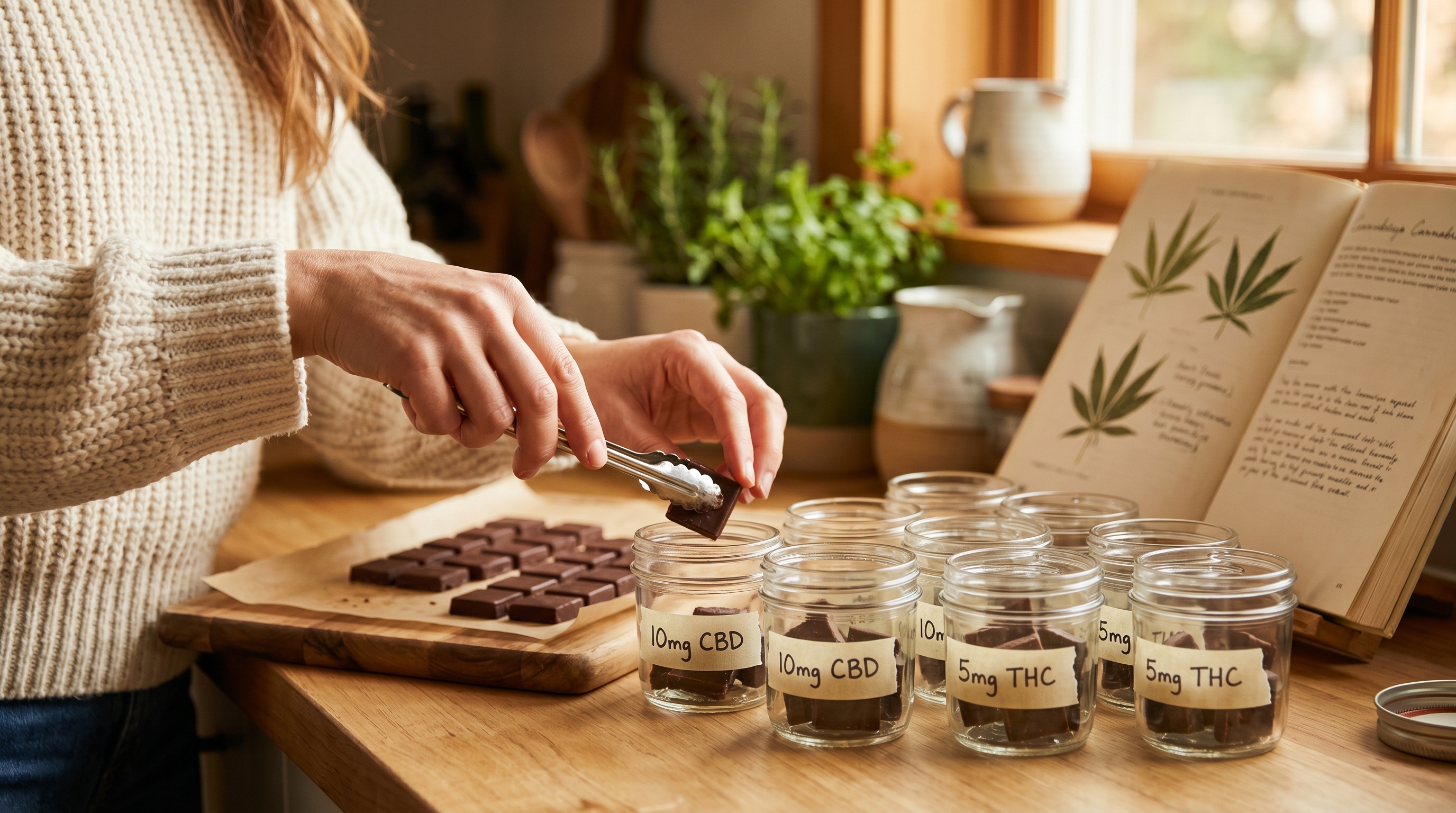
So about 1.6 grams of that flower — not 7 — gets you 24 cookies at roughly 10 mg each. That is the same recipe, dialed down to a dose you can actually plan an evening around. If you are still figuring out what dose suits you, our beginner’s dosing chart breaks down what 2.5, 5, and 10 mg tend to feel like, and our guide on when to increase your dose covers how to climb safely.
One more wrinkle: you do not always bake with all of your infused fat. If a recipe uses only half your butter, only half the THC goes into the batch. Multiply your total mg by the fraction of infusion you actually use before dividing by servings.
Quick-reference dosing table
These assume 0.75 efficiency and round to clean numbers. Use them as a sanity check, not gospel.
| Flower | THC% | Servings | Est. total THC | Est. per serving | Vibe |
|---|---|---|---|---|---|
| 1 g | 20% | 20 | ~150 mg | ~7.5 mg | Gentle / standard |
| 1.6 g | 20% | 24 | ~240 mg | ~10 mg | Standard |
| 3.5 g | 18% | 24 | ~470 mg | ~20 mg | Strong |
| 3.5 g | 20% | 12 | ~525 mg | ~44 mg | Very strong |
| 7 g | 20% | 24 | ~1,050 mg | ~44 mg | Very strong |
| 7 g | 22% | 50 | ~1,155 mg | ~23 mg | Strong |
A common starting point for newcomers is 2.5–5 mg; 10 mg is a typical “standard” serving in many legal markets; anything above 20 mg is firmly experienced-user territory. When in doubt, cut the cookie in half.
Common mistakes that wreck your math
- Skipping the efficiency factor. Using the theoretical maximum makes every serving look stronger than it is, so you under-dose flower and over-dose yourself when you compensate by eating more.
- Trusting “a gram is a gram.” A gram of 12% trim and a gram of 24% premium are nearly 2x apart in THC. Always run the percentage.
- Ignoring uneven distribution. This one bites even when your math is flawless. If the infused fat is not stirred thoroughly and portioned evenly, one brownie can carry triple another. Warm the infusion, mix well, and portion carefully — or use molds for gummies and capsules, which distribute far more consistently than a pan of brownies.
- Redosing too early. No formula protects you from impatience. Edibles can take up to two hours to peak. Wait it out.
- Not labeling the batch. Homemade edibles look exactly like ordinary food. Write the estimated mg-per-serving on the container, especially in a shared home. This is basic harm reduction.
The High IQ angle: estimates get better with tracking
Here is the honest truth the calculators do not advertise: your real efficiency factor is unique to your oven, your fat, your technique, and your flower. The 0.75 we used is a reasonable starting guess, but the only way to truly dial it in is to track what happened. Log the batch — grams, THC%, servings, and how the dose actually felt — and over a few batches your personal numbers stop being guesses. Tracking your sessions in High IQ turns “I think these are strong” into “these are about 11 mg and they hit me in 75 minutes.” Whether you reach for edibles, flower, or concentrates, the pattern is what makes it repeatable.
Key takeaways
- Total THC = grams × THC% × 1000 × efficiency, then divide by servings. That single chain of math is the whole game.
- Build in a loss factor of about 0.75. THC leaks away during decarboxylation (theoretical max ~0.877 conversion) and again during infusion (~60–90% transfer).
- Design the dose, do not discover it. Flip the formula to calculate how much flower you need for a target like 10 mg per serving.
- Even distribution matters as much as the math. Stir well, portion carefully, and consider gummies or infused coffee and tea for more consistent dosing than a brownie pan.
- Start low, go slow, label everything. A new-to-edibles starting point is often 2.5–5 mg; wait the full onset window before redosing.
Frequently asked questions
Do I really need a scale? Yes. Eyeballing grams is the single biggest source of dosing error. An inexpensive 0.1 g scale removes most of the guesswork before any math even begins.
What efficiency factor should I use? If you are unsure, 0.75 is a sensible, slightly conservative default. As you track real batches you can adjust it up or down to match your own process.
My flower has no lab label. Now what? Estimate on the higher side — assume 18–20% — because that produces a lower per-serving estimate, which keeps you on the cautious side. Then start with a small piece.
Why was my edible weaker (or stronger) than the math said? Real life. Decarb temperature, infusion time, how much THC stayed in the strained-out plant matter, and uneven mixing all push the real number around. Your math gives a range, not a promise.
How long before I know if I took too much? Effects can take up to two hours to fully arrive and a high can last several hours. If you overshoot, hydrate, find a calm space, and remember it will pass. Start low, go slow, and you will rarely get there.
Sources
- The Cannigma — “How to Actually Hit Your Target Dose with Edibles: A Practical Guide.” cannigma.com
- Dummies / Wiley — “Calculating Infusion Doses for Cannabis Edibles.” dummies.com
- Pacific Grass — “Edibles Potency Calculator” (decarboxylation 0.88 factor and infusion loss). pacificgrass.co
- MunchMakers — “Calculating THC Dosage in Edibles: The Complete Math Guide.” guides.munchmakers.com
- Veriheal — “Edible Dosage for Cooking Cannabis Recipes.” veriheal.com
This article is for educational purposes only and is not medical advice. Cannabis affects everyone differently, and homemade edible potency is inherently variable. Always start with a low dose, wait the full onset window before redosing, and follow the laws in your area.


