How to Test Your Homemade Edible Potency at Home
Estimate the THC dose in your homemade edibles with the calculation method, at-home test devices, and careful titration. Start low, go slow.

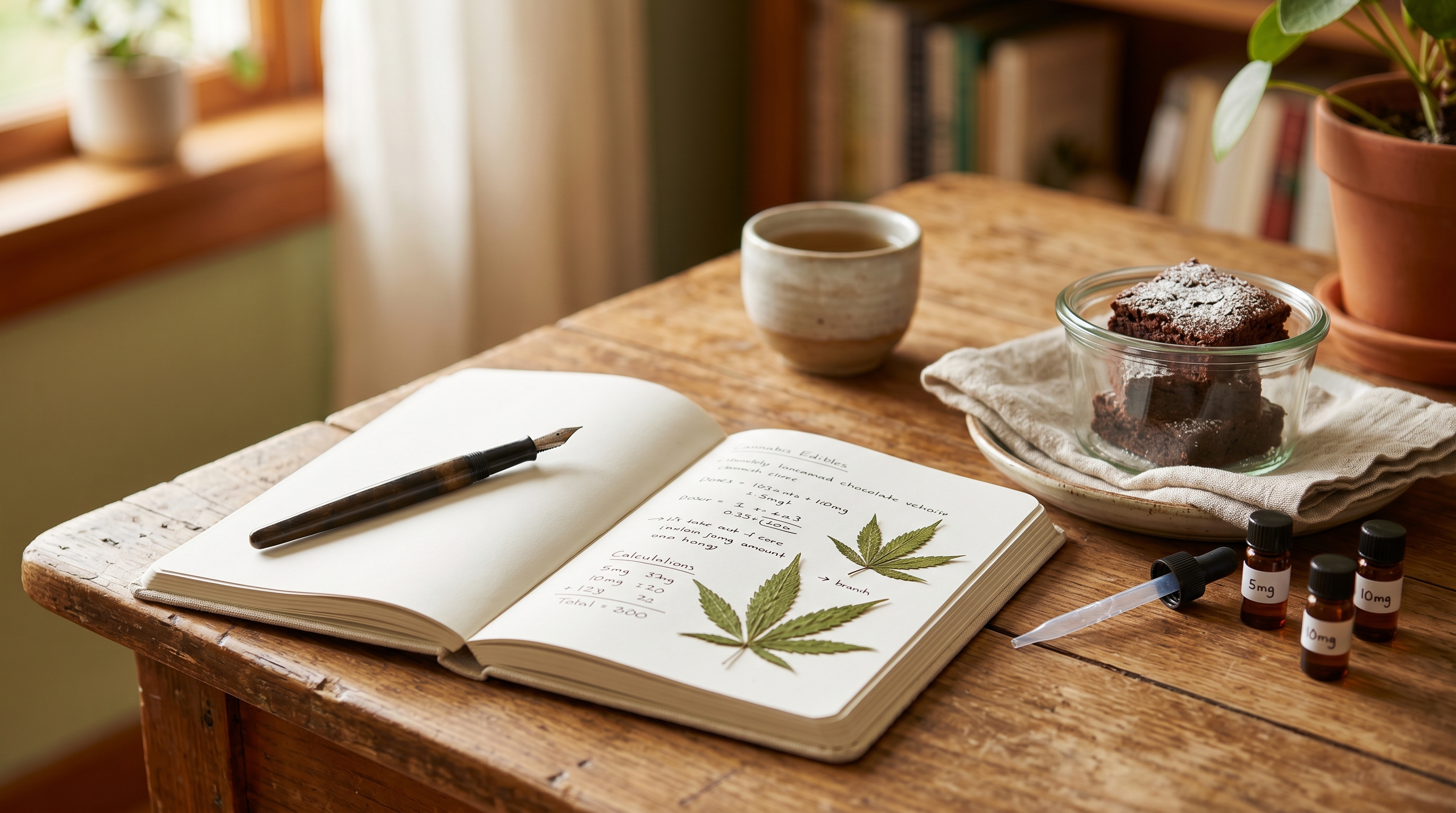
Here is the uncomfortable truth about the brownie cooling on your counter: you do not actually know how strong it is. Not really. You might have a guess, maybe even a confident one, but a homemade edible is not a lab-tested gummy with “10 mg THC” stamped on the wrapper. It is a best estimate baked into batter, and the gap between your guess and reality is exactly how people end up glued to the couch for six hours wondering what went wrong.
The good news is that you can shrink that gap a lot. The bad news is that you can never fully close it at home. This guide walks through the three honest ways to figure out how potent your edibles are — running the math, using an at-home test device, and carefully titrating with a test dose — plus when to just send a sample to a lab. Throughout, keep one rule taped to your forehead: these are estimates, not lab precision, so start low and go slow.
Why homemade potency is so hard to pin down
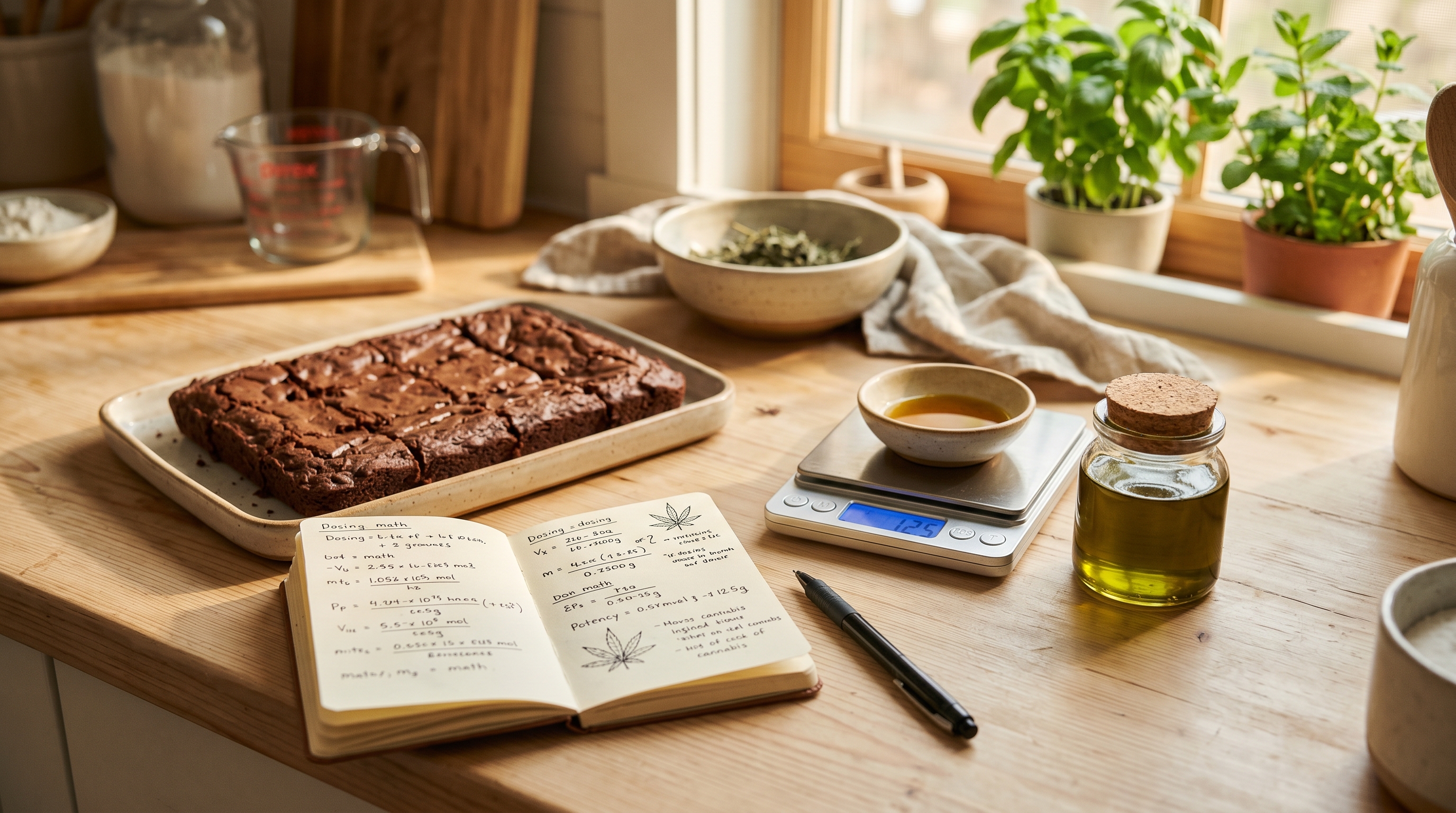
Before any method, understand why this is genuinely difficult. Several variables stack on top of each other, and each one introduces error.
Your starting flower is variable. Even a lab-tested COA gives you a single snapshot, and THC is not evenly distributed across a plant or even a single bud. Then comes decarboxylation, where heat converts non-intoxicating THCA into active THC. That conversion is never 100 percent — a good oven decarb at around 240°F for 40 minutes lands near 87–92 percent, while a rushed or low-temperature job can be far less.
Next, the infusion step loses more. When you simmer decarbed flower in fat, only a fraction of the available THC actually transfers into the butter or oil. For a typical stovetop infusion that number is often 60–80 percent, with the rest left behind in the plant material you strain out. Higher-fat carriers extract a bit more, which is one reason choosing the right fat matters. If you then bake the infusion into cookies, more THC degrades in the oven.
Finally, there is the distribution problem, and it is the scary one. Cannabinoids do not spread evenly through batter. Food scientists call it heterogeneous distribution, and in plain terms it means one corner brownie can carry two or three times the THC of a center one. That uneven mixing — not raw strength — is the single biggest reason homemade edibles send people to the emergency room. Someone eats one piece, feels nothing, eats another, and then both arrive at once. (If a piece does hit too hard, our guide on how to sober up from being too high can help.)
Method 1: The calculation (your starting estimate)
The fastest way to get a ballpark is to do the math before you ever taste anything. The core formula chains together every loss we just described:
Total active THC (mg) = Flower weight (g) × 1000 × THC% (decimal) × 0.877 × decarb efficiency × infusion efficiency
Let’s walk through it with real numbers. Say you infuse 7 grams of flower testing at 20 percent THC into one cup of butter:
- Convert to milligrams. 7 g × 1000 = 7,000 mg of flower.
- Apply THC percentage. 7,000 × 0.20 = 1,400 mg of THCA (the acid form in raw flower).
- Convert THCA to THC. Multiply by 0.877, the molecular conversion factor: ≈ 1,228 mg.
- Apply decarb efficiency. Using a conservative 0.85: ≈ 1,044 mg.
- Apply infusion efficiency. Using 0.70 for a home stovetop: ≈ 731 mg total THC in the batch.
Now divide by volume and servings. One cup of butter is 16 tablespoons, so that batch is roughly 46 mg per tablespoon. If a cookie recipe uses 8 tablespoons across 24 cookies, that’s 365 mg ÷ 24 ≈ 15 mg per cookie — already strong for many people.
A few honest caveats on this method. First, garbage in, garbage out: if you don’t know your flower’s THC percentage, assume a conservative 15 percent rather than guessing high, so any error pushes the dose down. Second, every efficiency figure is a rule of thumb, and real-world yield commonly runs 20–40 percent below calculator estimates. Third, the math tells you the average per serving — it says nothing about hot spots. For a deeper walkthrough with worked examples, see edible dosing math for home cooks. And whatever number you land on, cross-check it against the cannabis beginner’s dosing chart before you commit to a serving size.
The smartest move with the calculation is to design down. If your math says 15 mg per cookie and you want 5 mg, cut your infused butter with plain butter or simply make more, smaller servings. It is far easier to lower a number on paper than to un-eat a brownie.
Method 2: At-home test devices
If you want a real measurement rather than a chained estimate, at-home potency testers exist. The best known is the tCheck, which uses UV spectrophotometry — the same optical principle behind lab instruments — to read cannabinoid concentration in infused oils, butter, and alcohol tinctures.
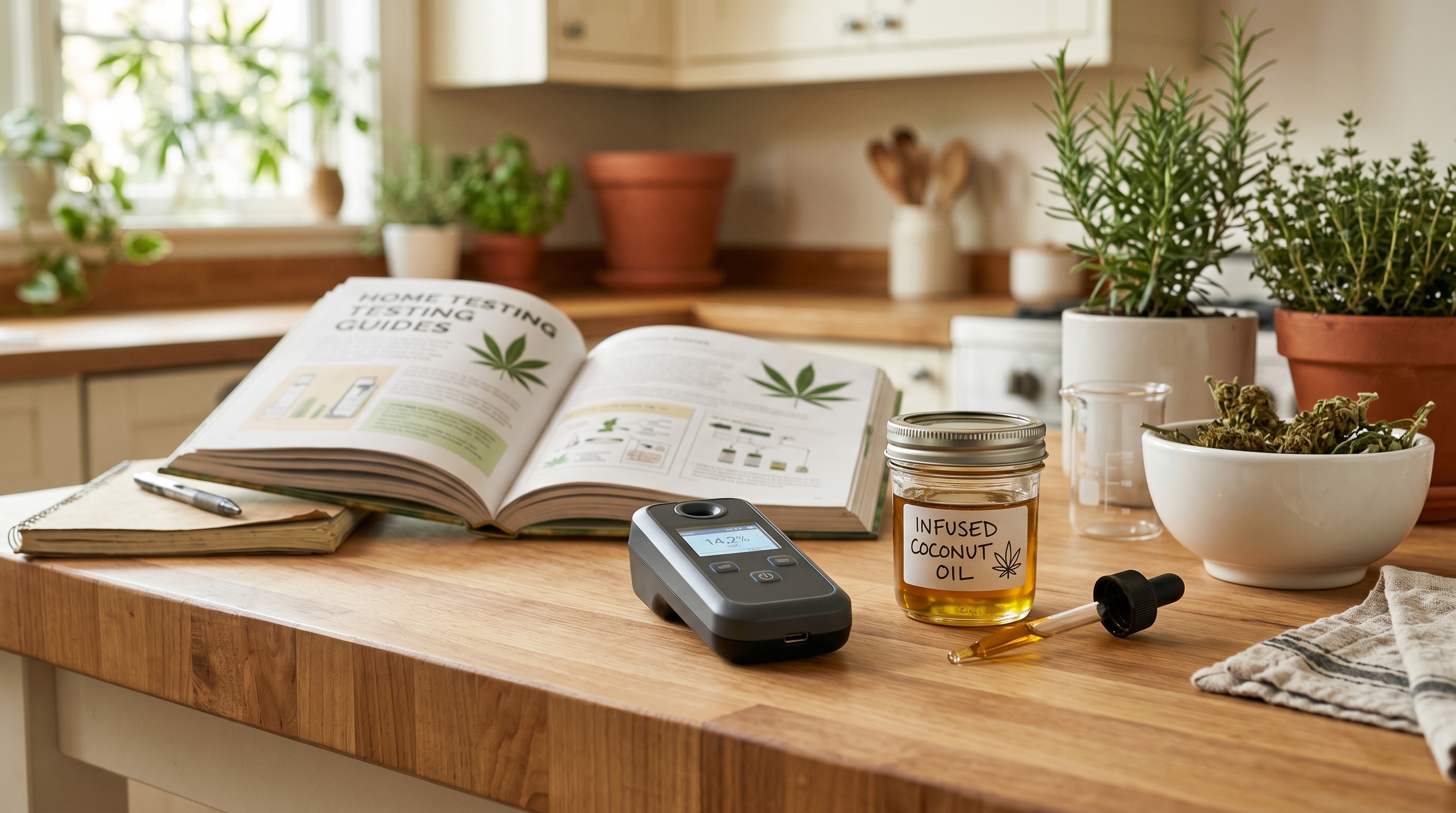
Here’s how it works in practice: you place a few drops of your infused oil into a tray, insert it, and within a couple of minutes get a reading in mg/mL. The companion app then does the per-serving math for you. The appeal is obvious — instead of stacking five guesses, you measure your actual infusion’s strength and build your recipe from a single real number.
Now the accuracy caveats, because this matters. The manufacturer reports validated accuracy of roughly ±3–4 mg/mL for flower-based infusions and ±2 mg/mL for isolate-based ones, with over 90 percent of samples landing within 3 percentage points of HPLC lab results in their head-to-head testing. That is genuinely useful for dosing decisions, but it is not lab-grade certification — the device itself documents repeatability within about ±15 percent, and it is calibrated at specific temperatures (butter readings are taken warm and liquid, not solidified).
The bigger limitation is one the device cannot fix: your reading is only as good as your sample. Cannabinoids settle and separate, so an unhomogenized oil gives a meaningless number. An under-decarbed batch reads low because the device measures activated THC, not THCA. Milk solids in butter, dark or flavored alcohol, mixed carrier oils, or air bubbles all throw off the result. Sample prep — thorough mixing, complete decarb, clean filtering — affects your number more than any device variability.
Two more practical notes. These devices measure your infusion, not the finished cookie. Once THC is baked into batter, you cannot practically extract and measure it — so the rule the pros follow is test the butter or oil before you bake. And there’s a measurement range: tCheck reads infused oils in the 1–15 mg/mL window, so very strong infusions read “OVER” and must be diluted (measure a known volume, add twice that volume of plain base oil, mix, read, then multiply by three).
Method 3: Careful titration with a test dose
Whether or not you ran the math or bought a device, the final calibration is your own body — done deliberately, never recklessly. Harm-reduction educators have a structured version of this, sometimes called the L.E.S.S. method, and the logic is simple: establish a batch’s strength on yourself by intentionally underdosing first.
Here’s the careful version:
- Make a large batch. Titration only works if you have many doses from one well-mixed batch. With 20+ servings, once you’ve dialed in the right amount, you can reproduce it. With only two doses, there’s nothing to calibrate against.
- Start with a small piece — less than a quarter of what you’d guess is a serving. The goal is a low level of effects. Underdosing is not a mistake here; it is the target.
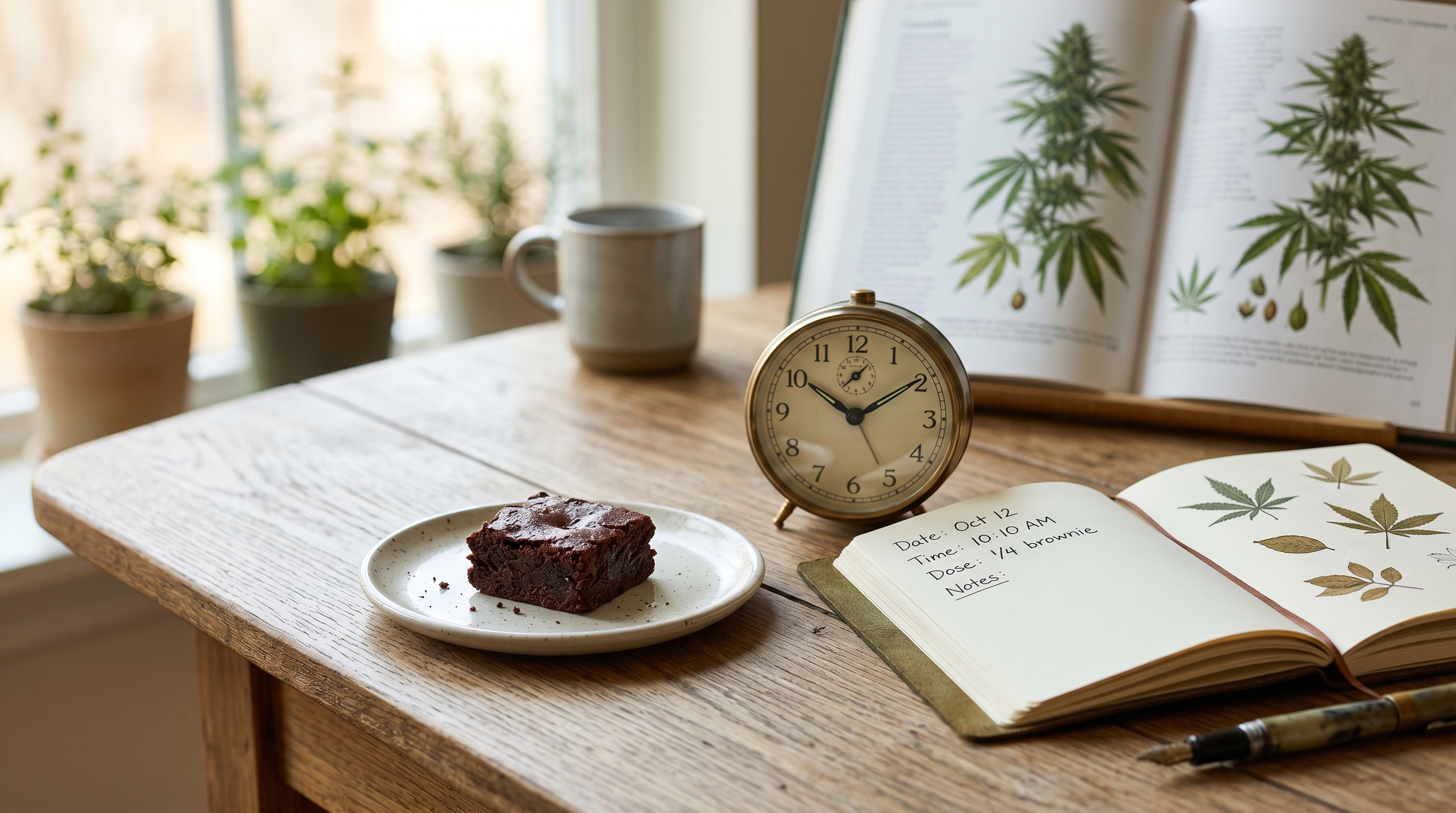
- Wait, really wait. Edible onset runs 30 minutes to 2 hours, and peak effects arrive later still — often around the 3-hour mark, with the experience lasting many hours. This delayed timeline is exactly why the edible dosing 2-hour rule exists. Do not redose because you “feel nothing” at 45 minutes.
- Write it down. Note the weight of the piece, the time, and the felt strength (weak, medium, strong is enough). That record turns a one-off experiment into a repeatable dose.
- Redose only after a full wait — no sooner than 90–120 minutes — and only with another small amount.
This is slower and less precise than the other methods, and it’s vulnerable to the hot-spot problem if your batch isn’t evenly mixed. But it accounts for something no calculator or device can: your individual response. Two people can eat the identical edible and have very different experiences, partly because of genetics and metabolism and partly because edibles convert THC into the more potent 11-hydroxy-THC in your liver — the chemistry behind why edibles hit harder and last longer than smoking. If you do overshoot, understanding greening out helps you ride it out safely.
When to use a lab
If you genuinely need precision — you’re dosing for a medical reason, sharing with people of unknown tolerance, or simply want certainty — send a sample to a testing lab. Analytical labs use methods like HPLC or gas chromatography to return exact mg/g figures, separate individual cannabinoids (THC, CBD, CBG, and more), and screen for contaminants your untested starting flower might carry. The trade-offs are cost (commonly $40–100 per sample) and turnaround (often several days, since you mail it in).
A lab is overkill for casual weekend brownies. It is worth it when the stakes are higher, or when you want to validate your home process once — test a batch, compare it to your calculation and device readings, and learn your true efficiency so future estimates get sharper. To make sense of what comes back, read how to read cannabis lab results. It’s also worth remembering that even commercial labels carry error bars — see why lab testing standards are failing consumers — so “lab-tested” means tighter, not perfect.
Reducing batch-to-batch variance
Testing tells you what happened; technique controls what happens next. The most reliable way to make your estimates trustworthy is to make your process consistent.
- Decarb deliberately. Use a consistent temperature and time so your conversion efficiency stops being a wild card. The decarboxylation science guide covers the ranges. Skipping or rushing decarb is the most common reason edibles come out weak.
- Control infusion heat and time. Too cool and you under-extract; too hot and you degrade THC into CBN. Steady, gentle heat is the goal — the foundation laid out in our cannabutter guide and choosing the right fat.
- Mix obsessively. Stir your infused fat thoroughly before measuring, and scrape the bowl when you fold it into batter. This is the single highest-leverage fix for hot spots, whether you’re making gummies or infused beverages.
- Portion and label. Cut servings evenly and write the estimated mg directly on the container. Future-you will thank present-you.
- Run a pilot. Make a tenth-scale test batch, evaluate it, then scale up with confidence. New to the whole process? Start with cannabis cooking 101 and the broader edible vs. flower vs. concentrate decision.
Track your batches over time — flower used, efficiency observed, dose that felt right — and you turn cooking into a personal dataset. That’s the same philosophy behind building a cannabis journal: the strain matters less than learning how you respond, batch after batch.
FAQ
Can I test the potency of a finished brownie or gummy? Not practically at home. Once cannabinoids are baked into a mixed food, you can’t easily extract and measure them. Test your infused butter or oil before you cook, then calculate per-serving doses from that reading.
How accurate are at-home test devices? Useful, not perfect. Reported accuracy is around ±3–4 mg/mL for flower infusions, with most readings within a few points of lab results — plenty for dosing decisions, but not a substitute for certified lab testing. Sample prep (mixing, full decarb, clean filtering) affects your number more than the device itself.
Why is my homemade edible weaker than I calculated? Usually incomplete decarboxylation or low infusion efficiency. Real-world yield commonly lands 20–40 percent below calculator estimates because some THC never converts, some stays in the plant material, and some degrades during cooking.
How much should my test dose be? Less than a quarter of a guessed serving — aim for a low level of effects. Wait a full 1–2 hours (peak comes even later) before deciding whether to take more. Never redose because nothing’s happened yet.
Do I really need to test every batch? If consistency matters, yes. Even the same recipe can vary 20–30 percent batch to batch because of heat distribution and extraction differences. At minimum, treat each new batch as unknown and start low.
The bottom line
Homemade edibles trade certainty for control and savings. You can narrow the uncertainty with three layered tools — run the calculation for a starting estimate, use an at-home device to measure your infusion, and titrate carefully with a test dose to learn your own response — and reach for a lab when precision genuinely matters. But none of these turn your kitchen into a certified facility. Every method is an estimate, every batch can hide a hot spot, and the safest assumption is always that the piece in your hand is stronger than you think. Start low, go slow, write it down, and let the data — not the guesswork — guide the next batch.
Sources
- tCheck. “How tCheck Measures THC Potency: The Optical Method Explained.” tcheck.me/blogs/cannabis-tips
- tCheck. “Analyzing the Accuracy of tCheck Potency Testing.” tcheck.me/blogs/cannabis-tips/how-accurate-is-tcheck
- tCheck. “Product Specs and Features of the tCheck 3 Device.” tcheck.me/blogs/support/product-specs-tcheck-3
- tCheck. “How to Test THC in Homemade Edibles at Home.” tcheck.me/blogs/cannabis-tips/how-can-i-test-thc-potency-homemade-edibles
- Erowid. “The L.E.S.S. Method: A Measured Approach to Oral Cannabis.” erowid.org/plants/cannabis/less_method
- RethinkTHC Research Team. “Homemade vs Store-Bought Edibles: Dosing, Safety, and What to Know.” rethinkthc.com (2026)
- ColoradoCrop. “Cannabutter Potency Calculator.” coloradocrop.com/tools/cannabutter-potency-calculator
- Sticky Thumb. “How to Make Edibles Properly: Dosing and Decarb Guide.” stickythumbdelivery.com (2026)


