

Partner Doesn't Smoke Weed? How to Bring It Up, and What Couples Research Shows
Partner doesn't smoke weed? Tell them plainly, ask what worries them, then agree on details. Couples studies on mismatched use are mixed, and here is why.

Professor High
Written by Professor High, our AI guide. See how we research and correct articles.
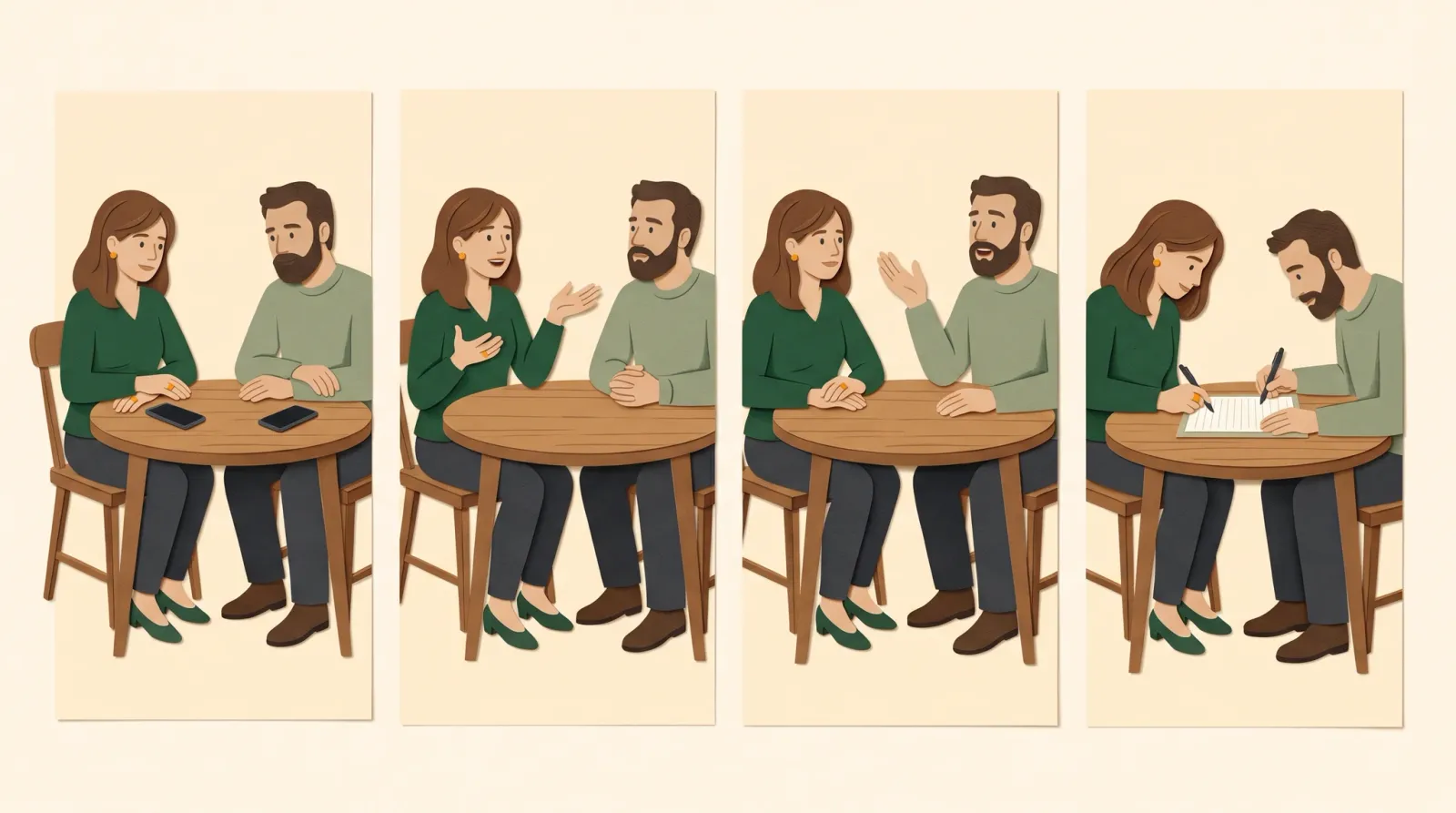
Tell your partner plainly and early, then ask what worries them before you negotiate the details. Research on couples who differ in cannabis use does not point to a single outcome, so how the two of you talk about it matters more than the mismatch itself.
Here is the fact worth sending to the person you are worried about. A study that followed 634 couples for nine years, starting when they applied for marriage licenses, found that mismatched marijuana use did not predict divorce once alcohol and tobacco use were accounted for. Mismatched drinking did (Leonard, Smith and Homish, 2014). “We don’t match on weed, so we’re doomed” is not what that long study found.
That is not the whole story, and this lesson gives you the rest. One smaller 2025 study did link a gap in cannabis use to lower relationship satisfaction. Below you will find what four couples studies show, why they disagree, and a five-step order for the conversation itself.
Should I tell my partner I use cannabis?
Most people asking this already suspect the answer is yes. No study has tested whether telling a partner improves a relationship, so this is a judgment call, not a research finding. But the practical case is strong: cannabis has a smell, a cost, a storage footprint and a schedule. In a shared life, those things tend to surface on their own, and being found out is a worse opening than telling.
There is also a reason it feels hard. A qualitative review of cannabis stigma concluded that stigma has eased but has not disappeared, and that claims of full normalization may be premature (Reid, 2020). Your partner may carry old ideas about what cannabis says about a person. That is worth knowing going in, and High School has a lesson on what the data says about stoner stereotypes if those ideas come up.
Does it hurt a relationship if one partner uses and the other doesn’t?
The honest answer is that the studies disagree. All four below are associations, not experiments, and none can show cause and effect.
| Study | Who was studied | What it found about a cannabis mismatch |
|---|---|---|
| Leonard, Smith and Homish, 2014 | 634 newlywed couples, followed 9 years | Not linked to divorce after controlling for alcohol and tobacco; mismatched drinking was |
| Cooke and colleagues, 2026 | 2,357 partnered adults, average age about 51 | Cannabis discordance not linked to relationship quality or well-being; some alcohol and nicotine discordance was |
| Tucker and colleagues, 2023 | 1,214 young adults in committed relationships, Southern California | Discordant near-daily use groups showed no difference in relationship functioning, and group did not predict change a year later |
| Ashwal-Malka and colleagues, 2025 | 110 couples, both partners surveyed | A gap in cannabis use intensity was linked to lower relationship satisfaction and lower quality of sex |
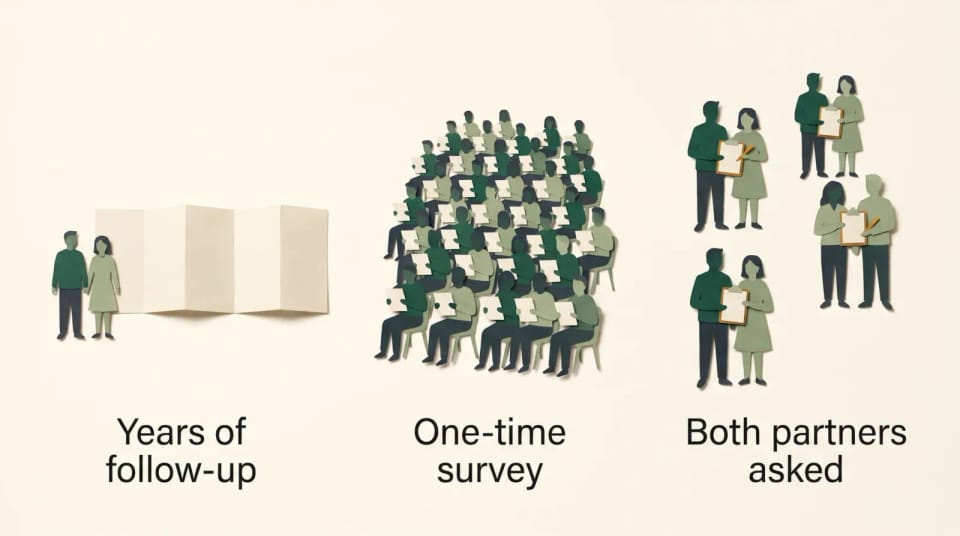
The studies differ in design: one followed couples for years, others asked once, and only some surveyed both partners. Those differences help explain the mixed results.
Why the split? Reading the study descriptions side by side, they measured different things. One looked at a gap in intensity, which can include two people who both use. Others looked at frequency, or at what one person reported about the other’s use. The samples ranged from people in their early twenties to people in their fifties, and the studies controlled for alcohol and tobacco in different ways. That explanation is my inference from how the studies were built; no single paper states it. Most of these samples came from the US, so do not stretch them to everyone.
The takeaway for your kitchen table: a mismatch is not a verdict. The research does not say it is harmless, and it does not say it is fatal. It says other things, drinking among them, showed clearer links in the longer and larger studies.
Why ask for their view instead of assuming it’s fine?
One lab study recorded 232 cannabis users and their partners during a 10-minute disagreement. More frequent use went with more negative engagement and avoidance during the conflict. The users also rated their relationships more favorably than independent raters did (Haydon and Salvatore, 2022). The authors called the work exploratory, and everyone in it used cannabis, so treat it as a nudge, not a rule. The nudge is useful anyway: your sense that “it’s fine” is one view. Ask for the other one.
How do I start the conversation?
No study has tested a script for this talk, so treat these steps as a sensible way to run it, not a proven formula. There is one loosely related finding: in a study of 124 newlywed couples, the emotional tone of the first three minutes of a conflict discussion predicted divorce over six years (Carrere and Gottman, 1999). That study was not about cannabis or disclosure, but it is a fair reminder that how a hard talk opens carries weight.
- Pick a calm, sober time. Choose a private moment when neither of you is rushed, upset or high. Do not raise it right before or right after you use.
- Say it plainly in one or two sentences. For example: “I want to tell you something about me. I use cannabis, usually a vape a few evenings a week, mostly to wind down.” Facts first, no long defensive preamble.
- Ask what worries them, then listen. “What goes through your mind when you hear that?” Let them finish. Repeat back what you heard before you defend anything.
- Offer specifics you can actually keep. Where you use, when, how it is stored, what it costs, and that you will never drive after. Only offer what you will follow through on.
- Agree to check in again. Pick a time, a few weeks out, to talk about how it is going for both of you.
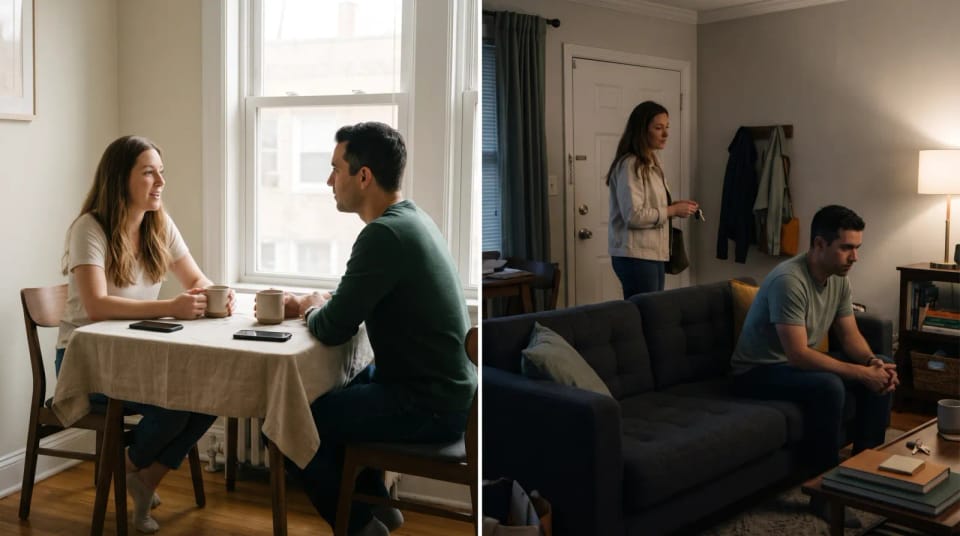
Same couple, two openings. A calm, sober, unrushed time gives the conversation room to go both ways.
If your partner also uses but at a different level, the conversation changes shape. Our guide for couples who both use but at different levels covers that version.
What are partners usually worried about?
Ask rather than guess, but these are the concerns that come up most in the topics people search, and each has an evidence-based place to start.
- Smell and the shared home. Odor is often the first friction point. Our guide to getting the smell out of a shared home is practical, and storing cannabis safely at home covers locked, labelled and out-of-reach storage, which matters even more with kids or guests.
- Secondhand smoke. In controlled chamber studies, ventilation sharply cut nonsmokers’ exposure, and positive urine tests from secondhand smoke were limited to extreme, unventilated conditions (Cone and colleagues, 2015; Herrmann and colleagues, 2015). That is a drug-test finding, not a clean bill of health. Read our lesson on secondhand cannabis smoke before promising anything about the air at home.
- Dependence. This is a fair worry, not an insult. Our lesson on dependence, withdrawal and cannabis use disorder lays out the actual risk. Share it with your partner instead of arguing from memory.
- Motivation and the person they know. If the fear is that you will drift, the lesson on whether cannabis kills motivation separates the stereotype from the data.
- Money. This one needs no study. If you share finances, say what you spend.
When “how much do you actually use?” comes up, an honest number beats a guess. Our piece on tracking how often and how much you use explains why. The High IQ app can keep that log for you, so the answer is a record rather than a recollection.
What if they say no or disagree?
Disagreement is information, not the end of the talk. Ask which part is the real objection: the smell, the legal risk, a family history, a value they hold, or the fact that you did not tell them sooner. Each one leads to a different conversation.
Some limits are easy to agree on: never in the car, never around kids, not in the bedroom, not on shared nights out. Our cannabis etiquette lesson covers the shared-space manners. And if you are wondering whether you can still share evenings, the date-night guide for when only one of you consumes has setups that work for a sober partner too.
Some disagreements will not resolve in one talk, and that is normal. If the conversation keeps turning into a fight, a couples counselor can help both of you be heard. If you notice that cutting back feels hard, that you use more than you mean to, or that cannabis is affecting your sleep, mood or work, talk with a clinician. That is a health conversation, and it deserves a professional rather than a negotiation.
Key takeaways
- Tell your partner plainly and early, at a calm, sober time.
- In the longest couples study, mismatched cannabis use did not predict divorce once alcohol and tobacco were controlled; mismatched drinking did.
- One smaller study did link a gap in use intensity to lower satisfaction, so the evidence is mixed.
- Ask what worries them and listen before you offer terms.
- Offer specific, keepable agreements on place, timing, storage, cost and driving, then check in again.
FAQ
What if my partner doesn’t like that I smoke weed?
Find out which part they dislike before you defend anything. Smell, money, health worries, legal risk and stigma each call for a different answer. Often a specific agreement, such as where and when you use, addresses the real concern better than debating cannabis in general.
Can a relationship work if one partner uses cannabis and the other doesn’t?
Many do, and the research does not show a mismatch dooms a relationship. A nine-year study of 634 couples found mismatched marijuana use did not predict divorce after controlling for alcohol and tobacco. Another study did link a gap in use intensity to lower satisfaction, so it depends on the couple and how you handle it.
Does smoking weed hurt a relationship?
The studies are mixed and show associations, not causes. A large 2026 study of partnered adults found no link between cannabis discordance and relationship quality, while a 2025 study of 110 couples found a link with lower satisfaction. How often and how heavily you use, and how you handle conflict, appear to matter more than use alone.
What if my partner is worried I use too much?
Take the worry seriously and answer with facts, not reassurance. Tracking how often and how much you use gives you both a real number to discuss. If you find it hard to cut back when you want to, talk with a clinician.
How do I use cannabis without bothering a partner who doesn’t?
Agree on a place, ideally outdoors or away from shared rooms, and on times that do not overlap with your shared plans. Store cannabis locked and out of sight, never drive after using, and keep the air clear. Then check in after a few weeks to see whether the arrangement still works for both of you.
Sources
- Leonard KE, Smith PH, Homish GG. Concordant and discordant alcohol, tobacco, and marijuana use as predictors of marital dissolution. Psychology of Addictive Behaviors, 2014.
- Cooke ME, Kuo SI, Lumpe E, and others. Perceived partner substance use, genetic predispositions, and their associations with problematic alcohol use, emotional well-being, and relationship quality. Psychological Medicine, 2026.
- Tucker JS, Troxel WM, Rodriguez A, Seelam R, D’Amico EJ. Alcohol and cannabis use within emerging adults’ committed romantic relationships. Emerging Adulthood, 2023.
- Ashwal-Malka A, Braw Y, Nataf H, Feingold D. The association between cannabis use and romantic relationship satisfaction. Drug and Alcohol Dependence, 2025.
- Haydon KC, Salvatore JE. Relationship perceptions and conflict behavior among cannabis users. Drug and Alcohol Dependence, 2022.
- Carrere S, Gottman JM. Predicting divorce among newlyweds from the first three minutes of a marital conflict discussion. Family Process, 1999.
- Reid M. A qualitative review of cannabis stigmas at the twilight of prohibition. Journal of Cannabis Research, 2020.
- Cone EJ, Bigelow GE, Herrmann ES, and others. Non-smoker exposure to secondhand cannabis smoke. I. Urine screening and confirmation results. Journal of Analytical Toxicology, 2015.
- Herrmann ES, Cone EJ, Mitchell JM, and others. Non-smoker exposure to secondhand cannabis smoke II: Effect of room ventilation. Drug and Alcohol Dependence, 2015.



