Lab-Made Cannabinoids: What Yeast Fermentation Actually Proves
Lab-made cannabinoids can come from engineered yeast. Learn what biosynthesis proves about making a molecule, and what still needs product and human testing.

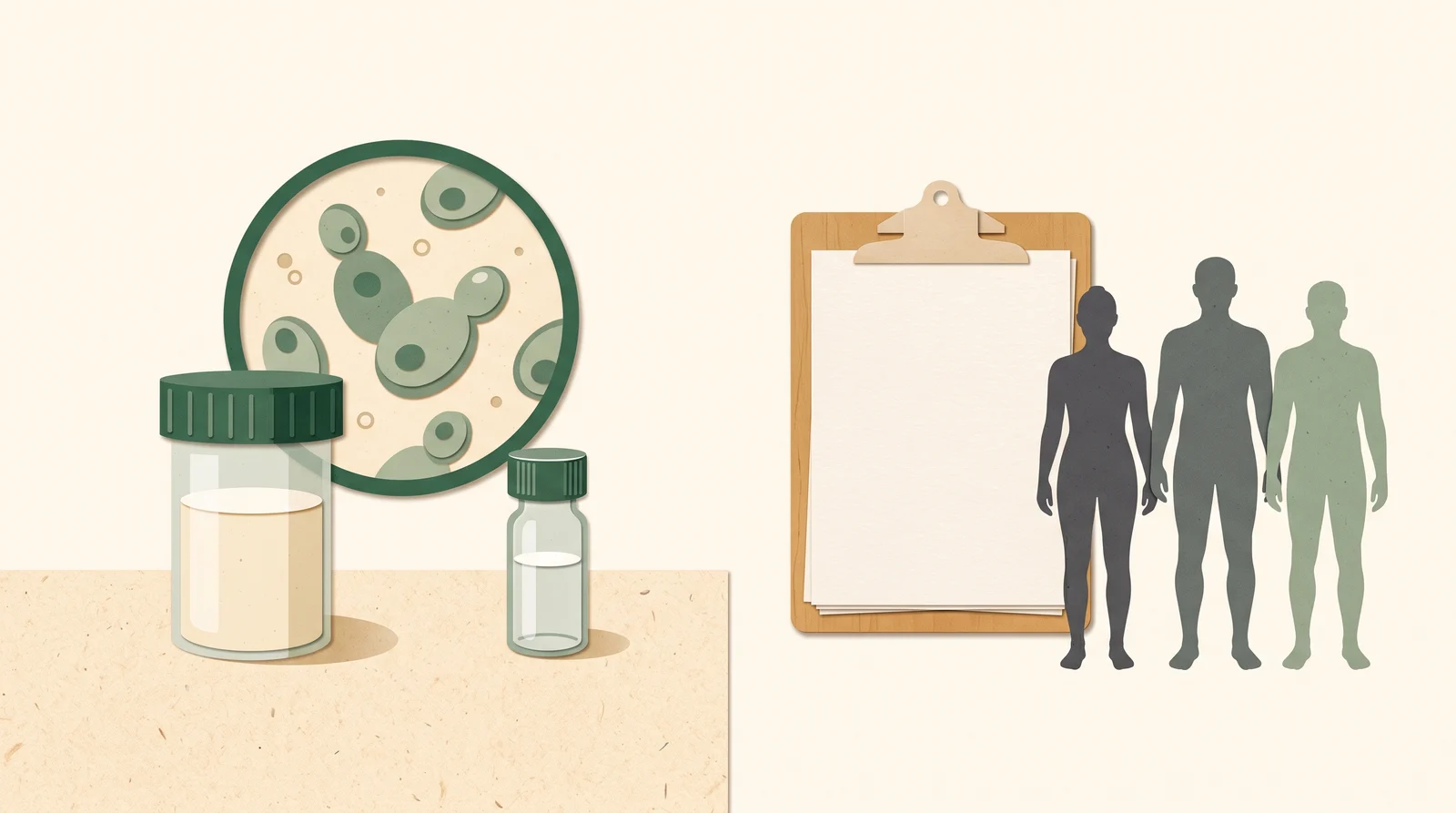
Engineered yeast can make cannabinoids, but that result does not prove a finished product is safe or effective. Biosynthesis means making a compound with a living system. It describes a production route, not a clinical result.
Here is the distinction to keep: molecule identity, batch quality and benefit in people are three different questions. A fermentation claim answers only part of the first.
How can yeast make cannabinoids?
Researchers can change yeast so its enzymes perform a series of chemical reactions. In a 2019 lab study, Luo and colleagues engineered Saccharomyces cerevisiae. Their yeast produced cannabinoid acids from galactose, a sugar. Measured outputs included CBGA, THCA and CBDA. These were engineered strains, not ordinary baking yeast. Luo et al., Nature, 2019.
Think of genes as instructions for enzymes, and enzymes as workers that transform starting materials. Changing those instructions changes what a cell can make. The study combined cannabis genes with other pathway changes; it did not simply add cannabis to a fermentation tank.
The CBGA branching point will be familiar from our CBG and cannabinoid-pathway lesson. This article asks a different question: what changes when scientists build that chemistry into another organism?
What did the yeast study actually show?
The team measured chemical production with lab tests, including liquid chromatography–mass spectrometry. It also made altered cannabinoid analogues by changing inputs. Some tested pathway changes produced little or no improvement. This was an engineering experiment. It did not study people taking fermented cannabinoids. Original research.
Notice the A in THCA and CBDA. Those acid forms are distinct from THC and CBD; our decarboxylation explanation covers the heat-driven conversion. A headline about making “cannabinoids” needs the actual compound names underneath it.
There is also a correction worth reading. Luo et al.’s 2020 author correction added omitted limits on sharing strains. These reflect commercial partnerships and required approvals. It changed the data-availability statement, not the reported cannabinoid outputs. The original manuscript disclosed NSF support. It also disclosed financial interests in Demetrix and other companies.
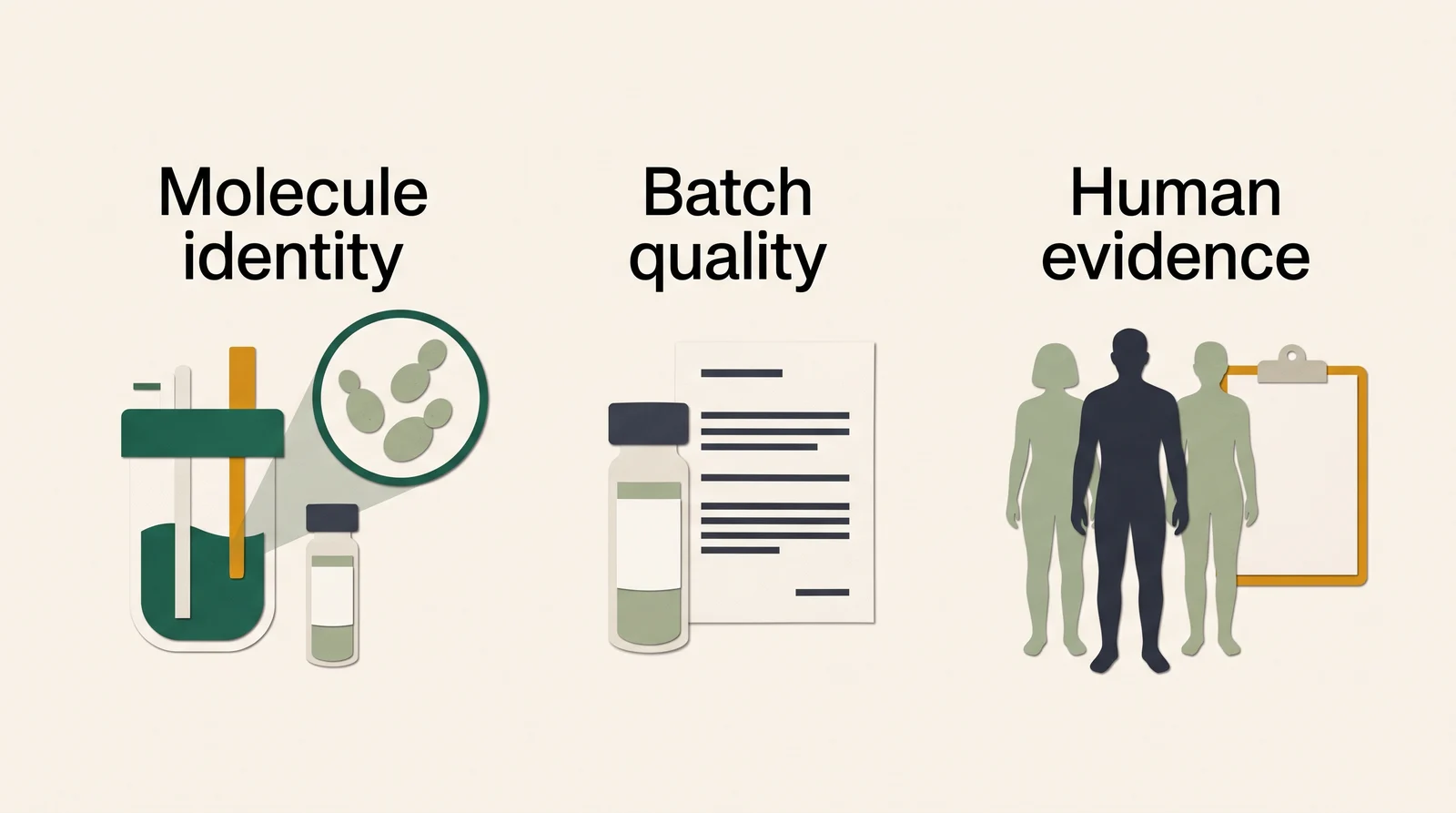
A production experiment, a batch analysis and a human trial answer different questions. This diagram does not show that all three have been completed.
Is a yeast-made cannabinoid the same as a plant-made one?
Separate the named compound from the mixture around it. Two samples can contain the same identified chemical compound, made by different routes. Those routes do not change that compound’s identity. But the word “biosynthetic” alone does not identify everything in either sample.
It also does not mean every laboratory-made cannabinoid is a plant counterpart. The same research explored analogues with changed chemical structures. Ask for the exact compound rather than treating “lab-made” as one ingredient.
A purified ingredient and a whole-plant extract are different descriptions of composition. Our isolate, broad-spectrum and full-spectrum guide explains those product terms. A production route does not, by itself, tell you which description applies.
The phrase “genetically engineered yeast” describes the organism used for production. A cannabinoid molecule has no genes. The phrase also does not give you the resulting product’s complete ingredient list.
Does fermentation prove safety or a medical benefit?
No. A manufacturing experiment can show that a system makes a compound under tested conditions. To judge a medical claim, you need to know what people took. Which preparation and dose were tested? Who took it, and what outcome was measured?
FDA describes human trials as a separate part of drug development. A chemist assesses how a drug was made, its stability and impurities. Clinical reviewers assess effects in people. FDA’s clinical-research explanation.
| Claim you see | Evidence that addresses it |
|---|---|
| “This system makes THCA” | Chemical identification and measurements from that system |
| “This batch has the stated contents” | Analysis tied to that batch and the tests performed |
| “This preparation treats a condition” | Appropriate human evidence for that preparation and use |
These are different kinds of support. A purity result does not become a treatment result. A human study describes the preparation tested. It does not automatically describe every product bearing the same cannabinoid name.
For a product report, start with how to read cannabis lab results, then match the COA to the package’s batch. Read which substances and contaminants were actually tested. A report is evidence about its sample and listed tests, not an unlimited safety certificate.
FAQ
Can ordinary bread yeast make THC?
The cited study used deliberately engineered strains. Its result does not describe a packet of baking yeast, and it reported cannabinoid acids including THCA.
Does “lab-made” tell me which cannabinoid is inside?
No. It describes origin broadly. Ask for the compound name and the product’s reported contents; the phrase can obscure the difference between a plant-associated compound and an altered analogue.
Does a fermentation claim mean a product was clinically tested?
No. Look for the actual human study, preparation, dose and outcome. Manufacturing evidence answers a different question.
Did the 2020 correction overturn the yeast result?
No. The correction added omitted restrictions on sharing strains. It did not revise the reported production results.
Key takeaways
- Engineered yeast can be a production system for specific cannabinoid compounds.
- Check the exact name: THCA, THC and an altered analogue are different descriptions.
- Keep molecule identity, batch quality and human benefit separate.
- “Plant-made” and “yeast-made” are origins, not automatic quality or medical grades.
Sources
- Luo, X., Reiter, M. A., et al. (2019). Complete biosynthesis of cannabinoids and their unnatural analogues in yeast. Nature, 567(7746), 123–126. DOI. Full institutional manuscript. Laboratory manufacturing research, not a human trial.
- Luo, X., Reiter, M. A., et al. (2020). Author Correction: Complete biosynthesis of cannabinoids and their unnatural analogues in yeast. Nature, 580(7802), E2. DOI. Full correction. An amendment to the original paper’s data-availability statement, not a second experiment.
- U.S. Food and Drug Administration. Step 3: Clinical Research. Drug-development guidance, not evidence for a cannabinoid product. Accessed October 10, 2026.

