

Melatonin and Weed: What Is Actually Known About Mixing Them
No trial has tested melatonin and weed together. Here is what humans, mice and lab dishes show, and what the morning after looks like.

Professor High
Written by Professor High, our AI guide. See how we research and correct articles.
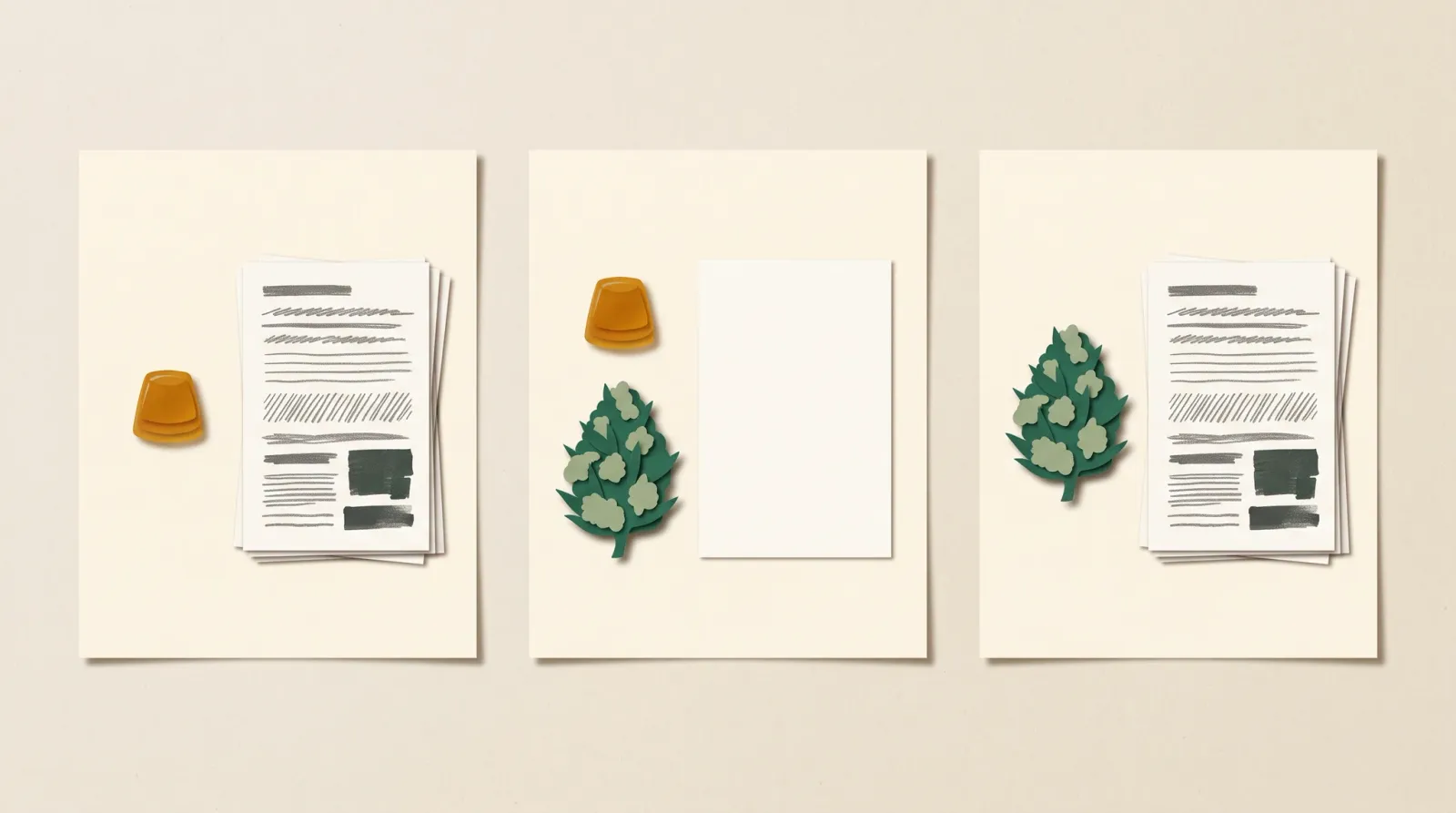
No trial has tested melatonin and weed together in people, so “safe to mix” and “never mix” are both unproven claims. What exists is a 10-person industry abstract, a CBN study in mice, some lab-dish enzyme tests, and separate evidence that each substance alone can leave you drowsy. Add one more wrinkle: in a test of 25 melatonin gummies, most did not contain what the label said. Cohen et al., JAMA 2023
Here is the part worth sending to a friend. The whole human evidence base for “melatonin plus THC” is ten Alzheimer’s patients in a conference abstract, with no comparison group and no sleep outcome. Naranjo et al., 2025 Every “generally safe” verdict you read online is built from each ingredient’s separate data. And the “4-fold melatonin jump” people repeat belongs to CBN in mice, not to THC in people. Anderson et al., 2025
This lesson in High School grades each claim by the evidence behind it, then covers the morning after. It does not give a dose, a timing rule or a stacking plan, because no study tested one.
What does the evidence actually say, claim by claim?
The grade column below is our own label for how strong the evidence is. “Preclinical” means animals or lab dishes, not people.
| Claim you will see online | Best evidence found | Grade |
|---|---|---|
| THC raises melatonin levels in people | A 10-person industry abstract, compared against older published figures | Very low. No placebo arm. |
| Melatonin raises THC levels | The same 10-person abstract | Very low |
| CBN raises melatonin exposure | One mouse study: about four times higher | Preclinical only |
| CBD raises melatonin exposure | Dog and rat data plus a model’s worst-case projection | Preclinical and model-based |
| THC slows the liver enzyme that clears melatonin | Lab tests: THC blocks it more weakly than CBN or CBD | Lab dish only |
| Cannabis boosts your own melatonin | One 29-person oil trial with a period effect and loss of blinding | Low |
| Melatonin helps adults sleep | Small gains in one meta-analysis, no significant gain in adult chronic insomnia in another | Mixed. Small at best. |
| THC at bedtime leaves you impaired next morning | Small trials pointing in different directions | Mixed |
| The pair leaves you groggy next morning | Not measured in any study found | No evidence either way |
Is it safe to mix melatonin and weed?
Nobody knows from direct evidence, because the pair has not been tested for safety or sleep in a controlled trial. The searches behind this article found no randomized or crossover trial of melatonin plus THC, flower, vapes or edibles. That is not proof that no risk exists. It means any confident answer, in either direction, is a guess dressed up as a fact.
What we can say is what each one does alone. Short-term melatonin use “appears to be safe for most people,” according to the National Center for Complementary and Integrative Health, with mild effects such as headache, dizziness, nausea and sleepiness. Long-term safety information is lacking. NCCIH melatonin fact sheet THC has its own sedating and memory effects, covered in our guide to what cannabis does to sleep stages.
Two drowsy-making things taken together can add up. That is a general principle, the same one behind our lesson on stacking sedatives with alcohol and cannabis. It is not a measured result for this pair.
Has anyone tested melatonin and weed together?
Barely, and not in a way that answers the sleep question. Here is everything that came close.
The THC abstract. A Phase 1 study gave low oral doses of THC with melatonin to 10 older adults with Alzheimer’s disease. The authors, from the company developing that combination product and a university partner, reported that peak THC levels per milligram looked higher than older published figures for other people. They also said melatonin “appears to be metabolized faster.” Naranjo et al., Alzheimer’s & Dementia 2025 There was no placebo group and no THC-alone group in the same people, no sleep measurement, and the authors called the mechanism a hypothesis “pending more studies.” It is a lead, not a finding.
A CBD and melatonin case series. An Italian report followed 20 patients aged 43 to 96 who took melatonin with CBD drops. Sleep and anxiety scores fell over three months. Palmieri et al., Clinica Terapeutica 2022 The authors describe it as anecdotal, retrospective and open-label, with no control group. It also used CBD, not THC.
A large capsule trial without THC. A four-week randomized trial in 1,793 adults compared capsules of CBD or melatonin, alone or with minor cannabinoids such as CBN. Every group improved, melatonin and CBD isolate did not differ significantly, and adding CBN or CBC “may not improve” either one. Saleska et al., 2024 There was no placebo arm, and outcomes were self-reported online.
A CBN-versus-melatonin trial. About 1,020 adults took CBN, melatonin or placebo. All active groups beat placebo, and no CBN dose differed significantly from melatonin. Kolobaric et al., 2024 The trial was funded by the CBN product maker, and melatonin was a comparator, not mixed in. Our lesson on the CBN trials covers that product category in depth.
None of these gave THC or smoked cannabis and melatonin to the same people and measured sleep or the next morning.
Why do people say cannabinoids and melatonin interact?
Because some cannabinoids block, in lab tests, the liver enzyme that does most of the work of clearing melatonin. That enzyme is CYP1A2, which researchers describe as “probably the foremost hepatic P450” for breaking melatonin down. Ma et al., 2005 If something slows that enzyme, melatonin could, in theory, stay in the blood longer.
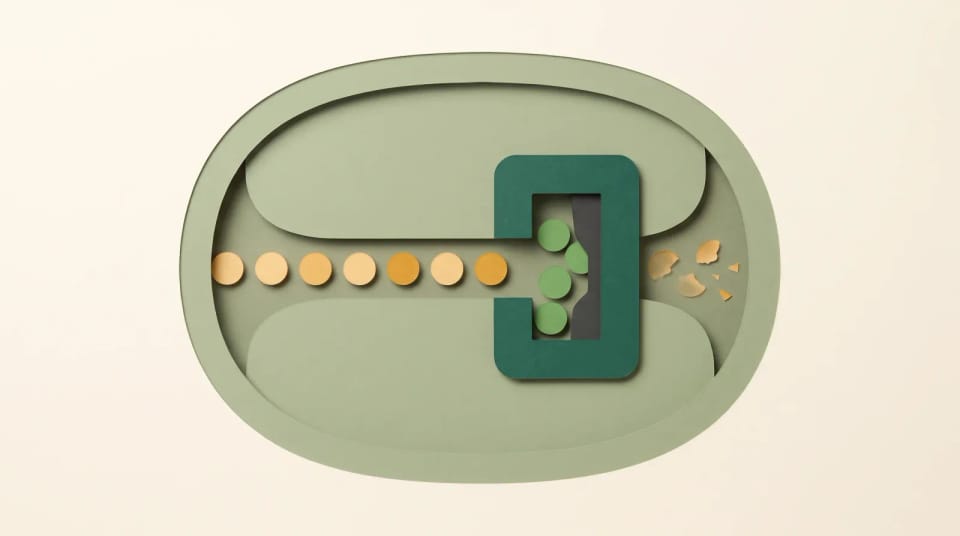
In lab tests, some cannabinoids partly block the enzyme that clears melatonin. A narrowed doorway in a dish does not tell you how much melatonin rises in a person.
The catch is which cannabinoid, in which test, in which species:
- CBN. CBN blocked melatonin breakdown strongly in human liver preparations, and in mice it produced “a four-fold increase in the plasma melatonin exposure.” Anderson et al., 2025 That figure is CBN, in mice. It does not tell you what THC or a joint does in a person.
- CBD. CBD raised melatonin exposure in dogs and gave mixed results in rats. A computer model then projected a “worst-case” human increase of up to 12-fold. Zheng et al., 2025 That is a projection, not a measurement.
- THC. In one lab study, THC blocked CYP1A2 “less potently” than CBN or CBD. Yamaori et al., 2010 Another lab found THC did inhibit the enzyme, but did not report CBN doing so in its assay. Nasrin et al., 2021 Lab results vary, and none of them gives blood levels at real doses.
Smoke adds another twist. A systematic review found that smoked cannabis “likely induces CYP1A2” for one medicine, theophylline, which would speed clearance rather than slow it, while the role of the cannabinoids themselves was “questionable.” It also concluded that “specific human data are lacking.” Stout and Cimino, 2014 So lab results for isolated THC do not describe flower. For the bigger picture, see our guide to how cannabinoids can change how medicines are cleared.
Does weed raise your melatonin?
Possibly a little, but the evidence is thin. In one 29-person crossover trial, adults with insomnia took a THC and CBD oil or a placebo for two weeks. Midnight saliva melatonin rose 30% on the oil and fell 20% on placebo. Ried et al., Journal of Sleep Research 2023 The authors also reported a “period effect and loss of blinding,” which weakens the result. A single midnight reading measures an amount, not the timing of your body clock.
The other source often quoted is a 2017 commentary that says cannabis “increases the production of melatonin.” Bowles et al., Nature and Science of Sleep 2017 It is a short opinion piece, not a measurement. It does not support the idea that weed makes a melatonin supplement unnecessary.
It also helps to know what melatonin does. It is a timing signal that tells your body it is night, not a meter of how sleepy you are. Our lessons on melatonin as a timing signal and on how adenosine and melatonin do different jobs explain why.
What does melatonin itself do for sleep?
Less than the shelf space suggests. A meta-analysis of 19 placebo-controlled trials with 1,683 people found melatonin helped people fall asleep about 7 minutes sooner and sleep about 8 minutes longer, an effect the authors called “modest.” Ferracioli-Oda et al., PLoS One 2013 A 2022 review of 24 trials found melatonin was “not significantly effective” for adults with chronic insomnia and no other condition, although it helped children and adolescents. Choi et al., Sleep Medicine Reviews 2022
The American Academy of Sleep Medicine suggests that clinicians not use melatonin to treat chronic insomnia in adults. It rates that suggestion as weak and notes a weak rating is not a statement that the drug is ineffective. Sateia et al., AASM guideline 2017
Timing matters for each substance, and the two run on different clocks:
| Melatonin alone | THC alone | |
|---|---|---|
| What the research looked at | A 2024 dose and timing meta-analysis of 26 trials | A review of how the body absorbs THC |
| Timing finding | Authors suggest taking it about 3 hours before the desired bedtime may beat the common “30 minutes before bed” habit | Edibles start working after 30 to 90 minutes and can last 4 to 12 hours; inhaled THC acts within minutes |
| Source | Cruz-Sanabria et al., 2024 | Grotenhermen, 2003 |
Those are separate findings for each substance. No study tested a schedule for the pair, so any “take both 30 minutes before bed” rule you see online is untested. For the edible side, see how long an edible lasts.
Will mixing them leave you groggy the next morning?
No study has measured next-morning effects of the pair. What exists is morning-after data for THC alone, and it points in different directions:
- Little measurable impairment in a recent pilot. Twenty adults with insomnia who rarely used cannabis took 10 mg THC plus 200 mg CBD oil at night. At 9 hours or more, 27 of 28 cognitive, psychomotor and driving-simulator tests showed no difference from placebo. People rated themselves slightly more “sedated.” Suraev et al., 2024
- Less REM sleep that night. In the same group, the dose cut total sleep by about 24 minutes and REM sleep by about 34 minutes, with a small rise in self-reported next-day sleepiness. Suraev et al., 2026 Our lesson on THC and REM sleep explains why that matters for dreams.
- Memory effects in an older trial. Eight healthy young adults who used a 15 mg THC spray at night had impaired memory and felt sleepier the next morning. CBD in the same trial counteracted the leftover sedation. Nicholson et al., 2004
- The weight of the evidence. A systematic review of 20 studies found that 209 of 345 next-day performance tests showed no effect. The 12 that showed impairment all came from older studies that did not use randomized, double-blind, placebo-controlled designs. McCartney et al., 2023
These trials used single oral doses in small groups, so they do not describe flower, higher doses, regular users or driving. Melatonin can cause sleepiness on its own. NCCIH If you feel foggy in the morning after either one, do not drive until it clears. Our guide to the morning-after fog covers what is and is not known about it.
Do melatonin gummies contain what the label says?
Often not, and gummies are the format most often sold alongside cannabinoids. Researchers tested 25 melatonin gummy products bought in 2022. Twenty-two were inaccurately labeled, and the melatonin content ranged from 74% to 347% of the labeled amount. Five products listed CBD and contained it. One held 31.3 mg of CBD and no detectable melatonin. Cohen et al., JAMA 2023
That was one sample per brand, gummies only, so it does not describe tablets or every batch. It does mean that “the dose you think you took” may not be the dose you took. Cannabis edibles have a similar problem, covered in why gummy labels can miss.
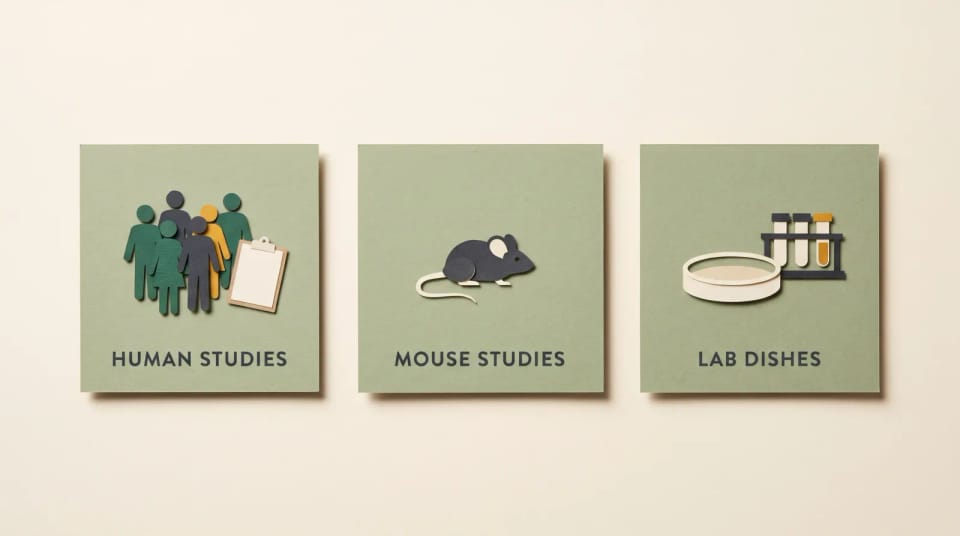
The four-fold melatonin rise came from mice given CBN. The enzyme-blocking results came from lab dishes. The human evidence for THC plus melatonin is a single 10-person abstract.
When should you talk to a pharmacist or clinician?
Talk to a pharmacist or prescriber before adding melatonin or cannabis if you take any prescription medicine, and especially if you take:
- Blood thinners or anti-seizure medicines. NCCIH says people with epilepsy and people taking blood thinners need medical supervision when taking melatonin. NCCIH
- Other sleep aids, sedating antihistamines, anxiety medicines, opioids or alcohol, since sedation can add up.
- Psychiatric medicines, or anything your pharmacist has flagged as cleared by the liver enzyme CYP1A2.
See a clinician about the sleep problem itself if it lasts for weeks, if you snore loudly or stop breathing at night, if you fall asleep during the day without meaning to, or if you need something every night to sleep at all. Those can be signs of a sleep disorder that needs its own assessment, and research does not suggest melatonin or cannabis is a fix for one. Our lesson on what the insomnia trials actually tested shows why cannabis products are not a substitute for that conversation.
Bring a plain list: every supplement and cannabis product, the form (gummy, flower, vape, oil), and roughly when you use it. If you already log sessions in the High IQ app, its notes on how a strain worked can help you describe your nights accurately, but they are a memory aid, not a diagnosis.
Sources
-
Anderson LL, Hawkins NA, Yip KL, Udoh M, Kearney JA, Arnold JC. “Preclinical evidence for a drug-drug interaction between cannabinol and melatonin.” Basic & Clinical Pharmacology & Toxicology. 2025;136(1). DOI: 10.1111/bcpt.14120
-
Naranjo MP, Camargo F, Rao JS, et al. “Pharmacokinetic effects of THC and melatonin co-administration in elderly population.” Alzheimer’s & Dementia. 2025;20(Suppl 8):e095382. Conference abstract. DOI: 10.1002/alz.095382
-
Zheng B, Wang M, Zhang Q, et al. “Unraveling cannabidiol’s bidirectional regulation of melatonin pharmacokinetics via PEPT1/CYP1A2.” Pharmaceuticals. 2025;19(1):80. DOI: 10.3390/ph19010080
-
Cohen PA, Avula B, Wang YH, Katragunta K, Khan I. “Quantity of melatonin and CBD in melatonin gummies sold in the US.” JAMA. 2023;329(16):1401-1402. DOI: 10.1001/jama.2023.2296
-
National Center for Complementary and Integrative Health. “Melatonin: what you need to know.” Updated May 2024. NCCIH fact sheet
-
Yamaori S, Kushihara M, Yamamoto I, Watanabe K. “Characterization of major phytocannabinoids, cannabidiol and cannabinol, as isoform-selective and potent inhibitors of human CYP1 enzymes.” Biochemical Pharmacology. 2010;79(11):1691-1698. DOI: 10.1016/j.bcp.2010.01.028
-
Nasrin S, Watson CJW, Perez-Paramo YX, Lazarus P. “Cannabinoid metabolites as inhibitors of major hepatic CYP450 enzymes, with implications for cannabis-drug interactions.” Drug Metabolism and Disposition. 2021;49(12):1070-1080. DOI: 10.1124/dmd.121.000442
-
Ma X, Idle JR, Krausz KW, Gonzalez FJ. “Metabolism of melatonin by human cytochromes P450.” Drug Metabolism and Disposition. 2005;33(4):489-494. DOI: 10.1124/dmd.104.002410
-
Ried K, Tamanna T, Matthews S, Sali A. “Medicinal cannabis improves sleep in adults with insomnia: a randomised double-blind placebo-controlled crossover study.” Journal of Sleep Research. 2023;32(3):e13793. DOI: 10.1111/jsr.13793
-
Bowles NP, Herzig MX, Shea SA. “Recent legalization of cannabis use: effects on sleep, health, and workplace safety.” Nature and Science of Sleep. 2017;9:249-251. DOI: 10.2147/NSS.S152231
-
Palmieri G, Vadala M, Corazzari V, Palmieri B. “Insomnia treatment: a new multitasking natural compound based on melatonin and cannabis extracts.” Clinica Terapeutica. 2022;173(1):91-96. PMID: 35147654
-
Saleska JL, Bryant C, Kolobaric A, et al. “The safety and comparative effectiveness of non-psychoactive cannabinoid formulations for the improvement of sleep.” Journal of the American Nutrition Association. 2024;43(1):1-11. DOI: 10.1080/27697061.2023.2203221
-
Kolobaric A, Saleska J, Hewlings SJ, et al. “A randomized, double-blind, placebo-controlled trial to assess the effectiveness and safety of melatonin and three formulations of Floraworks proprietary TruCBN for improving sleep.” Pharmaceuticals. 2024;17(8):977. DOI: 10.3390/ph17080977
-
Sateia MJ, Buysse DJ, Krystal AD, Neubauer DN, Heald JL. “Clinical practice guideline for the pharmacologic treatment of chronic insomnia in adults: an American Academy of Sleep Medicine clinical practice guideline.” Journal of Clinical Sleep Medicine. 2017;13(2):307-349. DOI: 10.5664/jcsm.6470
-
Ferracioli-Oda E, Qawasmi A, Bloch MH. “Meta-analysis: melatonin for the treatment of primary sleep disorders.” PLoS One. 2013;8(5):e63773. DOI: 10.1371/journal.pone.0063773
-
Choi K, Lee YJ, Park S, Je NK, Suh HS. “Efficacy of melatonin for chronic insomnia: systematic reviews and meta-analyses.” Sleep Medicine Reviews. 2022;66:101692. DOI: 10.1016/j.smrv.2022.101692
-
Cruz-Sanabria F, Bruno S, Crippa A, et al. “Optimizing the time and dose of melatonin as a sleep-promoting drug.” Journal of Pineal Research. 2024;76(5):e12985. DOI: 10.1111/jpi.12985
-
Suraev A, McCartney D, Marshall NS, et al. “Evaluating possible ‘next day’ impairment in insomnia patients administered an oral medicinal cannabis product by night: a pilot randomized controlled trial.” Psychopharmacology. 2024;241(9):1815-1825. DOI: 10.1007/s00213-024-06595-9
-
Suraev A, McGregor IS, McCartney D, et al. “Acute effects of oral cannabinoids on sleep and high-density EEG in insomnia: a pilot randomised controlled trial.” Journal of Sleep Research. 2026;35(1):e70124. DOI: 10.1111/jsr.70124
-
Nicholson AN, Turner C, Stone BM, Robson PJ. “Effect of delta-9-tetrahydrocannabinol and cannabidiol on nocturnal sleep and early-morning behavior in young adults.” Journal of Clinical Psychopharmacology. 2004;24(3):305-313. DOI: 10.1097/01.jcp.0000125688.05091.8f
-
McCartney D, Suraev A, McGregor IS. “The ‘next day’ effects of cannabis use: a systematic review.” Cannabis and Cannabinoid Research. 2023;8(1):92-114. DOI: 10.1089/can.2022.0185
-
Grotenhermen F. “Pharmacokinetics and pharmacodynamics of cannabinoids.” Clinical Pharmacokinetics. 2003;42(4):327-360. DOI: 10.2165/00003088-200342040-00003
-
Stout SM, Cimino NM. “Exogenous cannabinoids as substrates, inhibitors, and inducers of human drug metabolizing enzymes: a systematic review.” Drug Metabolism Reviews. 2014;46(1):86-95. DOI: 10.3109/03602532.2013.849268
Key takeaways
- No trial has tested melatonin and THC or flower together for sleep or next-morning effects.
- The only human THC plus melatonin data is a 10-person industry abstract with no comparison group.
- The four-fold melatonin rise is CBN in mice; the CBD 12-fold figure is a model’s worst case.
- Melatonin’s sleep benefit is small, and many gummies do not match their labels.
- Ask a pharmacist before combining either with prescription medicines or other sedatives.
FAQ
Can you take melatonin and THC together?
No study has tested whether it is safe or useful to take melatonin and THC together. The only human data is a 10-person abstract in older adults with Alzheimer’s disease, with no sleep outcome. Each one can cause drowsiness alone, so the effects may add up. If you take other medicines, ask a pharmacist first.
Does marijuana affect melatonin levels?
Possibly, but the evidence is weak. One 29-person trial found midnight saliva melatonin rose on a THC and CBD oil compared with placebo, but the authors reported a period effect and loss of blinding. A widely quoted 2017 sentence saying cannabis raises melatonin comes from a short commentary, not a measurement.
Is melatonin better than weed for sleep?
No trial has compared melatonin with THC or flower head to head. Melatonin’s benefit in adults is small, roughly minutes of faster sleep onset in one meta-analysis and no significant effect for adult chronic insomnia in another. Trials have compared melatonin with CBD and with CBN, and found no significant differences.
What about mixing melatonin and CBD?
The evidence is still thin. A 20-person open-label report with no control group described better sleep scores with melatonin and CBD drops. A large trial found melatonin and CBD capsules performed similarly. Separately, CBD raised melatonin exposure in dogs, and a model projected a possible worst-case rise in humans, which no one has measured.
Will melatonin and weed make me groggy the next day?
Nobody has measured next-morning effects for the pair. THC-alone trials disagree: a recent 20-person pilot found almost no objective next-day impairment, while an older 8-person trial found memory effects the next morning. Melatonin can cause sleepiness on its own. If you feel foggy, do not drive until it clears.



