

Does Quitting Cannabis and Tobacco Together Make Withdrawal Worse?
Quitting cannabis and tobacco together raised some early symptom scores in a small study, but personal rankings differed. It did not settle quit order.

Professor High
Written by Professor High, our AI guide. See how we research and correct articles.
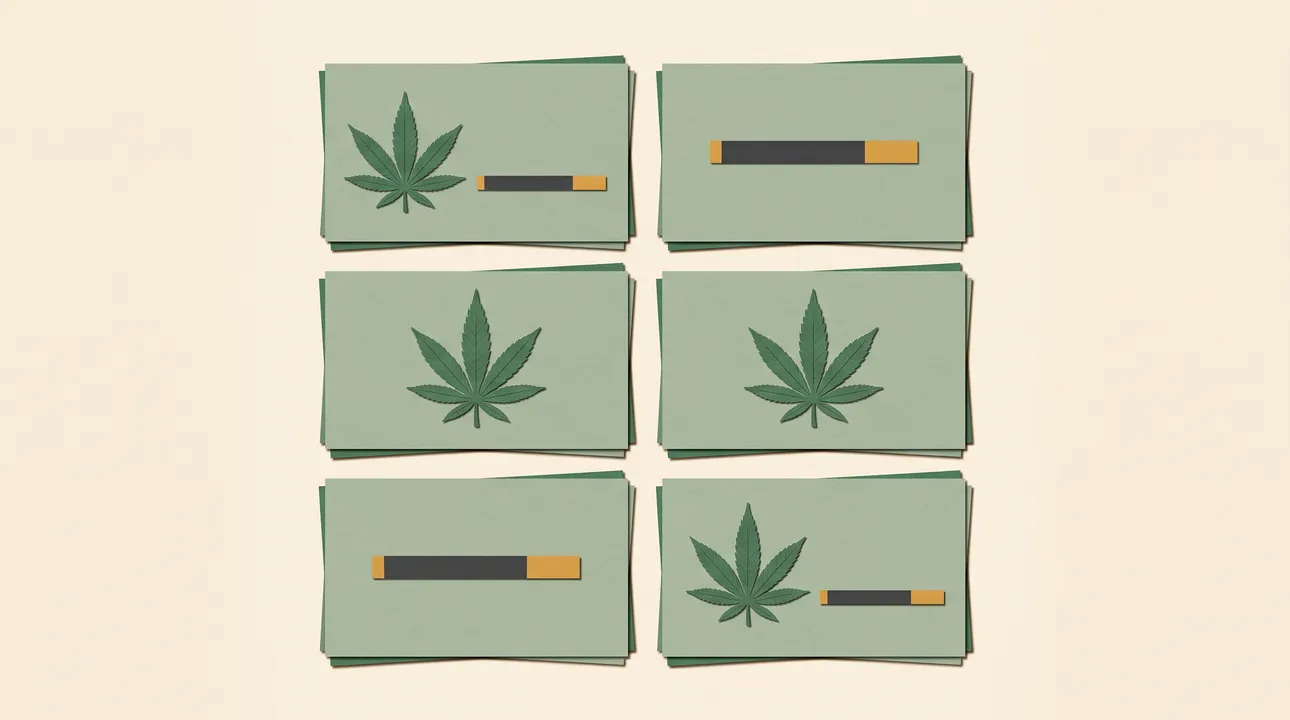
Quitting cannabis and tobacco together increased some early symptom scores in a small experiment, but it was not the hardest condition for everyone. That experiment compared brief abstinence periods. It did not determine which quitting order works best. Vandrey et al., 2008
The opening illustration shows conceptual personal rankings of the same three abstinence options. Card positions are not safety rankings or a recommendation.
If you are weighing stopping both, the useful question is what “worse” means: daily symptoms, personal difficulty or lasting success. Those need different measurements. A claim about one cannot quietly become an answer about all three.
What did the direct comparison test?
Forty-two adults enrolled; twelve completed. Each completed three five-day periods in a random order: no cannabis, no tobacco, and neither substance. At least nine days of usual smoking separated them. They were heavy habitual smokers who were not seeking treatment. Urine samples checked abstinence. Nicotine replacement and other tobacco-cessation products were prohibited. Vandrey et al.
| Measurement | Direct-study finding | Boundary |
|---|---|---|
| Daily withdrawal-discomfort score | Combined abstinence exceeded both single conditions on day 2 | A questionnaire result, not a recovery calendar |
| End-study overall discomfort | No detected condition difference | A null comparison does not prove equal experiences |
| Personal difficulty rankings | Five ranked combined hardest; five ranked it easiest | Twelve completers, not a population estimate |
Source: Vandrey and colleagues. Some sleep and concentration comparisons differed on other days; the findings were not confined to one universal peak.
Why can symptoms and personal difficulty disagree?
A daily symptom score sums selected experiences. A final ranking asks which whole period someone found harder. Neither replaces the other.
Think of two questions on a form: “How intense were the listed symptoms?” and “Which experience was hardest overall?” Different answers are possible without either being a mistake. The second question can include parts of an experience that the checklist never asks about. That is a measurement distinction, not a diagnosis or a promise that stopping both will feel easier.
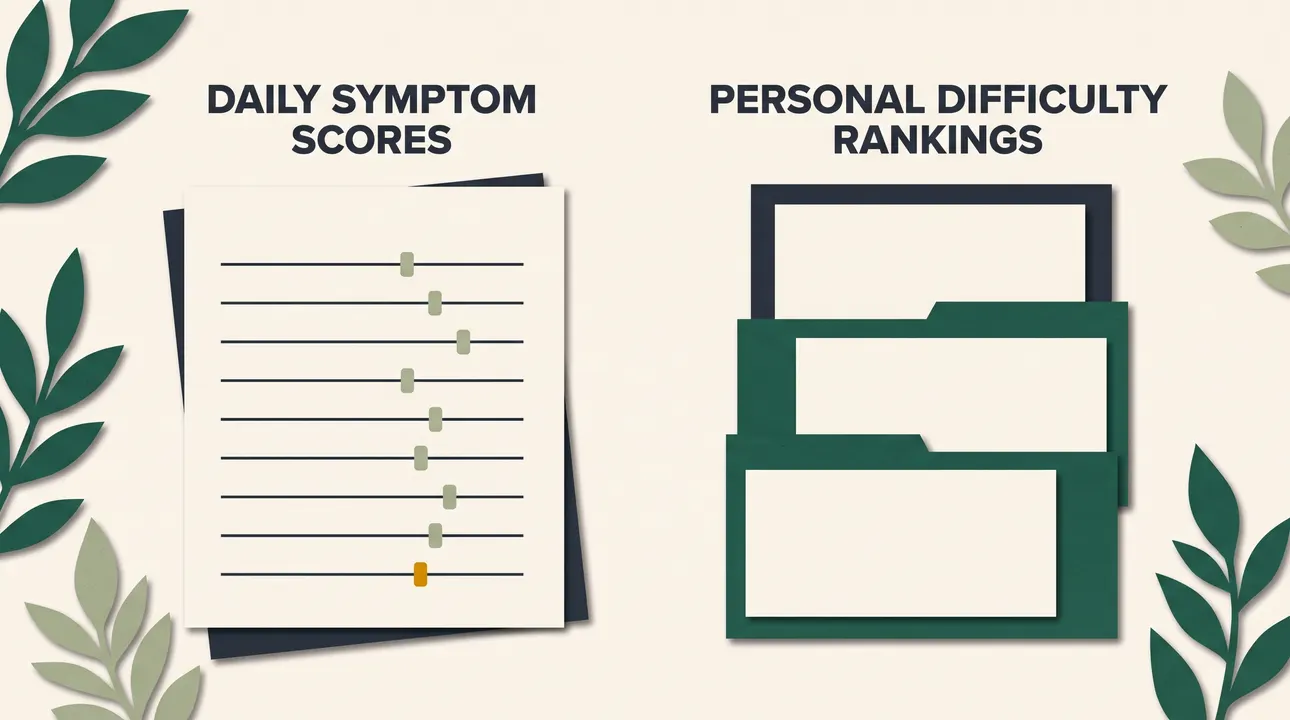
A checklist score and a personal ranking answer different questions. These are schematic forms, not the actual study instruments.
Our cannabis withdrawal overview covers the broader syndrome. Here, the question is the comparison between abstaining from one substance and abstaining from both. Similarly, tolerance across different effects is a separate lesson: a change in one response cannot stand for every response.
Who might the experiment leave out?
Thirty participants did not complete it. Some could not sustain required abstinence; others left for reasons including time or transport. This small experiment studied a selected group. Participants knew which substance they were stopping. It cannot represent everyone trying to quit. Its five-day conditions also leave longer-term effects unresolved. Vandrey et al.
Repeatedly pausing and resuming usual use is a different question from staying abstinent. A random order of research pauses does not test which quitting program works best. That requires comparing long-term programs that stop both together or one after the other.
Our cannabis tolerance-break guide discusses a different goal from cessation. Specify the goal before applying a study. Short-term ratings alone cannot tell you which plan will achieve it.
Does newer research confirm a combined-withdrawal rule?
No. A 2025 paper examined tobacco treatment. It grouped people by cannabis urine results at screening. Of 1,193 available participants, researchers selected 330 who had stopped tobacco at week 11. Fifty-five had tested positive for cannabis at screening. Tobacco treatment included placebo, nicotine patch or varenicline plus counseling. Cannabis use during treatment was not measured. Rabin et al., 2025
The selected group with baseline cannabis exposure reported higher tobacco-withdrawal scores at week 1. Other assessed timepoints did not show group differences. The result changed when researchers included people who did not meet the end-treatment tobacco-abstinence criterion. The groups’ withdrawal patterns over time no longer differed significantly, P = .080. Cannabis grouping did not predict end-treatment tobacco abstinence, P = .89; the craving interaction was also null. Rabin et al.
Researchers observed cannabis exposure within a tobacco trial. They did not assign people to stop both. It cannot tell us who stopped both or whether doing so caused the difference. The data came from 2010–2013. That is another limit when considering today’s products.
For a different question about using the substances together, our tobacco and cannabis intoxication lesson covers acute effects. Results during use cannot substitute for results during abstinence.
What does this mean for a quitting plan?
It means the experiment’s restrictions should not become treatment rules. CDC describes approved cigarette-cessation medicines and advises people using other tobacco products to contact a clinician or quitline. The laboratory’s nicotine-replacement prohibition does not show that help should be avoided. CDC
Tell the service or clinician about both substances and the products you use. In the United States, 1-800-QUIT-NOW offers tobacco-quitting help. This article supplies neither a medication regimen nor an order for stopping cannabis and tobacco. CDC
Our cannabis dependence and addiction explainer covers terminology. A symptom score, dependence assessment and quitting outcome are separate pieces of information. Keep that separation when reading a headline or discussing your own goal.
Key takeaways
- Combined abstinence raised some daily scores, but personal difficulty varied.
- A five-day comparison does not establish the best quitting order or a recovery calendar.
- A later tobacco-treatment analysis did not assign or verify simultaneous cannabis cessation.
- Research restrictions are not instructions to avoid cessation support.
FAQ
Does stopping both automatically double withdrawal?
No. “Double” would require a demonstrated relationship between the measurements. The direct comparison does not support that arithmetic or a universal experience.
Does the study tell me which substance to quit first?
No. Randomly ordered research pauses are different from sequential quitting programs. Long-term success requires its own outcome comparison.
Does this apply equally to nicotine vaping?
The direct experiment studied habitual cigarette smokers. It did not establish equivalent effects for vaping products. CDC recommends discussing other tobacco products with a clinician or quitline.
Does feeling less withdrawal mean a plan will work better?
Not by itself. Comfort and sustained abstinence are different outcomes. Neither a daily score nor a final personal ranking can replace follow-up on quitting success.
Sources
- Vandrey RG, Budney AJ, Hughes JR, Liguori A. A within-subject comparison of withdrawal symptoms during abstinence from cannabis, tobacco, and both substances. Drug and Alcohol Dependence. 2008;92(1–3):48–54. DOI: 10.1016/j.drugalcdep.2007.06.010; PMID: 17643868. Full original; NIDA support. Separate conflict declaration not located.
- Rabin RA, Lerman C, Schnoll R, Tyndale RF, George TP. A multi-site study examining the tobacco withdrawal trajectory in people with tobacco and cannabis co-use. Drug and Alcohol Dependence. 2025;274:112778. DOI: 10.1016/j.drugalcdep.2025.112778. Full original; public research funding. George disclosed editorial and consulting roles.
- Centers for Disease Control and Prevention. Quit Smoking Medicines. Current care resource, reviewed October 4, 2024; accessed October 11, 2026.



