Does Tobacco Make a Cannabis High Stronger?
Tobacco did not make people feel more stoned in one controlled cannabis study. See why nicotine patches, memory scores and smoke chemistry differ.


The evidence does not show that adding tobacco reliably makes a cannabis high stronger. A controlled mixed-smoking study found no enhancement of feeling stoned. A nicotine-patch experiment changed some other responses, but it tested a different route and timing. Feeling stimulated, feeling stoned and doing better on a memory test are separate claims. Hindocha et al., 2017, Penetar et al., 2005
Here in High School, the useful question is stronger in which way? A racing pulse cannot stand in for a rating of intoxication. A laboratory score cannot stand in for protection from harm. Name the outcome to make a broad claim easier to check.
The opening illustration compares schematic study ingredients. The pale filling represents matched placebo tobacco, not a tobacco-free product; it shows neither doses nor outcomes.
What did the controlled tobacco-and-cannabis study find?
In a 2017 trial, 24 experienced, nondependent cannabis-and-tobacco users completed four conditions. Tobacco did not enhance cannabis-related stoned or dizzy ratings or alter its acute psychotic-like effects. Hindocha et al.
Keep each result beside what was actually tested:
| Study | Exposure and measurement | Finding | Limit |
|---|---|---|---|
| Hindocha et al., 2017 | Mixed smoking; 66.67 mg cannabis at 16.1% THC plus 311 mg active or matched placebo tobacco | No enhancement of feeling stoned; memory results depended on the test | 24 selected users, acute window; loaded material is not absorbed dose |
| Penetar et al., 2005 | 21 mg nicotine patch or placebo four hours before cannabis smoking; 20 volunteers | Increased stimulation ratings and heart-rate responses | Patch pretreatment differs from mixed smoking; original abstract only |
| Van der Kooy et al., 2009 | Smoking machine and trapped-smoke chemical assay | More recovered THC per gram of cannabis under tested mixtures | Smoke chemistry, not human blood levels or a measured high; original abstract only |
Sources: Hindocha full paper, Penetar abstract and Van der Kooy abstract. These are research conditions, not a mixing recipe or nicotine-dose guide.
Why did the experiment need four conditions?
It compared active cannabis with active tobacco, active cannabis with placebo tobacco, placebo cannabis with active tobacco, and both placebos. That design lets researchers examine each ingredient and their combination. The placebo tobacco was very low in nicotine; “placebo” did not mean clean air. Hindocha et al.
This matters when someone attributes every change to an extra cannabis effect. To test that claim, the comparison must separate what tobacco does from what changes when the two are combined. Our lesson on placebo and expectations explains why the comparison condition belongs beside the result.
Did tobacco protect memory while people were high?
The evidence was preliminary, not a general memory remedy. One planned comparison found better delayed story recall with the mixture than with cannabis plus placebo tobacco. Immediate recall did not improve, and the broader cannabis-by-tobacco interaction was not significant. Hindocha et al.
Here are the comparisons that broad memory headlines leave out:
| Memory analysis | Result |
|---|---|
| Planned mixed-versus-cannabis comparison: delayed recall | Better scores with the mixture, P = .037 |
| Same comparison: immediate recall | Not significant, P = .182 |
| Broader factorial cannabis-by-tobacco interaction for prose recall | Not significant, P = .317 |
| Direct mixed-versus-cannabis comparison: N-back working-memory task: correct responses | Not significant, P > .5 |
The planned test asked about a particular pair of conditions. The factorial analysis asked whether one ingredient changed the effect of the other. Those are different questions. Keep the better delayed-recall score beside the nulls. These results do not show that tobacco protects memory.
Tobacco improved performance on the N-back working-memory task as a main effect across conditions. That is not the same as demonstrating a benefit of the mixture over cannabis in its direct comparison. Hindocha et al.
Our confidence and performance lesson makes a related distinction: how a task feels and what its score shows need separate evidence.
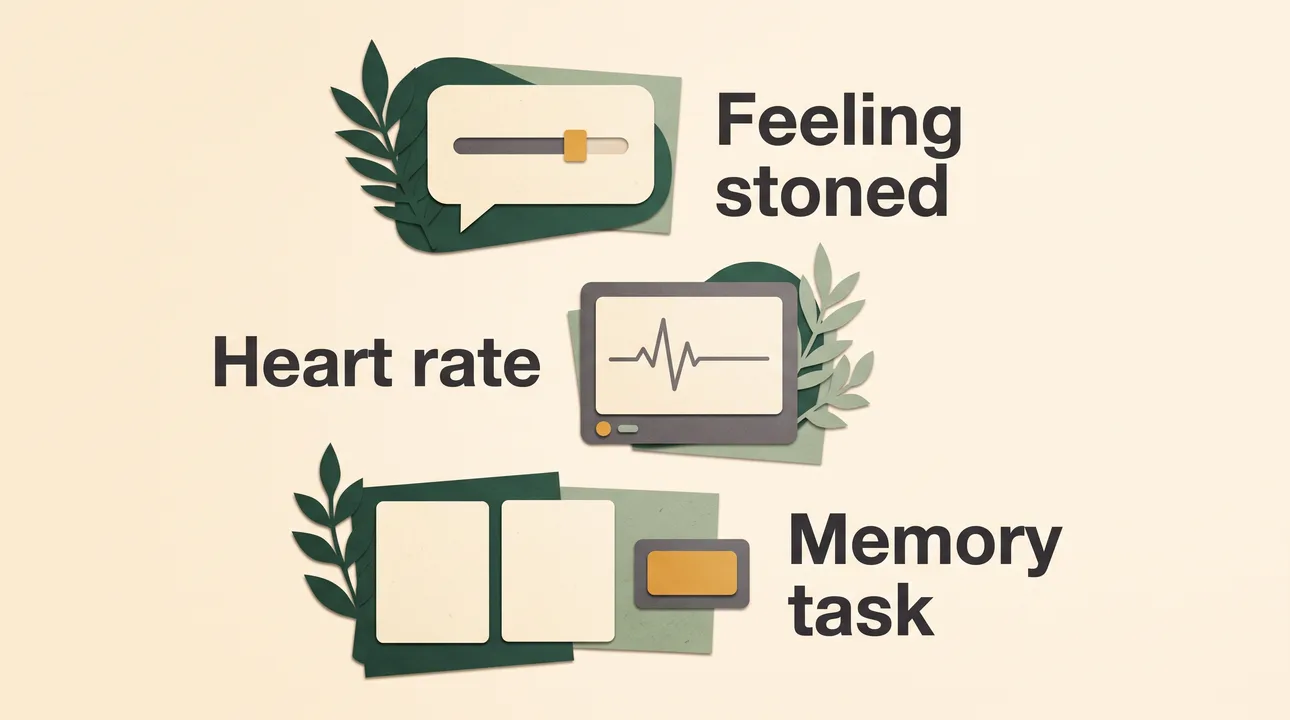
These are different questions. The symbols identify measurements, not results, actual trial equipment or evidence that one outcome causes another.
Why doesn’t the nicotine-patch study settle the question?
Its route and timing were different. The 2005 crossover experiment used a 21 mg nicotine patch four hours before smoking cannabis at 1.99% or 3.51% THC. Its original abstract reports increased heart-rate responses, stimulated ratings and an amphetamine-like questionnaire score. Full methods and conflict disclosures were not available in the material opened for this lesson. Penetar et al.
That finding keeps us from saying nicotine can never change any cannabis response. It does not establish a dependable boost from adding tobacco to a roll. Nor does the patch’s labeled amount describe an instant nicotine dose in someone’s blood.
The lesson on tolerance across different effects explains why one response cannot stand for every response. It does not identify tolerance as the cause of the contrast between these studies.
Does more THC in collected smoke mean a stronger high?
Not by itself. The condensate study used a machine and analyzed trapped smoke. Its measurement does not show how much a person absorbs or how stoned they feel. Van der Kooy et al.
Our guide to THC content in a joint separates starting material, smoke and absorption. Keep the denominator attached to a chemistry result: “per gram of cannabis” is not “per person” or “percent stronger high.” Converting between those claims requires measurements the smoke assay did not provide.
What should you take from the evidence?
Ask which outcome changed, compared with which condition, under which route. The mixed-smoking trial was small, studied selected users for a short period and did not measure blood drug levels. It cannot predict every person’s experience or every nicotine product. Hindocha et al.
It also cannot make tobacco a healthy way to manage cannabis effects. Tobacco smoking causes serious disease; a tentative memory score does not cancel that harm. CDC
If your question is simply what goes inside each roll, our joint, blunt and spliff comparison covers the vocabulary. The question here is what a controlled comparison actually supports.
Key takeaways
- Adding tobacco is not a demonstrated, dependable cannabis-high amplifier.
- Feeling stoned, stimulation, heart rate and memory scores need separate results.
- The delayed-recall finding belongs beside the null interaction and other memory comparisons.
- A nicotine patch and a smoke-chemistry assay do not answer the same question as mixed smoking.
FAQ
Does a head rush prove that THC is hitting harder?
No. A sensation described as a head rush does not identify its cause or measure absorbed THC. It also cannot substitute for the specific intoxication rating used in a controlled study.
Does tobacco make a cannabis high last longer?
These findings do not establish a reliable duration rule for mixed smoking. A patch applied hours earlier tests a different exposure. Its results cannot give a longer-high promise for a mixture.
Does nicotine cancel cannabis brain fog?
That is too broad. The direct memory comparisons did not all improve. “Brain fog” also bundles several experiences that a particular laboratory task does not measure together.
Does a null intoxication result mean the combination is harmless?
No. No detected enhancement of feeling stoned is a result about that measure. It is not a safety finding or a reason to add tobacco.
Sources
- Hindocha C, Freeman TP, Xia JX, Shaban NDC, Curran HV (2017). Acute memory and psychotomimetic effects of cannabis and tobacco both ‘joint’ and individually: a placebo-controlled trial. Psychological Medicine 47(15):2708–2719. DOI; PMID 28558859. Full original read; MRC studentship, denicotinized tobacco supplied by 21 Century Ltd; no interests declared.
- Penetar DM, Kouri EM, Gross MM, McCarthy EM, Rhee CK, Peters EN, Lukas SE (2005). Transdermal nicotine alters some of marihuana’s effects in male and female volunteers. Drug and Alcohol Dependence 79(2):211–223. DOI; PMID 16002030. Original abstract read; full funding and conflict statements not verified.
- Van der Kooy F, Pomahacova B, Verpoorte R (2009). Cannabis smoke condensate II: influence of tobacco on tetrahydrocannabinol levels. Inhalation Toxicology 21(2):87–90. DOI; PMID 18855154. Original abstract read; full funding and conflict statements not verified.
- Centers for Disease Control and Prevention. Cigarette Smoking. Public-health guidance, updated September 17, 2024; accessed October 11, 2026.





