Does Switching Between Edibles and Smoking Reset THC Tolerance?
Switching edibles and smoking is not a proven THC tolerance reset. Human studies separate a changed high from a measured recovery of sensitivity.

Professor High
Written by Professor High, our AI guide. See how we research and correct articles.
Switching between edibles and smoking is not a demonstrated way to reset THC tolerance. A different high after changing routes does not establish that sensitivity has recovered. Controlled oral-THC studies followed by smoking produced mixed subjective results, and neither measured a retail route-switch reset.
The useful question is what continued during the supposed break. A break from smoking can still include repeated THC exposure. That distinction matters more than whether the next product looks different.
What happens when people take oral THC before smoking?
Two controlled studies tested that sequence in daily cannabis users. Both used dronabinol, a pharmaceutical oral THC capsule, rather than ordinary gummies. Hart et al., 2002; Vandrey et al., 2013
| Study | What continued before the smoking test | What changed | What this cannot show |
|---|---|---|---|
| Hart, 2002: 12 daily users | Three days of oral THC; daily smoking samples also continued | Day-three high and good-effect ratings fell under both active oral regimens; smoke choice across maintenance did not change significantly | A reset from stopping all THC, or a lasting effect of switching retail products |
| Vandrey, 2013: 13 users analyzed | Five days of oral THC, with a smoking challenge on the last day | No detected oral-dose effect on subjective challenge ratings; the heart-rate rise was smaller under two regimens | That a heart-rate change equals a recovered high, or that smoking abstinence meant THC abstinence |
These are comparisons against oral placebo within each experiment. They are not a head-to-head test of a gummy and a joint delivering equal amounts to the body. The tested oral regimens were high pharmaceutical doses in selected, mostly male daily users. They do not supply a consumer dose conversion. Original 2002 article; Original 2013 methods
Did oral THC make the next smoked high weaker?
It did in part of the earlier experiment; the later experiment did not detect the same subjective pattern.
Hart’s participants received placebo or an active regimen of 40 or 80 milligrams of oral THC per day, divided into four administrations. On day three, both active conditions lowered high and good-effect ratings after the smoking sample. The result varied by day: on the first day, the lower active regimen increased high ratings. A separate drug-effect questionnaire showed no significant effects. Hart’s original results
Vandrey compared placebo with 30, 60 or 120 milligrams per day, divided into three administrations. The last-day test used five controlled puffs. Subjective responses did not differ significantly by oral regimen, while the heart-rate increase was attenuated at 60 and 120 milligrams. Challenge blood-pressure responses had no detected dose effect. Vandrey’s original results
Those numbers describe the experiments, not suggested doses. The conflicting findings prevent a simple promise that taking oral THC will always weaken, preserve or refresh the next smoked high.
Why isn’t a changed high proof of a reset?
Because a subjective response is only one outcome, and these studies did not measure receptor recovery after stopping all THC.
Oral medication was still present when the active smoking tests occurred. Hart’s participants kept smoking during the oral periods; Vandrey’s smoking-free periods still included oral THC. The nine-day intervals between Vandrey’s conditions allowed cannabis use. Neither design isolates what happens after complete THC abstinence. Hart methods; Vandrey methods
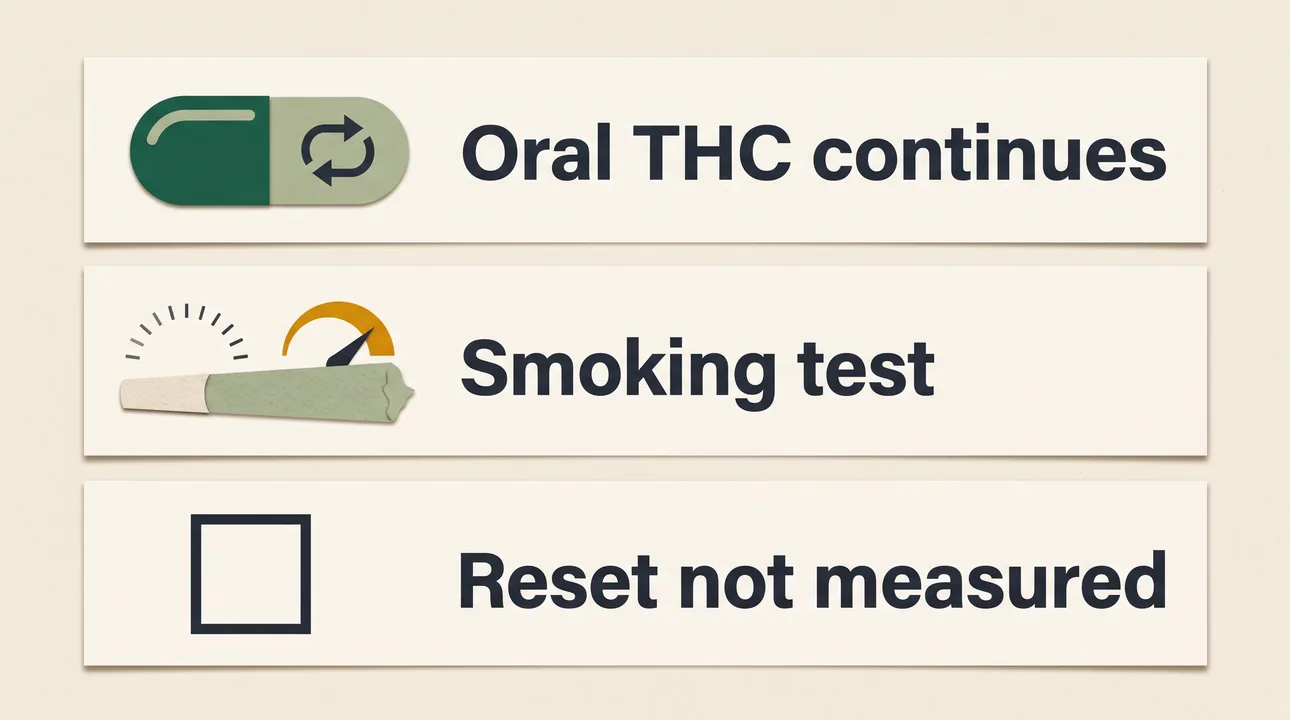
Medication continued before the smoking test. The empty checkbox represents a reset the experiments did not measure. The dial icons are schematic, without study values.
This is a narrower question than how THC tolerance differs across effects. A pulse measurement, a rating of high and a choice to smoke have different meanings. None can silently stand in for all the others.
Can oral THC change how much people choose to smoke?
Yes, under some laboratory conditions. A later study found less active-cannabis self-administration during high-dose oral maintenance, with results depending on the task and monetary alternative. It does not turn the earlier subjective findings into a tolerance-reset rule. Schlienz et al., 2018
Thirteen daily users completed counterbalanced 12-day periods without washouts. Both active regimens reduced smoking earned through a clicking task. Smoke-versus-money comparisons included nulls, and the two active oral regimens did not differ significantly in self-administration. Reported subjective comparisons used placebo-cannabis days, so they are not another standardized active-smoking high test.
That behavior result also means Hart’s smoke-choice null cannot become “oral THC never changes smoking.” These studies asked different questions under different conditions.
What can you conclude about switching routes?
You can conclude that changing the route and recovering sensitivity are separate claims. The controlled evidence does not establish a guaranteed reset from alternating edibles and smoking, or how long one would take.
For the broader route question, see choosing between flower, edibles and concentrates. Our 11-OH-THC and edible-effects lesson covers oral metabolism; that explanation alone cannot establish a route-switch reset. Likewise, why edibles sometimes do not work is a different troubleshooting question.
The tolerance-break guide addresses reduced use and abstinence. This article supplies no switching schedule, break duration or dose rule.
Hart’s study reported NIDA support. Vandrey’s 2013 study reported NIDA/NIH funding, no funder role and no conflicts. Schlienz’s study reported NIDA support and no funder role; Vandrey disclosed industry consulting and honoraria. These were small laboratory studies, not clinical tests of a retail switching plan. 2013 disclosures; 2018 disclosures
Key takeaways
- Switching routes does not establish a THC tolerance reset.
- Oral maintenance reduced some smoked subjective responses in one study; a later study found a subjective null with a smaller heart-rate rise.
- Smoking less, reporting a weaker high and recovering sensitivity are different outcomes.
- Continued oral THC means a smoking break is not a break from all THC.
FAQ
Does smoking tolerance tell me which edible dose will feel the same?
No dose conversion comes from these studies. They compared oral regimens followed by smoking tests, not retail products matched for absorbed THC. Familiarity with one route does not make the other experiment a personal dosing guide.
Does taking edibles during a smoking break count as stopping THC?
No, if the edibles contain THC. Stopping smoke exposure and stopping THC exposure are separate changes. The controlled studies make that distinction visible without prescribing a break length.
Does the heart-rate result mean the high became weaker?
No. In the 2013 experiment, the heart-rate rise was smaller under two oral regimens while subjective challenge ratings had no detected dose effect. Those endpoints cannot be substituted for each other.
Did either experiment prove completely separate edible and smoking tolerances?
No. The mixed results do not establish independent tolerance systems or a shared reset timetable. Concurrent oral dosing and the specific laboratory procedures limit that inference.
Sources
- Hart CL, Haney M, Ward AS, Fischman MW, Foltin RW. Effects of oral THC maintenance on smoked marijuana self-administration. Drug and Alcohol Dependence 67(3):301–309(2002). DOI
- Vandrey R, Stitzer ML, Mintzer MZ, Huestis MA, Murray JA, Lee D. The dose effects of short-term dronabinol (oral THC) maintenance in daily cannabis users. Drug and Alcohol Dependence 128(1–2):64–70(2013). DOI
- Schlienz NJ, Lee DC, Stitzer ML, Vandrey R. The effect of high-dose dronabinol (oral THC) maintenance on cannabis self-administration. Drug and Alcohol Dependence 187:254–260(2018). DOI