Why Don’t Edibles Work for Me? The ‘Ediblocked’ Myth
Edibles do nothing for you? Learn how timing, food, tolerance, product quality, and metabolism shape effects—and why the enzyme myth is unproven.

You ate the gummy. You waited. Your friend reorganized the universe from the couch while you reorganized the snack drawer, completely sober. If that keeps happening, the internet may call you “ediblocked”—someone who feels little or nothing from cannabis edibles.
The experience is real. The diagnosis is not.
There is no validated medical test for being ediblocked. Research has not proved that people who feel no edible effect are missing one particular liver enzyme. Several variables have better evidence. The product may contain less THC than expected. The clock may still be running. The serving may be unclear. Homemade cannabis may be poorly activated or mixed. Food, formulation, tolerance, and personal pharmacology can all change the response.
Key Takeaways
- “Ediblocked” is a nickname, not a diagnosis. No study has established a single syndrome or proved that a missing enzyme explains nonresponse.
- First rule out the ordinary explanations. Delayed onset, a mislabeled serving, low-potency or degraded product, homemade preparation errors, and tolerance are all more actionable than a genetics theory.
- Food can change the curve. A controlled trial found that a high-fat meal increased overall exposure to THC and 11-hydroxy-THC while also delaying the peak [Lunn et al., 2019]. That does not make “eat fat to get higher” a safe universal rule.
- Genes may contribute to variation, but the popular story runs ahead of the data. A small human CYP2C9 study found higher THC exposure in people with one slow-metabolizer genotype—not proof that a missing enzyme makes edibles ineffective [Sachse-Seeboth et al., 2009].
- Do not solve uncertainty with a giant dose. Oral THC can take up to four hours to reach its full effect, and delayed redosing is a common route to poisoning or serious distress.
What “Ediblocked” Usually Means
People use the word for several different experiences:
- No noticeable intoxication after a labeled THC edible.
- A faint or inconsistent response while friends feel much more from the same package.
- Smoking or vaping works, but swallowing THC does not seem to.
- One format works and another does not. A drink may register while a brownie does nothing, or a capsule may work while a gummy does not.
Those patterns are not interchangeable. One mystery brownie raises a product-and-dose question. Repeated weak effects from regulated products under consistent conditions raise a harder pharmacology question. Neither proves an enzyme deficiency. This is a troubleshooting map, not another beginner edible dosing chart or a guide to escalating dose.
Why Oral THC Is So Unpredictable
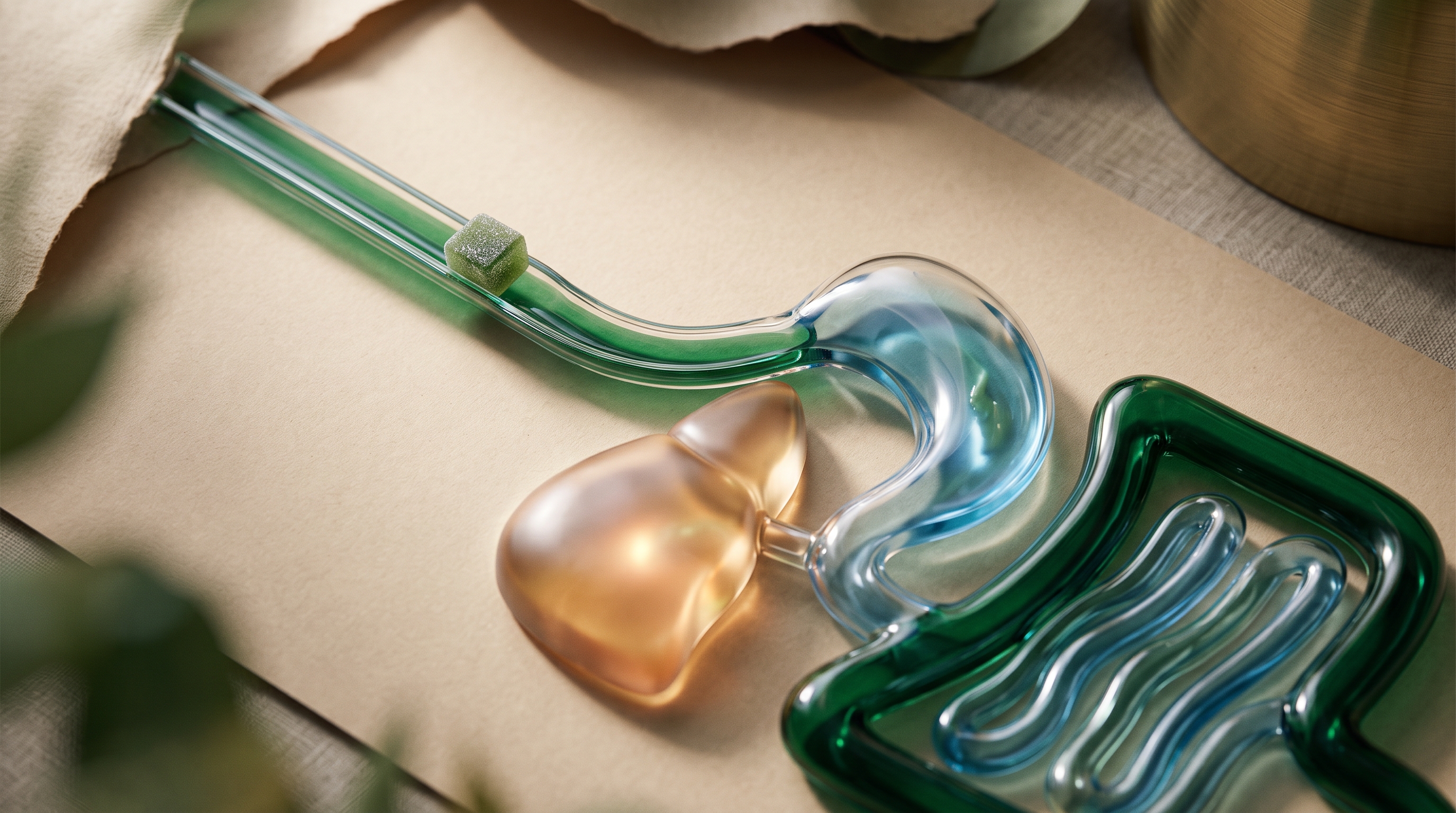
Inhaled THC crosses from the lungs into the bloodstream quickly. Swallowed THC takes the scenic route: it must leave the food or capsule, survive the digestive tract, cross the gut wall, and pass through the liver before much of it reaches systemic circulation. The liver converts some delta-9-THC into active 11-hydroxy-THC, the metabolite behind part of the distinctive edible experience. Our 11-hydroxy-THC explainer covers that route in detail.
A systematic review of 26 human oral-THC studies found delayed peak concentrations and high variability across capsules, tablets, oils, teas, cookies, and brownies. The authors concluded that oral THC has a highly variable pharmacokinetic profile and that baked goods and oils appeared especially variable [Poyatos et al., 2020].
In a controlled Johns Hopkins study, adults ate brownies containing 10, 25, or 50 milligrams of THC. Blood concentrations and subjective effects were related, but the dose-to-blood relationship was not a neat staircase: mean peak whole-blood THC at 25 and 50 milligrams was similar, despite the doubled labeled dose [Vandrey et al., 2017]. The study was small—six people per dose—and should not be used as a dosing calculator. It is a vivid demonstration that milligrams swallowed are not milligrams delivered to the brain.
That is why bioavailability comparisons provide ranges rather than a personal prediction.
Eight Reasons an Edible May Seem Not to Work
1. You judged it before the full effect arrived
Health Canada says eaten or drunk cannabis may begin to feel noticeable in 30 minutes to two hours, peak after two to four hours, and produce effects for four to eight hours. Its broader consumer guidance notes that some effects may last up to 12 hours and residual effects can persist longer. Food, medications, and product format can all alter the schedule.
This creates the classic edible trap: “nothing happened” becomes a second dose, then both doses arrive together. The two-hour rule is a useful minimum reminder, but it is not a guarantee that every person has reached the peak at exactly 120 minutes. Official guidance says full effects can take up to four hours.
If the first attempt happened during a busy event, the effect may also have been subtler than expected. Edibles do not always announce themselves with a dramatic wave. Attention, mood, environment, and expectations change what people notice.
2. The label or serving was misunderstood
“10 mg” can mean per piece, per serving, or per package. A chocolate bar may look like one object while containing several servings. A large packaging experiment found that many consumers struggled to identify a standard edible serving from the label [Goodman and Hammond, 2022].
Before blaming metabolism, read four separate numbers:
- total THC in the package
- THC per serving
- number of servings
- THC versus CBD in the product
A CBD-forward product may feel nothing like the THC experience someone expected. Products sold outside regulated systems add more uncertainty; do not assume every cannabinoid acronym is equivalent to tested delta-9 THC.
3. The product contained less active THC than expected
Label accuracy has improved in some regulated markets, but it is not universal. In a 2015 analysis of 75 edible products purchased from dispensaries in three US cities, only 17% were accurately labeled within the study’s tolerance; 60% contained less THC than the label claimed [Vandrey et al., 2015]. That study reflects particular products, cities, and an earlier market—not every licensed edible sold today. Still, it proves that “the package said so” is not perfect evidence of the swallowed dose.
Heat, light, air, moisture, and time can degrade a product or its food. Check the date, storage directions, seal, and signs of spoilage. Our edible shelf-life guide explains what to inspect. Never eat a questionable product just to test potency.
4. Homemade cannabis was not fully activated or evenly mixed
Raw cannabis contains much of its potential THC as THCA, which is not intoxicating in the same way. Heating drives decarboxylation toward THC. Too little heat can leave an infusion weak; too much can degrade compounds. Our decarboxylation science guide separates chemistry from kitchen folklore.
Even a well-decarboxylated infusion can be distributed unevenly. One corner of a pan may carry more cannabinoids than another. Arithmetic based on flower potency also assumes extraction and transfer efficiencies that a home kitchen cannot see. Use edible dosing math as an estimate, not laboratory truth, and read what at-home potency testing can and cannot establish.
If only one homemade batch “did nothing,” the batch is the leading suspect—not your genome.
5. Food and formulation changed absorption
THC is highly lipophilic—it associates with fats—and oral products do not all release it the same way. A gummy, oil-filled capsule, baked good, and emulsified drink may carry the same labeled milligrams but produce different concentration-time curves. Compare the practical differences in our gummies-versus-capsules guide and the formulation science behind fast-acting edibles. In a randomized crossover trial of 28 healthy adults, a high-fat meal increased overall exposure to both THC and 11-hydroxy-THC from capsules. It also delayed the time to peak [Lunn et al., 2019]. That result cannot predict whether a fatty meal would change one person’s response. It shows that meal conditions can alter both how much and when.
For troubleshooting, consistency is more informative than optimization. Note whether you took the same product under similar fed or fasted conditions. Do not combine a new edible, a new dose, and a radically different meal and then pretend you learned which variable mattered.
6. Tolerance muted the signal
Regular exposure to THC can reduce some effects. In a controlled study comparing 11 frequent and 10 infrequent cannabis users, frequent users reported less “feel drug” and sedation at a 15-milligram oral THC dose, consistent with tolerance, although responses also depended on dose [Kirk and de Wit, 1999]. Small sample, old study, useful clue—not a universal formula.
Tolerance can also be uneven. A person may recognize the rapid change from inhalation but overlook the slower curve of an edible. If frequent use is the likely explanation, escalating oral THC is not the cleanest or safest test. Learn how tolerance changes and what evidence supports in our cannabis tolerance-break guide.
7. Your individual pharmacology may be unusual
People differ in gastric emptying, gut absorption, liver function, body composition, age, sex-related physiology, medication use, and enzyme activity. Gastrointestinal or liver conditions could plausibly change oral drug handling. That does not mean an article can diagnose which factor applies to you.
Individual biology contributes to edible variability, but no validated test predicts a person’s response. If oral medications often behave unusually for you, you have digestive or liver disease, or cannabis is part of medical care, consult a clinician or pharmacist. Do not stop medication or conduct a high-dose challenge on your own. Cannabis can participate in clinically relevant medication interactions.
8. The format did not match the expected effect
Some products marketed as tinctures are swallowed immediately and behave like edibles. Others spend enough time under the tongue to allow some oromucosal absorption. Drinks may use emulsions designed for a different onset curve. Capsules must dissolve. A heavy meal can delay the timeline.
If one swallowed format seems unreliable, it does not prove all cannabis routes will behave identically. Our sublingual-versus-edible comparison explains why route labels can be fuzzier than they sound. That is information for comparing experiences—not permission to stack methods in one session.
The “Missing Liver Enzyme” Claim, Fact-Checked
Here is the viral version: Some people cannot get high from edibles because they lack the liver enzyme that converts THC into 11-hydroxy-THC. It sounds plausible because oral THC does undergo first-pass metabolism, and cytochrome P450 enzymes—including CYP2C9—help metabolize it.
The leap is everything after that.
A human study examined CYP2C9 variants in 43 healthy volunteers given oral THC. The CYP2C9*2 allele did not change THC pharmacokinetics. People with the rare *3/*3 genotype had a median THC area under the curve three times that of *1/*1 participants, lower levels of an inactive downstream metabolite, and a trend toward more sedation [Sachse-Seeboth et al., 2009]. In plain English, slower metabolism in that small group was associated with more THC exposure, not proven edible immunity.
That study did not recruit self-described “ediblocked” people, did not establish why anyone feels no high, and did not show that a missing enzyme blocks 11-hydroxy-THC formation. It tells us genetics can affect pharmacokinetics. It does not validate the meme.
There may be undiscovered genetic, enzymatic, transporter, microbiome, or absorption patterns behind persistent nonresponse. “May be” is the correct phrase. Until researchers compare carefully characterized nonresponders with responders, sequence relevant genes, measure THC and metabolites over time, and connect those measurements to subjective effects, the enzyme explanation remains a hypothesis—not a personal diagnosis.
A Safer Troubleshooting Checklist
The goal is to reduce uncertainty, not maximize intoxication.
- Confirm the product. Use a legal, regulated product where available. Check the cannabinoid, THC per serving, total package THC, date, seal, and storage directions.
- Avoid mystery batches. Do not use an unlabeled homemade edible to investigate your metabolism.
- Choose a low labeled dose appropriate to your experience and health guidance. Health Canada advises new or vulnerable consumers to look for 2.5 milligrams of THC or less. Lower may be appropriate for some people. More is not a diagnostic test.
- Change only one variable. Keep product, serving, meal conditions, location, and schedule as consistent as practical.
- Wait through the full window. Do not redose because nothing happened at hour one or two. Full effects may take up to four hours.
- Record, do not chase. Note product, labeled dose, time, food, medications, onset, perceived effects, and duration. The complete high-duration guide can help you define what to observe.
- Stop if the answer stays unclear. Repeatedly taking more is not responsible experimentation. Ask a clinician or pharmacist about health conditions, medications, and whether oral cannabis is appropriate for you.
When “Nothing Happened” Suddenly Becomes Too Much
Delayed onset is the reason this article refuses to recommend a giant test dose. If effects arrive late, stay somewhere safe, do not drive, do not operate machinery, and do not mix with alcohol or other intoxicants. Our guide to what to do when you are too high focuses on calm, practical harm reduction.
Call emergency services for trouble breathing, collapse or unresponsiveness, a seizure, severe chest pain, or behavior that creates immediate danger. In the United States, Poison Control is available at 1-800-222-1222. Call promptly for any child exposure; do not wait for symptoms. Cannabis products should remain locked, child-resistant, and out of sight and reach of children and pets. The CDC notes that children can become seriously ill after edible exposure.
The Professor High Verdict
If edibles repeatedly do little for you, you are not imagining it. You also do not need a dramatic enzyme story to make the experience legitimate.
Start with the boring variables because boring variables solve real mysteries: product, label, serving, preparation, storage, clock, meal, format, and tolerance. Then leave room for the honest scientific answer—human oral pharmacology varies, and we cannot yet explain every nonresponse.
Your safest next move is better information, not a bigger gamble. Track comparable experiences, read the label carefully, keep conditions consistent, and involve a healthcare professional when medications or health conditions enter the picture. “Ediblocked” may be a catchy label. It should never become a dare.
FAQs
Is being “ediblocked” a real medical condition?
No recognized diagnostic condition or validated test currently establishes that someone is ediblocked. The word describes a reported pattern—little or no perceived response to edibles. Product, timing, tolerance, absorption, metabolism, and expectations can all contribute.
Do some people lack the enzyme needed to process edibles?
That claim has not been proved. CYP enzymes help metabolize THC, and genetic variants can change THC exposure. But the available human pharmacogenetic evidence does not show that self-described nonresponders lack one enzyme or cannot form 11-hydroxy-THC.
Can eating fat make an edible work?
Food can change oral THC pharmacokinetics. One controlled capsule study found that a high-fat meal increased overall THC and 11-hydroxy-THC exposure and delayed the peak. That is not a guarantee, a dosing hack, or a reason to combine a larger dose with a heavy meal.
Does no effect mean the dose was too low?
Not necessarily. The product could be mislabeled, degraded, divided incorrectly, poorly prepared, delayed, or mismatched with expectations. Tolerance or individual biology may matter too. Do not infer the cause from one attempt or respond with an unusually large dose.
Why can smoking work when edibles do not?
The routes are different. Inhaled THC moves quickly from lungs to blood. Swallowed THC must be released from the product, absorbed through the gut, and processed by the liver. Each extra step adds variability. Smoking working normally does not identify which oral step differed.
Should I keep increasing the dose until I feel something?
No. Delayed effects can make repeated dosing unexpectedly intense, prolonged, and dangerous. Follow product and public-health guidance, wait through the full onset window, and talk with a clinician or pharmacist rather than using a high dose as a metabolic experiment.
Sources
- Poyatos, L., Pérez-Acevedo, A. P., Papaseit, E., et al. (2020). Oral Administration of Cannabis and Δ-9-tetrahydrocannabinol (THC) Preparations: A Systematic Review. Medicina (Kaunas), 56(6), 309. PubMed · DOI
- Vandrey, R., Herrmann, E. S., Mitchell, J. M., et al. (2017). Pharmacokinetic Profile of Oral Cannabis in Humans: Blood and Oral Fluid Disposition and Relation to Pharmacodynamic Outcomes. Journal of Analytical Toxicology, 41(2), 83–99. PubMed · DOI
- Lunn, S., Diaz, P., O’Hearn, S., et al. (2019). Human Pharmacokinetic Parameters of Orally Administered Δ9-Tetrahydrocannabinol Capsules Are Altered by Fed Versus Fasted Conditions and Sex Differences. Cannabis and Cannabinoid Research, 4(4), 255–264. PubMed · DOI
- Sachse-Seeboth, C., Pfeil, J., Sehrt, D., et al. (2009). Interindividual variation in the pharmacokinetics of Delta9-tetrahydrocannabinol as related to genetic polymorphisms in CYP2C9. Clinical Pharmacology & Therapeutics, 85(3), 273–276. PubMed · DOI
- Kirk, J. M., & de Wit, H. (1999). Responses to oral delta9-tetrahydrocannabinol in frequent and infrequent marijuana users. Pharmacology Biochemistry and Behavior, 63(1), 137–142. PubMed · DOI
- Vandrey, R., Raber, J. C., Raber, M. E., et al. (2015). Cannabinoid Dose and Label Accuracy in Edible Medical Cannabis Products. JAMA, 313(24), 2491–2493. PubMed · DOI
- Goodman, S., & Hammond, D. (2022). THC labeling on cannabis products: an experimental study of approaches for labeling THC servings on cannabis edibles. Journal of Cannabis Research, 4, 17. PubMed · DOI
Official guidance
Health Canada: Cannabis for medical purposes—using a cannabis product, updated January 22, 2026.
Centers for Disease Control and Prevention: Cannabis and Poisoning, updated February 15, 2024.
This article is educational and not medical advice. Cannabis laws vary. Avoid cannabis during pregnancy and breastfeeding, keep all products away from children and pets, never drive while impaired, and ask a healthcare professional about medications or health conditions.

