THC and CBD Patches: What Actually Gets Through Your Skin?
Do THC and CBD patches work? Explore human absorption studies, patch versus cream differences, and why labeled milligrams aren't a delivered dose.

Professor High
A cannabis patch looks reassuringly familiar. Peel, stick, get on with your day. The package lists milligrams, and the word transdermal makes it sound like the delivery problem has already been solved.
But here is the question to ask before comparing prices: how much of that cannabinoid actually gets through your skin?
THC and CBD can reach the bloodstream through some specially formulated skin products. That does not establish that every cannabis patch delivers its labeled contents, works for pain, or provides a predictable number of hours of relief. A patch is a product format; successful delivery requires evidence.
Let’s separate three questions that often get squeezed into one sales pitch: what is in the patch, what enters the body, and whether it helps the person wearing it.
Topical vs. transdermal: the packaging does not decide
Topical describes application to a body surface. In everyday cannabis shopping, it usually means a cream or balm intended for local use. Transdermal describes delivery through the skin into the systemic circulation—the blood that carries substances around the body.
A product can be applied topically and deliver a drug transdermally. A gel can be transdermal, while something shaped like a patch may not demonstrate meaningful blood delivery. FDA’s discussion of transdermal medicines includes both adhesive systems and gels. Its examples concern drug delivery technology, not an endorsement of cannabis patches. FDA transdermal research report
| What you see | What it tells you | What still needs evidence |
|---|---|---|
| Cream, lotion, or balm | Physical form and method of application | Where the cannabinoids go after application |
| Adhesive patch | A product stays against the skin | Whether cannabinoids cross into the blood |
| “Transdermal” on a label | The maker claims delivery through skin | Human absorption data for that formulation |
| A milligram amount | A stated quantity of cannabinoid | Whether it describes contents or delivered drug |
| A published clinical trial | Researchers studied a defined intervention | Whether your product matches that intervention |
For patches, resist turning a route category into one universal absorption percentage.
The surprising human patch study
In a 2024 study, Zamarripa and colleagues examined five retail hemp-derived CBD products in 46 healthy adults: cream, lotion, patch, balm, and gel, with matched placebo conditions. Seven participants received the active patch.
The tested patch and balm produced no detectable whole-blood concentrations of the six cannabinoids and metabolites measured at any study timepoint. CBD absorption was observed with the cream, lotion, and gel. A patch does not automatically deliver more than a lotion. Zamarripa, 2024
This small study cannot tell us that all patches fail. It tells us that this patch, under these study conditions and detection limits, did not demonstrate measurable blood delivery. Nor was it a clinical trial establishing pain relief.
The distinction matters when someone says, “Patches have been studied.” Ask which patch, which result, and which claim that result actually supports.
Yes, cannabinoids can cross skin—but check the formulation
A separate exploratory study used an experimental emulsion called Gefion GT4, applied to the skin. It was not a trial of an ordinary retail adhesive patch.
The study enrolled 18 healthy adults and used a single application containing 100 mg CBD and 100 mg THC. Both compounds were detected in circulation. Published online in 2022 and in a 2023 journal issue, the paper supports the possibility of transdermal cannabinoid delivery with that system. Varadi, 2023
There were important limits: no comparison group, substantial differences between participants, and blood sampling that stopped at 12 hours before fully capturing the concentration curve. No psychoactive effects were reported, but that small, short study cannot guarantee that other THC formulations will be non-intoxicating. The study was company-funded and included company-affiliated authors.
Think of it as an early engineering demonstration. It helps establish that a particular delivery approach can move cannabinoids across skin. It does not settle whether a different patch will deliver the same amount or improve a medical condition.
“20 mg in the patch” is not “20 mg delivered”
Imagine two hypothetical packages. Both say 20 mg CBD. One means the amount loaded into each patch. The other claims a measured amount delivered during a stated wear period. Those are different measurements, even when the number matches.
For a useful comparison, a label or supporting document should make the measurement explicit. Total content, release from the product, passage through skin, and blood exposure answer different questions. A laboratory content test does not become a human absorption study just because the product sticks to your arm.
FDA’s draft development guidance for transdermal and topical systems distinguishes a transdermal delivery rate, such as milligrams per day, from total drug load. It also discusses drug left in used systems. This is a useful way to understand the distinction; the document does not validate any cannabis patch’s delivery claim. FDA draft guidance
So avoid calculating a patch’s hourly dose by dividing the package’s total milligrams by its advertised wear time. The arithmetic may be tidy while the underlying assumption is unsupported.
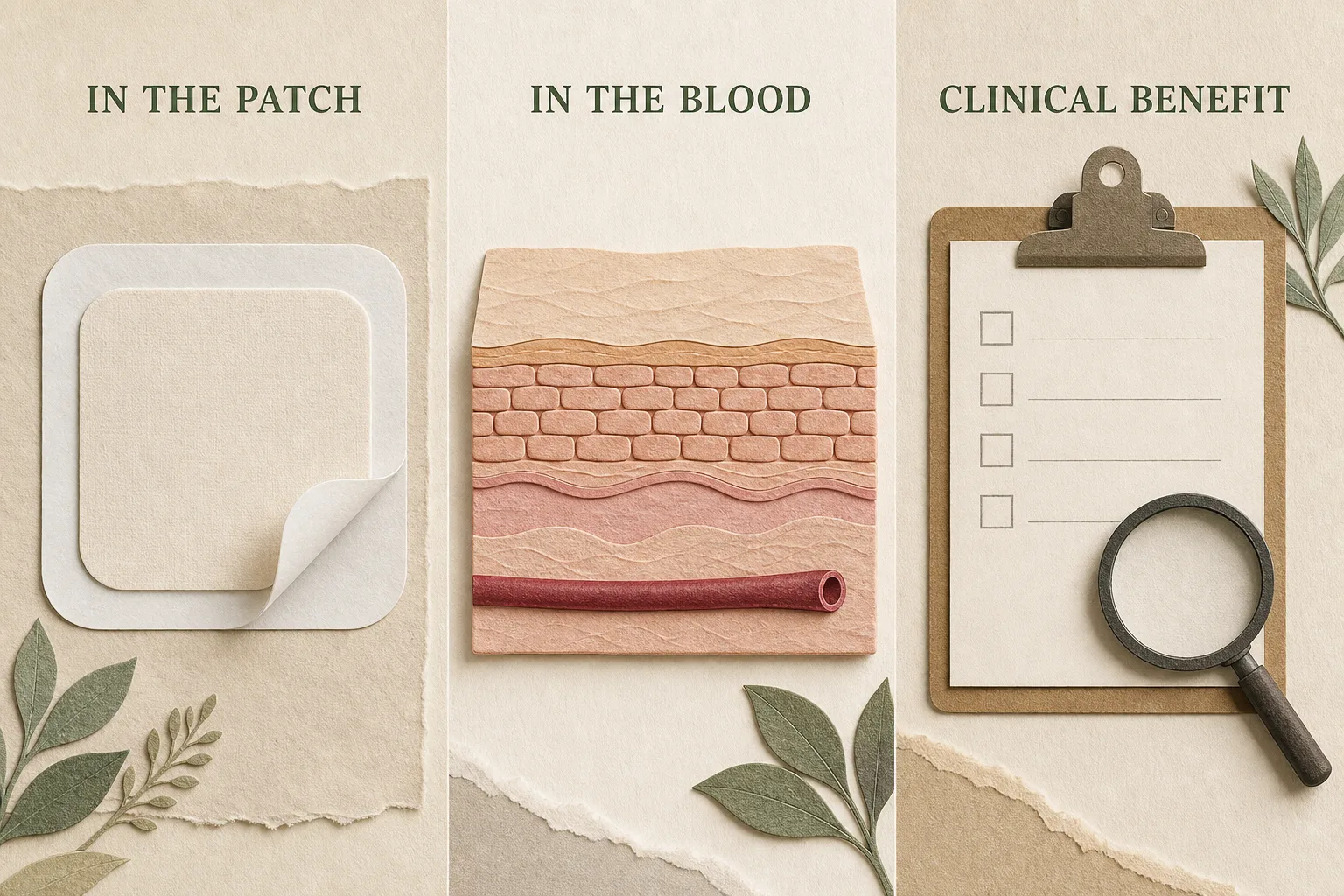
Conceptual illustration: product content, blood exposure, and clinical benefit require different evidence. The skin drawing is not an anatomical measurement or a depiction of proven delivery.
Absorption is not the same as benefit
Finding a substance in blood answers a pharmacokinetic question: where does the drug go, and how does its concentration change? Showing that people improve requires a different kind of study.
A useful example comes from a randomized trial of transdermal CBD gel in 188 adults with drug-resistant focal epilepsy. During the 12-week blinded period, neither active treatment group significantly outperformed placebo on the primary seizure-frequency endpoint. O’Brien, 2022
Later improvements reported in the open-label extension did not have the same blinded placebo comparison. They do not erase the primary result. This was also a gel studied for a specific condition, not proof about a retail patch for sore knees.
A convincing pain claim would need evidence in people with the relevant type of pain, using the actual formulation or a justified equivalent, with an appropriate comparison and meaningful outcomes. Blood levels alone cannot fill those gaps.
The same goes for trial registrations. A registry entry tells you what investigators planned or recorded. For example, the knee-osteoarthritis patch study NCT04412837 is listed as withdrawn for inadequate funding, with no results posted. It cannot be cited as a successful pain trial. ClinicalTrials.gov study record
If a product page links a study, follow the link before accepting the headline. Does the paper concern people, animals, isolated skin, or a planned trial? Then check whether the outcome matches the promise.
How long do THC and CBD patches take to work?
There is no defensible universal clock for this product category. Three different timelines often get mixed together:
- Wear time: how long the manufacturer instructs you to leave the product in place.
- Blood concentration: when a measured cannabinoid level rises, peaks, or declines.
- Perceived effect: when someone notices a change in how they feel.
These timelines are not interchangeable. A wear instruction does not prove continuous delivery throughout that period. A blood peak does not define when relief starts. A long sampling window does not mean a product provides relief for that many hours.
A useful manufacturer answer should name the product, study conditions, measured outcome, and uncertainty. “Everyone gets all-day relief” does none of that. If the only support is a generic article about transdermal technology, the product-specific timing claim remains unverified.
Record when you applied and removed a product, what the instructions said, and what you noticed. Keep observations separate from conclusions: “my knee hurt less that afternoon” is a useful note, but it does not identify which ingredient caused the change.
Five questions worth asking before buying
1. What exactly do these milligrams describe?
Look for an amount per patch rather than an unexplained total for the whole package. Ask whether a “delivered” amount was measured in humans, estimated from laboratory work, or simply assumed from the starting contents.
If the seller cannot explain the number, treat it as an unresolved question. Our guide to measurement uncertainty on lab reports explains another reason a precise-looking number deserves closer inspection.
2. Does the lab report match this finished product?
A batch-matched certificate of analysis can help check what was tested. A report for a raw CBD ingredient is not automatically a report for the finished adhesive product. Our guide to reading cannabis lab results explains how to inspect the document, while cannabis sample chain of custody explains why sample identity matters.
Label accuracy deserves attention. Spindle and colleagues tested 105 hemp-derived topical products. Among 89 listing CBD amounts, only 24% were within the study’s accuracy threshold of 10% of the label claim. This was a particular market sample, not a current defect rate for all patches. Spindle, 2022
3. Was this formulation studied in people?
Ask for the actual paper, not a screenshot of a graph. Check whether the product, cannabinoid mixture, and delivery system match. A study of an experimental emulsion should not quietly become evidence for a commercial patch.
4. What did the study measure?
A skin-permeation experiment, a blood-level study, and a controlled pain trial are different pieces of evidence. Look for the endpoint before reading the conclusion. If the primary outcome was negative, a smaller positive finding should not carry the entire marketing claim.
5. What other ingredients and instructions matter?
Read the entire ingredient list and product directions. The CBD number is not a complete description of the adhesive or formulation. Avoid improvising ways to increase delivery; bring unclear instructions to the manufacturer or a pharmacist.
What about interactions and drug tests?
CBD’s non-intoxicating reputation does not mean it is interaction-free. FDA identifies medication interactions among CBD’s risks and says absorption across different routes remains an open question. A patch’s appearance cannot establish that it is safe alongside your prescriptions. Discuss the exact product with a clinician or pharmacist; our CBD, THC, and prescription interaction guide provides background. FDA consumer information
Drug testing also resists blanket promises. In the 2024 retail-product study, no urine samples met the specified federal cannabis-positive criteria, but nine participants—including one in the patch group—had oral-fluid THC levels at or above the stated threshold. That is not a guarantee for another product or testing method. Zamarripa, 2024
For context on specimen differences, read cannabis and drug testing. Do not treat “applied to skin” as a promise of a negative result.
FAQs
Do CBD patches actually work?
“Work” needs a definition. Adhesion, delivery through skin, and relief of a symptom are separate outcomes. Ask for evidence that measures the outcome you care about with the product being sold.
Is a patch stronger than CBD cream?
The format alone does not establish strength. Compare clearly defined quantities and human data, not just the package’s milligrams or the word “transdermal.”
Can a THC patch get you high?
Potentially, if it delivers enough THC systemically. Skin application offers no guarantee against impairment. A small study reporting no psychoactive effects cannot establish one. THC is the intoxicating cannabinoid identified in FDA’s cannabis information.
Does third-party testing prove a patch absorbs?
A cannabinoid-content test measures the sample’s contents. It does not measure what passes through your skin. Ask for the absorption evidence separately.
Are CBD patches FDA-approved medicines?
FDA’s consumer guidance identifies one approved CBD prescription product and states that other CBD products have not been approved. Retail CBD patches should not borrow that medicine’s approval or clinical evidence. FDA consumer information
Key Takeaways
The best question is wonderfully simple: “What evidence shows this particular patch delivers what you say it delivers?”
A useful answer separates contents, absorption, and benefit. Keep those distinctions intact, and an impressive-looking package becomes much easier to evaluate.
Sources
- Zamarripa, C. A. et al. (2024). Pharmacokinetics and pharmacodynamics of five distinct commercially available hemp-derived topical cannabidiol products. Journal of Analytical Toxicology, 48(2), 81–98. DOI
- Varadi, G. et al. (2023; online 2022). Examining the Systemic Bioavailability of Cannabidiol and Tetrahydrocannabinol from a Novel Transdermal Delivery System in Healthy Adults: A Single-Arm, Open-Label, Exploratory Study. Advances in Therapy, 40(1), 282–293. DOI
- O’Brien, T. J. et al. (2022). Adjunctive Transdermal Cannabidiol for Adults With Focal Epilepsy. JAMA Network Open, 5(7), e2220189. DOI
- Spindle, T. R. et al. (2022). Cannabinoid Content and Label Accuracy of Hemp-Derived Topical Products Available Online and at National Retail Stores. JAMA Network Open, 5(7), e2223019. DOI
- FDA. FYs 2013–2017 GDUFA Science and Research Report: Transdermal Drug Products.
- FDA. Transdermal and Topical Delivery Systems—Product Development and Quality Considerations. Draft guidance, 2019; explanatory context, not cannabis-product approval.
- FDA. What You Need to Know About Products Containing Cannabis or Cannabis-derived Compounds, Including CBD.
- ClinicalTrials.gov. NCT04412837: The Use of Cannabinoid Patch for Knee Osteoarthritis. Withdrawn; no results posted. Checked September 6, 2026.
