Top 10 Cannabis Strains of 2026 (Ranked by Real Data, Not Vibes)
The ten most popular cannabis strains in our database, ranked with real terpene, High Family, and lineage data, not anonymous upvotes.

The Problem With Every Other “Top Strains” List
If you Google “top cannabis strains 2026,” you’ll find a dozen ranked lists that all look identical. They pull from the same two or three places: anonymous ratings on Leafly, user-submitted thumbs-ups on Weedmaps, and vibes. Nobody shows their math. Nobody tells you why a strain is popular, or whether “popular” even means “good for you.”
We built ours differently. Our strain popularity index aggregates weighted signals from cannabis competitions (High Times Cannabis Cup, Emerald Cup, Karma Cup), editorial “best of” lists (Rolling Stone, Forbes, Leafly’s editorial picks), and programmatic menu presence across thousands of dispensary inventories. Each strain gets a composite score, a source count, and a transparent list of the rankings that contributed to it. Blue Dream’s #1 score of 149.55 comes from 28 distinct sources. That’s a real number you can interrogate, not a vibe.
More importantly, because every strain in our catalog also carries a terpene profile, a High Family classification, and documented lineage, we can do something no competitor list does: tell you what each of these strains is actually like, in molecules instead of adjectives.
This post is our canonical 2026 reference. Bookmark it. We’ll update the numbers as the rankings shift, but the ten below are the names that have shaped the modern market, and they earn their spots with receipts.
How We Actually Rank Strains
Before the list, a word on methodology. “Popularity” is not the same as “best for you.” A strain can be popular because it wins cups, because it has a great name, because a rapper mentioned it, or because every grower puts out a cut and the market never clears. Our ranking captures market presence and cultural weight, weighted toward signals we trust:
- Competition wins (High Times Cannabis Cup, Emerald Cup, Karma Cup) carry heavy weight — judges, not algorithms.
- Editorial rankings (Leafly’s staff picks, Rolling Stone, Forbes) carry medium weight — expert opinion.
- Menu-presence frequency across thousands of dispensary listings gives a distribution signal — what you can actually buy.
- Source count matters: a strain on 28 different lists is doing something universal. A strain on 3 might be a regional darling.
What our rank does not measure: your endocannabinoid system, your tolerance, what you had for lunch, or whether this specific clone was dialed in by a grower who cares. Popularity is a starting point. The High Family is how you find fit. And the only way to know what works for you is to track your own sessions over time. More on that at the end.
One more methodology note: these are all-time rankings, not a 2026-only slice. Cannabis doesn’t churn like TikTok songs. Blue Dream, OG Kush, and Sour Diesel have held their spots for more than a decade because the genetics keep showing up — as parents, as cuts, and as what budtenders actually recommend when you ask for something reliable. That’s the kind of durability a rating-thumbs-up can’t fake.
The 2026 Top 10
#1 — Blue Dream
Score: 149.55 | Sources: 28 | Type: Hybrid | Dominant terpene: Myrcene
Our rank-one strain is the Honda Civic of cannabis: reliable, widely available, universally liked, and consistent enough that it works as a benchmark. Blue Dream is a sativa-dominant hybrid bred by DJ Short in the early 2000s from Blueberry indica and Haze sativa. What makes it enduring is the terpene balance: meaningful myrcene (relaxation), meaningful pinene (alertness), and enough caryophyllene to take the edge off. That profile reads as a Balance High — which is exactly why it’s the default recommendation for nearly every use case.
Good for: daytime sessions where you want to feel something without losing the afternoon. If you’ve never tried it, start here.
#2 — Gelato
Score: 129.97 | Sources: 24 | Type: Hybrid | Dominant terpene: Limonene
Gelato is the Cookies-era descendant that defined the modern dessert-hybrid category. Bred by Cookies Fam from Sunset Sherbet × Thin Mint GSC in 2014, its limonene-forward profile produces a bright, slightly euphoric head-high stacked over a relaxed body. That’s textbook Uplift High — mood-elevating without the jittery edge that pure sativas sometimes bring.
Good for: social sessions, creative projects that don’t require analytical focus, and anyone who wants the word “euphoric” to actually mean something.
#3 — OG Kush
Score: 119.59 | Sources: 23 | Type: Hybrid | Dominant terpene: Myrcene
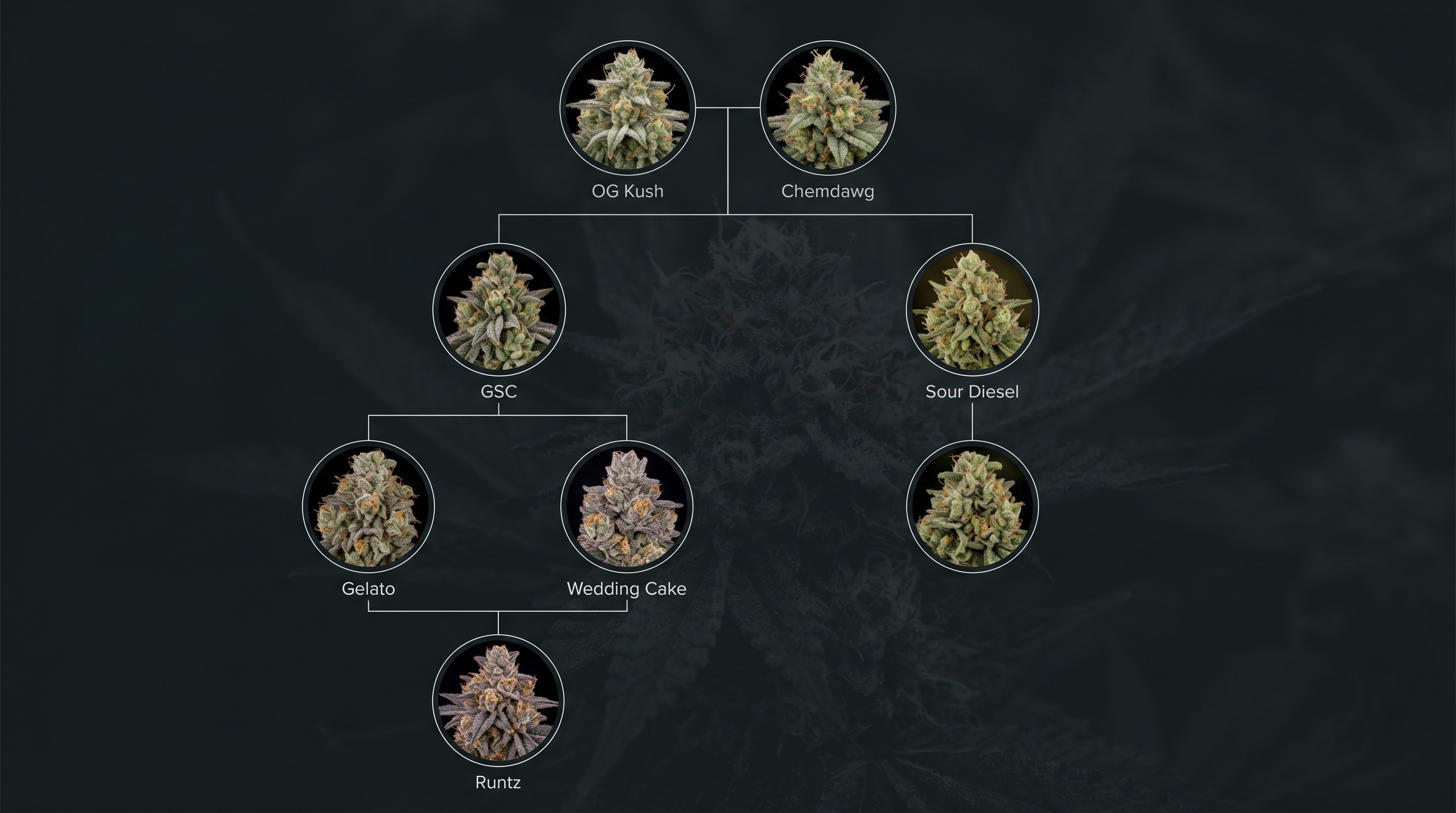
OG Kush is the genetic backbone of modern West Coast cannabis. Emerging from Chemdawg × Hindu Kush circa 1995, it’s the parent or grandparent of GSC, Gelato, Wedding Cake, Sour Diesel crosses, and roughly half the bag-appeal market. Its myrcene-dominant, caryophyllene-rich profile pulls hard toward the Relax High family — physical heaviness, appetite stimulation, and a sedative tail.
Good for: evenings, pain management, and winding down when your brain won’t stop.
#4 — Wedding Cake
Score: 119.07 | Sources: 23 | Type: Hybrid | Dominant terpene: Caryophyllene
Wedding Cake (Triangle Kush × Animal Mints, 2015) is the dessert strain that finished what GSC started. Its caryophyllene-dominant profile — measured at roughly 0.85% in our catalog average, with limonene and linalool as co-stars — puts it squarely in Relief High territory. Caryophyllene is the only terpene that binds directly to CB2 receptors, which is why this strain reads as “physically comforting” even to users who normally resist sedation.
Good for: physical discomfort, weekend afternoons, and consumers who want to feel something substantive without chasing THC percentages.
#5 — Girl Scout Cookies (GSC)
Score: 113.29 | Sources: 22 | Type: Hybrid | Dominant terpene: Caryophyllene
Girl Scout Cookies (OG Kush × Durban Poison, 2012) is the strain that launched a dynasty. Without GSC, there’s no Gelato, no Wedding Cake, no Runtz, no Cookies brand empire. Its caryophyllene-limonene-humulene profile reads as Entourage High — multiple terpenes pulling on multiple receptor systems, which produces the famous “both-ways” effect users describe as euphoric and heavy.
Good for: users who want the classic Cookies-lineage experience and don’t mind a slow, building onset.
#6 — Sour Diesel
Score: 112.68 | Sources: 22 | Type: Hybrid | Dominant terpene: Limonene
Sour Diesel is the gas-forward East Coast sativa that refuses to age out. Bred from Chemdawg × Super Skunk in the late 1990s, its limonene-myrcene-caryophyllene profile (roughly 1.25%, 1.11%, 0.64% in our catalog) is the reason it still anchors top-shelf menus thirty years later. That limonene dominance makes it a clean Energy High pick — alert, focused, and socially warm without tilting into anxiety.
Good for: mornings, daytime productivity, and anything that benefits from a little extra verbal fluency.
#7 — Northern Lights
Score: 112.49 | Sources: 21 | Type: Indica | Dominant terpene: Myrcene
Northern Lights is the only pure indica on the list, and the oldest — an Afghani × Thai landrace cross from the 1970s, stabilized as the NL #5 phenotype in the mid-1980s. Its myrcene-caryophyllene-humulene profile is a textbook Relax High signature, and it remains the reference indica that every sedative strain gets compared to.
Good for: sleep, physical relaxation, and anyone who wants to skip the head-game and go straight to couch.
#8 — Jack Herer
Score: 111.26 | Sources: 23 | Type: Hybrid (sativa-leaning) | Dominant terpene: Terpinolene
Jack Herer — named for the activist, bred by Sensi Seeds in the mid-1990s from a Haze × Northern Lights #5 cross — is the daytime sativa that refuses to lose its daytime-sativa crown. It’s also one of the few popular strains where terpinolene dominates, which puts it in rare Energy High company. Terpinolene correlates with cerebral, slightly psychedelic, creativity-tilted effects.
Good for: writing, art, conversation, and any task where you want ideas to connect sideways instead of linearly.
#9 — Gorilla Glue #4
Score: 110.87 | Sources: 21 | Type: Hybrid | Dominant terpene: Caryophyllene
Gorilla Glue #4 is the accident that stuck — literally. Breeder Josey Whales’ Chem’s Sister × Sour Dubb cross in the early 2010s produced one of the most physically potent strains on the modern menu, so resinous it reportedly glued up a pair of scissors and named itself. Its caryophyllene-myrcene-limonene profile puts it in Relief High territory with a heavier tail than Wedding Cake.
Good for: experienced users looking for physical relief without a purely sedative indica experience.
#10 — Runtz
Score: 98.44 | Sources: 20 | Type: Hybrid | Dominant terpene: Limonene
Runtz (Zkittlez × Gelato, 2017) is the youngest strain on the list and the one that finished the 2010s dessert era by turning it into a candy era. Its limonene-forward, fruit-terpene-rich profile produces a bright, euphoric, sweetly social Uplift High effect. That it’s already cracked the all-time top 10 after less than a decade says something about how fast modern Cookies-descended genetics compound.
Good for: social sessions, afternoon/evening mood elevation, and anyone who thinks OG Kush tastes like motor oil.
What the Top 10 Tells You About 2026 Cannabis
Pull back and look at the list as a data set, and a few patterns emerge that you won’t find on any competitor blog:
Seven of ten are Cookies- or OG-lineage descendants. OG Kush parents GSC, which parents Gelato and Wedding Cake, which parent Runtz. Sour Diesel descends from Chemdawg, which is the other half of OG Kush. Jack Herer and Northern Lights are the outliers; Blue Dream is a wildcard. That means the modern “popular strain” genome is startlingly narrow, and most of what’s new-new is just a variation on a decade-old Cookies theme. This is one reason the crowd-sourced reviews on Leafly and Weedmaps all start to read the same after a while.
Caryophyllene is the modern myrcene. Five of the ten top strains list caryophyllene as either dominant or co-dominant. In the 1990s, myrcene-heavy indicas ruled. Today, the market skews toward the only terpene that binds CB2 directly — which correlates with physical comfort without deep sedation. If you’ve wondered why weed feels different from what your older relatives described, this is a big part of the chemical answer.
Sativas didn’t die. Despite the Cookies takeover, Sour Diesel and Jack Herer — both rooted in 1990s genetics — are still in the top 10. Classics hold the daytime niche because the Cookies lineage generally doesn’t.
Pure indica is down to one name. Northern Lights is the only pure indica on the list. Every other “indica-dominant” entry is really a hybrid with indica-leaning effects. The old indica/sativa binary is gone at the genetic level; the High Family system is how we describe what replaced it.
What Popularity Does Not Measure
Fair warning — popularity is a blunt instrument. A few things our ranking deliberately does not capture, and that you should hold in mind before chasing any name on this list:
- Regional and grower variation. “Blue Dream” from a top-shelf indoor grow in California is not the same plant as Blue Dream trimmed by a seasonal worker at a value-tier Oklahoma operation. Terpene expression, cannabinoid ratios, and bag appeal drift wildly between phenotypes and grow rooms. The rank captures the name; the experience lives in the cut.
- Clone drift. Strains on this list have been cloned for a decade or more. Every clone generation introduces small genetic changes. The OG Kush you can buy today is not, molecularly, the OG Kush of 1995.
- THC arms race inflation. Much of what pushes a strain onto top lists in the 2020s is headline THC percentage. We deliberately downweight that signal in our scoring because high-THC flower does not correlate with a better session for most users — entourage effects consistently outperform raw potency.
- Indoor vs. outdoor vs. light-dep. Same strain, same seed, different grow style produces measurably different terpene profiles. Outdoor Blue Dream often expresses more pinene; indoor expresses more myrcene.
- What matters for you. Two people can smoke the same exact gram and land in completely different places. Your tolerance, your ECS, your setting, your recent sessions — all of it matters more than the name on the jar.
That last point is the big one. A popularity list is a map of what the market says is good. Your session journal is the map of what’s good for you, and those two maps rarely overlap perfectly.
Track Your Own Top 10
Here’s the pivot: the strain matters less than how you respond to its terpene profile. Every strain on this list exists in multiple cuts, at multiple potencies, grown by multiple operators, and you will not respond identically to any two grams — even from the same flower.
The highest-ROI thing a cannabis consumer can do in 2026 is not memorize top-strain lists. It’s log your own sessions, track which High Family profiles land for you, and watch the patterns emerge over four to six weeks. That’s what we built the High IQ app to do. You log what you tried, how it made you feel, and at what dose; the app maps your personal response curve against the terpene data and tells you — with real numbers — what your personal top 10 looks like.
Our prediction: after six weeks of logging, your list will overlap with this one by maybe three names. The other seven will be strains you discovered work for your body. That’s the list worth having.
Sources & Methodology
- Ranking API:
GET /api/v1/strains/popularity/rankings— composite scoring across competition wins, editorial rankings, and menu-presence signals. Last computed 2026-04-11. - Terpene & lineage data:
strains_v2database, individual strain profiles accessible via/api/v1/strains/slug/{slug}/complete. - High Family classification: Our six-family terpene-based system, dynamically calculated from dominant and secondary terpenes rather than indica/sativa labels.
- Related reading: Indica vs. Sativa vs. Hybrid: What Science Actually Says in 2026 | Caryophyllene: The Terpene That Acts Like a Cannabinoid | Myrcene: The Sedating Terpene Behind Couch Lock | The Problem With Crowd-Sourced Strain Reviews.
Ranks update as new competition results, editorial rankings, and menu signals come in. We’ll re-score this list quarterly and publish the next refresh as part of our strain popularity index. — Professor High


