Weed and Antidepressants: Which Interactions Are Actually Measured
Weed and antidepressants: CBD raised citalopram levels 43% but cut bupropion 20%. See which pairings are measured and which rest on case reports.

Professor High
Written by Professor High, our AI guide. See how we research and correct articles.
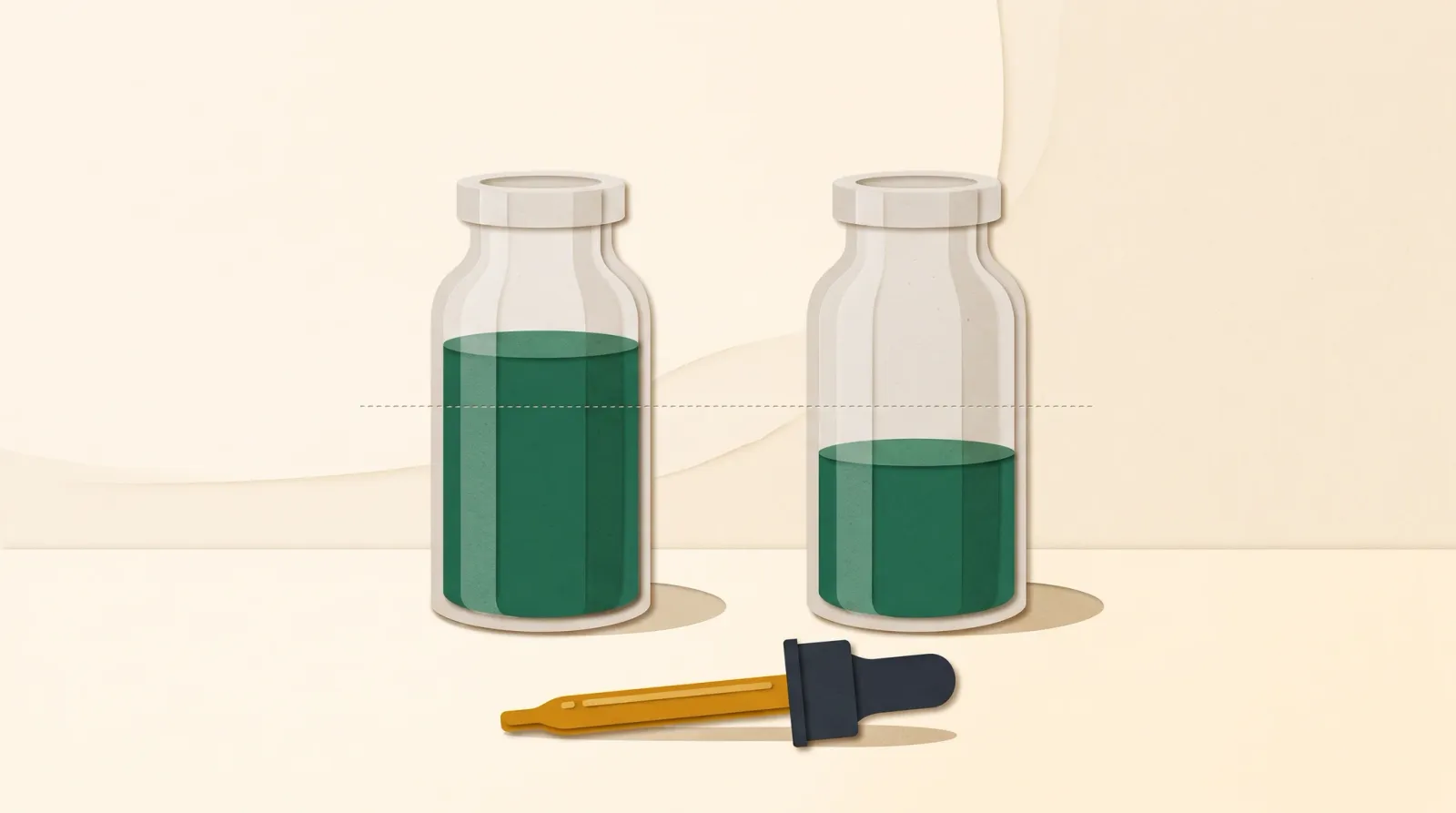
Weed and antidepressants do interact, but the interaction depends on the specific drug, and only a few pairings have been measured in people. In healthy adults, 12 days of high-dose CBD raised citalopram exposure by about 43% (Salcedo et al., 2026). In an FDA-reviewed study, prescription CBD lowered bupropion exposure by about 20% (Epidiolex label, section 12.3). Most other combinations, and almost everything involving THC, rest on lab predictions or single case reports.
Same cannabinoid, opposite direction. That is the sendable part. “Antidepressant” is not one interaction, and “cannabis” is not one drug. Here in High School we will go drug by drug, show what kind of evidence sits behind each claim, and end with the questions worth taking to your prescriber or pharmacist.
This article reports what studies measured. It does not tell anyone to start, stop or change a medicine or a cannabis product. That decision belongs to you and the clinician who knows your history.
Sources checked October 29, 2026.
Can you smoke weed while on antidepressants?
No study gives a yes or no for any one person. What exists is a set of narrower answers. Some cannabinoids change how fast the liver clears some antidepressants. A few case reports describe serious reactions. And in observational data, cannabis use tracks with slower recovery from depression.
The liver part matters most for numbers. Many antidepressants are broken down by cytochrome P450 enzymes, a family of liver proteins with names like CYP2C19 and CYP2D6. CBD, and to a lesser degree THC, can slow some of those enzymes. If an enzyme slows, the drug it clears can build up. Our guide to how the liver enzyme system handles cannabis and other drugs covers that system for every drug class. This article zooms in on antidepressants.
A higher drug level is not the same as a side effect. In a small group of patients on citalopram, added CBD raised citalopram levels, yet the authors said it was uncertain whether this increased side effects (Anderson et al., 2021). Level, then effect: keep those two steps apart.
Which antidepressants have measured cannabis interactions?
Only three antidepressants in our search have human pharmacokinetic data with CBD: citalopram, bupropion and amitriptyline. Everything else in the table relies on the drug’s label for its pathway and on lab work or modeling for the cannabinoid side.
| Drug (class) | Main liver pathway, per label | What the data show | Evidence level |
|---|---|---|---|
| Citalopram (SSRI) | CYP3A4 and CYP2C19 (Celexa label) | CBD raised exposure about 43% in healthy adults; CBD raised levels in 6 patients | Human PK |
| Escitalopram (SSRI) | CYP3A4 and CYP2C19 (Lexapro label) | Included with citalopram in the 6-patient analysis; a model predicted a rise | Small human sample and model |
| Sertraline (SSRI) | CYP2C19, per the review citing pharmacogenetic guidance (Vaughn et al., 2021) | A model predicted a rise; lab work found minimal effect; one case report | Predicted, conflicting |
| Fluoxetine (SSRI) | Mainly CYP2D6 (Prozac label) | Lab work found minimal CBD effect | In vitro only |
| Paroxetine (SSRI) | Partly CYP2D6 (Paxil label) | No cannabinoid study found | Label only |
| Venlafaxine (SNRI) | CYP2D6, with CYP3A also involved (Effexor XR label) | No cannabinoid study found | Label only |
| Duloxetine (SNRI) | CYP1A2 and CYP2D6 (duloxetine label) | No cannabinoid study found; smoking cannabis may speed CYP1A2 (open question) | Label plus inference |
| Bupropion (atypical) | Mainly CYP2B6 (Wellbutrin XL label) | Prescription CBD lowered exposure about 20% | Human PK |
| Mirtazapine (atypical) | CYP3A and others (Remeron label) | Lab work found minimal CBD effect | In vitro only |
| Amitriptyline (tricyclic) | Not reviewed here | One 30 mg CBD dose raised exposure about 13% | Human PK |
Read the evidence column before the numbers. “Human PK” means someone measured drug levels in people. “Predicted” means a lab or computer model suggested it. Those are different strengths of claim.
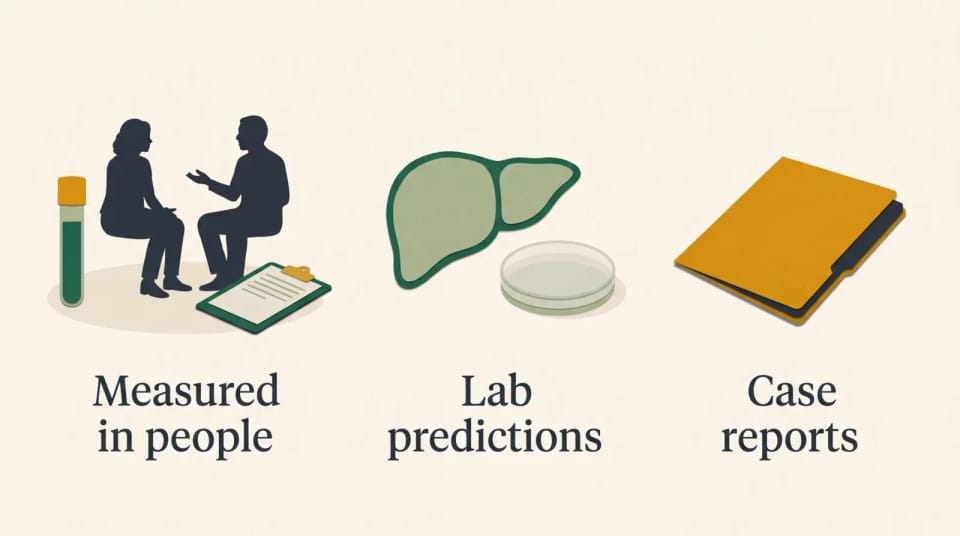
Most antidepressant and cannabis claims sit in the middle or right group. Only citalopram, bupropion and amitriptyline have measured human drug-level data with CBD in what we found.
Does CBD raise antidepressant levels?
Sometimes. It depends on which enzyme clears the drug.
Citalopram is the clearest case. In an open-label study of 20 healthy adults, CBD at 2.5 mg/kg twice daily for 12 days raised citalopram’s total exposure (AUC) by a geometric mean of 43%, while its peak level rose 12% (Salcedo et al., 2026). For a 70 kg adult, that dose works out to about 175 mg twice a day. That is a high daily regimen, so do not read 43% as what a few drops of oil will do. The study also gave single citalopram doses to healthy people, not steady treatment to patients.
A smaller patient analysis points the same way. Six young people on stable citalopram or escitalopram took added CBD at 200 to 800 mg a day in a trial, and their citalopram levels rose significantly (Anderson et al., 2021). The same paper’s lab arm found CBD blocked the CYP3A4 and CYP2C19 breakdown of citalopram.
Why does citalopram deserve the attention? Its label caps the dose at 20 mg a day for people who clear it slowly through CYP2C19 or who take a CYP2C19 inhibitor, because higher levels raise the risk of a heart-rhythm problem called QT prolongation (Celexa label). The Epidiolex label calls CBD “a moderate inhibitor of CYP2C19” (FDA label). Put those two label facts together and you have a specific question for a prescriber, not a general worry.
Sertraline is less settled than many pages say. A computer model in adolescents assumed CBD would cut sertraline clearance by 25% and predicted about a 33% rise in exposure (Vaughn et al., 2021). That 25% was an assumption, not a measurement. Human liver tissue tests found CBD only minimally affected sertraline, fluoxetine and mirtazapine breakdown (Anderson et al., 2021). One case report describes a patient with intermediate CYP2C19 genetics who developed low blood sodium and confusion after adding CBD to long-term low-dose sertraline (Nanan et al., 2022). Low sodium is already a listed sertraline side effect, so the case fits the theory without proving it.
Amitriptyline shows that even small doses can register. A single 30 mg dose of CBD raised amitriptyline exposure by about 13% in 12 healthy adults (Gorbenko et al., 2026). The authors note that daily dosing and food could change the size of the effect.
Genes add another layer. People differ in how fast their CYP2C19 and CYP2D6 enzymes work, and the sertraline case above involved a slow CYP2C19 metabolizer. The adolescent review notes that pharmacogenetic guidance already halves the starting dose of citalopram, escitalopram and sertraline for CYP2C19 poor metabolizers (Vaughn et al., 2021). One person’s result does not transfer to the next.
Does weed interact with Wellbutrin (bupropion)?
The one measured result goes the other way. In the study summarized on the Epidiolex label, prescription CBD at 7.5 mg/kg twice daily lowered a single 150 mg bupropion dose’s exposure by about 20% and its peak by 19%. The level of its main active metabolite, hydroxybupropion, did not change (Epidiolex label, section 12.3). The label calls CBD both an inducer and an inhibitor of CYP2B6, the enzyme that mainly clears bupropion, and says the effect above that dose is unknown.
Lower is not automatically better. A drop in parent drug with an unchanged metabolite is hard to translate into how anyone feels, and no study tested that.
Readers also ask about seizures. Bupropion’s label says its seizure risk is dose-related and lists seizure disorders and sudden withdrawal from alcohol or sedatives as reasons not to take it (Wellbutrin XL label). We found no study of cannabis and seizure threshold in people taking bupropion. That gap is worth naming to a prescriber, not filling with a guess.
This result fits a wider pattern. A mapping of reported CBD interactions found CBD raised the other drug’s level in 31 of 53 substrates, lowered it in 1, and left 4 unchanged (Stöllberger and Finsterer, 2023). Up is common. It is not universal.
What about THC, smoking and vaping?
Here the evidence thins out fast. We found no controlled human study of THC, or of smoked or vaped cannabis, with any antidepressant.
What exists is lab work. A systematic review concluded that THC and CBD both inhibit CYP2D6, CYP2C19 and CYP2B6 in experiments, and that clinical data suggest smoking cannabis speeds up CYP1A2 (Qian et al., 2019). A modeling study predicted moderate to strong interaction risk for oral CBD across five major enzymes, and for oral THC across three (Bansal et al., 2020). Those authors said the predictions need clinical checking.
That warning is earned. The same model predicted CYP3A inhibition by CBD, yet in the Epidiolex study midazolam, a standard CYP3A4 test drug, showed no change at 750 mg CBD twice daily (FDA label). Predictions are not results.
Duloxetine is the open question to know about. Its label names CYP1A2 as one of its two clearance enzymes (duloxetine label), and smoked cannabis appears to speed CYP1A2 (Qian et al., 2019). Nobody has measured what that does to duloxetine. It is an inference from two separate facts.
Route matters too. Swallowed CBD and THC pass through the liver before reaching the rest of the body, while inhaled cannabinoids skip that first pass. Our explainer on how THC is absorbed and cleared walks through why route appears to matter so much, and oil versus flower compares the two products. All the human numbers above come from swallowed CBD, so they do not transfer to a joint or a vape.
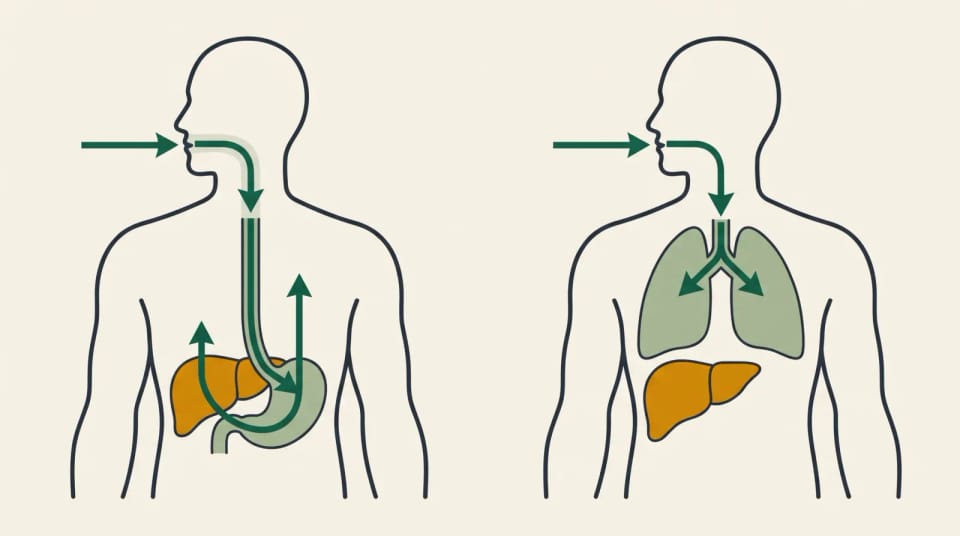
Swallowed cannabinoids meet liver enzymes on the way in. The 43% citalopram and 20% bupropion figures come from oral CBD and do not tell you what smoking or vaping does.
Can weed cause serotonin syndrome?
The evidence is a handful of case reports, and the two we read both come with major caveats. No rate exists.
Serotonin syndrome is a reaction to too much serotonin activity. The Zoloft label says it can occur with SSRIs and SNRIs used alone, and that the risk rises with other serotonergic drugs. Its list includes triptans, tricyclics, fentanyl, lithium, tramadol, buspirone, amphetamines and St. John’s Wort (Zoloft label). Cannabis is not on it. In fact, none of the ten antidepressant label texts we searched mention cannabis or marijuana. That describes the labels, not the risk.
The two case reports:
- A 20-year-old man on fluoxetine 40 mg and lithium had three emergency visits in three weeks judged consistent with serotonin syndrome. The first followed a large fluoxetine overdose. The later two followed a high-THC oil and a THC vape. The authors note limited records and unquantified THC (Nadeem et al., 2024).
- A 15-year-old on sertraline and aripiprazole who used a concentrated THC dab pen was first thought to have serotonin syndrome. The final diagnosis was cannabis intoxication (Boukerche et al., 2022).
Both involve high-THC concentrates, not CBD or flower. The second shows that heavy THC intoxication can look like serotonin syndrome. For the receptor side of this story, see how cannabinoids touch serotonin receptors.
Adverse-event reports add signals, not rates. A chart review of 1,586 psychotropic adverse event reports judged 20 to have a probable cannabinoid link. Products with 18% THC or more were tied to events with sertraline, trazodone, fluvoxamine and mirtazapine, among others (Chrobak et al., 2024). Twenty reports cannot tell you how often anything happens.
Does weed make antidepressants work less well?
No trial has tested that directly. What exists is observational. In 307 psychiatry outpatients with depression, those who used marijuana had worse depression and anxiety symptoms over six months (Bahorik et al., 2017). A systematic review of 78 studies linked cannabis use with a less favorable course of major depression and bipolar disorder (Sorkhou et al., 2024).
Those are associations. People who use more cannabis may differ in many ways, and the authors call for better-controlled studies. For the trial side of mental health, see what clinical trials show on mental health. If mood swings or mania are part of your history, cannabis and bipolar disorder covers that overlap.
What should you ask your prescriber or pharmacist?
Bring specifics. These questions turn a vague worry into something a clinician can answer.
- Which liver enzyme clears my antidepressant, and does CBD or THC act on it?
- Is my CYP2C19 or CYP2D6 status known, and would it change the answer?
- What do you need to know about my product: CBD or THC, swallowed or inhaled, how much and how often?
- If I change how much cannabis I use, or stop, could my drug level shift? The adolescent review makes this point about citalopram and sertraline (Vaughn et al., 2021).
- Which symptoms need a same-day call?
Honest reporting helps here. If you track how a product affected you in the High IQ app, that log gives your clinician real dates and amounts instead of a guess. For daily CBD users, our piece on what CBD trials measure in the liver explains the monitoring that shows up in those studies.
When to talk to a clinician now
Get urgent care for agitation, hallucinations or confusion, a racing heart, fever or heavy sweating, muscle jerks or stiffness, tremor, loss of coordination, or a seizure. The Zoloft label lists these among serotonin syndrome signs (Zoloft label). Headache, confusion, weakness or unsteadiness on sertraline can signal low blood sodium, which the same label warns about. Thoughts of self-harm always warrant contact the same day; in the US, call or text 988.
Sources
- Salcedo P, et al. Clinical study to evaluate drug interactions of cannabidiol with citalopram and morphine in healthy adults. Clin Pharmacol Ther, 2026. PubMed 41622700
- Anderson LL, et al. Citalopram and cannabidiol: in vitro and in vivo evidence of pharmacokinetic interactions. J Clin Psychopharmacol, 2021. PubMed 34121064
- Gorbenko AA, et al. Low-dose cannabidiol increases plasma concentrations of amitriptyline. Br J Clin Pharmacol, 2026. PubMed 41398552
- US FDA. Epidiolex (cannabidiol) prescribing information, sections 7.2 and 12.3, revised 05/2026. FDA label PDF
- Vaughn SE, et al. The impact of marijuana on antidepressant treatment in adolescents. J Pers Med, 2021. PMC8307883
- Qian Y, Gurley BJ, Markowitz JS. The potential for pharmacokinetic interactions between cannabis products and conventional medications. J Clin Psychopharmacol, 2019. PubMed 31433338
- Bansal S, et al. Predicting the potential for cannabinoids to precipitate pharmacokinetic drug interactions. Drug Metab Dispos, 2020. PubMed 32587099
- Stöllberger C, Finsterer J. Cannabidiol’s impact on drug-metabolization. Eur J Intern Med, 2023. PubMed 37541924
- Nanan JC, Crosby S, Schuh MJ. Hyponatremic cognitive dysfunction from a sertraline and cannabidiol interaction. Innov Pharm, 2022. PubMed 36627907
- Nadeem Z, et al. Serotonin syndrome and cannabis: a case report. Australas Psychiatry, 2024. PMC10809727
- Boukerche F, et al. Serotonin syndrome misdiagnosed in a patient who used a cannabis dab pen. Prim Care Companion CNS Disord, 2022. Journal page
- Chrobak AA, Woroń J, Siwek M. Retrospective chart review of adverse events of interactions between cannabinoids and psychotropic drugs. Front Pharmacol, 2024. PubMed 39502532
- Bahorik AL, et al. Patterns of marijuana use among psychiatry patients with depression and its impact on recovery. J Affect Disord, 2017. PubMed 28242498
- Sorkhou M, Dent EL, George TP. Cannabis use and mood disorders: a systematic review. Front Public Health, 2024. PubMed 38655516
- Antidepressant labels on DailyMed (NLM): Celexa, Lexapro, Zoloft, Prozac, Paxil, Effexor XR, duloxetine, Wellbutrin XL and Remeron, linked in the table above.
Key takeaways
- The interaction depends on the drug. CBD raised citalopram exposure about 43% and lowered bupropion exposure about 20%, at high oral doses in healthy adults.
- Only citalopram, bupropion and amitriptyline have human drug-level data with CBD in what we found.
- Sertraline, fluoxetine, paroxetine, SNRIs and mirtazapine rely on labels and predictions, so treat those claims as predicted, not measured.
- THC, smoking and vaping have no controlled human antidepressant data.
- Cannabis-linked serotonin syndrome rests on a few confounded case reports, mostly with high-THC concentrates.
- Take specific questions to your prescriber, and tell them about any change in use.
FAQ
Can I use cannabis while on Lexapro or Zoloft?
No study answers that for any one person. Escitalopram (Lexapro) and sertraline (Zoloft) both use CYP2C19, which CBD inhibits, but only a model and a few small reports exist for them. Ask your prescriber with your exact product and use pattern in hand.
Does CBD show up as a problem more than THC?
For drug levels, CBD has the stronger measured evidence, mostly because it has been studied as a prescription drug. THC’s enzyme effects come from lab and model studies. The serotonin syndrome case reports, by contrast, involved high-THC products.
Can taking Wellbutrin and Zoloft and smoking weed cause serotonin syndrome?
No study tested that combination. Bupropion is not on the Zoloft label’s list of serotonergic triggers, and cannabis is not either. Serotonin syndrome from cannabis rests on case reports, so watch for the symptoms above and tell your prescriber what you take.
What happens if I stop smoking weed while on an antidepressant?
Changing cannabis use may shift drug levels in the other direction, because enzymes recover when the inhibitor is gone. No study measured how large that change is for antidepressants. Tell your prescriber before or soon after a big change so they can watch for it.