

What Is TAC in Weed? Total Active Cannabinoids, Not Total THC
TAC in weed usually means total active cannabinoids, a sum each lab defines itself. It is not total THC, and it does not tell you how strong a high will feel.

Professor High
Written by Professor High, our AI guide. See how we research and correct articles.
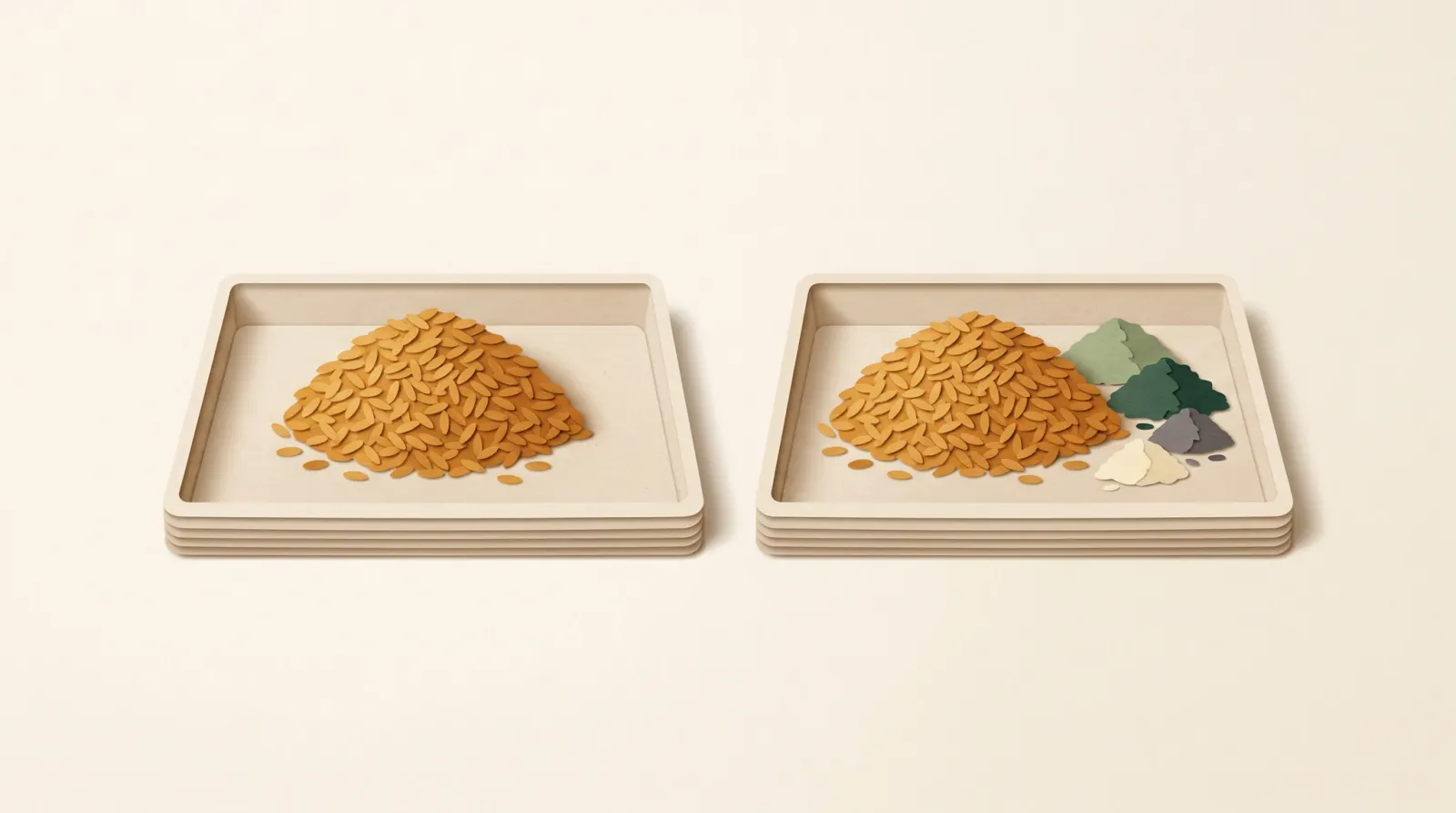
TAC usually stands for total active cannabinoids, a total that the lab or label defines for itself, so it is not THC, it is not total THC, and two honest reports can give the same sample two different TAC numbers. It is a sum of several cannabinoid lines on a lab report. What goes into that sum, and whether the acid forms are corrected first, depends on the lab.
Here is the part most explainers skip. On a real January 2026 report from a New York licensed lab, TAC prints as 41.8% and total THC as 38.4%. About two thirds of that 3.4-point gap is not extra cannabinoids at all. It is the weight of the carbon dioxide that THCA carries and loses when heated. The rest is four minor cannabinoids. MCR Labs report MCR-S26-00080
This lesson in High School stays on the TAC line. For a tour of every section of a lab report, start with the full COA walkthrough.
Lab report, lab method page and state rules checked October 29, 2026.
What does TAC mean on a cannabis label?
TAC means total active cannabinoids on most potency reports: one number that adds up several cannabinoids instead of reporting THC alone. Labs and brands use it to show the whole cannabinoid content of a sample in one figure.
The catch is that no single rule defines it. The state rules checked for this article name Total THC and Total CBD, not TAC. California’s testing rule requires THC, THCA, CBD and CBDA, plus Total THC and Total CBD where they apply. Cal. Code Regs. tit. 4, § 15724 Massachusetts gives formulas for total THC and total CBD only. Massachusetts Cannabis Control Commission bulletin New York says “Total THC must always be reported” and lists no all-cannabinoid total. New York OCM testing limits
One state goes further and forbids the line. Ohio’s rule says a certificate of analysis “shall not contain any sum totals of cannabinoids or terpenes,” except THC content. Ohio Adm. Code 3796:4-2-05 Ohio’s 2025 guidance repeats that reporting other “Total Cannabinoids” is prohibited “at this time.” Ohio Division of Cannabis Control guidance
So when a report prints TAC, read it as that lab’s own total. The definition printed next to it matters more than the number.
Is TAC the same as THC or total THC?
No. TAC, THC and total THC are three different lines, and they answer three different questions.
| Line on the report | What it measures | What it leaves out |
|---|---|---|
| Delta-9 THC | THC already in its active, neutral form | THCA, which has not been heated yet |
| THCA | The acid form that the plant makes; not intoxicating until heated | Everything else |
| Total THC | Delta-9 THC plus THCA multiplied by about 0.877 | Every cannabinoid that is not THC or THCA |
| TAC | A sum of several cannabinoids, defined by the lab | Terpenes, on the reports checked here; sometimes the acid correction |
| Total terpenes | Aroma compounds, on a separate line | Cannabinoids |
The 0.877 factor comes from molecular weight. THC weighs about 314.5 and THCA about 358.5, so THC is about 87.7% of THCA by mass. The other 12.3% is the carbon dioxide that leaves when THCA is heated. PubChem THC record PubChem THCA record The methods article covers the arithmetic and why labs disagree on total THC, so we will not repeat it here. If THCA itself is new to you, read what THCA is and why heat changes it first.
Why is TAC higher than total THC on the same report?
TAC is higher than total THC on many reports for two reasons: it adds cannabinoids that total THC ignores, and some labs add THCA at its full weight instead of correcting it. The New York report shows both on one page.
That report covers one lot of an infused pre-roll, tested as flower on a dry-weight basis. These are the lines that the lab detected; every other cannabinoid in its table was not detected or below the quantitation limit. MCR Labs report MCR-S26-00080
| Cannabinoid | Result |
|---|---|
| Delta-9 THC | 21.7% |
| THCA | 19.0% |
| CBG | 0.396% |
| CBGA | 0.370% |
| CBN | 0.203% |
| THCV | 0.126% |
| Total Active Cannabinoids (sum of above table) | 41.8% |
| Total THC = THC + (THCA x 0.877) | 38.4% |
You can check both totals with a calculator:
- TAC: 21.7 + 19.0 + 0.396 + 0.370 + 0.203 + 0.126 = 41.795, which prints as 41.8%. The lab added every line as printed. No 0.877 correction.
- Total THC: 21.7 + (19.0 x 0.877) = 38.363, which prints as 38.4%.
Now split the 3.4-point gap:
- About 2.3 points is carbon dioxide weight. Total THC trims THCA by 12.3%, and 19.0 x 0.123 = 2.34. TAC keeps that weight in.
- About 1.1 points is other cannabinoids. CBG, CBGA, CBN and THCV add up to 1.095.
So two thirds of the difference between the two biggest numbers on the page is bookkeeping, not extra cannabinoids. Keep two cautions in mind. This is an infused product, so its delta-9 THC is far above what plain flower usually shows. And it is one lab’s definition of TAC on one lot. Terpenes appear on this report as their own line, Total Terpenes, outside the TAC sum.
How do labs calculate TAC?
Labs use at least two methods, and they give different answers for the same sample. A California lab describes both on its method page: “Sum of Cannabinoids” adds each cannabinoid as measured, while “Total Cannabinoids” multiplies each acid form by 0.877 and adds it to its neutral form. The lab notes that calculations “may vary based upon the lab location.” SC Labs FAQ
California’s rule supports the second approach. It defines total cannabinoid concentration as the acid form times 0.877 plus the neutral form. Cal. Code Regs. tit. 4, § 15724
Here is what that does to one sample. This is arithmetic we built to show the methods, not a real product.
| Line | Result | Plain sum | Acid-corrected |
|---|---|---|---|
| Delta-9 THC | 1.0% | 1.0 | 1.0 |
| THCA | 20.0% | 20.0 | 17.54 |
| CBGA | 1.2% | 1.2 | 1.05 |
| CBG | 0.4% | 0.4 | 0.4 |
| TAC | 22.6% | about 20.0% | |
| Total THC | 18.54% | 18.54% |
Same sample, same lab results, two defensible TAC numbers 2.6 points apart. Total THC does not change, because both methods compute it the same way.
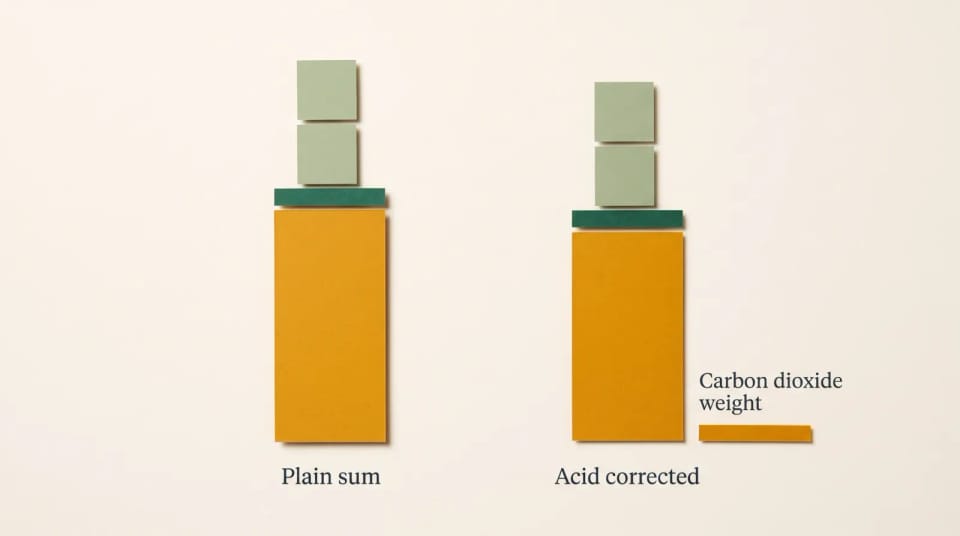
Same blocks, two totals. The acid-corrected method trims each acid form by its carbon dioxide weight before adding; the plain sum keeps it in. The illustration carries no real values on purpose.
There is a second wrinkle. The 0.877 factor is exact only for the THCA-to-THC pair. New Jersey’s guidance uses 0.878 for CBGA and 0.867 for THCVA and CBDVA. New Jersey CRC labeling guidance addendum New York tells labs to use 0.877 for any other marketed cannabinoid’s acid form. New York OCM testing limits Heat also changes each acid at its own pace: in one vacuum-oven study of extracts, THCA converted about twice as fast as CBDA and CBGA, and only the THCA reaction ran without side losses. Wang et al., 2016
Even total THC is not identical everywhere. Ohio adds delta-8 THC to its total and removed THCV from the calculation in April 2025. Ohio Division of Cannabis Control guidance Differences like these are one reason federal scientists run an interlaboratory program to help cannabis labs make their results comparable. NIST CannaQAP report, Phillips and Wilson, 2024
Can two labels have the same THC and different TAC?
Yes. Two products can print exactly the same total THC and still show different TAC, because TAC counts the cannabinoids that total THC ignores. Again, these are two labels we built to show the arithmetic, not real products. Both use the plain-sum method.
| Line | Label A | Label B |
|---|---|---|
| Delta-9 THC | 1.0% | 1.0% |
| THCA | 20.0% | 20.0% |
| CBGA | 1.2% | 0.1% |
| CBG | 0.4% | none detected |
| Total THC | 18.54% | 18.54% |
| TAC (plain sum) | 22.6% | 21.1% |
The 1.5-point TAC difference comes entirely from CBG and CBGA. Nothing about THC differs. A shopper who compares TAC alone sees Label A as “more,” but the extra is CBG and its acid, not THC.
The reverse also happens. A report that applies the acid correction to every acid, on a product with few minor cannabinoids, can show a TAC very close to total THC. Two TAC numbers from two labs are only comparable when you know both definitions. Our two-product worksheet shows what to compare instead.
Where do you find TAC on a COA?
TAC usually sits at the bottom of the cannabinoid potency table, next to or just below Total THC. Use this sequence to read it.
- Match the report to the package. A TAC from another batch tells you nothing about your jar. Here is how to make sure the COA is for this batch.
- Find the potency table. Look for the list of cannabinoids with percentages or mg/g. The totals are at the bottom.
- Read the definition next to TAC. Words such as “sum of above table” mean a plain sum. A formula with 0.877 on every acid means an acid-corrected total. No definition means you cannot tell.
- Check the reporting basis. New York requires flower results on a dry-weight basis; Ohio and Massachusetts require results “as received,” with no moisture correction. New York OCM testing limits Massachusetts Cannabis Control Commission bulletin The same flower reads higher on a dry-weight basis, because the water is removed from the denominator.
- Compare TAC with total THC. Subtract one from the other. Then check how much of the gap is THCA weight and how much is minor cannabinoids, as in the New York example.
Also read the abbreviations. “ND” means not detected, and “< LOQ” means the cannabinoid was found below the lowest amount the lab can measure reliably. SC Labs FAQ On the plain-sum report above, those lines added nothing to TAC.
Does a higher TAC mean a stronger high?
No. A higher TAC is not a forecast of a stronger high, and no study found for this article tests TAC as a predictor of effects. The reason is in what the sum contains.
Mechanism: TAC adds cannabinoids that act very differently. The CDC describes THC as impairing and CBD as not impairing, and notes that THCA is not psychoactive until heat converts it to THC. CDC cannabis FAQ A point of CBD and a point of THC count the same in TAC.
Absorption: The printed totals are ceilings, not what reaches you. In a 2005 smoking simulation, only about 30% of added THCA was recovered as THC. Dussy et al., 2005 A 2019 machine-smoking study found that THCA converted fully during combustion, but estimated lung availability for flower at about 19% to 27%. Hädener et al., 2019 Both were lab apparatus studies, not human trials, but they show that route and method change what is delivered.
Accuracy: The label number can be off. In a Colorado study of 23 flower samples, measured THC averaged 23.1% below the lowest label value. Schwabe et al., 2023 That study looked at labeled THC, not TAC, but the lesson carries over: a bigger number on a label is not proof of a bigger number in the jar.
Demonstrated effect: None for TAC. How a product feels depends on the dose you take, how you take it, your tolerance and the setting, which is the case we make in what THC percentage does and does not tell you. If you use the High IQ app, you can log how each batch actually worked for you, which tells you more over time than any total on a label.
If a product leaves you with a racing heart, chest pain, panic that does not settle, or confusion, get medical help. Talk to a clinician before using cannabis if you take prescription medicines, are pregnant, or have a heart or mental health condition. Nothing in this lesson is dosing or treatment advice.
Can TAC mean something else on a lab report?
Yes. On the microbial page of a lab report, TAC can mean Total Aerobic Count, a test for bacterial load measured in colony-forming units per gram (CFU/g). It has nothing to do with potency. A microbial-test vendor notes that the test cannot tell harmful bacteria from harmless ones and that “a low TAC result does not mean a cannabis sample is free of pathogens.” Medicinal Genomics application note
Both meanings can sit in the same document. The New York report above prints “Total Active Cannabinoids” on its potency page and “Total Viable Aerobic Bacteria” on its microbial page. MCR Labs report MCR-S26-00080 Check the units: a percentage or mg/g is potency, and CFU/g is microbiology.
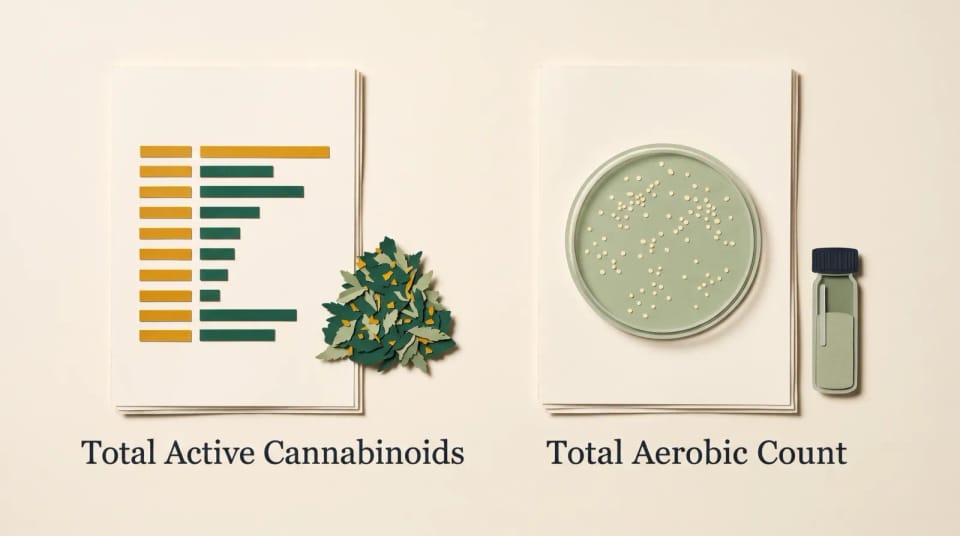
Same three letters, two different tests. Check the units: a percentage belongs to potency, CFU per gram belongs to microbiology. For the other safety panels, see the pesticide results guide.
Microbial, pesticide and heavy metal results are the safety panels that sit beside potency. A TAC result on one of those pages is a safety test, not a cannabinoid total.
Key takeaways
- TAC usually means total active cannabinoids, and each lab defines it.
- TAC is not THC and not total THC; it adds other cannabinoids and sometimes keeps THCA at full weight.
- On a real New York report, TAC was 41.8% and total THC 38.4%, and about two thirds of the gap was carbon dioxide weight.
- The same sample can give two TAC numbers, depending on the method.
- A higher TAC does not predict a stronger high.
- On a microbial page, TAC means Total Aerobic Count, a bacteria test.
FAQ
Does TAC include THCA?
On the reports checked here, yes. The difference is how: some labs add THCA at its full measured weight, and others multiply it by 0.877 first. The definition next to the TAC line tells you which.
Does TAC include terpenes?
Not on the reports checked here. The New York report prints Total Terpenes as its own line, outside the TAC sum. Terpenes are aroma compounds, not cannabinoids, so a terpene total belongs on a separate line.
Is a higher TAC better?
Not necessarily. TAC counts THC, CBD, CBG and other cannabinoids the same way, even though they act differently, and no study found here ties TAC to effects, quality or safety. Compare dose, format and the full cannabinoid table instead of one total.
What does 90% TAC mean?
By definition, it means the cannabinoids that the lab chose to add make up 90% of the sample’s weight, on that lab’s method and basis. It does not tell you which cannabinoids those are or how much reaches you. Read the table above the total to see what the number is made of.
Does TAC make you high?
TAC is a number on a report, not a substance, so it does not make you high by itself. The intoxicating part of what it counts is THC, including THCA after heat converts it. CBD, which TAC can also include, is not impairing.
Sources
- MCR Labs. Analytical Test Report MCR-S26-00080, Purple Punch (1g Infused PR). Report date January 20, 2026.
- SC Labs. FAQ: Sum of Cannabinoids and Total Cannabinoids. Accessed October 29, 2026.
- California Department of Cannabis Control. Cal. Code Regs. tit. 4, § 15724, Cannabinoid Testing. Cornell LII copy.
- Ohio Division of Cannabis Control. Ohio Adm. Code 3796:4-2-05, Testing laboratory reporting. Effective May 2, 2022.
- Ohio Division of Cannabis Control. Updated Guidance: Potency Testing and Reporting. April 2025.
- Massachusetts Cannabis Control Commission. Cannabinoid Reporting by Independent Testing Laboratories. November 27, 2023.
- New Jersey Cannabis Regulatory Commission. Packaging and Labeling Guidance, Revision 1.0, Addendum. February 18, 2025.
- New York Office of Cannabis Management. Cannabis Testing Limits. May 6, 2025.
- Medicinal Genomics. TAC Bacteria Testing for Cannabis: Total Aerobic Count. Accessed October 29, 2026.
- Yarberry A, Phillips MM, Wilson WB. Cannabis Laboratory Quality Assurance Program: Exercise 2 Cannabinoid Final Report. NIST, 2024. DOI: 10.6028/NIST.IR.8519
- Schwabe AL, et al. Uncomfortably high: Testing reveals inflated THC potency on retail Cannabis labels. PLoS One, 2023. DOI: 10.1371/journal.pone.0282396
- Dussy FE, et al. Isolation of Delta9-THCA-A from hemp and analytical aspects concerning the determination of Delta9-THC in cannabis products. Forensic Science International, 2005. DOI: 10.1016/j.forsciint.2004.05.015
- Hädener M, et al. A preliminary investigation of lung availability of cannabinoids by smoking marijuana or dabbing BHO and decarboxylation rate of THC- and CBD-acids. Forensic Science International, 2019. DOI: 10.1016/j.forsciint.2018.12.021
- Wang M, et al. Decarboxylation Study of Acidic Cannabinoids. Cannabis and Cannabinoid Research, 2016. DOI: 10.1089/can.2016.0020
- US Centers for Disease Control and Prevention. Cannabis Frequently Asked Questions. Reviewed January 31, 2025.
- National Center for Biotechnology Information. PubChem records for THC (dronabinol) and tetrahydrocannabinolic acid.



