

Where Can You Smoke Weed in Public? A State-by-State Rule Grid
Where can you smoke weed legally? Mostly on private property and at licensed sites. See the public-use rule and penalty in all 24 legal states and D.C.

Professor High
Written by Professor High, our AI guide. See how we research and correct articles.
In almost every US state with legal adult-use cannabis, the lawful places to use it are private property, with the owner’s permission, and licensed consumption sites. Streets, sidewalks and parks are off limits. A small group of states, including New York, New Jersey and Connecticut, writes the rule differently: it ties cannabis smoking to the tobacco smoking rules, so the state ban follows wherever tobacco smoke is already banned.
Here is the part that surprises people. The same act, lighting a joint on a public sidewalk, costs a civil fine of up to $25 in Virginia (Va. Code 4.1-1108), a violation with a fine of up to $1,000 in Oregon (ORS 475C.377 and ORS 153.018), and a misdemeanor punishable by up to 60 days in jail in Washington, D.C. (D.C. Code 48-911.01). “Legal weed” does not mean one rule.
This guide covers the 24 states plus D.C. that our state-by-state legality map counts as adult-use. It is a plain-language summary, not legal advice.
Statutes and agency pages checked October 29, 2026.
Can you smoke weed in public in a legal state?
Generally no. Every one of the 25 jurisdictions in the grid below restricts public use in its law. The differences are in how they write the rule, and they fall into four types:
| Rule type | What the law says | Where it applies |
|---|---|---|
| Public-use ban (all forms) | No consuming cannabis in a public place, whether smoked, vaped or eaten | 13 jurisdictions |
| Public smoking ban | No smoking cannabis in a public place; the section names smoking | 5 states |
| Follows tobacco rules | No smoking cannabis wherever tobacco smoking is banned; towns can add more | 4 states |
| Private places only | Use is allowed only in listed private places or licensed sites | 3 states |
Colorado is a clear example of the first type. Its legislative staff handbook says the ban on open and public use applies “regardless of the form in which the marijuana is consumed (smoking, eating, vaping, etc.)”, and it names parks, sidewalks, ski resorts, concert venues and apartment common areas as off limits. (Colorado Legislative Council, 2024 Marijuana Handbook)
Maine shows the last type. Its statute lets an adult consume cannabis only in a private residence, including the yard around it, or on private property not generally open to the public, with the owner’s explicit permission. (28-B M.R.S. 1501)
What is the public-use rule in each legal state?
Each row links to the statute or official page read for it. “Set elsewhere” means the penalty sits in a different section that this guide did not confirm. The last column records only an exception written into the text that was read; a “no” does not mean the state has no lounges.
| Jurisdiction | Rule type | Penalty in the text | Licensed-site exception in the text | Source |
|---|---|---|---|---|
| Alaska | Public-use ban | Violation, fine up to $100 | Not in this section | AS 17.38.040 |
| Arizona | Public smoking ban (includes open spaces) | Petty offense | Not in this section | A.R.S. 36-2853 |
| California | Public-use ban, plus no smoking where tobacco is banned | Set elsewhere (HSC 11362.4) | Yes, local licensed sites | HSC 11362.3 |
| Colorado | Public-use ban | Set elsewhere | Yes, hospitality licenses | Legislative handbook |
| Connecticut | Follows tobacco rules; towns may regulate | Set by town ordinance | Not on this page | CT cannabis portal |
| Delaware | Public-use ban (any area open to the public) | Misdemeanor, fine up to $200, jail up to 5 days | Not in this section | 16 Del. C. 4764 |
| District of Columbia | Public-use ban | Misdemeanor, up to 60 days in jail | No | D.C. Code 48-911.01 |
| Illinois | Public-use ban, plus Smoke Free Illinois Act | Set elsewhere | Not in this section | 410 ILCS 705/10-35 |
| Maine | Private places only | Civil, fine up to $100 | Not in this subsection | 28-B M.R.S. 1501 |
| Maryland | Public smoking ban | Civil, up to $50 first, up to $150 after | Not in this section | Crim. Law 5-601 |
| Massachusetts | Public-use ban, plus no smoking where tobacco is banned | Civil, up to $100 | Yes, where the town voted to allow it | M.G.L. c. 94G, 13 |
| Michigan | Public-use ban | Set elsewhere | Yes, municipal designated areas | MCL 333.27954 |
| Minnesota | Private places only | Not in this section | Yes, licensed premises and events | Minn. Stat. 342.09 |
| Missouri | Public smoking ban | Civil, up to $100 | Yes, licensed areas | Mo. Const. art. XIV, 2 |
| Montana | Public smoking ban | Civil, up to $50 | Yes, licensed areas | MCA 16-12-106 |
| Nevada | Public-use ban (also stores and vehicles) | Misdemeanor, fine up to $600 | Yes, by board regulation | NRS 678D.310 |
| New Jersey | Follows tobacco rules | Set elsewhere | Yes, consumption areas | NJ cannabis page |
| New Mexico | Public smoking ban | Civil, $50 | Yes, consumption areas | NMSA 26-2C-26 |
| New York | Follows tobacco rules (Clean Indoor Air Act) | Set elsewhere (Penal Law 222.10) | Yes, licensed dispensaries | NY Department of Health |
| Ohio | Private places only (for smoking and vaping) | Minor misdemeanor | Not in this section | ORC chapter 3796 |
| Oregon | Public-use ban | Class B violation, fine up to $1,000 | Not in this section | ORS 475C.377 |
| Rhode Island | Follows tobacco rules; cities may ban more | Set elsewhere | Not in this section | R.I. Gen. Laws 21-28.11-22 |
| Vermont | Public-use ban | Civil, $100, then $200, then $500 | Not in this section | 18 V.S.A. 4230a |
| Virginia | Public-use ban | Civil, up to $25 (up to $250 from July 1, 2027) | No | Va. Code 4.1-1108 |
| Washington | Public-use ban (also in view of the public) | Class 3 civil infraction | Not in this section | RCW 69.50.445 |
Two rows carry a date. Virginia’s first-offense fine rises from $25 to $250 on July 1, 2027, and a third offense is already a Class 4 misdemeanor. Ohio’s rules moved into chapter 3796 of the Revised Code under Senate Bill 56, effective March 20, 2026. Our Ohio cannabis law guide covers what else that bill changed.
Which states make public use a crime?
At least five treat it as a criminal offense rather than a civil fine: Arizona (petty offense), Delaware, D.C. and Nevada (misdemeanors), and Ohio (minor misdemeanor for smoking or vaping outside allowed private property). Virginia joins them on a third offense.
Delaware’s text is worth reading closely. Its “area accessible to the public” includes sidewalks, streets, alleys, parking lots and parks. It also includes any outdoor spot within 10 feet of a sidewalk or street, and within 10 feet of the entrances, exits, opening windows or air intakes of any public or private building. The penalty is a fine of up to $200, up to 5 days in jail, or both. (16 Del. C. 4764(d)) As of October 29, 2026, the code text still shows that misdemeanor.
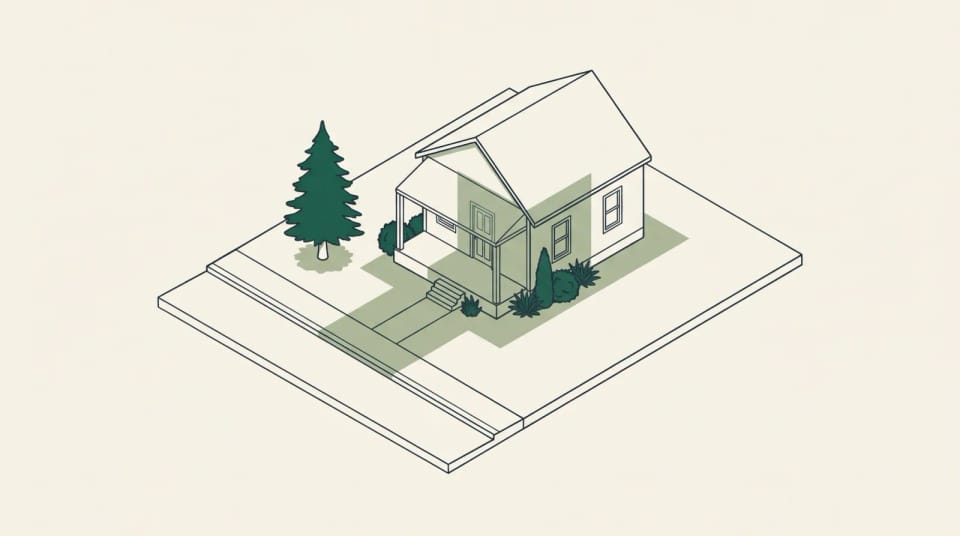
Delaware counts outdoor spots near sidewalks, streets and building entrances as public, so a front step on private property can fall inside the rule.
D.C. goes furthest on definitions. Its law counts any place the public is invited as public space, and it lists private clubs among them. (D.C. Code 48-911.01)
Where this guide confirmed the penalty, the other states use a civil fine or infraction, more like a parking ticket than an arrest. That is still a legal record of a violation, and the fine is not the only thing that can follow: a lease, a job or a park pass has its own rules.
What do “follows tobacco rules” states actually allow?
These states bar cannabis smoke wherever tobacco smoke is already barred, instead of writing a separate public-place ban.
- New York. The Clean Indoor Air Act defines smoking as burning tobacco, cannabis or cannabinoid hemp products. It bars smoking and vaping in most workplaces, restaurants, bars and public transportation areas. Its list of places where smoking may be allowed includes private homes, hotel rooms rented to guests and licensed cannabis dispensaries. (NY Department of Health)
- New Jersey. The state’s own page says cannabis smoking “is allowed where cigarette smoking is permitted, unless stated otherwise,” and that landlords may prohibit use. (NJ cannabis page)
- Connecticut. The state says you generally cannot smoke or vape cannabis anywhere you cannot smoke or vape tobacco. Cities and towns may pass ordinances on public use, and use is banned in state parks, on state beaches and on state waters. (CT cannabis portal)
- Rhode Island. The law says nothing in it authorizes smoking or vaping cannabis in any public place. It bans it where tobacco is banned or where a rule or local ordinance bars it. (R.I. Gen. Laws 21-28.11-22) Cities may ban it in parks, beaches and other public spaces. (21-28.11-16)
So “follows tobacco rules” is not a blanket permission. The state rule is a floor; the city and the property owner can both say no. Smoke rules track tobacco rules because the concern is the same: other people breathing it. Our guide to secondhand cannabis smoke covers what the exposure research shows. If smoke exposure brings on wheezing, chest tightness or other breathing symptoms, talk to a clinician.
Is it different if you eat an edible in public?
It depends on how your state wrote the rule. In the 13 “public-use ban” jurisdictions, the ban covers consuming, not just smoking. Colorado’s handbook says so in plain words. Maine, Minnesota and Ohio limit use to listed private places.
Arizona, Maryland, Missouri, Montana and New Mexico wrote their public-use sections around smoking. That does not make an edible on a park bench a legal right there. Other laws, park rules, city ordinances and the property owner can still apply, and this guide did not find a statute that grants public edible use anywhere.
Where can you legally use cannabis, then?
Three places, in most states.
- Private property, with the owner’s permission. Colorado’s handbook puts it simply: use is allowed only on private property in a way that is not open and public, and owners may restrict it. It notes that many hotels, apartments, rental properties, businesses and hospitals do. If you rent, read our guide to whether a landlord can ban cannabis.
- A licensed consumption site, where your state and town allow one. Colorado, Massachusetts, Michigan, Missouri, Montana, Nevada, New Jersey and New Mexico name some form of licensed or designated site in the text read for this guide. New Mexico’s consumption-area rules and Nevada’s lounge rules are covered in their state guides.
- Your own home, subject to your lease. This is the safest default everywhere in the grid.
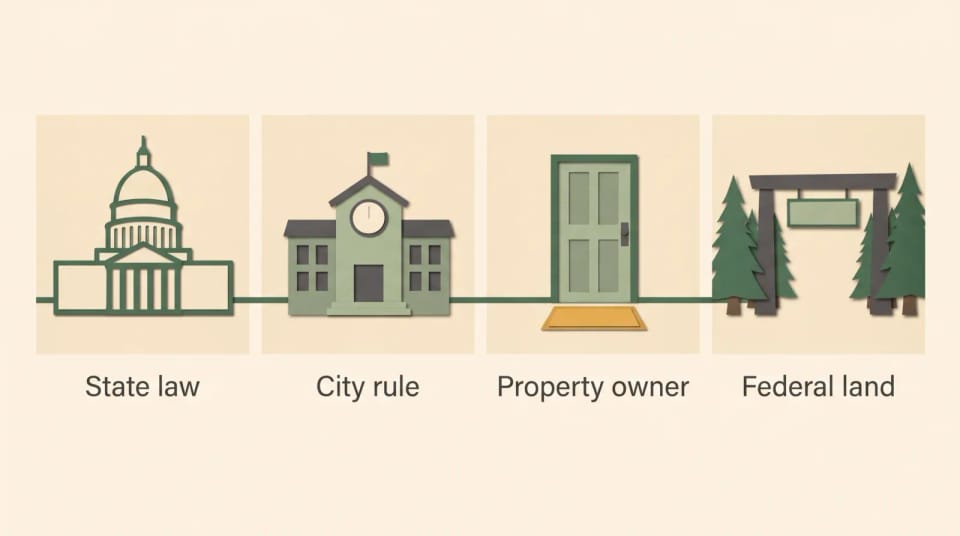
Each layer can say no on its own. A permissive state law does not overrule a city ordinance, a landlord or a national park.
Can a city ban it even if the state allows it?
Yes, in many states. Chicago is a useful example: the city says public consumption is illegal on streets, in parks and in areas next to licensed dispensaries, and allows consumption at businesses licensed for on-premises use and on private property at the owner’s discretion. (City of Chicago) Connecticut and Rhode Island write local regulation directly into state law.
Before you plan a trip, search the city’s own cannabis page, not just the state’s. Our cannabis tourism guide helps with trip planning, and the cannabis etiquette guide covers sharing a space when the law leaves room.
What about national parks, cars and crossing state lines?
State law does not change three answers.
- Federal land. The National Park Service says possession or use of marijuana inside a park unit is prohibited, because it remains illegal under federal law. (NPS, Bering Land Bridge) Colorado’s handbook adds wilderness areas.
- Vehicles. Nevada’s statute names vehicles alongside public places, and Delaware bans use in a moving vehicle. Driving after use is its own question; see how long to wait before driving.
- Planes and borders. Federal rules apply. See flying and crossing borders with cannabis and our state-by-state travel guide.
Key takeaways
- No legal state gives you a general right to use cannabis on public streets or in parks.
- Most bans cover all forms; five states’ sections name smoking; three states list only private places.
- New York, New Jersey, Connecticut and Rhode Island tie smoking to tobacco rules, and towns can add more.
- Penalties run from a $25 civil fine in Virginia to up to 60 days in jail in D.C.
- Check four layers: state law, city rule, property owner, federal land.
FAQ
Can you smoke weed in a hotel room?
Usually only if the hotel allows it. Connecticut requires hotels to ban cannabis smoking and vaping everywhere on the property, though they may not ban other legal consumption in nonpublic areas. (CGS 21a-422l) New York’s tobacco law allows smoking in rented hotel rooms, but the hotel can still set its own policy.
Can you smoke weed in a national park in a legal state?
No. The National Park Service prohibits possession and use inside its units and enforces federal law there, even in states with legal cannabis. State parks are a separate question, and Connecticut bans use in its state parks.
What happens if you get caught smoking weed in public?
It depends on the state. In most it is a civil fine or infraction, often $25 to $100 for a first offense. In Arizona, Delaware, D.C., Nevada and Ohio it is a criminal offense, and Oregon’s civil fine can reach $1,000.
Can tourists smoke weed in public?
No. The same rules apply to visitors and residents. A tourist’s lawful options are a private residence with the owner’s permission, lodging that allows it, or a licensed consumption site where the state and town permit one.
Is it legal to smoke weed on your own porch?
In most states, private property is the lawful place, but “in view of the public” can matter. Washington bans consuming in view of the general public. Delaware counts any outdoor spot within 10 feet of a sidewalk or street as public, which can include a front porch. Renters also need the landlord’s permission.



