Flying and Crossing Borders With Cannabis in 2026
Airports, airspace and international borders each answer to different law. What actually happens at each — and why non-citizens carry the worst risk.

Professor High
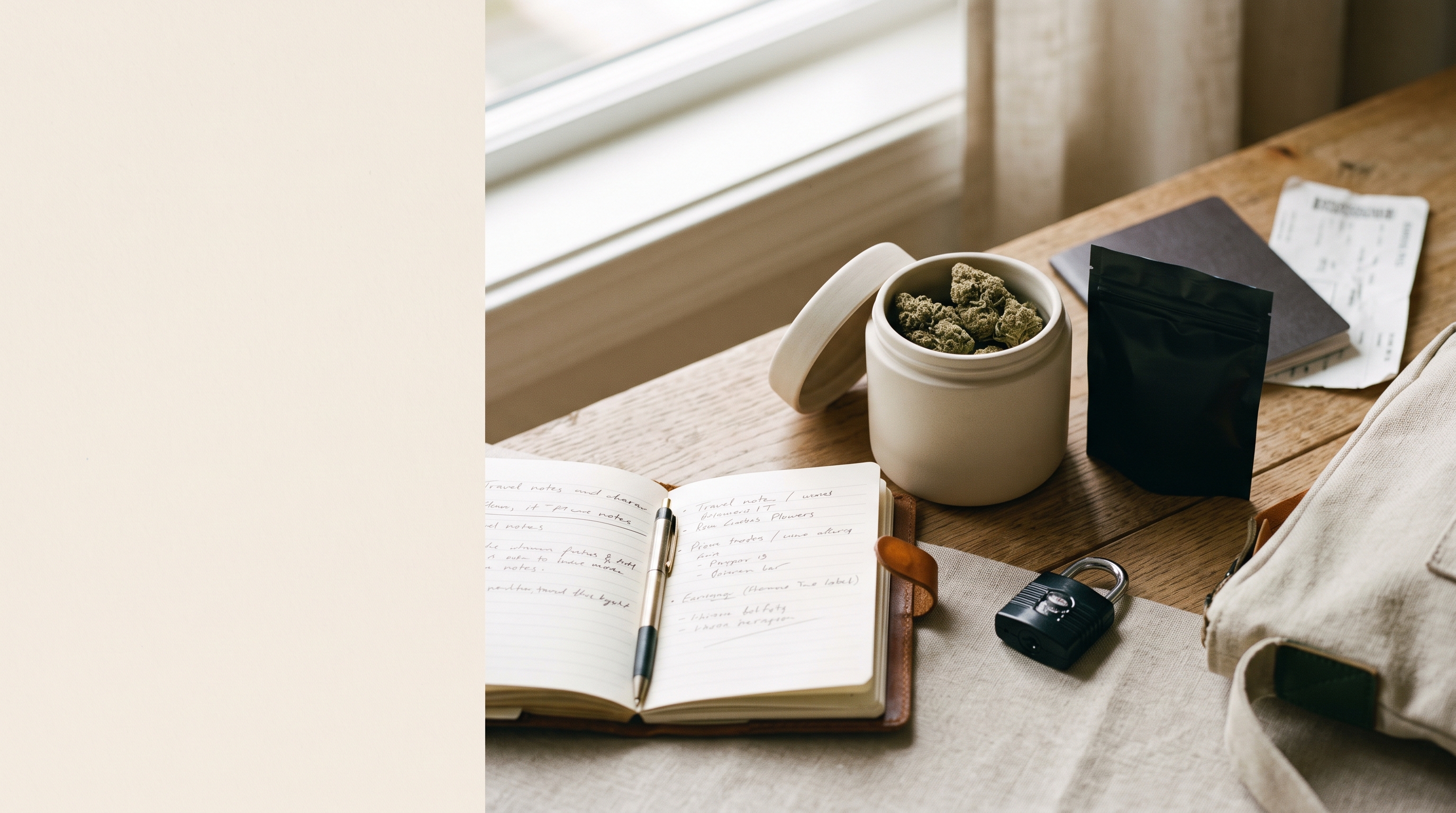
Same eighth, same TSA officer, completely different day
Two people fly out on the same Tuesday with the same legally purchased eighth in the same side pocket. One goes through Los Angeles and nothing happens. The other goes through a checkpoint in a prohibition state and spends the afternoon giving a statement to a city police officer.
Nobody broke a different law. The item was identical. What differed was whose officers were standing there when it was found, and what their employer had told them to do about it.
That is the whole puzzle. Once you see an airport as a stack of jurisdictions rather than one “is it legal” question, the inconsistency stops being mysterious. International borders are a genuinely different problem, and a far more serious one — especially if you are not a U.S. citizen.
This is general information, not legal advice. Laws, agency policy and local enforcement practice change, sometimes without announcement. Verify current rules with the relevant authority — and, if your immigration status is at stake, with a licensed immigration attorney — before you travel.
Four layers of law sit on top of the same carpet
| Layer | Who it is | What it governs |
|---|---|---|
| State law | Your state legislature | Whether possession is an offence at all |
| Airport operator policy | The city or authority that owns the airport | Whether cannabis is permitted on the property |
| Local police policy | Airport police or the city PD | Whether anyone gets arrested |
| Federal law | Congress, DEA, TSA, FAA | The checkpoint, the aircraft and the airspace |
The federal layer never goes away — it applies in Denver exactly as it applies in Dallas. What changes between airports is the middle two layers, and those are the ones that decide whether your trip continues.
It is the same structure that keeps interstate cannabis commerce illegal between two legal states, and the reason a state-by-state map tells you less about airports than you would expect.
What changed in April 2026 — and what did not
On 28 April 2026 the Acting Attorney General issued a final rule (91 FR 22714) moving part of the cannabis supply into Schedule III of the Controlled Substances Act. It is real, and much narrower than the headlines.
It covers exactly two things: FDA-approved drug products containing marijuana, and marijuana subject to a state-issued licence to manufacture, distribute or dispense it for medical purposes.
Everything else stayed put. The rule says so directly: “any form of marijuana other than in an FDA-approved drug product or marijuana subject to a state medical marijuana licence remains a schedule I controlled substance.”
So an adult-use eighth is still Schedule I. A licensed medical product is Schedule III. The legal status of what is in your bag now depends on its paperwork. Read what rescheduling actually means for you before assuming anything got easier.
One detail matters enormously later: the rule kept the import and export permit requirement, adding these Schedule III products to the list of substances that may only cross a border under a DEA permit. Rescheduling did not open a border.
What TSA says, and what TSA does
TSA updated its “What Can I Bring?” tool on 27 April 2026, the day before the order took effect. Search it now and you get one cannabis entry: Medical Marijuana. Carry-on: Yes (Special Instructions). Checked: Yes (Special Instructions).
The page then says, verbatim:
“TSA’s screening procedures are focused on security and are designed to detect potential threats to aviation and passengers. Accordingly, TSA security officers do not search for illegal drugs, but if any illegal substance or evidence of criminal activity is discovered during security screening, TSA will refer the matter to a law enforcement officer.”
Three things follow from that paragraph.
TSA is not looking for your cannabis. That is not a wink — it describes what their machines are calibrated for. Cannabis turns up incidentally, because an organic mass in a bag earns a second glance.
“Special Instructions” is currently a label with no instructions behind it. Firearms, lithium batteries and oversized medical liquids all have published rules you can read. Medical marijuana does not. The category exists; the guidance does not.
TSA does not decide what happens next. The referral does. Once the matter goes to law enforcement, the outcome is set by a police officer working under state law and local policy.
Why the airport police desk decides your day
Compare two published positions.
Los Angeles states on its own website that “APD officers, who are California Peace Officers, have no jurisdiction to arrest individuals if they are complying with state law” — while warning in the same paragraph that “TSA screening stations are under federal jurisdiction,” and that marijuana laws vary state by state.
Denver International has taken the opposite line since Colorado legalised: cannabis is not permitted on airport property, and passengers are asked to discard it before entering.
Neither is misapplying the law. They are answering different questions. Los Angeles is answering “what may our state peace officers arrest for?” Denver is answering “what do we permit on our property?” You can be entirely within state law and still breach an airport’s own rules.
Now flip the geography. Land in Texas or Florida, and the officer taking the referral at that end works from a very different rulebook. Many states also do not recognise out-of-state medical cards, so how card reciprocity works is worth checking before assuming documentation protects you.
There is one more federal thread: FAA regulation 14 CFR 91.19 makes it unlawful to operate a civil aircraft in the U.S. knowing marijuana is on board, unless the carriage is authorised by a federal or state statute or agency. It binds the operator, not you — but it is why airlines maintain their own bans, and why “the airport is fine with it” and “the airline is fine with it” are separate facts.
Amnesty boxes: real, useful, barely used
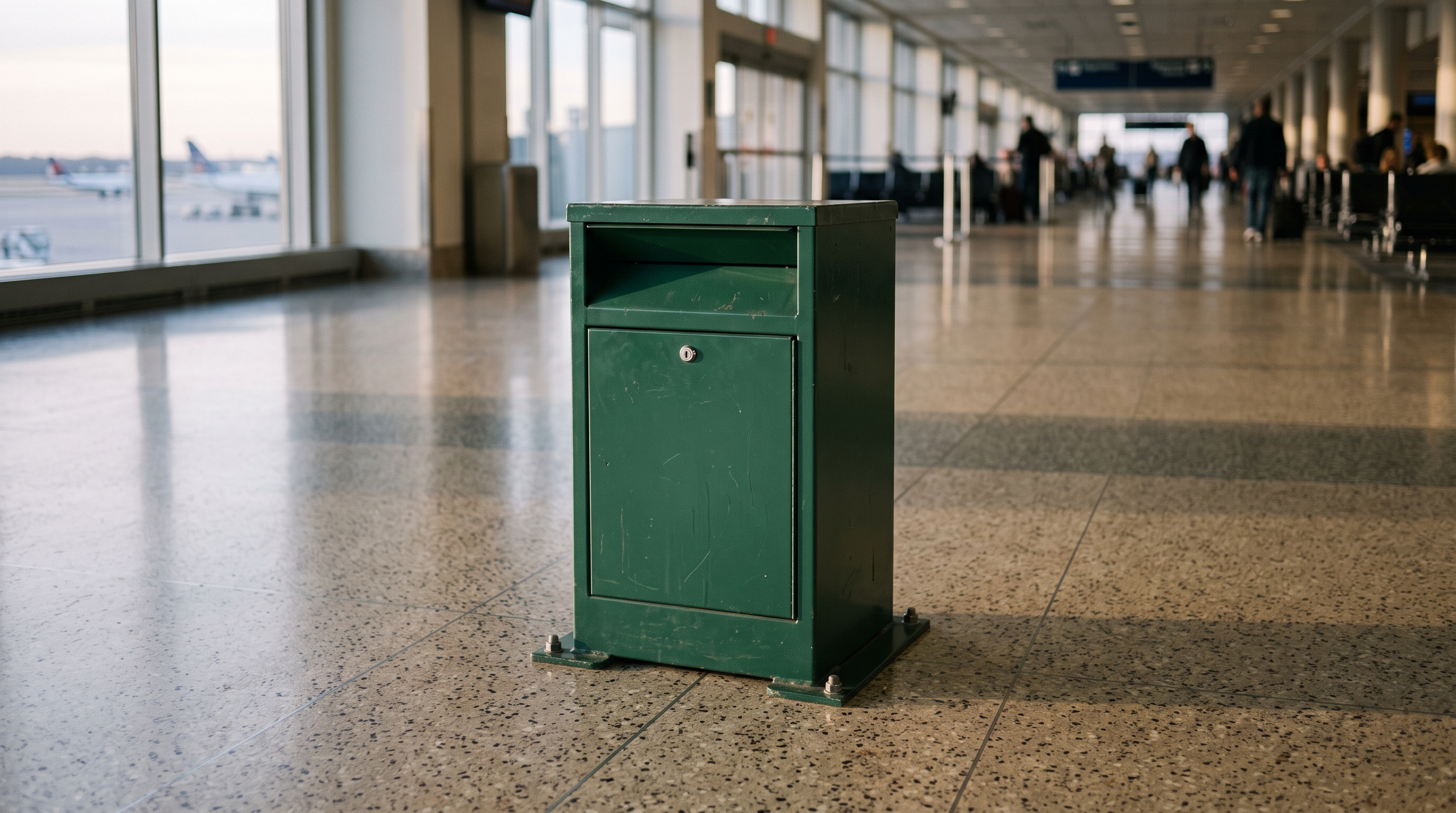
Colorado Springs installed the first ones in January 2014. Chicago followed in 2020 and now has twelve green steel boxes across O’Hare and Midway, emptied by Chicago police at a cost of roughly $29,000. Las Vegas has around a dozen.
They work as advertised: a receptacle placed before the checkpoint where you surrender cannabis with no questions and no record.
They are also almost never used. Chicago police logged just 34 collections from January 2020 through March 2022 across both airports, and only about half of those logs recorded anything resembling cannabis. Some boxes were functioning as expensive bins.
The lesson is not that boxes are useless — it is that nobody walks into a terminal thinking “I should check my pockets.” The box only helps someone who has already remembered. Hence the least glamorous advice here: check your bag at home. Carts hide in laptop sleeves, edibles live at the bottom of gym bags for months, and a disposable vape is the single most commonly forgotten item.
Two legal states, one federal sky
Los Angeles to Denver is a flight between two functioning adult-use markets. Both ends are legal. The middle is not.
Aviation is federally regulated end to end. The moment your bag enters the screening area you are in a federal enclave, and the moment the aircraft leaves the ground you are in federal airspace. The federal baseline has no gaps for convenient routes.
This is also why “I bought it legally and I have the receipt” is weaker than people expect. The receipt proves the purchase was lawful at the point of sale. It says nothing about the transport.
Hemp, CBD, and the checkpoint confusion
Hemp is where most honest mistakes happen, because two products can look identical, sit on the same shelf, and fall on opposite sides of a legal line.
The 2018 Farm Bill carved hemp out of the CSA’s marijuana definition using one number: not more than 0.3% delta-9 THC on a dry weight basis. Because it referred only to delta-9, a large market in delta-8 and THCA products grew in the gap — the so-called farm bill loophole.
That gap is closing. The FY2026 agriculture appropriations act (P.L. 119-37, enacted 12 November 2025) rewrote the definition to use total THC rather than delta-9 alone, and added a ceiling of 0.4 milligrams of total THC per container for finished hemp-derived cannabinoid products. Congressional Research Service analysts note the new definition takes effect 12 November 2026, at which point products falling outside it move back into Schedule I. Our 2026 hemp regulation explainer covers the market fallout, and what happened when hemp-derived THC reached children covers why it changed.
Three practical points:
- A compliant CBD product is not a federal offence, but an officer cannot tell by looking. A tincture, gummy or topical needs its label and certificate of analysis to make its own case. Knowing full-spectrum from broad-spectrum from isolate tells you what you are actually carrying.
- After 12 November 2026, “it’s hemp” stops being a reliable answer for most intoxicating products.
- Abroad, none of this transfers. Many countries have no hemp carve-out at all.
International borders are a different category of risk
Everything above concerns a bad day. What follows can concern the rest of your life.
Crossing an international border with cannabis is not domestic possession. It is import or export, separately prohibited, with its own penalties — and the April 2026 rescheduling deliberately preserved the DEA permit requirement for moving any cannabis product, Schedule III included, across a border.
Canada: legal on both sides, illegal in between
Canada legalised adult use in 2018. Twenty-four U.S. states have adult-use programmes. It changes nothing at the line between them. The Canada Border Services Agency puts it plainly:
“Transporting cannabis across the border in any form – including any oils containing THC or cannabidiol (CBD) - without a permit or exemption authorized by Health Canada remains a serious criminal offence subject to arrest and prosecution, despite the legalization of cannabis in Canada.”
CBSA specifies the prohibition applies regardless of amount, regardless of whether you hold a medical document, and regardless of where you are travelling from. Their slogan is four words: Don’t bring it in. Don’t take it out. Our Canadian law guide covers the domestic picture; the border is a separate rule.
If you are not a U.S. citizen, read this twice
U.S. immigration law does not care that your conduct was legal where it happened.
Under INA 212(a)(2)(A)(i)(II), any non-citizen “convicted of, or who admits having committed, or who admits committing acts which constitute the essential elements of” a violation of any law relating to a controlled substance is inadmissible. Note what is missing from that sentence: a conviction. An admission alone is sufficient. Two further grounds sit alongside it — INA 212(a)(1)(A)(iv) for anyone determined to be a drug abuser or addict, and INA 212(a)(2)(C) for anyone an officer has “reason to believe” is or has been a trafficker.
Rescheduling did not fix this. The statute is tied to “a controlled substance (as defined in section 802 of title 21),” and 21 U.S.C. 802(6) defines that term as anything in schedules I through V. Schedule III is still a controlled substance. Immigration attorneys analysing the April 2026 order reached the same conclusion: it may supply arguments at the margins for a documented patient in strict compliance with a state programme, but the INA has not been amended and the exposure remains.
The waiver is narrower than people assume. Under INA 212(h), the Attorney General may waive the controlled substance ground only “insofar as it relates to a single offence of simple possession of 30 grams or less of marijuana.” One offence. Simple possession. Thirty grams. Nothing else in that ground is waivable.
It also reaches past the border booth. USCIS policy treats a violation of federal controlled substance law as a conditional bar to the good moral character required for naturalisation — same narrow 30-gram exception — even where the conduct was lawful under state law. The Immigrant Legal Resource Center has documented the practical shape of this for years: a lawful permanent resident who uses cannabis legally at home is generally not deportable for it, but that same person returning from a short trip abroad is examined under the inadmissibility grounds, and an admission made at that moment can cost the green card permanently. Employment in a licensed, tax-paying cannabis business has been treated as grounds for a “reason to believe” trafficking finding.
Practitioner guidance is consistent and narrow:
- Do not carry cannabis across any U.S. border — any form, including CBD, any quantity, card or no card.
- Do not lie to an officer. Misrepresentation is its own serious ground.
- You are not obliged to answer questions about past conduct. You may decline, and you may ask to withdraw your application for admission rather than answer. That is discretionary and not guaranteed, but it is often far less damaging than an admission.
- Clean your phone and your social media. A photograph inside a dispensary has been the opening for exactly the questioning that produces an admission.
- Speak to a licensed immigration attorney before any international trip if you have any cannabis history. Not after.
Countries where the penalty is not a fine
These are official positions, not folklore.
| Country | Official position |
|---|---|
| Singapore | The Central Narcotics Bureau publishes tiered penalties: possession under 330g carries up to 10 years or a S$20,000 fine; trafficking, import or export of more than 500g makes the offender liable for the death penalty. Consumption alone carries a minimum of one year. UK Foreign Office advice adds that sentences apply “including when transiting through the airport,” and that scanners are used on the baggage of transiting passengers. |
| Japan | The Cannabis Control Act was amended to criminalise use itself, effective 12 December 2024, with maximum penalties raised to seven years. U.S. State Department advice is blunt: marijuana and certain prescription drugs “are illegal in Japan, even if you have a prescription from the United States.” |
| UAE | Zero tolerance. Possession of even the smallest amount can bring a minimum three-month prison term; trafficking sentences can include the death penalty; and drugs in your bloodstream are counted as possession. Some CBD products, skincare items and vape refills are illegal. |
| Indonesia | Zero tolerance, with long sentences or the death penalty possible. Official guidance specifically lists medicinal cannabis, cannabis oils and creams, hemp products, CBD, THC, hash and edibles as illegal, “whether carried in a bottle, vape, or any other form.” |
Note the pattern: transit counts, CBD counts, and a prescription from home counts for nothing. Thailand, which liberalised and then reversed course, is a reminder that status can change between booking and landing. Even permissive destinations — the Netherlands, Spain, Germany, Portugal, Uruguay, Mexico, Australia, South Africa — permit conduct inside their borders. None permit you to arrive carrying.
Medical patients and prescriptions
There is a real international mechanism for prescribed controlled medicines, though cannabis usually falls outside it.
Within the Schengen Area, Article 75 of the Schengen Implementing Convention provides for a certificate, issued or authenticated by your country’s competent authority on the basis of a medical prescription, allowing a resident to carry prescribed narcotic or psychotropic medicines. It is valid for a maximum of 30 days, and you need a separate certificate per substance.
Outside Schengen there is no harmonised system. The International Narcotics Control Board says so directly: “each country regulates this matter differently,” and it recommends contacting the embassy or consulate of your destination. Most countries want a prescription from a licensed doctor, often translated, capped at a 30 to 90 day supply.
None of that makes a U.S. medical card portable. It is a state document, frequently unrecognised by other U.S. states, and it carries no weight whatsoever at an international border.

What to actually do
Domestic flights. Leave it. The cost-benefit is not close — you are risking a missed flight, a police interaction and a record to avoid buying a replacement at the other end for the price of lunch. If you find something at the terminal, use an amnesty box; if there isn’t one, walk back out to your car.
Buy at your destination. In any legal state this is trivial. If you have never done it in an unfamiliar market, what to expect on a first dispensary visit and how to choose a dispensary will get you there. Learn the local possession limits — Colorado, Nevada and Illinois all set them differently — and remember that driving impaired is a serious offence in every state, legal or not.
International trips. Do not carry. Not flower, not edibles, not a vape, not CBD, not a topical, not a bottle from a pharmacist. Check the destination’s official position — your own government’s travel advice page is the fastest reliable source — and check it again for anywhere you transit, because transit is where several of the harshest systems catch people.
If you are not a U.S. citizen, the rule is simpler and stricter: cannabis is something you do not carry, do not discuss with an officer, and do not photograph.
Buying at the destination beats smuggling anyway
The thing you were trying to bring was never really the product. It was the effect — a specific experience you have learned to trust.
That experience does not live in the name on the jar. It lives in the chemistry. The reason your favourite Blue Dream works for you is a particular cannabinoid ratio and terpene profile: perhaps the myrcene and caryophyllene load that leaves you relaxed rather than wired, or the limonene lift that keeps you uplifted. Two jars sharing a name can be chemically unrelated, which is why “just get the same strain” so often disappoints — and why organising by High Family travels better than a name ever will.
So at an unfamiliar counter, do not hunt for the name. Describe the chemistry: a balanced profile for daytime, an uplift profile if you want focused energy, a relax profile if you want sleep. Ask for the certificate of analysis. If Granddaddy Purple is what works at home, its terpene signature is what you are shopping for — and the same logic finds you a substitute for Sour Diesel, Northern Lights or Jack Herer in a market that has never heard of your local grower.
That is the whole This Is Why I’m High thesis in travel form: strain names are unreliable, chemistry and your own response are what matter. Track what works for you in the High IQ app and you carry the useful part of your stash — the data — through any checkpoint in the world, without carrying anything at all.
Frequently asked questions
Can I fly with medical marijuana now that TSA lists it as allowed? TSA’s tool lists it as permitted with “Special Instructions” but has not published what those instructions are. Federal law now treats state-licensed medical cannabis as Schedule III, which is still a controlled substance, not a legal one. The referral language is unchanged, so a local officer under state law still determines the outcome. Attorneys quoted since the change describe it as safer than before, not risk-free, and suggest medical-state to medical-state flights, original packaging, and your card on you.
Is it legal to fly with cannabis between two legal states? No. Screening areas and airspace are federally regulated, so the flight never enters the protection of either state’s law.
What happens if a TSA officer finds cannabis in my bag? TSA refers it to law enforcement. What follows depends entirely on the state you are in and local police policy — which is why the same discovery is a shrug at one airport and an arrest at another.
Is CBD safe to fly with? Domestically, a compliant hemp product is not a federal offence, but bring the label and the certificate of analysis, because an officer cannot verify it by sight. From 12 November 2026 the federal definition narrows to total THC with a 0.4 mg per container ceiling, so many products sold as hemp today will no longer qualify. Internationally, assume CBD is treated as cannabis — the UAE and Indonesia both ban it explicitly.
I have a medical card. Does that help at an international border? No. Canada’s border agency states expressly that holding a medical document does not change the prohibition. Schengen’s Article 75 certificate covers prescribed controlled medicines for up to 30 days per substance, but it cannot make cannabis lawful in a country that prohibits it.
I am a visa or green card holder. What is my actual risk? Higher than a citizen’s, and it does not require a conviction. An admission to committing acts constituting a controlled substance offence is itself a ground of inadmissibility, and the only waiver covers a single offence of simple possession of 30 grams or less. Rescheduling did not change the statute. Speak to an immigration attorney before you travel.
Sources
Legal and government sources verified for this article:
- DEA / Office of the Acting Attorney General, Schedules of Controlled Substances: Rescheduling of Food and Drug Administration Approved Products Containing Marijuana From Schedule I to Schedule III, final rule, 91 FR 22714, effective 28 April 2026 — federalregister.gov
- Transportation Security Administration, What Can I Bring? — Medical Marijuana, last updated 27 April 2026 — tsa.gov
- Los Angeles World Airports, LAX Marijuana Policy — flylax.com
- 14 CFR 91.19, Carriage of narcotic drugs, marihuana, and depressant or stimulant drugs or substances — ecfr.gov
- 8 U.S.C. 1182 (INA 212), grounds (a)(1)(A)(iv), (a)(2)(A)(i)(II), (a)(2)(C) and the (h) waiver — uscode.house.gov
- 21 U.S.C. 802(6), definition of “controlled substance” as schedules I through V — uscode.house.gov
- USCIS Policy Manual, Volume 12, Part F, Chapter 5, Conditional Bars for Acts in Statutory Period — uscis.gov
- Immigrant Legal Resource Center, USCIS Policy Manual Penalizes Legalized Marijuana, practice alert by Kathy Brady — ilrc.org
- U.S. Customs and Border Protection, CBP Reminds Travelers from Canada that Marijuana Remains Illegal in the United States — cbp.gov
- Canada Border Services Agency, Travellers: Cannabis at the border — cbsa-asfc.gc.ca
- Congressional Research Service, Change to Federal Definition of Hemp and Implications for Federal Enforcement, IN12620, 3 December 2025 (Neuhofer, Sacco and Sheikh) — congress.gov
- Singapore Central Narcotics Bureau, Singapore’s anti-drug laws on Cannabis, last updated 3 July 2026 — cnb.gov.sg
- UK Foreign, Commonwealth and Development Office travel advice for Singapore, Indonesia and the United Arab Emirates — gov.uk
- U.S. Department of State, Japan International Travel Information — travel.state.gov
- International Narcotics Control Board, General Information for Travellers Carrying Medicines Containing Controlled Substances, including the Schengen Article 75 certificate — incb.org
- Chicago Sun-Times reporting on amnesty box collection logs at O’Hare and Midway, obtained under open records request (Tom Schuba, 6 April 2022); NBC News on the first amnesty boxes at Colorado Springs Airport (Erik Ortiz, 15 January 2014)
