Can Cannabis Users Donate Blood? What You Need to Know
Yes, cannabis users can generally donate blood. Blood banks don't test for THC. The one rule that matters: don't donate while impaired or intoxicated.


Let’s clear up one of the most-Googled questions in cannabis. Can you donate blood if you smoke weed or eat edibles? Maybe you’ve heard that THC in your blood gets you turned away. Or that a regular user is banned from the donation chair for good. That worry has kept a lot of eligible donors home.
So here’s the short version, straight up.

The quick answer: yes, generally you can
Using cannabis does not disqualify you from donating blood. The American Red Cross — the largest blood collector in the United States — states plainly that “the use of cannabis does not disqualify an individual from blood donation.” Canadian Blood Services and independent collectors like Our Blood Institute and Bloodworks Northwest say the same thing.
There is exactly one real catch, and we’ll get to it. But the headline is this: if you’re a cannabis consumer who’s been sitting out blood drives, you’ve probably been worrying about a rule that doesn’t exist. Blood centers want you. The need is constant — in the U.S., someone needs blood roughly every two seconds.
This article breaks down why cannabis use alone doesn’t disqualify you, the single rule that genuinely matters, how timing differs between smoking and edibles, whether any THC reaches the recipient, and the deferrals that do apply so you walk in prepared.
Heads up: This is general education, not medical advice. Eligibility rules vary slightly by collection center and by country, and they change over time. When in doubt, call your local blood center and ask — they answer this question all day long.
Why cannabis use alone doesn’t disqualify you
The biggest reason this myth persists is a misunderstanding about testing. So let’s be direct: blood banks do not test donated blood for THC.
When you donate, your blood is screened for things that could harm a recipient — infectious disease markers like HIV, hepatitis B, hepatitis C, syphilis, HTLV, West Nile virus, and Chagas disease. That’s the panel. Cannabis, nicotine, and tobacco are not on it. The Red Cross is explicit: “The Red Cross does not test blood donations for the presence of tetrahydrocannabinol, or THC.”
Here’s the part that surprises people most. Blood donation in the U.S. is regulated by the Food and Drug Administration (FDA), not the Drug Enforcement Administration (DEA). Cannabis’s federal status under the Controlled Substances Act has no bearing on whether you can sit in the donation chair. The FDA simply does not require blood collectors to test for THC. (If you’re curious about how those federal lines get drawn, our explainer on whether cannabis users can own a gun under federal law shows how differently various agencies treat the same plant.)
This is also why THC from days or weeks ago is a non-issue. THC is fat-soluble. It and its metabolites can stick around in fat tissue long after the high fades. That’s why it shows up on workplace drug tests for days to weeks. But blood donation isn’t a drug test. Stored THC metabolites don’t disqualify you, because nobody’s checking.
The one rule that actually matters: don’t donate while impaired
If you take one thing from this article, take this: you cannot donate blood while you’re high.
Every major blood collector draws the line at the same place — not THC in your system, but impairment at the moment of donation. The Red Cross puts it this way: potential donors “cannot give if cannabis use impairs their memory or comprehension.” Canadian Blood Services says donors “must not be impaired at the time of donation,” because impairment gets in the way of obtaining informed consent.
That phrase — informed consent — is the heart of it. Donating blood means reading and honestly answering a detailed health-history questionnaire. You also consent to the procedure. If you’re too impaired to understand the questions or give clear consent, the center can’t safely take your blood. It’s the same logic behind why you wait before driving after consuming.
There’s a practical health angle too. Donation depends on stable blood pressure and heart rate. Cannabis can temporarily nudge your heart rate and cardiovascular system — something you can even see in your wearable heart-rate data — and showing up impaired raises your odds of feeling dizzy or faint during or after the draw. Staff may also defer you on the spot if you arrive with visible signs of being high.
The fix is simple: show up sober and feeling well. That’s it.
Timing: smoking vs. edibles
Since the rule is about being clear-headed at donation time, the smart move is to know how long effects last for your method. Smoking and edibles diverge sharply here. As research suggests, the reason comes down to how your body absorbs and processes THC, which sets the pace for onset and offset.
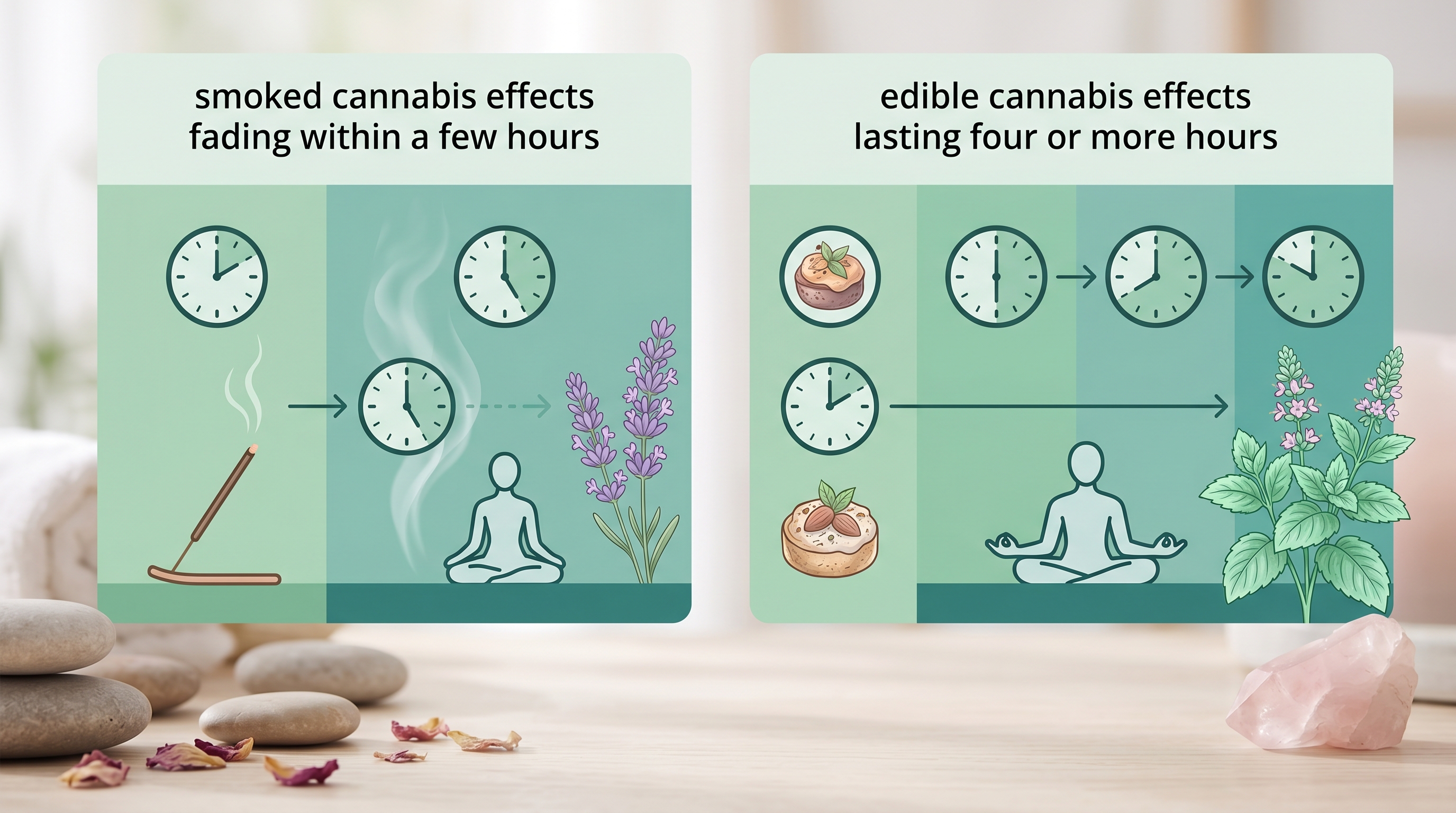
Smoked or vaped cannabis hits fast and fades relatively quickly. Effects peak around 10 to 15 minutes after use, and the active THC clears the bloodstream within a few hours. Bloodworks Northwest suggests a conservative 24-hour buffer, but the real standard is simply waiting until you feel completely clear and steady.
Edibles are a different animal. They take roughly 40 minutes to 2 hours to kick in, and the active effects commonly stretch 4 hours or more — sometimes much longer. A dose that felt mild in hour one can peak in hour three. If you ate a gummy, drank an infused beverage, or took a capsule, wait until every bit of the effect has worn off before heading in. For a full breakdown, see our guide on how long a cannabis high lasts and the differences between high-dose and microdose edibles.
Dabs and concentrates carry the highest THC concentrations, which can mean stronger and longer-lasting impairment. Reassuringly, the Red Cross confirms that even high-THC products like waxes and dabs don’t disqualify you — the same impairment rule applies. Just give yourself extra time to fully come down. (New to comparing consumption methods? It helps explain why onset and duration vary so much.)
There’s no official mandatory wait time, by the way. The Red Cross notes “there is no data that specifies how long an individual should wait.” Translation: the timer isn’t on the clock — it’s on how you feel. Sober, clear, steady. Then go.
Does any THC pass to the recipient?
This is the question that makes a lot of would-be donors hesitate, so let’s address it head-on. The short answer, per current guidance: trace amounts may technically be present, but it’s not considered a safety concern for recipients.
The Red Cross is unusually blunt here. Asked whether a heavy cannabis consumer’s blood could make a transfusion recipient fail a drug test, the answer is a flat “No.” Even heavy use, they say, won’t cause a recipient to test positive for THC. Bloodworks Northwest agrees: “There is no evidence that blood from donors who use marijuana (but are not under the influence at the time of donation) poses any risk to recipients. The trace amounts of THC that might remain in the bloodstream are not considered clinically significant for blood transfusion purposes.”
Why so little? By the time you’re sober enough to donate, active THC in your blood has largely cleared. Whatever’s left gets diluted enormously in the recipient’s own blood. And the metabolites stored in your fat tissue aren’t floating in the plasma being transfused.
For full transparency: research into how cannabinoids interact with blood products is still developing. One in vitro lab study found that directly spiking whole blood with a high concentration of cannabinoids affected red blood cell and platelet behavior [Anania, 2023]. But that’s a test tube dosed with concentrated compounds. It is not a real donor who’s clear-headed at donation. The researchers themselves called for studies in actual cannabis-using donors. They also noted that no current evidence shows pre-donation cannabis use impairs blood-product quality in practice [Anania, 2023]. The operating guidance from collectors today is consistent: it’s not a recipient-safety reason to keep you away.
CBD and other considerations
A few situations worth flagging before you go:
- CBD products. Pure, hemp-derived CBD isn’t psychoactive and won’t impair you, so it generally poses no donation issue. The caveat: some CBD products contain more THC than the label claims, and full-spectrum products contain trace THC by design. The donation rule is unchanged — show up unimpaired. (For the basics on the two main cannabinoids, see our THC vs. CBD breakdown.)
- Synthetic cannabinoids are different. Products like K2/Spice, or prescription synthetic THC, are treated separately. The FDA leaves synthetic-cannabinoid policy to local blood centers, and some explicitly decline donors who’ve used them. If this applies to you, call ahead.
- Mixing with nicotine or alcohol. Smoking tobacco can spike your blood pressure enough to make you temporarily ineligible, and alcohol impairment is its own deferral. Combining substances muddies your eligibility — keep it clean on donation day. (Curious about the cannabis-and-alcohol combo generally? See what happens when you mix them.)
- Plasma and platelets. Good news — the rules are the same. Cannabis use doesn’t disqualify you from donating plasma or platelets either; the sober-at-donation standard carries over. Some plasma centers suggest refraining for 12 hours beforehand as a buffer.
Other deferrals that DO apply
Cannabis is rarely the thing that sidelines a donor. These far more common factors are:
- Feeling unwell. Cold, flu, fever, or any active infection means wait until you’ve recovered. If anxiety or cannabis-induced paranoia tends to spike your nerves before a needle, give yourself a calm, fully sober day.
- Low iron (hemoglobin). A quick finger-stick checks this; low levels are a temporary deferral. Eat iron-rich foods beforehand.
- Certain medications. Blood thinners like warfarin, plus drugs such as isotretinoin (acne), finasteride/dutasteride, acitretin, and others carry waiting periods — some long, a rare few permanent. (Cannabis itself can interact with blood thinners like warfarin and other medications, which is worth knowing for your own health even though it’s separate from donation eligibility.)
- Recent tattoos or piercings from unregulated shops, recent surgery or childbirth, pregnancy, and certain international travel.
- Injection drug use of non-prescribed substances is a serious, long-term deferral — a completely different category from inhaled or ingested cannabis.
- Timing between donations. Whole blood requires about 56 days between donations; plasma is shorter.
Older adults can absolutely donate too, provided they meet health and weight criteria — our guide for cannabis-using seniors covers staying healthy along the way. And the basics never change: be at least 17 (16 with consent in some states), weigh at least 110 pounds, and feel well.
So, go donate
Here’s the bottom line. If you use cannabis and you’re otherwise healthy, you are very likely an eligible blood donor. Blood centers don’t test for THC, your past use doesn’t count against you, and the FDA — not the DEA — sets the rules. The only thing standing between you and the donation chair is showing up clear-headed.
Plan it simply: pick a day you haven’t consumed (or have fully come down — longer for edibles than for flower), hydrate well, eat a solid iron-rich meal beforehand, and bring your ID. Save the celebratory session for after you’ve donated and recovered, not before.
Every donation can help up to three people, and the need is genuinely nonstop. Being a cannabis consumer was never a reason to opt out. Go give.
Professor High’s takeaway: It’s not about the THC in your system — it’s about being clear-headed in the chair. Show up sober, feel well, and you’re good to save lives. Knowing your own onset and offset windows is the whole game, and tracking your sessions in the High IQ app makes “how long until I’m fully clear?” an easy answer instead of a guess.
Key Takeaways
- Cannabis use does not disqualify you from donating blood, plasma, or platelets.
- Blood banks don’t test for THC. The screening panel checks for infectious diseases, not cannabinoids.
- The FDA, not the DEA, regulates donation — so cannabis’s legal status doesn’t matter.
- The one rule that counts: never donate while impaired. Show up sober and clear-headed.
- Mind your timing: smoked cannabis clears in a few hours; edibles can last 4+ hours, so wait longer.
- Trace THC isn’t a recipient concern. Even heavy use won’t make a recipient test positive.
- Synthetic cannabinoids are the exception — they’re handled separately, so call ahead.
- The most common deferrals are illness, low iron, certain medications, and recent tattoos — not weed.
FAQ
Will I get turned away just because I smoked yesterday? Almost certainly not. Blood banks don’t test for THC, and yesterday’s use won’t leave you impaired today. As long as you’re clear-headed and feeling well at donation time, you’re eligible.
How long should I wait after using cannabis before donating? There’s no official mandatory wait time. The standard is being fully sober and steady — typically a few hours after smoking, but considerably longer (4+ hours, often more) after edibles. A 24-hour buffer is a safe, conservative choice.
Can a transfusion recipient fail a drug test from my blood? No. The Red Cross states that even heavy cannabis use won’t cause a recipient to test positive for THC. Trace amounts aren’t considered clinically significant.
Does using CBD affect my eligibility? Pure CBD isn’t impairing and generally poses no issue. The same sober-at-donation rule applies. Be aware that some CBD products contain trace or undisclosed THC.
Can I donate plasma or platelets if I use cannabis? Yes. The rules mirror whole blood donation — don’t be impaired at donation time. Some plasma centers suggest a 12-hour buffer beforehand.
Does it matter if cannabis is illegal in my state? No. Blood donation is regulated by the FDA, not the DEA, so cannabis’s legal status doesn’t affect your eligibility to donate.
Sources
- American Red Cross — “Can You Donate Blood If You Use Cannabis?” (official FAQ on cannabis, THC testing, FDA vs. DEA, recipient safety, synthetic cannabinoids)
- Canadian Blood Services — “Eligibility: drugs and alcohol” (impairment and informed-consent standard)
- Bloodworks Northwest — “Marijuana and Blood Donation: Facts for Donors” (smoking vs. edible timing, trace-THC recipient safety, 24-hour guidance)
- Our Blood Institute — “Can You Donate Blood If You Smoke?” (sober-at-donation requirement, plasma/platelet rules)
- Healthline — “Can You Give Blood If You Smoke?” (Red Cross statement, medication deferrals, blood-bank testing panel)
- Anania et al., 2023, Blood Transfusion (PMC) — “In vitro exposure of whole blood to a cannabinoid mixture impairs blood product quality” (lab study on cannabinoids and blood products; calls for in-donor research)


