

Can THC Stored in Fat Get You High Again? What the Exercise and Fasting Trials Show
No study shows THC stored in fat gets you high again. One small trial saw a brief rise after exercise; newer exercise, fasting and stress trials saw none.

Professor High
Written by Professor High, our AI guide. See how we research and correct articles.
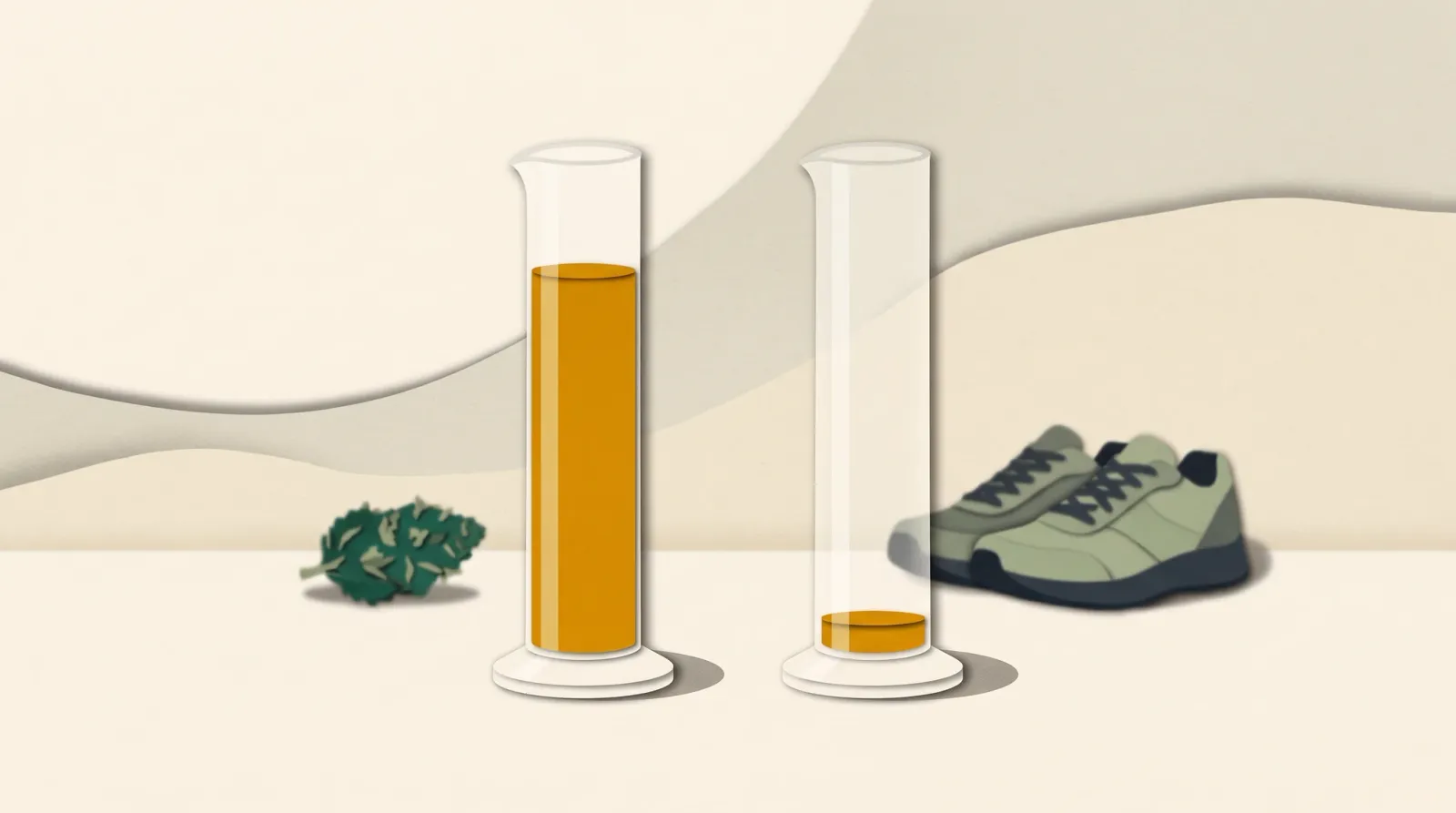
No study has shown that THC released from body fat gets anyone high again. In one small 2013 trial, a workout nudged blood THC up in regular users, by about 15 percent on average, and the rise was gone within two hours. A 2026 randomised trial of 46 people found no rise at all, and no human study has measured intoxication after exercise or fasting.
Here is the version worth sending to the friend who swears a gym session “brought it back”: four human studies have tested whether exercise, fasting or stress pushes fat-stored THC into the blood. One found a small, short rise. Three found no clear rise. Not one measured anyone getting high from it.
This class in High School covers the “get you high” half of the question. For detection windows, see the guide on how long THC and its metabolite stay detectable. This article gives no advice on passing a drug test, dieting or fasting.
Sources checked October 29, 2026.
Does THC really get stored in body fat?
Yes. THC dissolves far more easily in fat than in water, so after a session some of it leaves the blood and settles into fatty tissue. For what studies indicate about the full journey, see how THC moves from blood into fat and back.
In people, a methods study measured THC in fat biopsies from heavy users, sampled one week before and four weeks after smoking. Levels ranged from 0.4 to 193 ng per gram of tissue (Johansson and colleagues, 1989). The abstract does not say which person or time point held which value, so treat it as proof that fat holds THC for weeks, not as a typical amount.
Fat lets THC go slowly. In 18 heavy users kept on a research unit for 7 days without cannabis, 9 still had blood THC above 1 ng/mL on day 7, between 1.2 and 5.5 ng/mL (Karschner and colleagues, 2009).
In a 30-day study of daily users, 2 of the 5 people still enrolled at day 30 had THC at 0.3 ng/mL (Bergamaschi and colleagues, 2013).
So the slow leak is real. The question is whether something can turn the leak into a gush.
Where did the idea of “reintoxication” come from?
It came from rats. In 2009, an Australian team gave rats THC every day for 10 days, waited, then either withheld food for 24 hours or gave a stress hormone (ACTH) that breaks down fat. Both raised blood THC in the rats (Gunasekaran and colleagues, 2009). The same hormone also made THC leak out of THC-loaded rat fat cells in a dish.
The paper’s title gave the idea its name: “reintoxication”. But the authors were careful. They wrote that further research would need to confirm functional effects such as impaired thinking or “flashbacks”. No behaviour was measured.
A 2014 follow-up did test behaviour, still in rats. After five days of heavy THC dosing and a washout, a 24-hour fast raised a THC metabolite in the blood and made the rats move around less. After a single dose, a fast gave only a modest metabolite rise and no change in movement. Exercise raised the metabolite but did not stop rats finishing a 30-minute treadmill run (Wong and colleagues, 2014).
Rats moving less is not a person feeling high. And the effect showed up only after repeated heavy dosing.
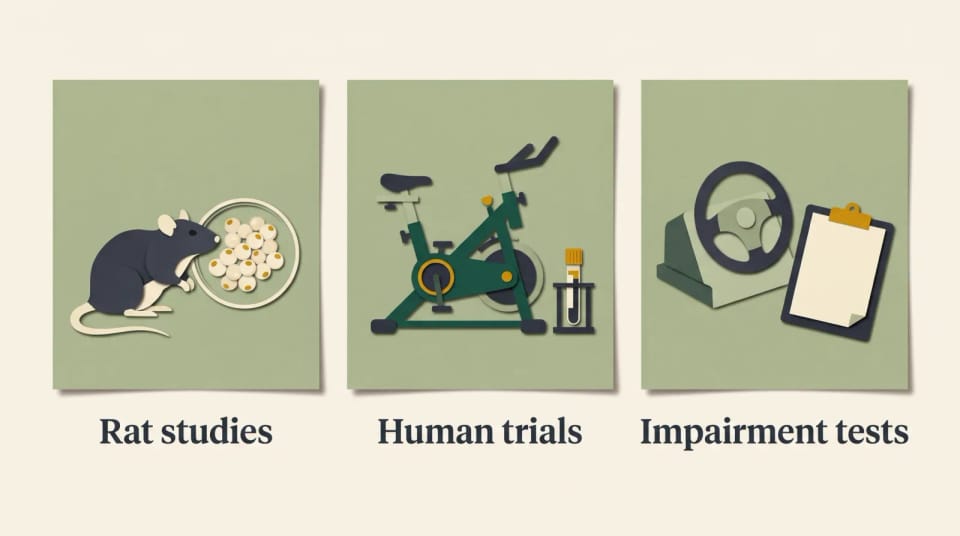
The fat-release idea started in rats. Human trials asked whether blood THC rises. A separate body of research asks whether blood THC tracks impairment. None of the three shows a person getting high again.
Does exercise release THC from fat in humans?
Sometimes a little, and not reliably. Here is the full human record in date order.
| Study | Who | Trigger | What happened to blood THC |
|---|---|---|---|
| Wong 2013 | 14 regular users | 35 min stationary bike, fed or after an overnight fast | Small, statistically significant rise after exercise; back down at 2 hours |
| Westin 2014 | 6 daily users on a detox ward | 45 min treadmill, or 24 hours without food | “No major differences”; no one above 3.6 ng/mL |
| McCartney 2025 | 15 regular users | 10 min in cold water (about 10°C) | Fat breakdown markers rose; plasma THC did not |
| Mills 2026 | 46 adults in inpatient withdrawal, randomised | 35 min cycling daily for 7 days, or stretching | No difference between groups; THC did not rise |
The 2013 study is the one every “exercise brings the high back” claim traces to. Exercise raised fat-breakdown markers and gave a “small” rise in plasma THC, and the size of the rise tracked body mass index. The lead author told TIME the average rise was about 15 percent, ranging from 0 to 34 percent, and that it lasted under two hours (TIME, 2013). The same report says the study “wasn’t designed to measure intoxication”. Later authors describe the rise as slight, under 40 percent, and gone at two hours (Westin and colleagues, 2014).
The 2014 detox-ward study had six lean daily users exercise or fast in random order. Compared with each person’s own earlier level, mean serum THC rose 25 percent after exercise, and one person came close to doubling. But the authors saw no major differences overall, and no sample went above 3.6 ng/mL. Urine results did not spike when people exercised or fasted. Six people is far too few to settle anything, and none had much fat to release.
The 2025 cold-water study used a stressor that clearly kicked off fat breakdown: free fatty acids rose 18 percent and glycerol 37 percent. Plasma THC still did not rise (McCartney and colleagues, 2025). It was a single-arm study with no control group.
The 2026 randomised trial is the largest test so far. Daily cycling did not raise plasma THC compared with stretching, and THC actually fell 7 to 14 percent from before exercise to 30 minutes after (Mills and colleagues, 2026). The authors could not reproduce the 2013 rise and suggest one reason: the 2013 group had fasted before some sessions, and theirs had not. The trial stopped early, before reaching its 80-person target.
One more caution: blood THC wobbles on its own. In the 7-day study above, 88.9 percent of heavy users had at least one day when THC was higher than the day before, with no workout or fast as the trigger (Karschner and colleagues, 2009). A single higher reading does not prove fat released it.
Can fasting release THC from fat?
Not in any human study so far. The 2013 trial found that fasting changed blood sugar and fat markers but did “not significantly alter plasma cannabinoid levels” (Wong and colleagues, 2013). The 2014 study found no major change after 24 hours of water-only fasting. The only fasting rise on record is in rats given THC every day.
That gap matters, because several pages claim “exercise and fasting increase THC”. A 2013 news write-up of the human study said the same, and the paper’s own abstract says otherwise for fasting.
Is the rise big enough to get you high?
Almost certainly not, going by the numbers we have. Look at the scale.
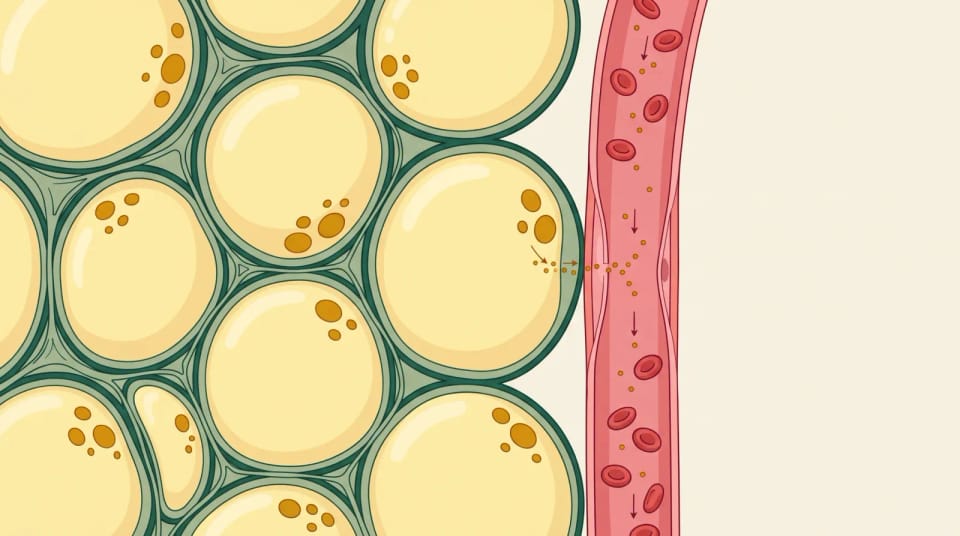
Fat lets THC go slowly. Even in the one trial that saw a rise after exercise, the extra THC was a small fraction of an already low level.
The table below sets figures from different studies side by side. The matrices differ (serum, plasma and whole blood do not read identically), so treat this as a sense of scale, not a direct comparison.
| Situation | Blood THC reported | Source |
|---|---|---|
| Heavy users, day 7 without cannabis (the 9 of 18 still above 1 ng/mL) | 1.2 to 5.5 ng/mL | Karschner 2009 |
| Daily users after exercise or a 24-hour fast | Never above 3.6 ng/mL (serum) | Westin 2014 |
| Chronic users, peak after one 5.9% THC cigarette | Median 28.3 ng/mL (plasma) | Lee 2015 |
| Peak after one 6.8% THC cigarette | Median 50 ng/mL (whole blood) | Schwope 2011 |
Now an illustration, not a study finding. Take a regular user at 2 ng/mL a few days after stopping. A 15 percent rise adds 0.3 ng/mL. A single cigarette puts the median chronic user at about 28 ng/mL, nearly a hundred times that extra amount. The absolute values from the 2013 trial were not available to check, so this is arithmetic on the reported percentage, nothing more.
Regular users are also the people least likely to feel a small change. Tolerance means regular users feel less from the same blood level, and every human trial here studied regular or daily users.
Does a higher blood THC level mean you are high?
Not reliably, and that is the real test of “can it get you high”. A federal report to Congress concluded that THC in blood “does not appear to be an accurate and reliable predictor of impairment”, and that low levels can come from chronic use with no recent use and no impairment (NHTSA, 2017).
Later reviews agree. A meta-regression of 28 publications found the link between blood THC and driving-related impairment “very weak”, with no significant relationship in regular users (McCartney and colleagues, 2022).
A 2025 systematic review found that 10 of 12 studies saw no significant linear link between blood THC and driving measures (Behzad and colleagues, 2025).
In heavy users tracked through 33 days of abstinence, only one task, and only at two time points, lined up with cannabinoid levels (Karschner and colleagues, 2016). The 2025 cold-water study measured thinking and coordination directly and found no change. Participants’ “stoned” rating crept from about 1 to 3 on a 100-point scale, and the authors note that could be expectation, since everyone knew what was being tested.
For what a blood result does and does not show, see how long weed stays in your blood. For practical timing, see how long to wait before driving.
Why do I feel high when I haven’t smoked?
No study explains it. People report feeling “a bit high” days or weeks after stopping, and forums often blame withdrawal or placebo. Neither explanation has been tested for this experience, so I will not hand you either as the answer.
What the evidence does say: a normal high fades over hours, as covered in how long a cannabis high lasts. Fat release, where it shows up at all, is small and short. The researchers who measured residual THC in heavy users suggested it as a possible cause of lingering thinking effects, but that remains untested (Karschner and colleagues, 2009). Exercise also changes how you feel through your own chemistry; the runner’s high and your own endocannabinoids is one example, and it has nothing to do with stored THC.
When to talk to a clinician. If you feel intoxicated, confused, dizzy or detached when you have not used cannabis, or the feeling keeps coming back, talk to a doctor. Those symptoms have many possible causes, and stored THC is not a safe assumption. Get urgent help for chest pain, fainting, a severe headache or sudden weakness.
What about drug tests?
A small rise in blood THC is a different question from a urine test. Most urine tests look for THC-COOH, the inactive metabolite, which cannot get you high. A 2025 paper notes that THC-COOH is unlikely to be stored in fat in the first place (McCartney and colleagues, 2025).
In the detox-ward study, urine metabolite levels did not spike with exercise or fasting. The authors concluded these triggers were unlikely to change cannabinoid levels enough to matter for testing programmes (Westin and colleagues, 2014). No study predicts an individual’s result from their body fat, workouts or meals.
Sources
-
Johansson E, Noren K, Sjovall J, Halldin MM. “Determination of delta 1-tetrahydrocannabinol in human fat biopsies from marihuana users by gas chromatography-mass spectrometry.” Biomedical Chromatography. 1989. DOI: 10.1002/bmc.1130030109
-
Gunasekaran N, Long LE, Dawson BL, et al. “Reintoxication: the release of fat-stored delta(9)-tetrahydrocannabinol (THC) into blood is enhanced by food deprivation or ACTH exposure.” British Journal of Pharmacology. 2009. DOI: 10.1111/j.1476-5381.2009.00399.x
-
Karschner EL, Schwilke EW, Lowe RH, et al. “Implications of plasma Delta9-tetrahydrocannabinol, 11-hydroxy-THC, and 11-nor-9-carboxy-THC concentrations in chronic cannabis smokers.” Journal of Analytical Toxicology. 2009. DOI: 10.1093/jat/33.8.469
-
Schwope DM, Karschner EL, Gorelick DA, Huestis MA. “Identification of recent cannabis use: whole-blood and plasma free and glucuronidated cannabinoid pharmacokinetics following controlled smoked cannabis administration.” Clinical Chemistry. 2011. DOI: 10.1373/clinchem.2011.171777
-
Wong A, Montebello ME, Norberg MM, et al. “Exercise increases plasma THC concentrations in regular cannabis users.” Drug and Alcohol Dependence. 2013. DOI: 10.1016/j.drugalcdep.2013.07.031
-
Bergamaschi MM, Karschner EL, Goodwin RS, et al. “Impact of prolonged cannabinoid excretion in chronic daily cannabis smokers’ blood on per se drugged driving laws.” Clinical Chemistry. 2013. DOI: 10.1373/clinchem.2012.195503
-
Westin AA, Mjønes G, Burchardt O, Fuskevåg OM, Slørdal L. “Can physical exercise or food deprivation cause release of fat-stored cannabinoids?” Basic and Clinical Pharmacology and Toxicology. 2014. DOI: 10.1111/bcpt.12235
-
Wong A, Keats K, Rooney K, et al. “Fasting and exercise increase plasma cannabinoid levels in THC pre-treated rats: an examination of behavioural consequences.” Psychopharmacology. 2014. DOI: 10.1007/s00213-014-3532-3
-
Lee D, Bergamaschi MM, Milman G, et al. “Plasma cannabinoid pharmacokinetics after controlled smoking and ad libitum cannabis smoking in chronic frequent users.” Journal of Analytical Toxicology. 2015. DOI: 10.1093/jat/bkv082
-
Karschner EL, Swortwood MJ, Hirvonen J, et al. “Extended plasma cannabinoid excretion in chronic frequent cannabis smokers during sustained abstinence and correlation with psychomotor performance.” Drug Testing and Analysis. 2016. DOI: 10.1002/dta.1825
-
Compton RP. “Marijuana-Impaired Driving: A Report to Congress.” National Highway Traffic Safety Administration, DOT HS 812 440. 2017. NHTSA report PDF
-
McCartney D, Arkell TR, Irwin C, Kevin RC, McGregor IS. “Are blood and oral fluid Delta9-tetrahydrocannabinol (THC) and metabolite concentrations related to impairment? A meta-regression analysis.” Neuroscience and Biobehavioral Reviews. 2022. DOI: 10.1016/j.neubiorev.2021.11.004
-
Behzad D, Zhao S, Besa R, et al. “Association of driving with blood delta-9-tetrahydrocannabinol: a systematic review.” International Journal of Neuropsychopharmacology. 2025. DOI: 10.1093/ijnp/pyaf021
-
McCartney D, Levoux J, Gordon R, et al. “Does acute stress induced via cold water immersion increase blood THC concentrations in regular cannabis users?” Psychopharmacology. 2025. DOI: 10.1007/s00213-025-06833-8
-
Mills L, Rooney K, McCartney D, et al. “The effect of daily aerobic cycling exercise on cannabis withdrawal: An inpatient randomised controlled trial.” Scientific Reports. 2026. DOI: 10.1038/s41598-026-40468-9
-
TIME staff. “One Toke, Many Hits: Exercise Could Trigger Additional High for Marijuana Users.” TIME. September 17, 2013. TIME archive article
Key takeaways
- THC is stored in fat and leaks out slowly for days to weeks in heavy users.
- The “reintoxication” idea comes from rat studies with repeated heavy dosing.
- One small human trial saw a brief rise after exercise; three later human studies, including a 2026 randomised trial, saw no clear rise.
- Fasting has not raised blood THC in any human study.
- No human study has measured anyone getting high from fat-released THC, and blood THC is a poor predictor of impairment anyway.
FAQ
Can THC stored in fat get you high?
No study shows that it can. The largest rise reported in people was small, averaged about 15 percent of an already low level, and faded within two hours. No trial measured intoxication after exercise or fasting.
Does burning fat release THC?
Possibly a little, sometimes. One 2013 trial found a small rise in blood THC after cycling, linked to fat breakdown. A 2014 study and a 2026 randomised trial found no clear rise, and a 2025 cold-water study saw fat breakdown with no THC rise.
How long does THC stay in fat?
Weeks, at least in heavy users. Fat biopsies have held THC four weeks after smoking, and some daily users still had traces in their blood at 30 days. Lighter users were not studied in these trials.
Does a higher BMI mean more stored THC is released?
It is not established. The 2013 trial found the rise tracked BMI in 14 people. A 7-day study of 18 heavy users found no link between BMI and residual blood THC, and no trial has studied people with obesity.
Does a positive blood test mean you are high?
No. Federal and review evidence finds that blood THC does not reliably predict impairment, and low levels can persist in regular users with no recent use. A blood result shows presence, not how impaired someone is.



