

How Long Does Weed Stay in Your Blood? Windows by How Often You Use
Occasional use often leaves blood THC measurable for hours. Daily use can last days, by cutoff. How long does weed stay in your blood depends on the test.

Professor High
Your friendly cannabis educator, bringing science-backed knowledge to the community.
Written by Professor High, our AI guide. See how we research and correct articles.
Occasional use often leaves blood THC below a common cutoff within hours. Some daily users still measure above 1 ng/mL after days without cannabis.
In a locked research unit, 2 of the 5 daily smokers still enrolled at 30 days had whole-blood THC of 0.3 ng/mL. That sits just above a 0.25 ng/mL reporting limit. Thirty men started the study. Positive days were mixed with negative days. This is not a solid month of positive tests. Bergamaschi et al., 2013
Set that next to occasional use. Six people each smoked one cigarette. Plasma THC stayed measurable for a mean of 7.2 hours after a 1.75% THC cigarette, and 12.5 hours after a 3.55% cigarette. The longer range ran from 6 to 27 hours. The lab limit was 0.5 ng/mL. Those times come from Huestis, Henningfield, and Cone (1992), as cited by Karschner and colleagues. Huestis et al., 1992 Karschner et al., 2009
A blood test asks a narrow question. It does not ask whether you feel high. It does not ask whether you are safe to drive. It asks whether a named chemical is above a named cutoff in a named kind of blood.
The drug testing guide gives a short blood note, then moves on to urine, saliva, and hair. This page stays on blood. It is not medical advice. It is not legal advice. It is not a way to beat a test.
What does a THC blood test actually measure?
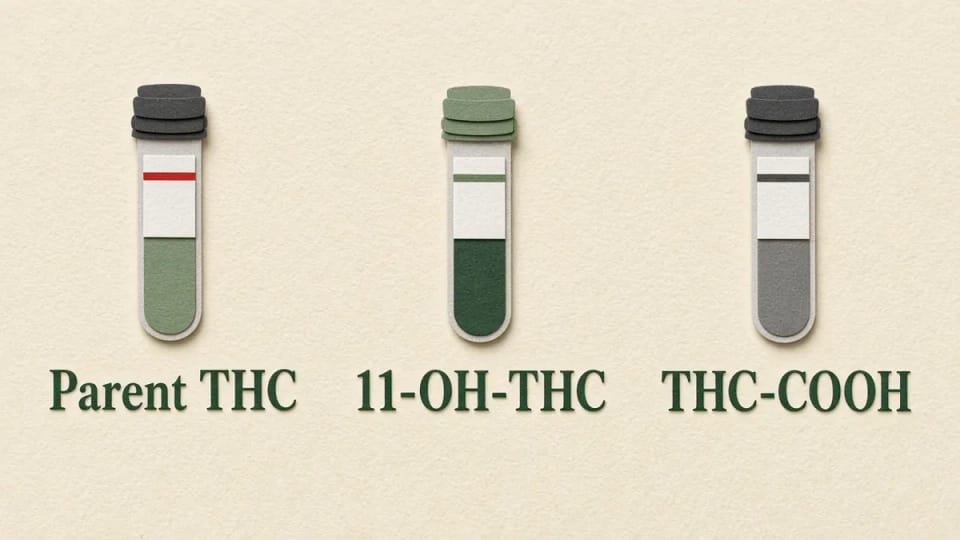
A THC blood test can report three related chemicals. They are not the same result.
Parent THC is the main intoxicating chemical from the plant. 11-OH-THC is an active product the body makes, especially after you swallow cannabis. THC-COOH is a later, inactive metabolite. Many urine tests chase THC-COOH. A blood test for recent use is usually aimed at parent THC.
You will see these tests after a crash, in a hospital, and in some clinical or forensic labs. A workplace screen is much more often a urine cup. Urine is a different sample. A donation draw is different again. Cannabis and blood donation is its own question.
Delta-8, delta-10, and HHC are a separate identification problem. The windows below are for delta-9 THC studies.
How long does weed stay in your blood after occasional use?
For a person who rarely uses cannabis, parent THC in blood is a short story.
Huestis, Henningfield, and Cone studied six occasional users. Karschner’s 2009 plasma paper quotes their detection times. After one low-strength cigarette (1.75% THC), plasma THC was measurable for a mean of 7.2 hours. The range was 3 to 12 hours. After one stronger cigarette (3.55% THC), the mean was 12.5 hours. The range was 6 to 27 hours. Both used a plasma limit of 0.5 ng/mL. Do not read that as “always gone by lunch.” The top of the range is more than a day.
How the body absorbs and clears THC explains the fast rise and the fast fall. The test still depends on the cutoff.
How long can daily use keep THC in a blood test?
Daily use breaks the “a few hours” rule. Leftover THC can sit in blood after the last use.
Schwope and colleagues studied ten heavy chronic cannabis smokers, not occasional users. Each person smoked one 6.8% THC cigarette (about 54 mg THC) over about 10 minutes. They reported 10 to 168 joints in the previous 14 days. The typical rate was about 5 joints a day, on about 12 of those days. The whole-blood limit was 1 ng/mL. Median THC peaked near 50 ng/mL at about 15 minutes. At 6 hours the median was 1.4 ng/mL. The range ran from under the limit to 7.4. At 22 hours, six people were still sampled. One of those six was still positive (about 17%). That person measured 5.0 ng/mL of THC. Some already had THC in blood before the session. A 0.5 ng/mL plasma limit and a 1 ng/mL whole-blood limit are not the same net. Schwope et al., 2011
Karschner and colleagues watched 25 daily users for seven days on a closed unit. The sample was whole blood. The THC limit was 0.25 ng/mL. Nine people never had measurable THC. On day 7, 6 of 25 were still at or above 0.25 ng/mL. Three of those six were at or above 1.0 ng/mL. The highest day-7 value was 3.0 ng/mL. Every person still had THC-COOH on every day. The team did not follow this group to day 30. Some tubes had been frozen for up to five years. Karschner et al., 2009
A companion paper used plasma, not whole blood, in 18 daily users. On day 7, 9 of 18 were above 1 ng/mL (1.2 to 5.5). Four were above 2 ng/mL. That is a day-7 snapshot. It is not seven solid days above the line for every person. Plasma numbers run higher than whole-blood numbers from a paired draw. Do not stack them as if they were one tube.
Bergamaschi and colleagues went much further. Thirty men who smoked daily gave whole blood for up to 33 days of watched abstinence. The THC limit was 0.25 ng/mL. On admission, 27 of 30 were positive. The median was 1.4 ng/mL. Three of those 27 were at or above 5 ng/mL. Five percent of the group stayed at or above 1.0 ng/mL across a 12-day span. The longest consecutive run at or above 1.0 ng/mL was 12 days. The median last day with any THC detection was 22 days. Only five men were still in the study at day 30. Two of those five measured 0.3 ng/mL. Women were not enrolled. The last dose before admission was not witnessed. The paper did not test driving skill.
A separate detox study is thinner. Odell and colleagues took daily blood for seven days from 21 heavy users in two Melbourne units. Some still had THC in blood at seven days. The abstract does not give the cutoff or the day-7 level, so this page does not invent them. Odell et al., 2015
None of these studies isolated a weekly-only group. A person who uses once a week is not the daily cohort. There is no sourced weekly row to print.
A tolerance break changes how often you use. It does not hand you a personal clearance date. The studies above used locked units, not a home calendar.
How long is THC in blood after an edible?
Swallowed cannabis is slower, and the peak in blood is lower, than a smoked peak.
Vandrey and colleagues gave brownies with 10, 25, or 50 mg THC to six people per dose. Mean whole-blood peaks were 1, 3.5, and 3.3 ng/mL. The 25 mg and 50 mg peaks were similar. 11-OH-THC rose to a similar peak, on a similar clock, as parent THC. Whole blood could show THC from the first sample out to 22 hours. The limit was 0.5 ng/mL. Felt effects peaked around 1.5 to 3 hours and lasted about 6 to 8 hours. Blood tracked how people said they felt. It did not line up cleanly with thinking tests. Six people per dose is a small study. Vandrey et al., 2017
Smoke and a swallowed dose do not make the same mix of chemicals. After smoking, 11-OH-THC in blood is only about a tenth of parent THC. After an oral dose, the two can be close to equal. Karschner’s whole-blood paper states that contrast. Why edibles hit harder is the longer version. Hour by hour edible timing is about the experience, not a blood cutoff.
Vapor is closer to smoke than to a brownie. In a controlled comparison, smoked and vaporized blood patterns were similar. Oral dosing produced more THC-COOH. Newmeyer et al., 2016
A lower edible peak can still be a positive test. It can also fall under a high cutoff while the person still feels the dose. That is why a single hour count is a bad promise.
Why do whole blood and plasma give different numbers?
Whole blood is the full tube. Plasma and serum are the liquid left after cells are removed. The same draw can print two different THC numbers.
In the Schwope session, the median peak was 50 ng/mL in whole blood and 76 ng/mL in plasma. That pair is about this one cigarette and these ten heavy chronic smokers. The paper does not publish a universal conversion factor. At 22 hours, 2 of 6 plasma samples were still positive. One of 6 whole-blood samples was still positive (about 17%).
You may see a rule of thumb that serum at 2 to 5 ng/mL is like whole blood at 1 to 2.5 ng/mL. Karschner was quoting other researchers’ proposed driving limits, not a ratio measured in that study. Treat it as a caution, not as math you can apply to your own result.
If a report does not name the matrix, you do not know which row in the table below applies.
Does a positive blood test mean you are impaired?
No. A positive blood test means the chemical cleared the cutoff. It does not measure impairment by itself.
McCartney and colleagues pooled 28 studies and 822 driving-related outcomes. In occasional users, blood THC barely tracked performance. The link was about −0.08 after swallowing cannabis and about −0.10 after inhaling it. In people who use weekly or more, they found no significant link between the blood marker and performance. Their conclusion is plain. Blood THC and oral-fluid THC are relatively poor indicators of cannabis impairment. McCartney et al., 2022
A 2017 report to Congress from the National Highway Traffic Safety Administration reaches the same neighborhood. Blood THC correlates poorly with impairment. The report’s author argues that a single per se cutoff is not a meaningful impairment line. Peak effect can sit near 90 minutes after smoking, while the THC level has already dropped by more than 80% from its peak. That timing is the report’s citation of earlier work, not a new driving trial in the report itself. Compton, 2017
Put the two failure modes side by side.
A daily user can sit above 1 ng/mL, or even above 2 ng/mL in plasma, days after the last use. Karschner’s team said it is unknown whether those low levels come with thinking changes. Leftover THC is not proof of use in the last few hours. It is also not proof that the person is unimpaired.
An occasional user can be impaired while blood THC is already under a cutoff. The level peaks early. The effect can lag the peak. Vandrey’s brownies make the same point from the other direction. Felt effects and the blood number are related, and they are not a meter.
State driving limits differ. This page does not list them. The driving guide holds that table. A roadside breath test is a different tool from a venous blood tube. Cannabis plus alcohol is a different impairment question again.
Two Research Hub papers sit next to this, and neither is a detection-window study. One reviews THC and alcohol levels in Ontario impaired-driving files. Another looks at how a legal THC driving threshold was raised.
Nothing here is a “safe to drive after X hours” rule. The studies do not support one.
What cutoff changes the detection window?
The same blood can be “positive” at 1 ng/mL and “negative” at 5 ng/mL. Read the cutoff and the matrix before you trust a headline hour count.
| Use in the study | Matrix and cutoff | What was measured | Source |
|---|---|---|---|
| One 1.75% THC cigarette, 6 occasional users | Plasma, 0.5 ng/mL | Mean 7.2 hours measurable (range 3–12) | Huestis 1992, via Karschner 2009 |
| One 3.55% THC cigarette, same 6 users | Plasma, 0.5 ng/mL | Mean 12.5 hours (range 6–27) | Huestis 1992, via Karschner 2009 |
| One 6.8% cigarette, about 54 mg, 10 heavy chronic smokers | Whole blood, 1 ng/mL | Median 1.4 ng/mL at 6 hours (under the limit to 7.4). At 22 hours, 1 of 6 still sampled was positive (about 17%). One person at 5.0 | Schwope 2011 |
| Brownie, 10, 25, or 50 mg, 6 people per dose | Whole blood, 0.5 ng/mL | Measurable from 0 to 22 hours. Mean peaks 1, 3.5, and 3.3 ng/mL | Vandrey 2017 |
| Daily users, 25 people, 7 watched days | Whole blood, 0.25 ng/mL | Day 7: 6 of 25 at or above 0.25. 3 of 25 at or above 1.0. High 3.0 | Karschner 2009, Addiction |
| Daily users, 18 people, day 7 only | Plasma, above 1 and above 2 ng/mL | 9 of 18 above 1 (1.2–5.5). 4 of 18 above 2 | Karschner 2009, JAT |
| Daily users, 30 men, up to 33 watched days | Whole blood, 0.25 ng/mL | At or above 1.0 for up to 12 days in a row. Day 30: 2 of 5 men still enrolled at 0.3 | Bergamaschi 2013 |
| Heavy use, 21 people in detox, 7 days | Blood, cutoff not in the abstract | Some still detectable at 7 days. No day-7 level quoted here | Odell 2015 |
A 5 ng/mL whole-blood line is much stricter than 0.25 or 1. On admission in the Bergamaschi group, only 3 of 27 positive men were at or above 5 ng/mL. Schwope’s group had already fallen to a median of 1.4 ng/mL by 6 hours, with a top value of 7.4. A 5 ng/mL cutoff would miss a lot of what a 1 ng/mL cutoff still catches. It would also miss the day-7 leftovers in Karschner’s whole-blood group, where the high was 3.0 ng/mL.
THC-COOH is the long tail. In Karschner’s whole-blood group it was still measurable in all 25 people on day 7. In Bergamaschi’s group, 4 of 5 men still enrolled at 30 days still had it (0.6 to 2.7 ng/mL). A metabolite hit is not a parent-THC hit.
If you want a record of what you used, when, and how much, keep a simple log. A later lab number cannot rebuild that. A cannabis journal is one way to do it.
Key takeaways
- Occasional plasma THC often falls under 0.5 ng/mL within hours, and the range after a stronger cigarette reached 27 hours in six people.
- Some daily users still measure whole-blood THC at or above 1 ng/mL on day 7. A few of the men still enrolled at day 30 measured 0.3 ng/mL.
- Name the matrix. Plasma peaks ran higher than paired whole-blood peaks. There is no single conversion factor in these papers.
- Edible blood peaks are lower and later than smoked peaks, with relatively more 11-OH-THC.
- A cutoff of 1, 2, or 5 ng/mL changes who counts as positive. Blood THC is a poor impairment test on its own.
FAQ
How long does THC stay in your blood?
For occasional use in the Huestis study, plasma THC was measurable for a mean of about 7 to 12 hours, with a range up to 27 hours at 0.5 ng/mL. For daily use, whole-blood THC can still clear 1 ng/mL on day 7, and a few of the men still enrolled at day 30 were at 0.3 ng/mL. The cutoff and the matrix change the clock.
Does a blood test show weed?
It can show parent THC, 11-OH-THC, THC-COOH, or some mix of them, if the level clears that lab’s limit. A negative test means “under this cutoff in this sample.” It does not mean cannabis was never used. A positive parent-THC test in a daily user can be leftover THC, not use in the last hour.
How long is THC in blood after an edible?
In the Vandrey brownie study, whole-blood THC was measurable from 0 to 22 hours at 0.5 ng/mL. Mean peaks were about 1 to 3.5 ng/mL, far below a typical smoked peak. 11-OH-THC rose along with THC. Six people per dose is a small sample.
What does a 1, 2, or 5 ng/mL cutoff mean?
Each number is a line the lab or the statute picks. The same tube can pass a 5 ng/mL rule and fail a 1 ng/mL rule. Whole blood and plasma are not interchangeable. In one smoked session the median peaks were 50 ng/mL in whole blood and 76 ng/mL in plasma. Ask which fluid the number refers to.
Does a positive THC blood test mean someone is impaired?
Not by itself. A 2022 meta-regression found only a weak link in occasional users and no significant link in people who use weekly or more. A daily user can be over a low cutoff while leftover THC remains. An occasional user can be affected after the level has already fallen. This page does not give a safe driving time.
Sources
- Huestis MA, Henningfield JE, Cone EJ (1992). Blood cannabinoids. I. Absorption of THC and formation of 11-OH-THC and THCCOOH during and after smoking marijuana. Journal of Analytical Toxicology. https://doi.org/10.1093/jat/16.5.276
- Karschner EL, Schwilke EW, Lowe RH, Darwin WD, Pope HG, Herning RI, Cadet JL, Huestis MA (2009). Do Δ9-tetrahydrocannabinol concentrations indicate recent use in chronic cannabis users? Addiction. https://doi.org/10.1111/j.1360-0443.2009.02705.x
- Karschner EL, Schwilke EW, Lowe RH, Darwin WD, Herning RI, Cadet JL, Huestis MA (2009). Implications of plasma Δ9-THC, 11-hydroxy-THC, and 11-nor-9-carboxy-THC concentrations in chronic cannabis smokers. Journal of Analytical Toxicology. https://doi.org/10.1093/jat/33.8.469
- Bergamaschi MM, Karschner EL, Goodwin RS, Scheidweiler KB, Hirvonen J, Queiroz RHC, Huestis MA (2013). Impact of prolonged cannabinoid excretion in chronic daily cannabis smokers’ blood on per se drugged driving laws. Clinical Chemistry. https://doi.org/10.1373/clinchem.2012.195503
- Odell MS, Frei MY, Gerostamoulos D, Chu M, Lubman DI (2015). Residual cannabis levels in blood, urine and oral fluid following heavy cannabis use. Forensic Science International. https://doi.org/10.1016/j.forsciint.2015.01.026
- Schwope DM, Karschner EL, Gorelick DA, Huestis MA (2011). Identification of recent cannabis use: whole-blood and plasma free and glucuronidated cannabinoid pharmacokinetics following controlled smoked cannabis administration. Clinical Chemistry. https://doi.org/10.1373/clinchem.2011.171777
- Vandrey R, Herrmann ES, Mitchell JM, Bigelow GE, Flegel R, LoDico C, Cone EJ (2017). Pharmacokinetic profile of oral cannabis in humans: blood and oral fluid disposition and relation to pharmacodynamic outcomes. Journal of Analytical Toxicology. https://doi.org/10.1093/jat/bkx012
- McCartney D, Arkell TR, Irwin C, Kevin RC, McGregor IS (2022). Are blood and oral fluid Δ9-THC and metabolite concentrations related to impairment? Neuroscience and Biobehavioral Reviews. https://doi.org/10.1016/j.neubiorev.2021.11.004
- Newmeyer MN, Swortwood MJ, Barnes AJ, Abulseoud OA, Scheidweiler KB, Huestis MA (2016). Free and glucuronide whole blood cannabinoids’ pharmacokinetics after controlled smoked, vaporized, and oral cannabis administration in frequent and occasional cannabis users. Clinical Chemistry. https://doi.org/10.1373/clinchem.2016.263475
- Compton R. Marijuana-Impaired Driving: A Report to Congress. National Highway Traffic Safety Administration, DOT HS 812 440. https://www.nhtsa.gov/sites/nhtsa.gov/files/documents/812440-marijuana-impaired-driving-report-to-congress.pdf



