Why Does Weed Make You Dizzy—or Give You the Spins?
Why cannabis can cause dizziness, lightheadedness, or the spins—and what to do safely when the room starts moving after THC.


You take a hit, stand up, and suddenly the floor seems to tilt. Your ears may buzz. Your vision may narrow. Or you lie still while the room appears to keep turning—the classic “spins.”
The short answer: THC can make you dizzy by changing heart rate, blood-vessel tone, blood pressure, perception, and balance at the same time. Standing can briefly reduce blood flow reaching the brain in some people. A high dose, low tolerance, anxiety, rapid breathing, an edible that keeps intensifying, or alcohol can make the experience worse. “The spins” can feel like vertigo, but cannabis-specific vestibular research is limited, so one tidy inner-ear explanation would be more confident than the evidence allows.
Most episodes improve as the intoxication fades. Your immediate priority is preventing a fall or crash: stop consuming, sit or lie down somewhere safe, breathe normally, and do not drive. New, severe, or persistent symptoms deserve medical attention.
Key Takeaways
- Cannabis dizziness may involve a postural blood-pressure drop, altered cerebral blood flow, a faster heart rate, impaired coordination, or several of these at once.
- “Lightheaded,” “off-balance,” and “the room is spinning” describe different sensations. THC can blur those categories, but recurring true vertigo should not automatically be blamed on weed.
- More THC is generally more likely to produce unpleasant effects, while route, tolerance, medications, and individual sensitivity change the response.
- Anxiety and overbreathing can amplify dizziness. Aim for gentle, normal breathing—not huge gasping breaths and never breathing into a paper bag.
- Water can ease thirst, but it is not an antidote for THC or a guaranteed fix for dizziness.
- Alcohol plus cannabis can produce greater impairment than either alone. If you already feel dizzy, adding alcohol is the wrong experiment.
First, What Kind of “Dizzy” Do You Mean?
“Dizzy” is a suitcase word: people pack several sensations into it.
| What it feels like | A possible contributor after cannabis | Best immediate move |
|---|---|---|
| Faint, gray vision, head rush after standing | Postural blood-pressure or cerebral blood-flow change | Sit or lie back down; rise only after the feeling passes |
| Room or body seems to rotate | Intoxication, disrupted sensory integration, or an unrelated vestibular problem | Keep still, focus on a stable object, avoid walking alone |
| Wobbly or poorly coordinated | THC-related impairment | Stay seated; avoid stairs, showers, traffic, tools, and driving |
| Racing heart with tingling and fear | THC effects plus anxiety or overbreathing | Breathe gently and regularly; ask a calm, sober person to stay |
| Dizziness with repeated vomiting | Overconsumption, another illness, or a pattern such as cannabinoid hyperemesis syndrome | Seek medical advice; urgent care may be needed if severe |
A head rush when standing is not identical to rotational vertigo, and neither is identical to panic. You can also experience several at once.

The Best-Supported Explanation: Postural Circulation Changes
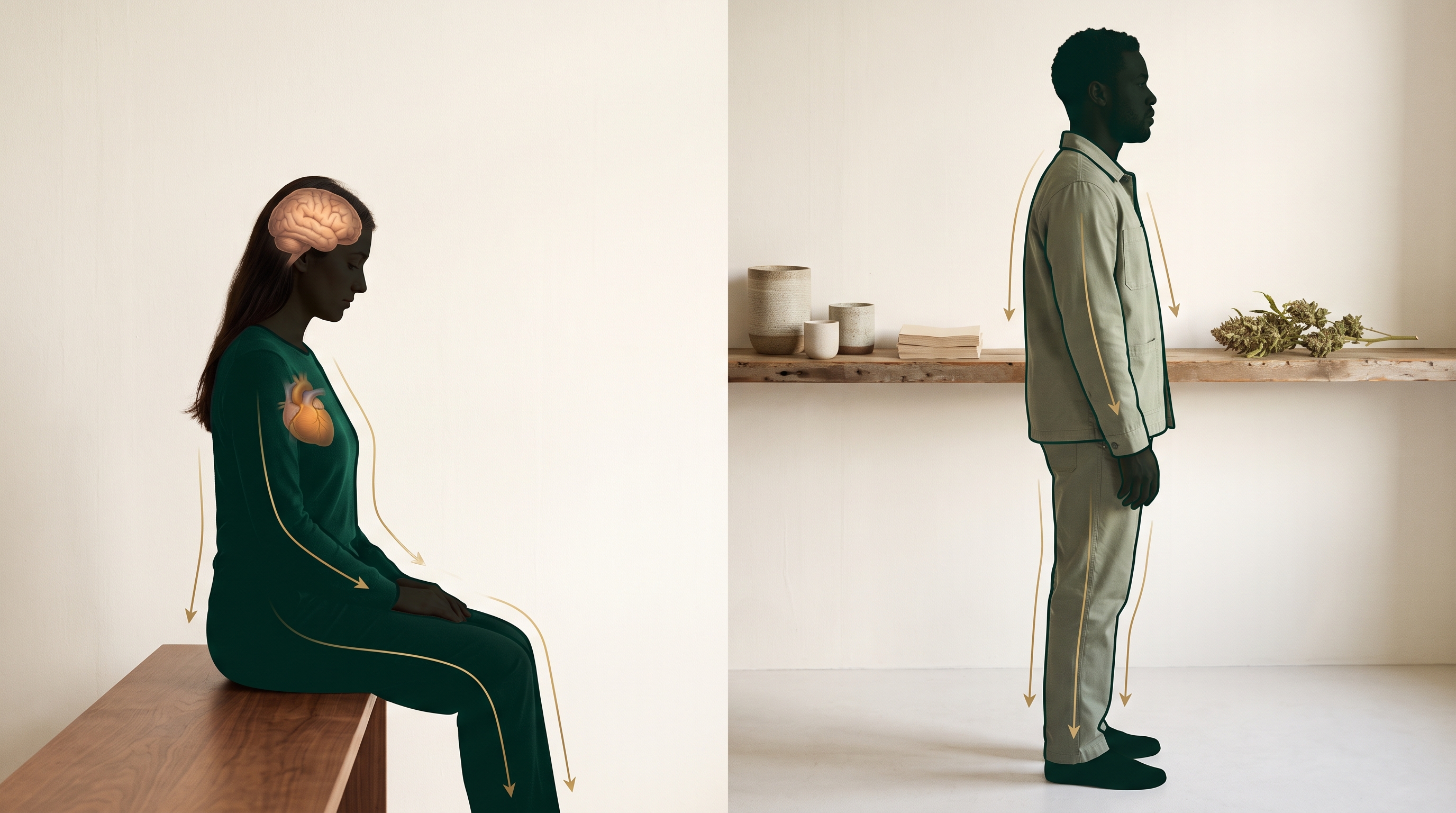
When you stand, gravity shifts blood toward your legs. Your nervous system normally responds by tightening blood vessels and adjusting heart rate so the brain keeps getting a steady supply. THC can alter that cardiovascular balancing act.
In a small controlled study of ten healthy men, six reported moderate-to-severe dizziness while standing after smoking cannabis but not placebo. The participants with the strongest symptoms showed notable reductions in blood pressure and middle cerebral artery blood velocity [Mathew et al., 1992]. This is direct human evidence for a mechanism behind the familiar “I stood up and almost disappeared” sensation—but it is also an old, very small study of men using products unlike much of today’s market.
A later randomized, double-blind, placebo-controlled study followed 29 volunteers after THC infusion or cannabis smoking. Both conditions produced postural dizziness, and 28% of participants reported severe symptoms. That group showed the largest standing-related drops in blood pressure and cerebral blood velocity [Mathew et al., 2003]. Importantly, symptom severity did not map neatly to measured plasma THC, a reminder that a blood number does not perfectly predict one person’s experience.
The broader evidence is imperfect. A systematic review found strong evidence that cannabis acutely increases heart rate, but blood-pressure findings were mixed and many studies had a high risk of bias [Ghasemiesfe et al., 2020]. “Weed always lowers blood pressure” is too simple; posture, timing, dose, tolerance, and study conditions matter.
If the dizziness reliably appears when you rise, treat the posture change as useful information. Move in stages: lying to sitting, pause, then sitting to standing with support. That is fall prevention, not a diagnosis or a guarantee.
Why Your Heart May Race at the Same Time
THC commonly raises heart rate soon after use, especially in people without much tolerance. A pounding pulse can feel alarming on its own. Add a momentary drop in pressure while standing, and the combination may feel like weakness, fluttering, tunnel vision, or imminent fainting.
This does not make every cannabis-related racing heart an emergency, but chest symptoms should not be dismissed as “just weed.” Our cannabis and heart health guide covers the evidence. Anyone with heart disease, fainting, rhythm problems, blood-pressure treatment, or recurring symptoms should discuss cannabis with a clinician.
THC also acts through the endocannabinoid system, which participates in neural and cardiovascular regulation. That biology is more complicated than a single receptor flipping a “dizzy” switch. Product composition, other drugs, and the person using it all matter.
Why “The Spins” Are Harder to Explain
The feeling that you or the room is rotating is often called vertigo. Balance depends on the brain combining information from the inner ears, eyes, muscles, and joints. Intoxication can impair coordination, change visual processing, and make motion unusually salient. Darkness may remove a stable visual reference and make rotation more obvious.
What we cannot confidently say is that ordinary cannabis spins always come from one proven inner-ear pathway. Controlled human research specifically separating THC-related vertigo from lightheadedness and general impairment is sparse. “THC changed how several sensory signals were integrated” is a reasonable explanation; “your inner-ear crystals moved because of weed” is not an evidence-based conclusion.
If the room-spinning sensation is one-sided, repeatedly returns while sober, is triggered by a particular head movement, or comes with hearing loss, severe headache, weakness, numbness, or speech trouble, do not keep using cannabis as the explanation. Those clues warrant clinical evaluation.
Dose, Route, and Tolerance Change the Odds
Cannabis effects depend on more than a strain name. The genetics of cannabis sensitivity, experience, potency, sleep, food, medications, and setting may all influence a session.
Inhaled cannabis
Smoking and vaping deliver effects within minutes, so dizziness can arrive quickly. Concentrates can deliver a large THC exposure in a small volume. Our consumption-method comparison explains why route changes onset; it does not establish a universally “safe” method.
Edibles
Edibles arrive later and last longer. Someone may take more before the first serving has peaked, then discover that the experience is still climbing. Health Canada says ingested effects may begin in 30 minutes to two hours and commonly last four to eight hours, with lingering effects sometimes lasting longer. Follow a conservative edible dosing approach, and remember that an edible’s delayed onset makes immediate self-correction impossible.
For the science behind those differences, see why edibles can hit harder.
Tolerance
Frequent use can blunt some effects, but it does not prevent dizziness, falls, interactions, or impaired driving. After time away, an old dose may no longer feel familiar. Read our tolerance-break guide before assuming your old baseline survived.
Anxiety Can Turn a Wobble Into a Spiral
THC can provoke anxiety or panic, particularly at an unexpectedly high exposure. Anxiety may make you scan every heartbeat and movement for danger. Some people then start breathing faster or taking repeated huge breaths. Overbreathing lowers carbon dioxide in the blood and can itself produce lightheadedness, tingling, feelings of unreality, and a pounding heart. Those sensations can reinforce the fear, creating a feedback loop.
The goal is normal, gentle breathing. Let your shoulders drop and avoid giant inhalations or breath holds. Do not use a paper bag; a serious heart or lung problem can resemble panic.
If paranoia is dominating the experience, use the grounding approaches in our cannabis and paranoia guide. If the whole experience is simply too intense, our guide to coming down safely when you feel too high is the broader playbook. Neither article should override emergency symptoms.
Dehydration: Possible Contributor, Not a Universal Answer
People often say dizziness means dehydration and water will “sober you up.” That leaps beyond the evidence.
Dehydration from heat, exercise, illness, vomiting, or inadequate fluid intake can cause lightheadedness, so it may stack with cannabis effects. Cannabis also causes dry mouth, but dry mouth does not prove whole-body dehydration.
If you are awake and swallowing normally, small sips of a nonalcoholic drink are reasonable. Water does not remove THC from receptors or guarantee the spins will stop. Repeated vomiting, inability to keep fluids down, confusion, or worsening weakness calls for medical advice—not a bigger bottle.
Alcohol Makes the Situation Less Predictable
Alcohol can impair balance and produce nausea or dizziness without cannabis. Combining them can intensify impairment. In a randomized trial of 28 young adult cannabis users with a history of binge drinking, alcohol and cannabis together produced greater subjective drug effects and several performance deficits than either alone [Wickens et al., 2022].
A separate randomized crossover study of 18 healthy participants tested 10 mg oral THC with a low intravenous alcohol exposure. The combination produced synergistic heart-rate effects and worse perceived driving ability than either drug alone [Schnakenberg Martin et al., 2023]. These laboratory designs still challenge the idea that “a little of each” is automatically mild.
If you feel dizzy after cannabis, do not add alcohol to settle yourself. Do not drive, bike in traffic, swim, or try to walk home alone. Read what happens when cannabis and alcohol mix before the next session—not during the spins.
What to Do Right Now: A Safer Six-Step Response
1. Stop consuming
Put the cannabis and alcohol away. With an edible, what you already swallowed may continue taking effect, but another serving cannot undo the first one. The same principle applies to “one more hit to balance it out.”
2. Sit or lie down safely
Get away from stairs, traffic, balconies, water, hot stoves, and sharp objects. Sit with back support or lie on your side if nauseated. If standing triggered the episode, do not repeatedly stand up to test whether it is gone.
3. Reduce sensory load
Use soft light and a quiet, cool room. Keep your head relatively still if movement worsens the spinning. Focusing on one stable object may feel easier than closing your eyes, though preferences vary.
4. Breathe normally
Aim for a quiet, unforced rhythm. If you notice rapid breathing, gently slow the exhale. Do not force enormous breaths, hold your breath, or breathe into a bag.
5. Ask a sober person to stay
A calm companion can prevent falls, keep you from driving, note what product and amount you used, and call for help if symptoms escalate. If no one is present, phone someone and keep the line open.
6. Let time—not a hack—do the metabolism
There is no proven instant reset. A drink, bland snack, or reassurance may improve comfort, but they do not neutralize THC. Avoid caffeine or nicotine if your heart is racing. Review when not to increase a cannabis dose after you are sober.

When Dizziness Is an Emergency
Call emergency services now for loss of consciousness; chest pain; trouble breathing; a seizure; sudden severe headache; one-sided weakness or numbness; facial droop; trouble speaking, reading, understanding, or walking; blue or gray lips; or a person who cannot be awakened. Tell responders what was taken, how much if known, when, and whether alcohol, medication, or another substance was involved.
Seek urgent medical advice for severe or worsening dizziness, a significant fall or head injury, repeated or prolonged vomiting, inability to keep fluids down, an unusually fast or irregular heartbeat that does not settle, or symptoms that remain concerning after the expected intoxication window. In the United States, Poison Control is available at 1-800-222-1222. Elsewhere, contact your local poison center or emergency service.
Repeated vomiting plus abdominal pain can be different from a one-time bad session; our guide to greening out explains where acute overconsumption ends and other patterns may begin.
If dizziness happens repeatedly at low exposures, appears while sober, or is new after a medication change, stop experimenting and speak with a healthcare professional. Cannabis may be the trigger, a contributor, or a coincidence. Only an appropriate evaluation can sort that out.
How to Reduce the Chance Next Time
- Choose a legal, clearly labeled product where available, and record the THC amount you actually used.
- Reduce the dose rather than searching for a magical terpene, strain label, or antidote.
- Wait for onset before adding more, especially with edibles.
- Avoid combining cannabis with alcohol or other intoxicants.
- Use in a safe setting with seating available; be extra careful around heat and after exercise.
- Stand slowly, with support, if you have experienced postural lightheadedness before.
- Ask a clinician or pharmacist about medication interactions and cardiovascular risk.
- Treat a lower tolerance after a break as new information.
For a first-session safety foundation, start with our beginner cannabis guide. Tracking product, route, amount, timing, food, alcohol, and symptoms is far more informative than simply recording “indica” or “sativa.” Patterns can help you decide whether a lower dose changes the experience—or whether cannabis is not agreeing with you.
FAQs
Why do I get dizzy when I stand up after smoking weed?
THC may interfere with the normal cardiovascular adjustment to standing. Small controlled human studies found that people with severe postural dizziness after cannabis showed larger drops in blood pressure and cerebral blood velocity. Sit or lie back down, wait, and rise slowly with support. Recurrent faintness deserves medical evaluation.
Are “the spins” from weed the same as vertigo?
They can feel similar, but the phrase “spins” does not identify a cause. THC can impair perception, coordination, and sensory integration; postural lightheadedness can also be described as spinning. Recurring rotation while sober, hearing changes, focal neurologic symptoms, or severe headache should not be written off as intoxication.
Does drinking water stop cannabis dizziness?
Not reliably. Fluids may help if dehydration is also present and may soothe dry mouth, but water does not neutralize THC. Small sips are sensible when you can swallow safely. Severe vomiting or inability to keep fluids down requires medical advice.
Can low blood sugar cause the spins when high?
Low blood sugar can cause dizziness, sweating, weakness, or confusion, particularly in someone using insulin or medicines that lower glucose. Those symptoms overlap with intoxication and panic. Follow your clinician’s established low-glucose plan if you have one; do not assume every dizzy episode needs sugar or cannabis. Severe confusion or inability to swallow is an emergency.
Why does weed make me dizzy now when it did not before?
The dose, potency, route, tolerance, food, sleep, alcohol, medications, illness, and product composition may have changed. A new recurring reaction—especially at low doses—deserves a pause and a healthcare conversation rather than repeatedly testing it.
Can CBD prevent the spins from THC?
There is not enough evidence to promise that CBD will prevent or reverse cannabis-related dizziness. Product ratios and individual responses vary, and CBD can interact with medications. Do not take more cannabinoids as an emergency fix.
The Bottom Line
Cannabis-related dizziness is real, but it is not one single phenomenon. A postural circulation change has direct human evidence behind it; heart-rate changes, impairment, anxiety, and alcohol can add to the sensation. The specific mechanism of the “spins” is less settled than internet folklore suggests.
Your safest move is gloriously unglamorous: stop, get seated or lying down, breathe gently, do not drive, and let a sober person help. If symptoms are severe, neurologic, respiratory, cardiac, persistent, or simply feel wrong, get medical help. Professor High would rather have you make one cautious call than turn a warning sign into a content experiment.
Sources
- Mathew, R. J., Wilson, W. H., Humphreys, D., Lowe, J. V., & Wiethe, K. E. (1992). Middle cerebral artery velocity during upright posture after marijuana smoking. Acta Psychiatrica Scandinavica, 86(2), 173–178. DOI
- Mathew, R. J., Wilson, W. H., & Davis, R. (2003). Postural syncope after marijuana: A transcranial Doppler study of the hemodynamics. Pharmacology Biochemistry and Behavior, 75(2), 309–318. DOI
- Ghasemiesfe, M., Ravi, D., Casino, T., Korenstein, D., & Keyhani, S. (2020). Acute cardiovascular effects of marijuana use. Journal of General Internal Medicine, 35(3), 969–974. DOI
- Wickens, C. M., Wright, M., Mann, R. E., et al. (2022). Separate and combined effects of alcohol and cannabis on mood, subjective experience, cognition and psychomotor performance: A randomized trial. Progress in Neuro-Psychopharmacology and Biological Psychiatry, 118, 110570. DOI
- Schnakenberg Martin, A. M., Flynn, L. T., Sefik, E., et al. (2023). Preliminary study of the interactive effects of THC and ethanol on self-reported ability and simulated driving, subjective effects, and cardiovascular responses. Psychopharmacology, 240(6), 1235–1246. DOI
- Health Canada — Consumer information: Cannabis, updated 2025
- Health Canada — Cannabis for medical purposes: Side effects, updated 2026
- Centers for Disease Control and Prevention — Cannabis frequently asked questions, updated 2024
- MedlinePlus — Hyperventilation, updated 2024

