Cannabis Laws in Australia 2026: The ACT Experiment
Recreational cannabis is illegal across Australia except a personal-use carve-out in the ACT. Medical access is legal nationwide. Here is the 2026 map.

You may have heard that “weed is legal in Canberra.” So you might assume Australia quietly joined the legalization club. I have bad news and good news. The bad news: there is not one legal recreational shop anywhere in Australia. The good news: the Australian Capital Territory ran a bold cannabis policy test. And the results are now in. Let me walk you through what is actually true in 2026.
The quick answer
Here is the whole landscape in one breath:
- Recreational cannabis is illegal everywhere in Australia except a narrow personal-use exemption in the Australian Capital Territory (ACT).
- Medical cannabis is legal nationwide through a doctor’s prescription, via Therapeutic Goods Administration (TGA) pathways that have existed since 2016.
- No legal recreational sales exist anywhere, not even in the ACT. You cannot buy, sell, or gift it.
- Driving with any THC in your system is illegal in every state and territory, even if you are not impaired.
- Penalties for possession vary wildly between states, from on-the-spot fines to potential jail time.
So Australia is not a patchwork like the United States. There, whole states flip to legal retail. Australia is one country with a single bold local exception. It also has a medical system that quietly exploded in size. Now the detail.
The ACT experiment: decriminalized, not legal
On 31 January 2020, the Australian Capital Territory did something no other Australian government had done. A new law took effect: the Drugs of Dependence (Personal Cannabis Use) Amendment Act 2019. Under it, adults aged 18 and over in the ACT can now:
- Possess up to 50 grams of dried cannabis or up to 150 grams of fresh cannabis.
- Grow up to two plants per person, with a maximum of four per household.
- Use cannabis in their own home for personal use.
That sounds like legalization. It is not. The official ACT position is blunt. Cannabis is decriminalized, not legal. The law did not erase the offence. It just made an exception for adults. And several things stay firmly illegal:
- Selling, sharing, or gifting cannabis to anyone, including a friend.
- Using cannabis in public (parks, streets, vehicles).
- Growing with hydroponics or artificial cultivation.
- Exposing a child to cannabis smoke, or storing it within a child’s reach.
- Driving with any cannabis in your system (zero tolerance).
Here is the thorny part. It is the heart of “the ACT experiment.” Australia has a federal drug law too. Section 308.1 of the Commonwealth Criminal Code makes cannabis possession a crime across the whole country. That includes the ACT. When the territory passed its law, the federal Attorney-General said it did not provide a defence to the federal offence. He expected the Australian Federal Police to keep enforcing it. Legal scholars in the UNSW Law Journal called it a “precarious high” [Murphy, 2020]. ACT residents stay exposed to federal charges even when they follow territory law. In practice, those low-level federal charges have not happened. But the conflict has never been resolved.
This is what experts call “laboratory federalism.” A small region tests a policy the rest of the country is not ready for. So what did the lab report say?
What the data actually showed
The ACT government reviewed its own reform during 2024, three years in. The findings are worth quoting because they cut against a lot of fearmongering:
- Cannabis use rates stayed stable — they did not spike [Health, 2024]. ACT residents actually used cannabis at rates below the national average.
- Cannabis-related criminal charges fell sharply. One analysis found the laws almost entirely halted cannabis-related offences.
- No substantial change in cannabis-related hospital presentations.
- No notable change in the price or availability of cannabis.
In other words: the sky did not fall. That mirrors Germany after its 2024 reform. There, decriminalization led to at least 100,000 fewer formal offences. Use, health harms, and road incidents did not rise. It is a very different story from Thailand’s chaotic reversal. There, a fast opening was followed by a push to limit access to medical patients only. Want the bigger picture of how countries diverge? Read how cannabis culture differs around the world.
Medical cannabis: legal nationwide and growing fast
This is where Australia’s story gets genuinely surprising. While recreational cannabis stayed mostly frozen, medical cannabis went vertical.
In 2016, Australia amended the Narcotic Drugs Act 1967. That move legalized the cultivation, production, and medical use of cannabis. Patients get it through two TGA pathways for “unapproved” products. These are the Special Access Scheme (SAS) and the Authorised Prescriber (AP) scheme. A doctor prescribes. A pharmacy dispenses.

The growth has been staggering. A 2026 review in the Journal of Cannabis Research tracked it [Springer, 2026]. Australia went from 231 regulatory applications in 2017 to over one million total prescriptions by 2024. That is a roughly 4,000-fold jump. It makes medical cannabis one of the fastest-growing parts of the health system. TGA data showed 224,462 SAS-B approvals in 2025 alone, up 26% on 2024.
The engine behind this boom is telehealth. Clinics built “one-stop-shop” models: phone consult, prescription, home delivery. That ease drew scrutiny in 2025. An ABC News investigation reported one doctor had issued around 17,000 scripts in six months. That is one script every four minutes. One pharmacist dispensed 959,000 products in a year. The regulator AHPRA warned that some doctors seemed to put “profit over patient safety.”
The deeper issue is quality control. More than 99% of medical cannabis products in Australia are “unapproved.” That means the TGA has not checked their quality, safety, or strength the way it would a normal medicine. In August 2025 the TGA opened a formal review. It called the SAS and AP pathways “no longer appropriate” for such high volume. After 790 submissions, its February 2026 response signaled reform. Expect plain packaging, standard THC and CBD labels, clear warnings, and tighter oversight. The goal is to do this without cutting off real patients.
If you are a patient navigating this, our guides on how to read cannabis lab results and finding your THC to CBD sweet spot are worth bookmarking, and medical vs recreational cannabis explains why that line is often more bureaucratic than biological.
State by state: the recreational picture
Outside the ACT, recreational cannabis is illegal across Australia. But “illegal” hides a lot of variation. In some states a small amount may draw only a fine. In others it can carry far heavier penalties. Here is the lay of the land.
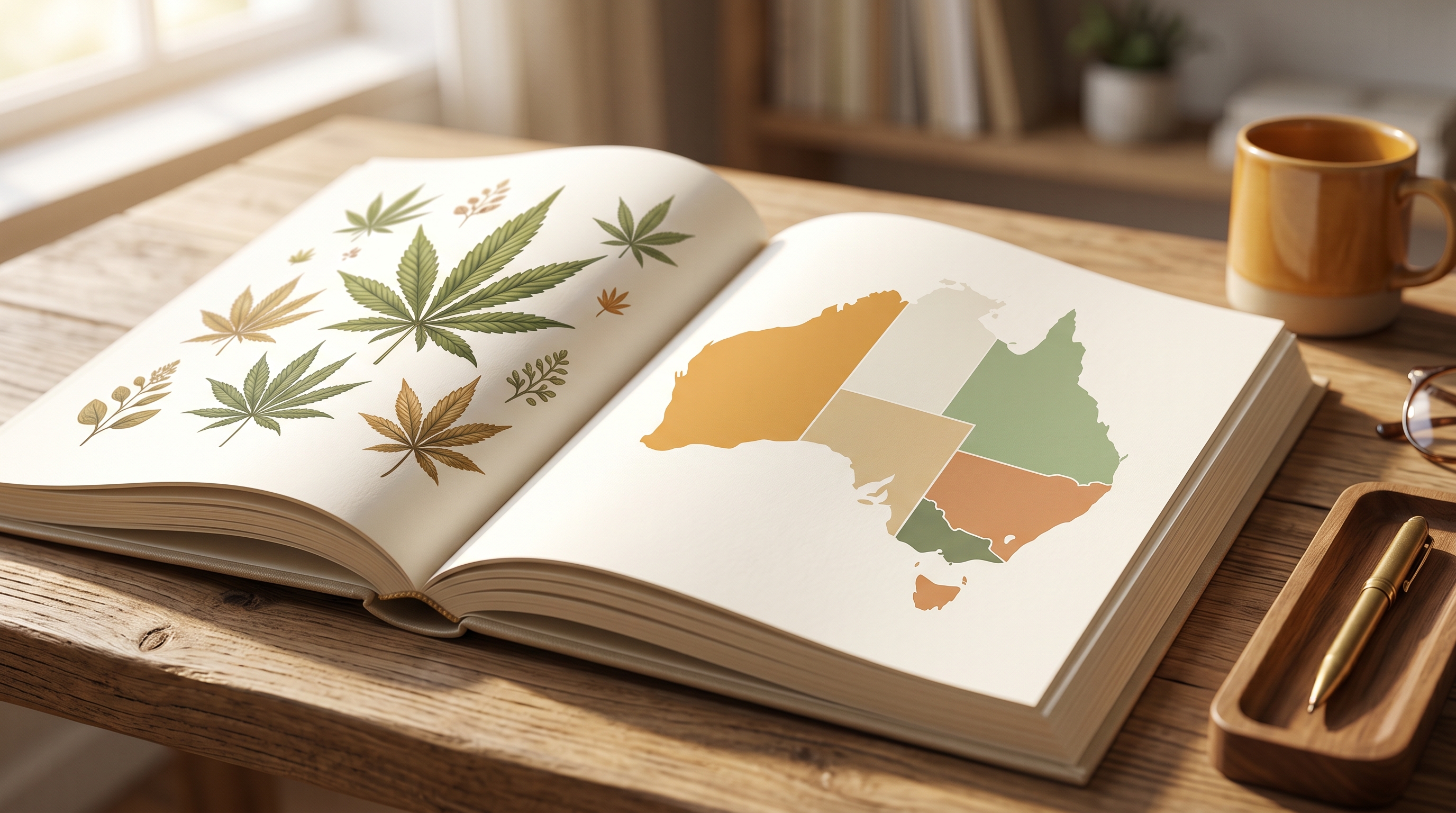
Australian Capital Territory (ACT) — The outlier. Personal possession (50g) and home growing (2 plants per person) are decriminalized for adults. Medical use is legal. Selling is still illegal.
South Australia (SA) — The original reformer. SA removed criminal penalties for minor cannabis offences back in 1987. A “simple cannabis offence” covers possession under 100g, one non-hydroponic plant, private use, or gear. It now draws a Cannabis Expiation Notice. That is an on-the-spot fine of $250 to $400, due within 28 days. There is no court and no conviction.
Northern Territory (NT) — Runs an infringement-notice system for small amounts (up to 50g). Police may issue a fine instead of a charge. Unpaid fines can escalate to court.
New South Wales (NSW) — Possession is a crime under the Drug Misuse and Trafficking Act 1985. But police run a Cannabis Cautioning Scheme. A May 2025 update lets eligible adults caught with up to 30 grams get up to two cautions instead of charges. The scheme sits alongside a broader Early Drug Diversion Initiative. It is discretionary, not a right.
Victoria (VIC) — Illegal. There are diversion and caution options for minor possession, depending on the case. People often assume it is more permissive than the law actually is.
Queensland (QLD) — The strictest of the big states. Police must offer drug diversion for minor possession in some cases. But Queensland keeps the harshest penalties. That can include jail even for smaller amounts.
Western Australia (WA) — Illegal. Caution and diversion programs exist for eligible low-level matters. A patient registry supports medical access.
Tasmania (TAS) — Illegal. It uses an escalating diversion scheme for minor offences. Prescribers historically needed Tasmanian registration, which made medical access harder.
The takeaway: crossing a state line can turn the same joint from a $250 fine into a court date. American consumers face the same kind of confusion. Our guides on state-by-state cannabis laws in 2026, how to travel with cannabis legally, and interstate cannabis commerce show how a single country can hold a dozen contradictory rules at once.
Driving laws: the trap everyone misses
This deserves its own section. It surprises medical patients and tourists alike. Australia uses presence-based drug driving laws, not impairment-based ones. Random roadside saliva testing is routine in every state and territory. Alcohol has a limit: you are only over at 0.05. THC has no such limit. Any detectable THC in your system breaks the law.
That means you can be stone-cold sober and still fail. THC can linger for hours or days after your last use. A valid medical prescription does not exempt you in most places. The ACT applies the same zero-tolerance rule despite its personal-use reform. To see how long THC sticks around, read how long THC stays in your system and how long to wait before driving.
The reform outlook for 2026 and beyond
Where is this heading? A few currents are worth watching.
The Penington Institute released a 2025 blueprint for state-level cannabis regulation. It argued that criminalization is “outdated and counterproductive.” It also noted the illicit market reaps over $5 billion a year. Pressure is building. But no state has committed to a legal adult-use retail market like Canada, Uruguay, or two dozen US states.
On the medical side, the TGA’s 2026 reforms will reshape how patients get products. Expect tighter labelling, more education, and limits on the loosest telehealth models. The federal-versus-territory tension in the ACT also remains a quiet constitutional question mark.
The honest 2026 summary: Australia has progress, but its edges are always visible. The ACT proved decriminalization can work without social collapse. The medical system proved demand is enormous. What is missing is a national framework that ties it all together. That is the same gap the United States is still wrestling with. For context on how other places have tried regulated supply, the European social-club model and Portugal’s quarter-century of decriminalization are instructive reference points, and the longer history of cannabis prohibition shows just how recent any of this reform really is.
Key takeaways
- Recreational cannabis is illegal across Australia. The one exception is the ACT’s personal-use carve-out, and even there you cannot legally buy it.
- The ACT experiment worked on its own terms. Use stayed flat, charges fell, and there was no spike in health harms.
- Medical cannabis is legal nationwide and has grown to over a million prescriptions a year, though the TGA is now tightening oversight.
- Penalties vary by state, from a $250 fine in South Australia to potential jail in Queensland.
- Driving with any detectable THC is illegal everywhere, prescription or not.
Frequently asked questions
Is cannabis legal in Australia? Recreational cannabis is illegal everywhere except a personal-use exemption in the ACT, and even there you cannot legally buy it. Medical cannabis is legal nationwide with a prescription.
Can tourists buy weed in Australia? No. There are no legal recreational dispensaries anywhere, and tourists cannot access the medical system without an Australian prescription. If you are curious about where you can legally consume, the rise of cannabis tourism covers the genuinely legal destinations.
Can I grow cannabis at home in Australia? Only in the ACT, where adults may grow up to two plants per person (four per household), without hydroponics. Everywhere else, home growing is a criminal offence.
Is medical cannabis hard to get? No. If anything, the opposite. Over a million prescriptions were issued by 2024, mostly through telehealth. The 2026 concern is that access has been too easy and loosely overseen. That is exactly what the TGA is now tightening.
Can I drive after using medical cannabis? In most of Australia, no. Driving laws are presence-based, so any detectable THC is an offence regardless of a prescription or impairment.
The Professor’s takeaway
Australia is a strange case. It decriminalized in one tiny territory. It legalized medical use across the whole continent. And it still hands out fines, or worse, for a single joint. The penalty depends on which side of an invisible line you stand on. The ACT experiment gave us real evidence: reform did not raise use or harm. But laws are not the same as knowing your own body. Wherever you are, the smarter move is to track how cannabis actually affects you. That is the whole reason we built a tool for personal cannabis intelligence. Know your laws. Then know yourself.
Sources
- ACT Government, “Cannabis” official guidance (act.gov.au/cannabis)
- Drugs of Dependence (Personal Cannabis Use) Amendment Act 2019 (ACT)
- ACT Health, “Review of the operation of the Drugs of Dependence (Personal Cannabis Use) Amendment Act 2019,” 2024
- Murphy, “A Precarious High,” UNSW Law Journal (2020), 43(2)
- Australian Government Department of Health, “Drug laws in Australia”
- TGA Special Access Scheme & Authorised Prescriber data (2024–2025); Cannabiz, “SAS-B approvals climb 26% in 2025” (Jan 2026)
- “Evolving health policy and regulatory oversight of medicinal cannabis in Australia,” Journal of Cannabis Research (2026)
- ABC News 7.30, “Medicinal cannabis prescribing practices under scrutiny” (May 2025)
- TGA consultation on unapproved medicinal cannabis products & response (Aug 2025 / Feb 2026)
- South Australia Controlled Substances Act 1984 & Cannabis Expiation Notice schedule
- NSW Police Force, “Cannabis Cautioning Scheme — Guidelines for Police” (May 2025)
- Penington Institute, “Cannabis in Australia” (Nov 2025)
This article is general educational information, not legal or medical advice. Cannabis laws and penalties differ by Australian state and territory and change over time. Always consult official government sources or a qualified legal or medical professional before making decisions about cannabis.


