Cannabis Laws in South Africa 2026: The Private Use Ruling
South Africa decriminalized private cannabis but never legalized sales. Here is what the 2018 ruling and 2024 Act actually allow in 2026.

South Africa has one of the strangest cannabis laws on the planet. You can grow it at home. You can use it in private. You can even share it with a friend. But you cannot legally buy it. You cannot legally sell it. No recreational shop exists to walk into. The plant is decriminalized, yet the supply chain is still a crime.
That sounds contradictory. It is. South Africa got here through a court case, not a ballot measure. The gap between “you may have it” and “but you may not buy it” shapes daily life for millions in 2026. Let me walk you through how it works. I will cover what the limits are. I will also explain why police still arrest people for a plant the Constitutional Court protected.
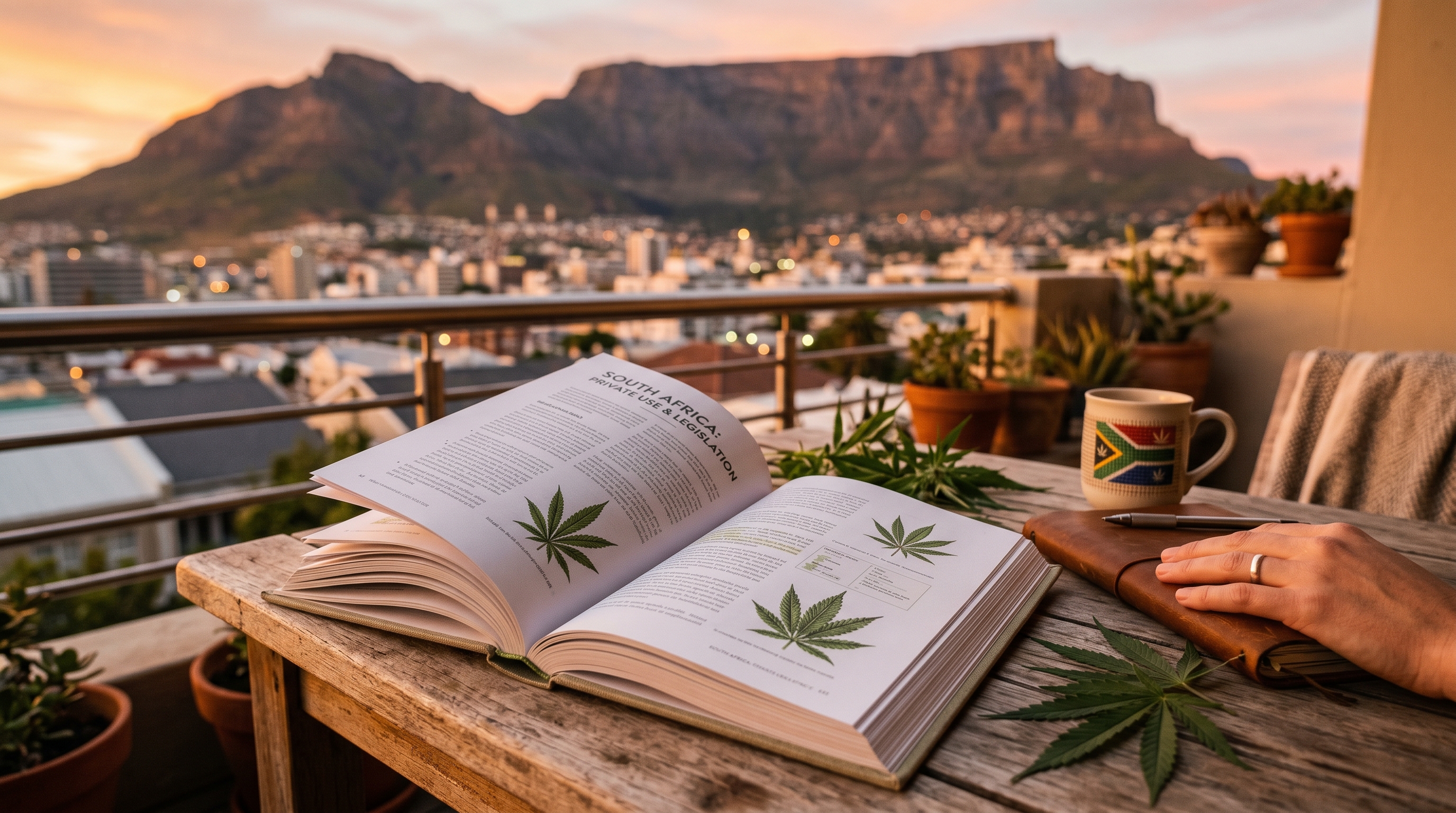
The quick answer
Here is the short version before we go deep:
- Private adult use is legal. Adults 18 and over may use, possess, and grow cannabis in private for personal use.
- Sharing is fine. Selling is not. You can give cannabis to another adult. But once money or any payment changes hands, it counts as dealing.
- No legal recreational market exists. There are no licensed shops. The “cannabis clubs” you may have heard of sit in a legal gray zone.
- Medical cannabis is legal but tightly controlled. It runs through the South African Health Products Regulatory Authority (SAHPRA).
- Hemp is being commercialized fast. It is now treated as an ordinary farm crop.
- Enforcement is messy. Arrests of private users still happen in 2026. They hit the Rastafari community hardest.
This is not legal advice. The rules are still shifting. Now let me explain how one court ruling rewired a whole country. If you want to compare destinations, our guide to cannabis tourism in 2026 and our wider history of cannabis add global context.
The 2018 ruling: privacy, not popularity
Most countries loosened cannabis laws by passing a law or holding a vote. South Africa did it through the courts. On 18 September 2018, the Constitutional Court handed down a unanimous judgment. The case was Minister of Justice and Constitutional Development and Others v Prince [Prince, 2018]. Most people just call it the Prince ruling.
The case was driven by Gareth Prince. He is a Rastafari attorney. He had fought cannabis prohibition for nearly two decades. The court did not say cannabis was harmless. It did not say the public wanted it legal. It ruled on something narrower and more powerful: the right to privacy under Section 14 of the Constitution.
The judges found a clear problem. Punishing an adult for using, possessing, or growing cannabis in private for personal use was an unfair invasion of privacy. So they struck down parts of the Drugs and Drug Trafficking Act and the Medicines Act. But they did it only to that exact extent.
What the ruling decriminalized:
- Using or possessing cannabis by an adult in private, for personal use
- Growing cannabis by an adult in a private place, for personal use
What it did not touch:
- Use or possession by anyone under 18, anywhere
- Use or possession by an adult in public
- Dealing — buying and selling stayed fully illegal
The court also did something clever. It refused to limit “private” to your home. The right to privacy reaches past your front door, the judges said. The order was paused for 24 months. That gave Parliament time to write proper law. Interim protections kicked in right away [De Vos, 2018]. For broader context on how nations differ here, our look at how cannabis culture differs around the world shows how unusual this approach is.
The Cannabis for Private Purposes Act: the law finally arrives
Parliament took its time. The 24-month deadline came and went. It was not until 28 May 2024 that President Cyril Ramaphosa signed the Cannabis for Private Purposes Act 7 of 2024 into law [Ramaphosa, 2024]. People call it the CfPPA. It put into writing what the Prince ruling had already set out six years earlier.
The Act’s stated goal is to “respect the right to privacy of an adult person to use or possess cannabis.” It does several things at once:
- Makes private adult use, possession, and cultivation legal
- Lets adults share cannabis with other adults without payment
- Bans dealing in cannabis
- Allows criminal records to be wiped for past simple possession or use
- Adds protections to keep cannabis away from children
The Act also defines “cannabis” in a precise way. It means the flowering or fruiting tops and the products made from them. That covers buds, oils, and extracts. But it excludes seeds, seedlings, stalks, leaves, and branches. That small detail matters more than it sounds. We will come back to it.
The limits (such as they are)
Here is the frustrating part. As of mid-2026, the regulations setting exact amounts are still not final [SAHRC, 2024]. The Act builds the frame. But the Minister must publish rules that set the limits. Those rules are stuck in draft. Until they are gazetted, the real limits stay fuzzy.
An earlier version of the Bill is often used as a guide. It is not binding law. Still, the expected limits look something like this:
| Activity | Expected limit |
|---|---|
| Cultivation, private | 4 flowering plants per adult; 8 per home with 2+ adults |
| Possession, private | 600g dried per adult; 1,200g per home |
| Possession, public | About 100g dried (you may hold it, but not use it) |
| Sharing | Allowed adult-to-adult, no payment |
⚠️ Important: Treat those numbers as informed guesses, not gospel. Until the regulations are published, the exact thresholds are legally undefined. That gap is exactly where the enforcement problems begin.
Go over the limit and you face a fine. You could also face up to five years in prison. Use cannabis near a child or a non-consenting adult and you commit an offense too. The same is true if your smoke disturbs people nearby. Compare this to the United States patchwork, the German club model, or the Australian state-by-state system. South Africa sits in a category of its own.
The commercial gap and the hemp gold rush
This is the heart of the contradiction. You can grow and use cannabis. But there is no legal way to buy it. No licensed shops. No legal retail. If you do not grow your own, you have two options. You buy on the informal market. Or you join a cannabis club in legal limbo.
The government knows this is a problem. It is also an economic one. Officials say the cannabis and hemp sector is already worth about R14 billion. With proper commercial rules, they think it could reach R40 billion [Business Day, 2026]. President Ramaphosa used his 2025 State of the Nation Address to set the tone. He said he wants South Africa to “lead in the commercial production of hemp and cannabis.”
To get there, the country is pushing on several fronts:
- The National Cannabis Master Plan moved to the Department of Trade, Industry and Competition in September 2024. The goal was to centralize policy [M&G, 2024].
- A Hemp and Cannabis Commercialisation Policy was aimed at Cabinet approval around April 2026.
- An overarching Cannabis Bill is expected in Parliament around mid-2027. It would unify private use, commercial growing, manufacturing, and research.
Hemp moves faster than weed
Recreational commerce has stalled. But hemp is sprinting ahead. Hemp is now a farm crop. In December 2025, the allowed THC level for hemp plants rose from 0.2% to a much friendlier 2%. The government has issued more than 2,000 hemp permits. Confused by the line between hemp and high-THC cannabis? Our breakdown of the confusing 2026 hemp vs cannabis landscape untangles it.
The result is a strange split. A farmer can get a permit to grow industrial hemp at scale. Yet the same farmer cannot legally sell a gram of flower to the adult next door. Thinking about growing your own? Our beginner’s guide to growing cannabis at home and our seed-to-harvest timeline cover the basics — within the limits the law allows.
The medical pathway
South Africa legalized medical cannabis back in 2017. That came before the Prince ruling. The medical route runs through SAHPRA. The agency has issued roughly 120 licences. They cover growing, manufacturing, oil extraction, and packaging. Much of it aims at export markets in Europe and beyond.
But the medical route is not an easy back door. It is tightly regulated. It is expensive to enter. It favors pharma-grade production over walk-in patients. For most South Africans, “medical cannabis is legal” does not mean an easy prescription at the local pharmacy. The framework still regulates THC as a substance that needs careful control. That is why even cannabis-infused foods hit a regulatory wall over THC and CBD limits.
Curious how medical and recreational lines blur in practice? We have argued that the medical-versus-recreational divide is largely artificial. South Africa is a textbook example of that legal fiction.
The Rastafari context: this fight started with faith
You cannot grasp South African cannabis law without the Rastafari community. They have been at the center from the start. Cannabis is known locally as dagga. It has deep roots in indigenous South African medicine and spiritual practice. Those roots stretch back centuries.
Gareth Prince is the man whose name sits on the 2018 ruling. He is a practicing Rastafari. He first fought prohibition in 2002 in Prince 1 and Prince 2. Back then his argument was religious freedom. He said the law unfairly restricted Rastafari worship. He lost that round 5–4. Years later he came back with a privacy argument. This time he won, and the court was unanimous.
But the win has not brought peace on the ground. The South African Human Rights Commission has tracked ongoing profiling, harassment, and arrests of Rastafari members [SAHRC, 2024]. These continue despite the Prince ruling. They continue despite the CfPPA. They even continue despite an August 2023 directive from the SAPS National Commissioner. That directive paused cannabis searches and arrests. Yet Rastafari individuals report being pulled off public transport and searched. The trigger is often nothing more than wearing dreadlocks.
The community also says it has been locked out of the legal economy. Traditional growers kept these genetics alive for generations. Now their products go unrecognized. Meanwhile corporate licensees chase export deals. It is a decolonial argument as much as a legal one. For why cannabis genetics carry this weight, see our piece on landrace strains and the original genetics. Our history of cannabis from ancient medicine to modern science adds more.
Enforcement reality: legal on paper, risky in practice
Here is where the contradiction bites hardest. The law says adults can possess cannabis in private. The reality is that arrests continue in 2026.
The core problem is the missing regulations. No official amount thresholds exist yet. So the line between “personal possession” and “dealing” falls to each police officer’s judgment. The Act allows arrest only on reasonable grounds to suspect dealing. But the SAHRC found most arrests are still for simple possession and use [SAHRC, 2024].
Gareth Prince is now a legal adviser to the cannabis community. He reported handling roughly ten cases in a short span. People had been arrested along one notorious stretch of road. They carried amounts from 200 grams to two kilograms. They were arrested for possession. There was no evidence of dealing [Maverick, 2024]. SAPS crime stats also keep lumping cannabis in with hard drugs. That keeps alive the idea that it is part of the illegal drug trade.
In April 2026, the fight reached court again. Prince, the Rastafari Nation Council, and a group of small-scale farmers brought an urgent High Court application [Cape Argus, 2026]. They sought relief against three things. Continued arrests. The destruction of cannabis plants. And the exclusion of traditional growers from the legal economy. The case was postponed. The underlying tension remains unresolved. Critics point to the Act’s deepest flaw. It grants the right to use cannabis. Yet it gives no legal source to obtain it. So people must break the law to use a right the Constitution protects.
💡 Professor High’s take: South Africa decriminalized the plant but criminalized the marketplace. Then it forgot to write the rulebook. Until the regulations are gazetted and a legal supply exists, “decriminalized” comes with an asterisk the size of Table Mountain.
This kind of legal whiplash is not unique. Look at Thailand’s cannabis reversal for a country that swung the other way. Or see our overview of where weed is legal in 2026. And if you wonder why the language of legality matters, understanding High Families is a reminder. Knowing your cannabis — legally and chemically — beats guessing.
Frequently asked questions
Is cannabis legal in South Africa in 2026? Private adult use, possession, and cultivation are legal. Buying, selling, and public use are not. There is no legal recreational retail market.
Can I buy cannabis from a dispensary in South Africa? No. There are no licensed recreational dispensaries. Medical cannabis exists through SAHPRA. But it is tightly regulated and not a walk-in option. “Cannabis clubs” sit in a legal gray zone.
How much cannabis can I legally possess? The exact limits are not final. The regulations under the Act are still in draft. Earlier draft figures pointed to around 600g private per adult and 4 plants per adult. But those are not binding law yet.
Can I grow cannabis at home? Yes. An adult may grow cannabis in a private place for personal use. You cannot sell what you grow.
Can tourists use cannabis in South Africa? The law applies to adults in general. But tourists face the same risks. There is no legal way to buy. Enforcement is inconsistent. And public use is not tolerated. If you are reading our cannabis tourism guide, approach South Africa with caution.
Why do people still get arrested if it is decriminalized? No official amount limits exist. So police use their own judgment to decide what counts as “dealing.” Many arrests for simple possession continue. They affect the Rastafari community most.
How does South Africa compare to the United States? Very differently. The US runs a state-by-state retail patchwork. South Africa decriminalized private use nationally but built no legal market at all. Our global culture comparison explores why these models diverge.
Key takeaways
South Africa is a striking case study in reform from the top. It started with a constitutional right to privacy. It did not start with a commercial push. That gave it something genuinely progressive. The law protects what adults do in private. But it also left a gaping hole where a legal market should be. And it left a vacuum that police keep filling with arrests.
In 2026, the country sits in a holding pattern. Private use is protected. Commerce has stalled. Hemp is accelerating. Medical access is narrow. Traditional communities are still fighting for recognition. The overarching Cannabis Bill expected around 2027 may finally close the gap. That gap is between “you may use it” and “here is where to legally get it.”
Wherever you live, one thing matters most. It is knowing why a cannabis experience works for you. That matters more than any strain name on a label. It is the whole reason we built High IQ. We help you find your ideal high by tracking what actually works for your body. Not what the marketing says. Understanding the law is step one. Understanding yourself is the rest.
Sources & disclaimer
Sources:
- Constitutional Court of South Africa, Minister of Justice and Constitutional Development and Others v Prince [Prince, 2018] (ZACC 30, 18 September 2018) — concourt.org.za
- Pierre de Vos, “Con Court cannabis judgment: what was the reasoning?” [De Vos, 2018] — constitutionallyspeaking.co.za
- Cannabis for Private Purposes Act 7 of 2024, signed 28 May 2024 [Ramaphosa, 2024] — gov.za / Government Gazette
- SAnews.gov.za, “SA emerging as a leader in the global hemp and cannabis industry” (September 2025)
- Mail & Guardian, “Cannabis master plan moved from agriculture to trade and industry ministry” [M&G, 2024]
- Business Day / Business Report, cannabis commercialisation parliamentary briefing coverage [Business Day, 2026]
- Daily Maverick, “SA Human Rights Commission warns police against wrongful cannabis arrests” [Maverick, 2024]
- Cape Argus, “High Court postpones urgent challenge to South Africa’s cannabis laws” [Cape Argus, 2026]
- South African Human Rights Commission, Rights of the Rastafari report [SAHRC, 2024]
Disclaimer: This article is for educational and informational purposes only. It does not constitute legal advice. Cannabis laws in South Africa are still evolving. Key regulations under the Cannabis for Private Purposes Act remain unfinalized as of publication. Enforcement varies by location and officer judgment. Always consult a qualified South African attorney before making decisions about cannabis possession, cultivation, or any related activity.


