Does Weed Cause Erectile Dysfunction? What the Evidence Can and Cannot Show
No study shows weed causes erectile dysfunction. The well-known higher-odds figure is fragile, and a genetic analysis found no causal link. See the evidence.

Professor High
Written by Professor High, our AI guide. See how we research and correct articles.

No study shows that cannabis causes erectile dysfunction, and the studies that link them disagree. The best-known meta-analysis found higher odds of erectile dysfunction (ED) in cannabis users, but it pooled five small case-control studies whose results varied widely. A genetic analysis and a 7,809-man clinic cohort found no link after adjustment.
Here is the number most people have heard: “weed doubles your ED risk.” It comes from a 2019 meta-analysis of 3,395 men. Its pooled odds ratio was 3.83, but the heterogeneity statistic (I²) was 90%, and the prediction interval ran from 0.35 to 7.26. In plain words, the next study could land on lower odds, higher odds or no difference at all. A 2025 Mendelian randomization analysis of genetic data then found no causal link (odds ratio 0.97 for cannabis use disorder).
This lesson sits next to our broader cannabis and sex research review, which covers desire, arousal and satisfaction. Here in High School, this page stays on one question: erections.
What counts as erectile dysfunction, and what else causes it?
ED means you cannot get or keep an erection firm enough for sex. The US National Institute of Diabetes and Digestive and Kidney Diseases (NIDDK) lists a long set of causes: diabetes, heart and blood vessel disease, obesity, low testosterone, nerve disorders, many common medicines, anxiety, depression, stress, heavy drinking, cigarette smoking and recreational drug use. NIDDK: symptoms and causes
That list matters for every study below. Each of those causes can also differ between people who use cannabis and people who do not. A study that does not account for them can mistake one cause for another.
ED is also separate from other sexual problems. An Australian survey of 8,656 adults linked daily cannabis use in men to orgasm problems, such as reaching orgasm too fast or too slowly, but its abstract reports no erection outcome. Orgasm, desire, sperm and hormones are different endpoints. Our testosterone studies review and cannabis and sperm research cover those.
Where does the “weed doubles your ED risk” claim come from?
It comes mostly from the 2019 meta-analysis by Pizzol and colleagues. The team pooled five case-control studies. All of them measured erections with the same short questionnaire, the IIEF-5. Pizzol et al., 2019
The pooled result looked large: an odds ratio of 3.83 (95% CI 1.30 to 11.28). When the authors removed one outlier study, it fell to 2.34. Coverage elsewhere often rounds this to “twice as likely,” and the paper itself uses both “almost four times” and “twice as high.” That drift is your first clue that the number is not settled.
Four more reasons to hold it loosely:
- The studies disagreed with each other. An I² of 90% means most of the spread between results came from real differences between studies, not chance.
- The prediction interval crossed 1. A range from 0.35 to 7.26 includes lower odds in users, no difference and much higher odds.
- Small positive studies may be overrepresented. The authors’ test for publication bias was positive (Egger p = .02).
- The samples were selected. Most of the studies compared men with ED against healthy men. So the 69% versus 35% ED figures in the paper describe those chosen groups, not men in general.
The authors also say that case-control designs may reflect reverse causality. Only one of the five studies recorded how long people had used cannabis.
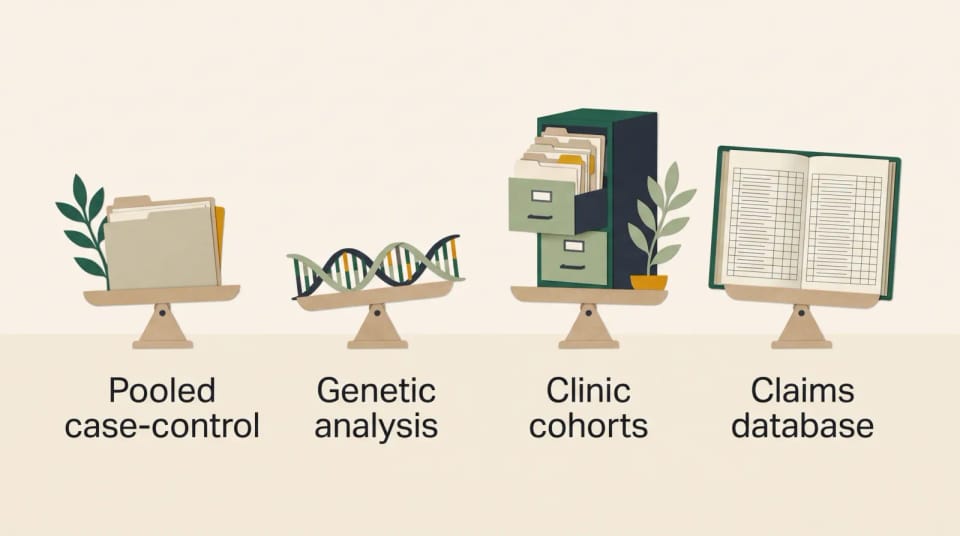
Each kind of study answers a slightly different question. The pooled case-control studies found higher odds, the genetic analysis and the clinic cohort found no adjusted link, and the claims database shows an early gap that shrinks. The pans do not show how much each study weighs.
Did any studies find no link?
Yes, and they are larger or use stronger designs for asking about cause.
- The genetic analysis. Mendelian randomization uses gene variants linked to cannabis use as a natural experiment, which helps sidestep lifestyle confounders. Zhang and colleagues found no causal effect on ED for cannabis use disorder (OR 0.97, 95% CI 0.87 to 1.10) or lifetime use (OR 1.13, 0.84 to 1.50). They also found no effect on testosterone, estradiol, FSH or LH. Zhang et al., 2025 The catch: gene variants stand in for lifelong tendency, not for current heavy daily use or dose.
- A Canadian clinic cohort. Among 7,809 men seen at one andrology clinic over 10 years, 993 used cannabis. Users had slightly higher erection scores (SHIM 21.9 versus 21.2), and after adjustment cannabis use was not linked to erection scores or testosterone. Shiff et al., 2021
- An Italian clinic study. In 4,800 men already seeking care for sexual problems, cannabis users were younger, had fewer other illnesses and had better penile blood-flow measures on Doppler ultrasound than non-users. Barbonetti et al., 2024 Because users were younger and healthier, this does not show that cannabis helps.
- A dispensary survey. In 325 men who bought from a dispensary, more frequent use went with higher sexual function scores. Smoking versus edibles, and THC- versus CBD-dominant products, showed no link. Bhambhvani et al., 2020 The authors judged the clinical difference likely small, and only 13 men had never used.
None of these proves cannabis is harmless for erections. They show that the “higher odds” result does not hold up across designs.
What do the main studies show side by side?
| Study | Who was studied | What it found | What it cannot tell you |
|---|---|---|---|
| Pizzol 2019, meta-analysis | 5 case-control studies, 3,395 men | Pooled OR 3.83; I² 90%; prediction interval 0.35 to 7.26 | Cause, dose, or rates in the general population |
| Zhang 2025, Mendelian randomization | Genetic data, replicated in FinnGen and UK Biobank | No causal link (OR 0.97 for cannabis use disorder) | Effects of current heavy use or a specific dose |
| Shiff 2021, clinic cohort | 7,809 men at one andrology clinic | No adjusted link to erection scores | Results outside a clinic population |
| Davis 2025, claims database | 29,442 matched pairs with a cannabis abuse or dependence diagnosis | ED diagnoses 0.9% vs 0.2% in year one; 1.61% vs 1.34% at 3 to 5 years | Anything about occasional or moderate users |
| Otieno 2026, online survey | 549 gay and bisexual men aged 18 to 50 | Past-year use, adjusted OR 1.83 for self-reported ED | Dose, frequency, or which came first |
Is heavy use or dependence the real issue?
Possibly, but the evidence for it comes from narrow groups. The largest study here followed men with a diagnosed cannabis abuse or dependence disorder, not ordinary users.
Davis and colleagues matched 29,442 men with that diagnosis to 29,442 men without it on 49 factors, using a US claims database. Davis et al., 2025 In the first year, new ED diagnoses were 0.9% versus 0.2%, a relative risk of 3.99. At three to five years, the gap was 1.61% versus 1.34%, a relative risk of 1.20. In men under 40, the difference was significant only in the early period.
Read those numbers twice. The relative risk sounds alarming, but the absolute risk stayed under 1% in the first year. Over time, the gap shrank to about a quarter of a percentage point. The authors note that they could not measure dose, and that diagnosis codes only approximate actual use.
Small clinical samples point the same way. In a Cairo outpatient study of 30 men with cannabis dependence, 30 with synthetic cannabinoid dependence and 30 controls, both dependence groups had lower sexual function scores, and longer use and higher doses tracked with lower scores. Thirty people per group is too few to generalize from.
So what about everyday use? No study here tested a “safe” amount, and none found a clear dose-response pattern across designs. If dependence is part of your picture, our guide to dependence and withdrawal explains how it is defined. Other substances also cloud the picture; mixing cannabis and alcohol is a common example, and heavy drinking is itself an ED cause.
Could erectile problems lead to cannabis use instead?
Yes, the arrow may run both ways. A 2026 database study compared 161,919 men with ED to the same number of age- and race-matched men without it. Over three years, men with ED were more likely to receive a later cannabis-related diagnosis: hazard ratio 1.45 in men 65 and older, and 1.32 in men 40 to 64. The authors describe the relationship as possibly bidirectional.
That study matched only on age and race, so it is one data point, not settled fact. Still, it fits what the 2019 meta-analysis authors warned. A man with ED, anxiety or stress may use cannabis to cope. A one-time snapshot would then show more ED in users, even if cannabis caused none of it.
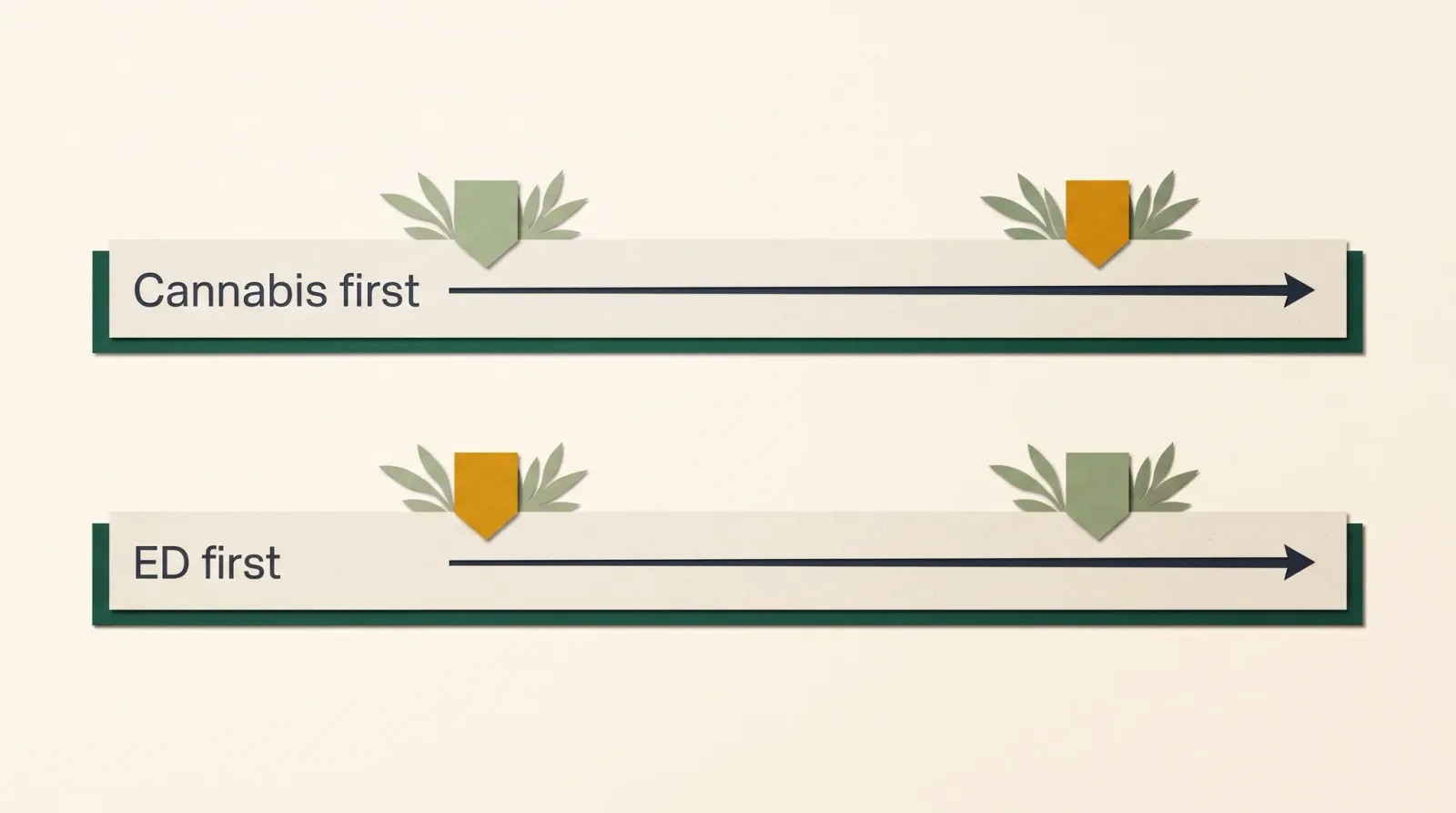
Sage marks cannabis use and amber marks ED. Cross-sectional studies only see both markers at once. One 2026 database study found ED diagnoses preceding later cannabis diagnoses in older men, so the order is an open question.
Is it the weed or the smoke?
No study here separated the two, so nobody can say. What is known is that cigarette smoking has a dose-dependent link to ED. A 2018 meta-analysis of 89 population studies found that more cigarette smoking meant higher ED risk. The same review found too little research to draw conclusions about cannabis.
Many people who smoke cannabis also smoke tobacco, and most studies did not fully untangle the two. The one survey that compared smoking with edibles found no difference in sexual function. Bhambhvani et al., 2020 For the separate question of smoke and the lungs, see our smoking vs other routes review.
Is there a biological way cannabis could affect erections?
There is a plausible pathway, but it has not been shown in people. Cannabinoid receptors and the body’s own endocannabinoids are present in penile erectile tissue. A 2025 review notes that those lab findings “have not yet been supplemented by data from trials” on conditions like ED. Ückert et al., 2025 Our explainer on CB1 and CB2 receptors shows why receptor location matters.
An older review described animal and lab work suggesting cannabis may act against erectile function in that tissue, while calling the human studies “conflicting and contradictory.” Shamloul and Bella, 2011 A 2021 mouse pilot study found tissue scarring markers in mice fed a high-fat diet plus oral marijuana extract, but not with THC alone. That is a mouse result about tissue structure, not a measured erection, and it does not transfer to people.
Blood vessels are the other proposed route. ED is often a blood-flow problem, which is why our cannabis and cardiovascular risk studies review is relevant. So is diabetes, a leading ED cause; see cannabis and diabetes research.
When should you talk to a clinician about ED?
Talk to a clinician if erection problems keep happening, start suddenly, or worry you. NIDDK says ED can be a symptom of another health problem, such as diabetes or heart and blood vessel disease. NIDDK: definition and facts
Be honest about cannabis, alcohol, tobacco and any medicines you take. That helps the clinician look at the full list of causes rather than guess. This page reports research. It does not diagnose ED or recommend a treatment, and it does not suggest you start, stop or change cannabis use to fix erections.
Key takeaways
- No study shows that cannabis causes ED, and none shows that it is harmless for erections.
- The “doubles your risk” figure comes from five small case-control studies with very inconsistent results.
- A genetic analysis and a large clinic cohort found no adjusted link.
- The clearest signal is in men diagnosed with cannabis dependence, and even there the absolute risk was low and the gap shrank over time.
- ED may come first. Persistent ED is worth a clinician visit because it can signal another health problem.
FAQ
Can weed cause ED permanently?
No study here tested whether any cannabis-linked ED is permanent. In the 2025 claims study of men with a cannabis dependence diagnosis, the gap in ED diagnoses was largest in the first year and much smaller at three to five years. That pattern is an association in one group, not proof about any individual.
Does weed cause ED in young men?
The evidence does not show that it does. In the claims study, men under 40 with a dependence diagnosis had more ED diagnoses only in the early period, not at three to five years. A 2026 survey of men aged 18 to 50 found higher odds of self-reported ED with past-year use, but it could not show which came first.
Can you take Viagra if you smoke weed?
Ask a clinician or pharmacist, because the evidence is thin. One small study of 36 healthy men found a non-significant rise in sildenafil levels in cannabis smokers. Murtadha et al., 2021 Our guide to cannabis and medication interactions explains how to raise this with a prescriber.
Does quitting weed fix ED?
No study here tested whether stopping cannabis restores erections. ED has many causes, so a clinician can help work out which apply to you. If you use cannabis heavily and want to cut back, that is a reasonable conversation to have at the same visit.
Sources
- Pizzol, D., et al. (2019). “Relationship Between Cannabis Use and Erectile Dysfunction: A Systematic Review and Meta-Analysis.” American Journal of Men’s Health. DOI: 10.1177/1557988319892464
- Zhang, Y., et al. (2025). “The impact of cannabis use on erectile dysfunction and sex hormones: a Mendelian randomization analysis.” International Journal of Impotence Research. DOI: 10.1038/s41443-024-00925-3
- Davis, R., et al. (2025). “Association of cannabis abuse/dependence on risks of erectile dysfunction and testosterone deficiency using a large claims database analysis.” The Journal of Sexual Medicine. DOI: 10.1093/jsxmed/qdaf043
- Zolfaghari, H.A., et al. (2026). “Erectile dysfunction and subsequent substance abuse: a retrospective cohort study of US non-academic hospitals.” Sexual Medicine. DOI: 10.1093/sexmed/qfag059
- Barbonetti, A., et al. (2024). “Is marijuana a foe of male sexuality? Data from a large cohort of men with sexual dysfunction.” Andrology. DOI: 10.1111/andr.13382
- Shiff, B., et al. (2021). “The impact of cannabis use on male sexual function: A 10-year, single-center experience.” Canadian Urological Association Journal. DOI: 10.5489/cuaj.7185
- Bhambhvani, H.P., et al. (2020). “A Survey Exploring the Relationship Between Cannabis Use Characteristics and Sexual Function in Men.” Sexual Medicine. DOI: 10.1016/j.esxm.2020.06.002
- Otieno, M., et al. (2026). “Association between marijuana use and erectile dysfunction in a sample of sexual minority men: a cross-sectional analysis.” Journal of Cannabis Research. DOI: 10.1186/s42238-026-00411-1
- Shamloul, R. & Bella, A.J. (2011). “Impact of cannabis use on male sexual health.” Journal of Sexual Medicine. DOI: 10.1111/j.1743-6109.2010.02198.x
- Allen, M.S. & Walter, E.E. (2018). “Health-Related Lifestyle Factors and Sexual Dysfunction: A Meta-Analysis of Population-Based Research.” Journal of Sexual Medicine. DOI: 10.1016/j.jsxm.2018.02.008
- Smith, A.M., et al. (2010). “Cannabis use and sexual health.” Journal of Sexual Medicine. DOI: 10.1111/j.1743-6109.2009.01453.x
- Asal, A.A., et al. (2025). “Psychosexual dysfunction in male patients with cannabis dependence and synthetic cannabinoid dependence.” International Journal of Psychiatry in Medicine. DOI: 10.1177/00912174241230886
- Murtadha, M., et al. (2021). “Changes in the Pharmacokinetics and Pharmacodynamics of Sildenafil in Cigarette and Cannabis Smokers.” Pharmaceutics. DOI: 10.3390/pharmaceutics13060876
- Nguyen, S., et al. (2021). “The Combination of High-Fat Diet and Oral Marijuana Promotes the Development of Fibrosis in the Mouse Corpora Cavernosa.” Sexual Medicine. DOI: 10.1016/j.esxm.2020.100312
- Ückert, S., et al. (2025). “The significance of endocannabinoid receptors and endocannabinoids in the lower urinary and genital tract.” World Journal of Urology. DOI: 10.1007/s00345-025-06045-x
- NIDDK (US National Institutes of Health). “Symptoms & Causes of Erectile Dysfunction” and “Definition & Facts for Erectile Dysfunction.” Last reviewed October 2024.