Cannabis and Essential Tremor: What the Research Shows
Cannabis has not shown a clear benefit for essential tremor in small controlled trials. See the published results, safety findings, and evidence limits.


Cannabis has not shown a clear benefit for essential tremor in the small controlled trials discussed here. A UC San Diego pilot published in April 2025 tested oral THC plus CBD against placebo and found no signal of tremor improvement. That is a preliminary negative result, not proof that every cannabinoid preparation is ineffective [Longardner et al., 2025].
Here in High School, the important update is simple: the trial results are published. A trial plan, an encouraging story, and a completed placebo comparison answer different questions. The published comparison deserves more weight than speculation about what the trial might find.
Is essential tremor the same as Parkinson’s tremor?
No. Essential tremor commonly affects the hands during actions such as writing or holding a cup. Parkinson’s tremor more often occurs at rest, though symptoms can overlap. A clinician evaluates the pattern and other signs; a shaking hand alone does not establish either diagnosis [Mayo Clinic, 2025].
This distinction matters when reading cannabis claims. A Parkinson’s survey cannot establish a treatment benefit for essential tremor. Nor does a change in sleep, comfort, or anxiety automatically show a reduction in tremor itself. The condition and the outcome both need to match the question.
What did the 2025 THC/CBD trial test?
The researchers ran a randomized, double-blind, placebo-controlled crossover pilot. In a crossover study, participants receive both the active preparation and placebo in separate periods. The order is randomized, and a washout separates the periods.
They tested a pharmaceutical-grade oral capsule containing 5 mg THC and 100 mg CBD. Researchers adjusted the dose according to tolerability, with a study maximum of three capsules daily. Each arm included titration, two weeks at the highest tolerated dose, and tapering. A three-week washout came between the arms [Longardner et al., 2025].
Those numbers describe the experiment. They are not a dosing guide. The tested capsule was not a dispensary gummy, inhaled flower, or a sublingual tincture. Our THC-versus-CBD guide explains the ingredients, while the oral-versus-sublingual comparison explains why delivery format also matters.
Did it reduce the measured tremor?
The study did not find greater tremor reduction with THC/CBD than with placebo. Its primary outcome measured tremor amplitude during a digital spiral-drawing task. Clinical tremor ratings also showed no detected benefit signal [Longardner et al., 2025].
Seven people enrolled, and five completed every visit. All enrolled participants were White men, with an average age of 67. The team had planned a larger study. This small, narrow sample limits how confidently the results apply to other people. Participants and clinicians also usually guessed the treatment assignment correctly, another limit to the blinding [Longardner et al., 2025].
The distinction to keep is “no benefit detected in this pilot” versus “all possible cannabis treatments disproven.” The first describes the finding. The second claims more than this experiment could test.
| Question | What this trial tells us |
|---|---|
| Did this oral THC/CBD capsule outperform placebo on tremor measures? | No benefit signal was detected. |
| Were all seven participants able to finish? | No; five completed all visits. |
| Does it establish a benefit from a retail cannabis product? | No; that product was not tested. |
| Does it rule out every possible formulation or longer treatment? | No; the sample and treatment period were limited. |
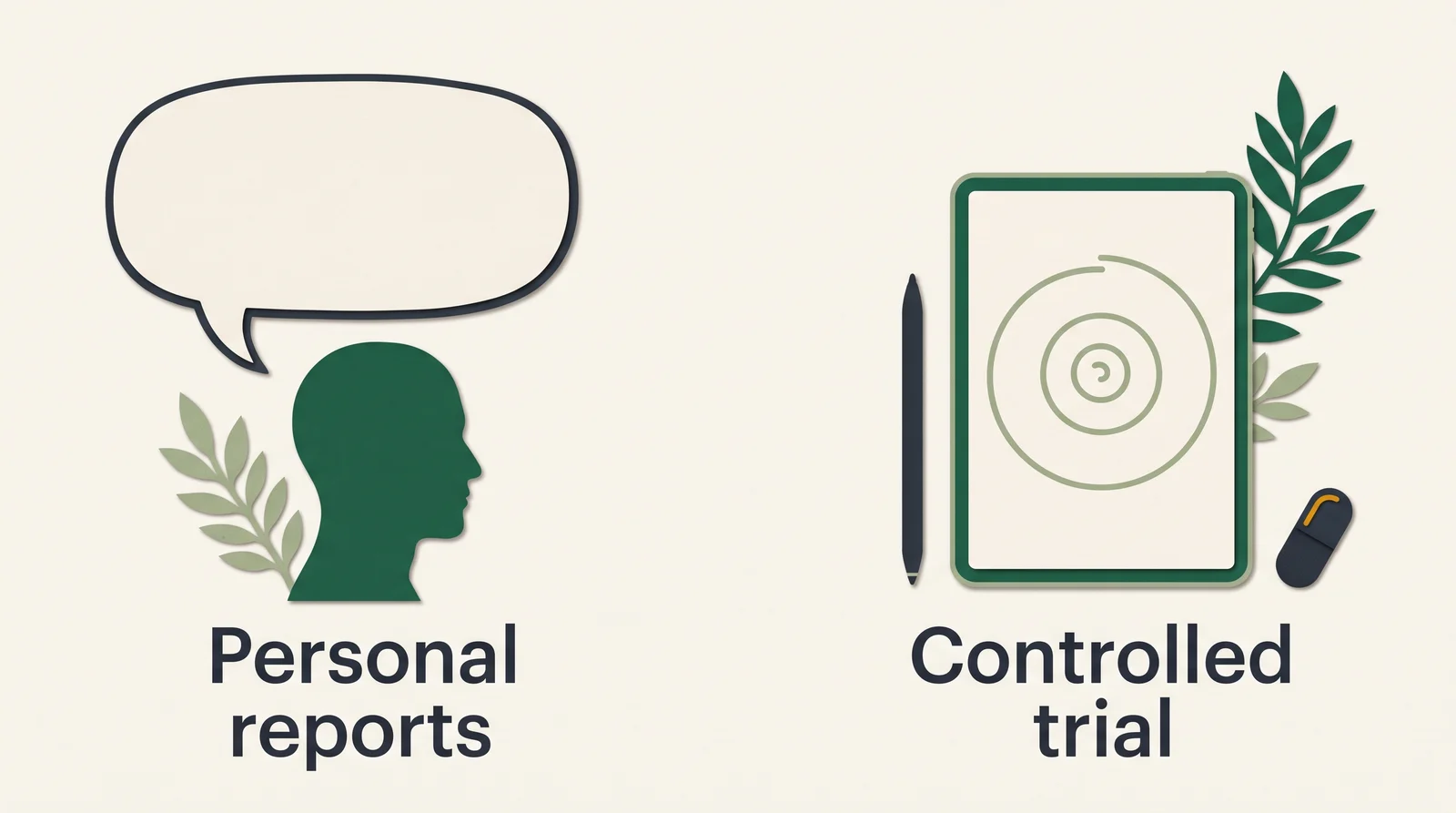
Personal reports and a placebo-controlled spiral assessment are different evidence. This is a conceptual illustration, not participant data.
What happened with side effects?
Tolerability was part of the result, not a footnote. One participant withdrew after a serious event assessed as probable convulsive syncope: fainting accompanied by seizure-like movements. The study’s safety board considered a relationship to the study drug reasonably possible. That does not prove the drug caused the event, and the paper does not diagnose epilepsy from it.
A second participant could not tolerate the lowest capsule dose because he felt altered. Only one tolerated the study’s maximum daily amount, and he needed it divided rather than taken together [Longardner et al., 2025]. A small trial cannot provide a dependable estimate of how often these problems would occur in the wider population.
Tilray supplied the investigational capsules and placebo, plus regulatory and financial support. Other support came from the International Essential Tremor Foundation and the Center for Medicinal Cannabis Research. Company support does not erase the null result, but it belongs beside the study’s limitations.
What about CBD without THC?
An older trial also found no short-term tremor benefit. The 2021 randomized, double-blind crossover study enrolled 19 people with essential tremor. Participants received a single oral 300 mg CBD dose or placebo in sessions two weeks apart. Assessments at 60 and 210 minutes found no significant differences in upper-limb tremor, motor-task scores, or the clinical impression of change [Santos de Alencar et al., 2021].
That was a single-dose test, not months of daily CBD treatment. The authors specifically said the result did not exclude a possible effect from chronic treatment. It also cannot supply a CBD dosing recommendation.
Taken together, these two trials do not establish a cannabinoid treatment for essential tremor. Their different formulations and follow-up periods should stay visible when someone combines them into a broad claim.
How should someone considering cannabis use this evidence?
Bring the published results to the clinician managing the tremor. Ask whether the diagnosis is clear, what treatments fit the symptoms, and whether cannabis would create additional problems with current medicines. Mayo Clinic describes options including medicines, occupational adaptations, and procedures for selected patients [Mayo Clinic, 2025]. A negative cannabis trial does not mean there are no care options.
Our appointment-preparation card can help organize questions for that discussion. Bring a complete medicine and supplement list. Do not replace prescribed treatment or copy the trial regimen based on this article.
If you already use a cannabis product, a product lab report can describe its tested contents. A chemistry result is different from a clinical efficacy result. The same applies when comparing cannabis products beyond THC percentage: an ingredient profile is different from a demonstrated clinical benefit.
Key takeaways
- The UC San Diego THC/CBD essential-tremor pilot was published in April 2025 and found no benefit signal.
- Seven enrolled; five completed. Side effects and the narrow sample limit interpretation.
- A separate single-dose CBD trial was also negative, with a different follow-up window.
- These results do not establish a retail product, dose, or strain for essential tremor.
FAQ
Are the UC San Diego essential-tremor trial results still pending?
No. The pilot results were published on April 14, 2025. The tested oral THC/CBD formulation did not show a signal of tremor benefit against placebo.
Does a negative pilot prove cannabis can never help essential tremor?
No. It means that benefit was not detected with this preparation in this small, short trial. It also gives no basis for promising that an untested preparation will work.
Is CBD alone proven to reduce essential tremor?
No. The single-dose CBD trial described here found no significant short-term improvement. It did not answer whether longer treatment has an effect.
Can Parkinson’s cannabis reports guide essential-tremor treatment?
They cannot establish efficacy for a different condition. Diagnosis, product, study design, and measured outcome must match before a result can answer the essential-tremor question.
Sources
- [Longardner et al., 2025] Longardner, K., Shen, Q., Castellanos, F. X., Tang, B., Gandhi, R., Wright, B. A., Momper, J. D., & Nahab, F. B. “Double-Blind, Randomized, Placebo-Controlled, Crossover Study of Oral Cannabidiol and Tetrahydrocannabinol for Essential Tremor.” Tremor and Other Hyperkinetic Movements, 15. DOI: 10.5334/tohm.1005. PMID: 40248111. Open full text.
- [Santos de Alencar et al., 2021] Santos de Alencar, S., Crippa, J. A. S., Brito, M. C. M., Pimentel, Â. V., Cecilio Hallak, J. E., & Tumas, V. “A single oral dose of cannabidiol did not reduce upper limb tremor in patients with essential tremor.” Parkinsonism & Related Disorders, 83, 37–40. DOI: 10.1016/j.parkreldis.2021.01.001. PMID: 33465546.
- [Mayo Clinic, 2025] Mayo Clinic Staff. Essential tremor: symptoms and causes and diagnosis and treatment. Clinical background and care options, not evidence of cannabinoid efficacy. Accessed 2026-10-10.

