Sublingual Tinctures vs Edibles: Onset Time Compared
Sublingual tinctures absorb partly through the mouth for a faster onset, while edibles route through the liver. Here is how the timing really compares.

Picture this. You hold a tincture under your tongue and feel something in 20 minutes. Another night you take a gummy and wait an anxious hour and a half, wondering if it was a dud. You have already felt the central difference of this comparison. Same plant. Same THC. Wildly different clocks.
The reason is not magic, marketing, or a stronger product. It is anatomy. A sublingual tincture and an edible take two different roads into your bloodstream. Those roads have very different speed limits. Knowing the difference is the most useful thing you can learn before reaching for either one.
Let me walk you through how each method gets THC into your system. We will cover what the research says about onset and duration, why edibles feel “stronger” even at the same dose, and which one fits which moment. As always, this is education, not medical advice, and individual responses vary a lot.
The criteria: what we are actually comparing
Before the table, here is what matters when you compare any two consumption methods:
- Onset — how long until you feel the first effects
- Time to peak — when effects are strongest
- Duration — how long the experience lasts
- Bioavailability — what fraction of the dose actually reaches your bloodstream
- Dosing control — how easily you can find and repeat a comfortable dose
The whole sublingual-versus-edible story comes down to one anatomical fork in the road: do the cannabinoids enter through the thin tissue under your tongue, or do they go down into your gut and through your liver first?
How a sublingual tincture is absorbed
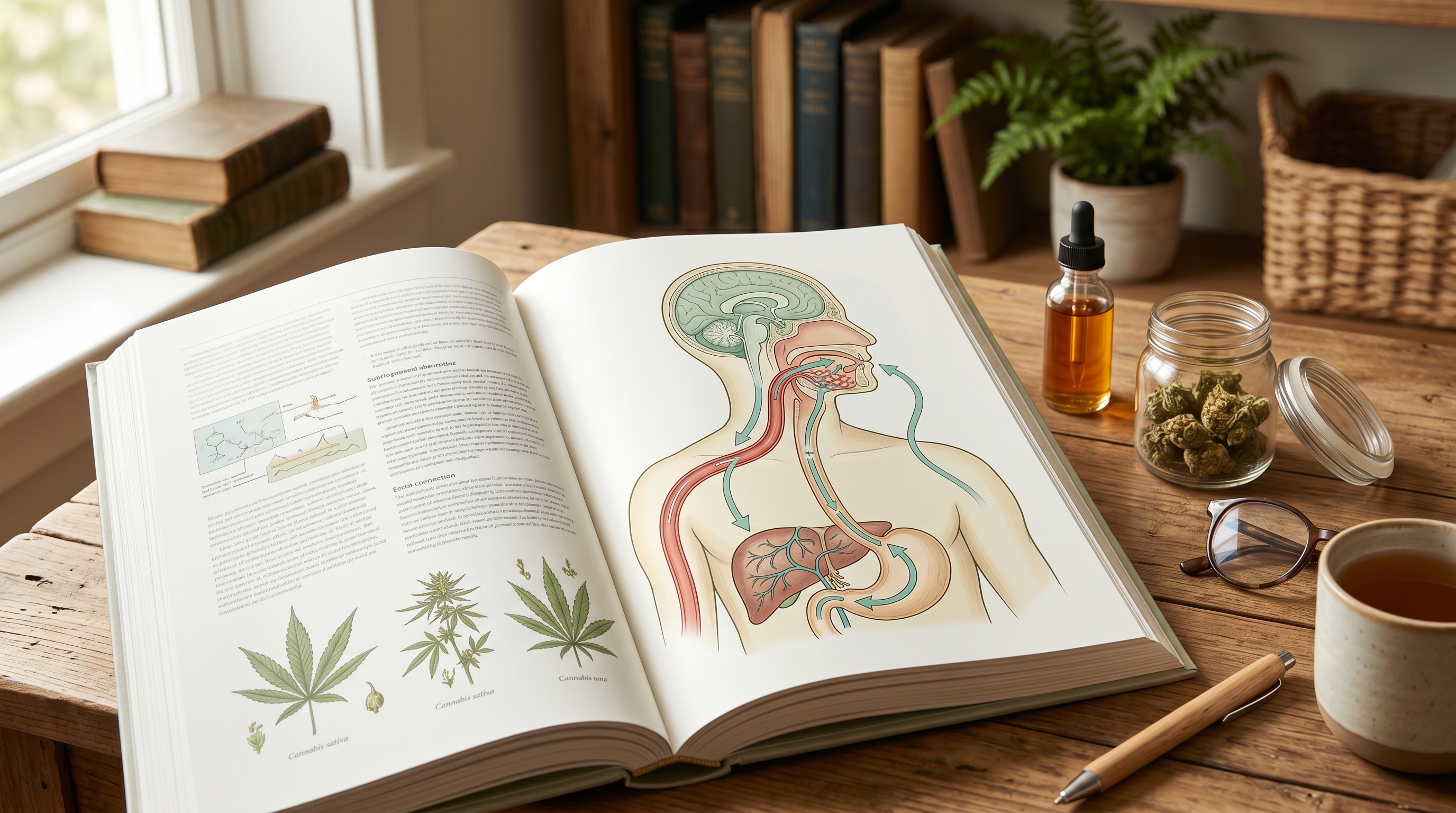
The floor of your mouth is lined with thin mucous membranes fed by a dense network of capillaries. This is the same tissue that lets nitroglycerin tablets work for heart patients within minutes. When a cannabis tincture sits against that tissue, some of the THC can absorb straight into your bloodstream. It skips the trip through your stomach and liver.
That partial bypass is the whole appeal. Cannabinoids that absorb under your tongue arrive mostly as delta-9-THC, the familiar parent compound, and they show up sooner because they take a shortcut.
Here is the honest catch, and it is a big one: the bypass is only partial. Sublingual absorption of THC is incomplete and variable. THC is intensely fat-loving (lipophilic), which slows its movement across the watery mucosal surface. Meanwhile, saliva keeps building up and you eventually swallow. Research on Sativex, the one approved oromucosal cannabis spray, found that its blood-level profile and its metabolite ratios look a lot like swallowed cannabis. That strongly suggests much of the dose is swallowed rather than truly absorbed under the tongue [Lucas, 2018].
So a tincture is best understood as a hybrid. You get a faster first wave of delta-9-THC from whatever absorbs sublingually, followed by a slower second wave from the portion you swallow, which then behaves exactly like an edible. This is why the technique matters so much, which we will get to.
How an edible is absorbed
An edible takes the long road. THC travels down to your stomach and small intestine and gets absorbed there. From there it flows through the portal vein straight to your liver, before it ever reaches the rest of your body. That liver detour is called first-pass metabolism, and it changes everything.
Two things happen on this route. First, you lose a lot of THC to stomach acid, slow gut absorption, and the liver itself. That is why oral bioavailability is so low. Most estimates land somewhere around 4 to 20 percent, often cited at roughly a third of what you get from inhalation [Lucas, 2018]. Second, and more interesting, the liver enzyme CYP2C9 converts a large share of delta-9-THC into a different molecule: 11-hydroxy-THC. More on that compound shortly, because it is the reason edibles feel the way they do.
The practical consequence is a slow, delayed, and often unpredictable onset. Peak blood levels can take one to three hours, and effects can stretch for many hours after that. Research suggests this slow timeline is normal, and our guide to cannabis pharmacokinetics walks through how the body handles THC at each stage.
Onset and duration compared
Here is the side-by-side. These ranges come from clinical pharmacokinetic literature and reflect typical patterns, not guarantees. Your body, your last meal, your tolerance, and your genetics all shift these numbers.
| Method | Onset | Time to peak | Duration | Rough bioavailability |
|---|---|---|---|---|
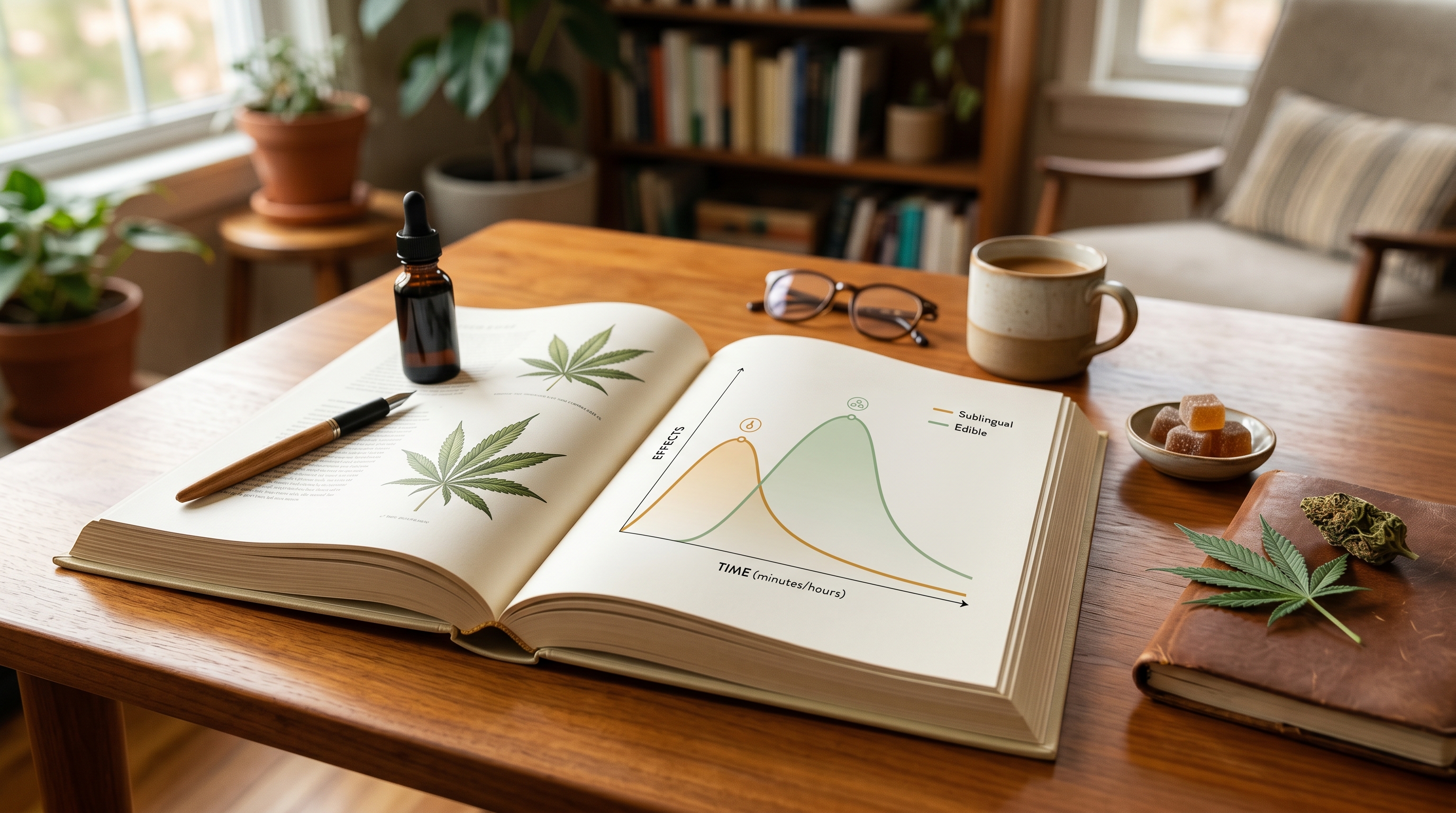
| Sublingual tincture | 15–45 min | ~1–2 hr | 2–6 hr | ~12–25% (estimated, variable) |
| Edible | 45 min – 2+ hr | 1–3 hr | 4–8 hr (sometimes longer) | ~4–20% |
The pattern is clear. The tincture’s partial mucosal absorption buys you a faster onset. That means quicker feedback on whether you have had enough. The edible’s full liver route is slower to start but tends to run longer. That can be a feature or a problem, depending on what you want.
One nuance is worth flagging. Because much of a tincture is still swallowed, its total duration often overlaps with edibles more than the onset gap would suggest. You feel it sooner, but the tail can be similar. For a full breakdown of why timelines stretch, read how long does a cannabis high last.
The 11-OH-THC factor: why edibles feel different
This is the part most “tincture vs edible” comparisons skip, and it is the most important.
When you eat THC, your liver converts a big share of it into 11-hydroxy-THC (11-OH-THC). This metabolite is not a weaker leftover. Early human work suggested it is more potent at the CB1 receptor than delta-9-THC, and it appears to cross the blood-brain barrier readily. A 2024 preclinical study reported that 11-OH-THC was equal to or greater than THC in activity in an animal model, even after accounting for pharmacokinetic differences [Ruzic, 2024].
The telltale fingerprint is the metabolite ratio. After inhaling, the ratio of 11-OH-THC to THC in your blood is low, often cited around 1-to-20. After eating, that ratio flips to roughly 1-to-1 or higher because so much THC is converted on the way through the liver. In plain terms: an edible doesn’t just deliver THC, it manufactures a second, arguably stronger psychoactive compound inside you.
This is why an edible can feel more intense, more body-heavy, and longer-lasting than an inhaled dose of the same milligrams. We have a full explainer on this exact mechanism in why edibles hit harder: the science of 11-OH-THC.
So where does a tincture land? Right in the middle. The portion absorbed under your tongue arrives as delta-9-THC, with less liver conversion. The swallowed portion still produces 11-OH-THC, just like any edible. A well-used tincture gives you a faster, clearer-headed first wave on top of a more edible-like body experience. For the bigger map of how every method stacks up, see cannabis consumption methods ranked by bioavailability.
Dosing control: where each one shines
Tinctures win on titration. Because the onset is faster, you get feedback sooner, which makes it easier to find your dose without overshooting. A dropper also lets you measure in small, repeatable increments rather than committing to a whole gummy. If you are new to measured dosing, our cannabis beginners dosing chart and edible dosing for beginners are good starting points.
Edibles are the classic over-consumption trap. The slow, unpredictable onset is exactly why people redose too early, feel nothing at 45 minutes, eat a second gummy, and then get hit by both at once. The fix is boring but it works: wait at least two hours before redosing. If you make your own, precision matters even more, which is why we wrote edible dosing math for home cooks and a guide to testing homemade edible potency at home.
Why “hold it under your tongue” actually matters
If you are going to use a tincture, the technique is the product. Hold the liquid under your tongue and against the floor of your mouth for at least 60 to 90 seconds before swallowing. Avoid drinking anything for a few minutes after. The longer the tincture stays in contact with that thin tissue, the more THC absorbs the fast way instead of heading to your gut.
Here is the reality check, though. Even with perfect technique, a fair amount is still swallowed and becomes, in effect, a slow edible. So a tincture is never a pure “fast” method. It is a faster-leaning hybrid. If you swallow it right away, you have basically taken a liquid edible. That is a perfectly fine thing to do if it is what you want.
A food note that applies to both: a high-fat meal can substantially increase how much THC your gut absorbs from the swallowed portion. That can make either method feel stronger and later than you expected.

Which one for whom
Neither is “better.” They are tools for different jobs.
Reach for a sublingual tincture when you want:
- Faster feedback so you can dial in your dose
- Fine, repeatable control with a dropper, including microdosing
- A discreet, smoke-free option without waiting two hours
- A gentler learning curve than a fixed-dose edible
Reach for an edible when you want:
- The longest-lasting effect, useful for extended evenings or evening wind-down
- A pre-measured, grab-and-go dose with zero technique required
- That heavier, full-body 11-OH-THC character on purpose
- Something to share, like a batch of homemade gummies
Both are smoke-free, which is why they appeal to people moving away from inhalation, including many older adults. If you are still weighing the broader menu, how to choose between flower, edibles, and concentrates lays out the full landscape, and cannabis capsules and pills cover a close cousin of the edible. Want to make your own tincture from scratch? Start with how to make cannabis tinctures at home.
A quick word on nano. Some products use nano-emulsified or water-soluble THC to speed up absorption from the swallowed portion. The promise is a faster, more edible-like-but-quicker onset. The science is still maturing and results vary by formulation, so treat bold speed claims with healthy skepticism. We dig into it in nano-emulsified THC: why it absorbs faster than regular edibles.
The verdict
A sublingual tincture is the faster, more controllable option, with an onset around 15 to 45 minutes and an experience that leans toward clear-headed delta-9-THC, provided you actually hold it under your tongue. An edible is the slower, longer, heavier option, with a 45-minute-to-two-hour onset and a distinctive 11-OH-THC body character courtesy of your liver.
But here is the bigger truth, and it is the one our team comes back to constantly: the method is only half the equation. The strain’s terpene profile, your tolerance, your last meal, and your individual biology shape the experience just as much as the delivery route. Two people can take the same 10 mg gummy and have completely different nights.
That is exactly why we built High IQ around tracking. Log what you took, how you took it, and how it actually felt, and over time you stop guessing and start seeing your own patterns. The best onset time is the one you have measured on yourself.
Key takeaways
- Tinctures absorb partly through the mouth, so onset is faster, roughly 15 to 45 minutes.
- Edibles route through the liver first, so onset is slower, often 45 minutes to two-plus hours.
- The liver turns eaten THC into 11-OH-THC, a more potent metabolite that makes edibles feel heavier and last longer.
- Hold a tincture under your tongue for 60 to 90 seconds; the swallowed portion still behaves like an edible.
- For both, wait before redosing, eat with care since fat boosts absorption, and track your own response.
FAQ
Is a tincture just a liquid edible? Only if you swallow it immediately. Held under the tongue, part of the dose absorbs through the oral mucosa for a faster onset. Swallowed straight away, it behaves much like any edible.
Why does my edible take so long to kick in? Because it has to be digested, absorbed in the gut, and pass through the liver before reaching your bloodstream. That route is slow and lossy, which is also why oral bioavailability is low. See why edibles hit harder for the full mechanism.
Does sublingual really skip the liver? Partially. The fraction that absorbs under your tongue largely bypasses first-pass metabolism, but the swallowed portion does not. Real-world tinctures are a blend of both routes.
How long should I hold a tincture under my tongue? Aim for at least 60 to 90 seconds, and avoid drinking right after, to maximize the fast mucosal absorption. Longer contact, more of the quick wave.
Which lasts longer, a tincture or an edible? Edibles generally run longest, often 4 to 8 hours or more. Tinctures are shorter on average but overlap with edibles because of the swallowed portion. Read how long does a cannabis high last.
Can I drive after either one? Both can impair you for hours, edibles especially. Wait until you are fully clear and never assume a tincture is “lighter.” See cannabis and driving: how long to wait.
Sources
- [Lucas, 2018] Lucas, C. J., Galettis, P., Schneider, J. “The pharmacokinetics and the pharmacodynamics of cannabinoids.” British Journal of Clinical Pharmacology, 2018. (Oral bioavailability and first-pass metabolism overview.)
- [Ruzic, 2024] “The Intoxication Equivalency of 11-Hydroxy-Δ9-Tetrahydrocannabinol Relative to Δ9-Tetrahydrocannabinol.” Journal of Pharmacology and Experimental Therapeutics, 2024. https://jpet.aspetjournals.org/article/S0022-3565(24)17796-8/abstract
- “Oral Administration of Cannabis and THC Preparations: A Systematic Review.” MDPI Medicina, 2020. https://www.mdpi.com/1648-9144/56/6/309
- “Cannabinoid Oral Mucosal Delivery: Approaches to Formulation, Fabrication, and Permeation Enhancement.” AAPS PharmSciTech, 2026. https://link.springer.com/article/10.1208/s12249-026-03380-z
- “Clinical Evaluation of the Cannabis-Using Patient: A Moving Target.” The Permanente Journal, 2024. https://www.thepermanentejournal.org/doi/10.7812/TPP/24.088
- Patilea-Vrana, G. I. et al. “Hepatic Enzymes Relevant to the Disposition of THC and 11-OH-THC.” Drug Metabolism and Disposition, 2019. https://dmd.aspetjournals.org/content/47/3/249
Educational content only. Cannabis affects everyone differently, and nothing here is medical advice. Follow your local laws and talk to a qualified clinician about your individual situation.


