Cannabis and Glutamate: The Overlooked Excitatory Connection
Glutamate is the brain's main excitatory signal. How cannabis CB1 receptors suppress its release, and why that matters for memory and neuroprotection.

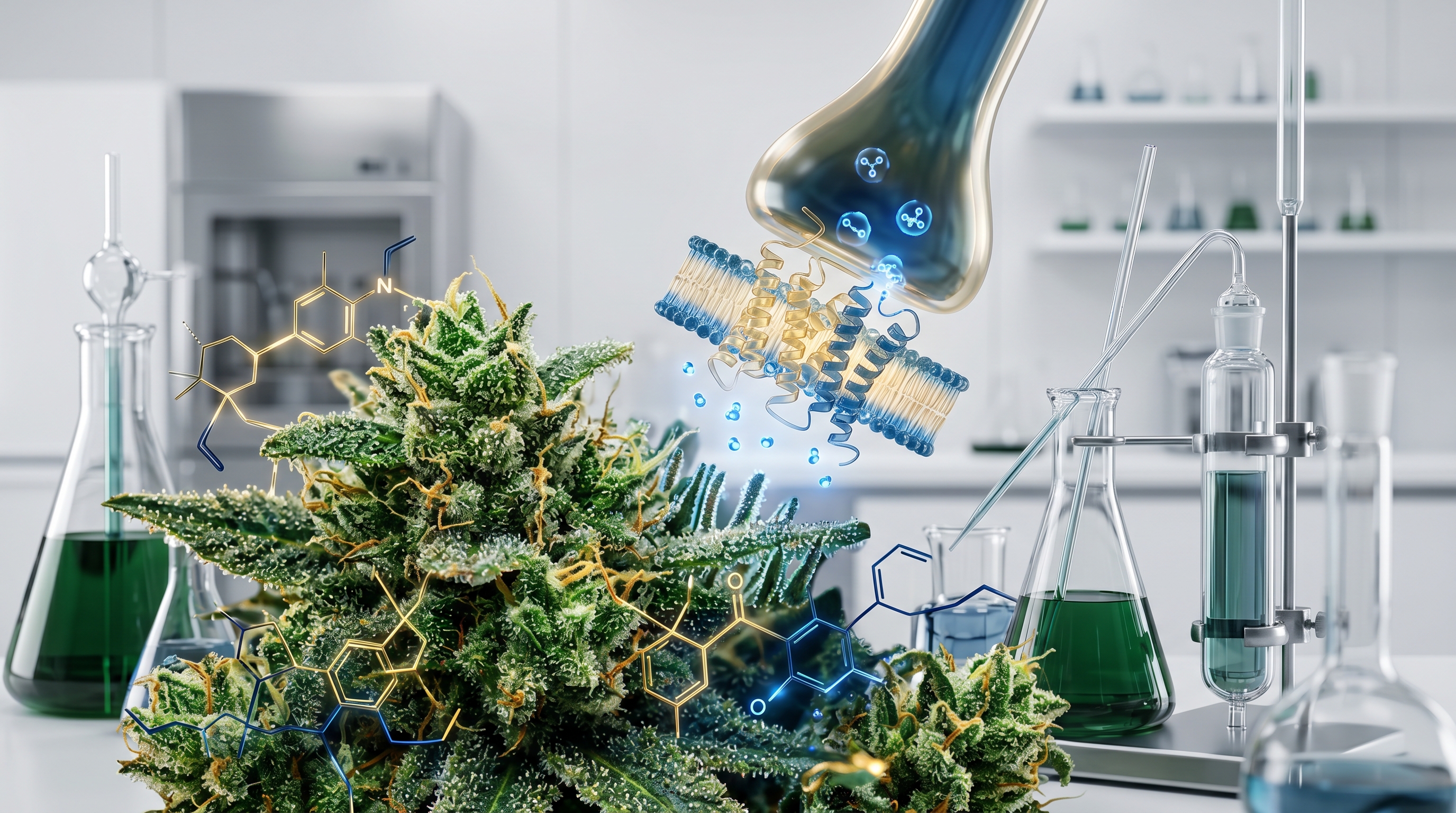
If you read my last deep-dive on cannabis and GABA, you already know half of the story. GABA is the brain’s brake pedal — the inhibitory neurotransmitter that quiets neurons down. But a brake is only meaningful if there is an accelerator. That accelerator is glutamate, and it is, by a wide margin, the most important excitatory neurotransmitter in your nervous system.
Glutamate gets far less attention than dopamine, serotonin, or even GABA in popular cannabis writing. That is a shame, because the relationship between cannabis and glutamate is arguably more fundamental to how THC actually changes your experience — and to some of the most exciting (and most worrying) findings in cannabis neuroscience. Today we are going to fix that oversight.
A quick disclaimer before we wade in: none of this is medical advice. I am going to walk you through mechanisms that researchers have mapped largely in rodents, brain slices, and cultured neurons. Extrapolating from a mouse hippocampus to your Saturday-night experience requires humility, and I will hedge accordingly.
What Glutamate Actually Does
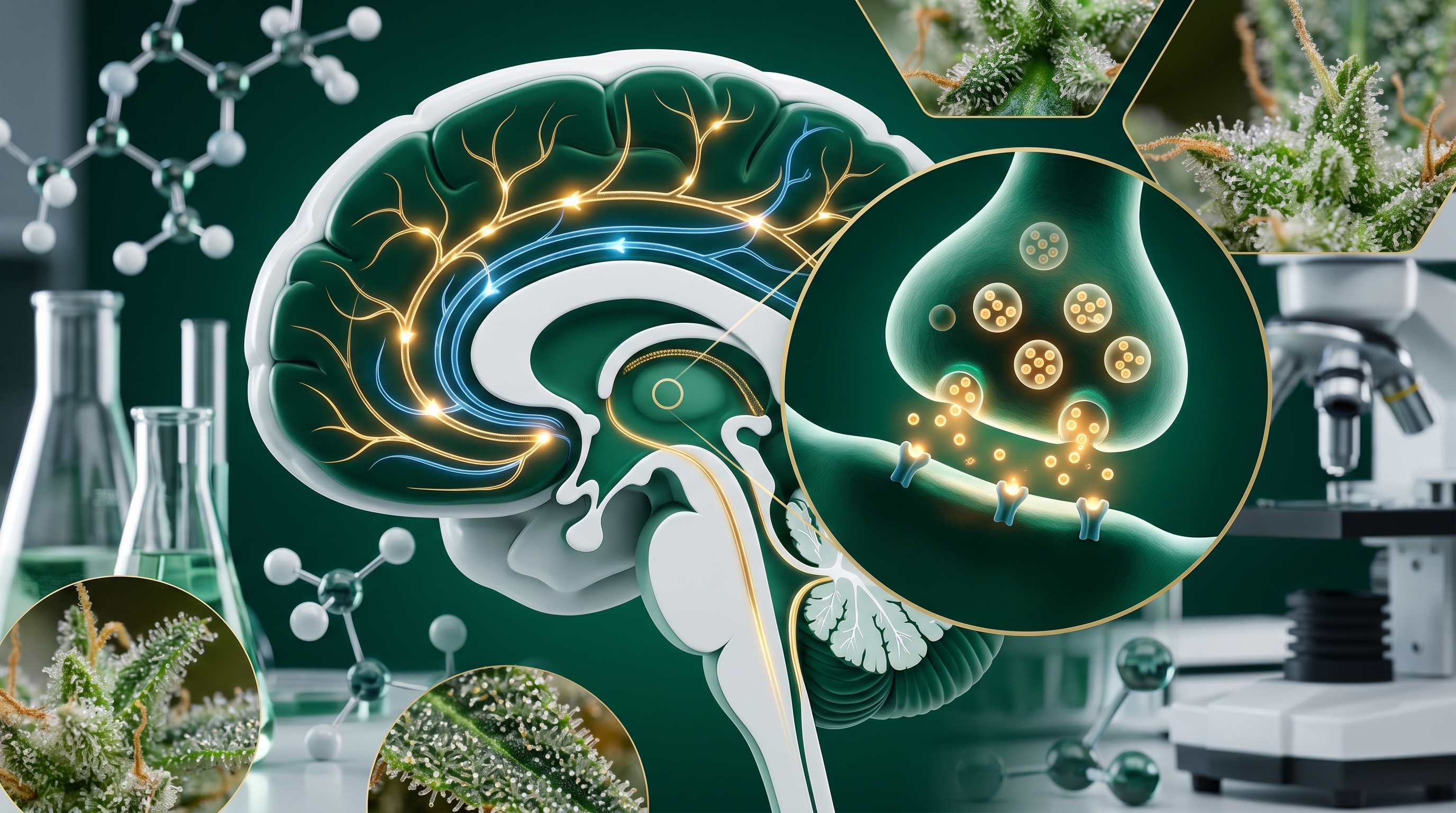
Roughly 80–90% of the neurons in your brain use glutamate as their primary signal. When a glutamatergic neuron fires, it dumps glutamate into the synapse, where it activates receptors on the next neuron — chiefly AMPA receptors (fast, moment-to-moment signaling) and NMDA receptors (slower, and central to learning).
NMDA receptors are the celebrities here. They are gated by both voltage and glutamate. That makes them coincidence detectors. They only fully open when the sending and receiving neurons fire at the same time. This property underlies long-term potentiation (LTP) — the cellular handshake that encodes memory. In plain Professor High terms: glutamate, acting through NMDA receptors, is how your brain decides this connection matters, strengthen it.
So glutamate is not just “excitement.” It is the chemistry of learning, attention, and the wiring of experience itself. That raises an obvious question. What does cannabis do to it?
The Retrograde Trick: How Cannabis Touches Glutamate
Here is the part that surprises people. THC does not bind glutamate receptors. It binds CB1 receptors, the most abundant G-protein-coupled receptor in the brain. And CB1 receptors sit on the sending side of synapses, where their job is to turn down neurotransmitter release.
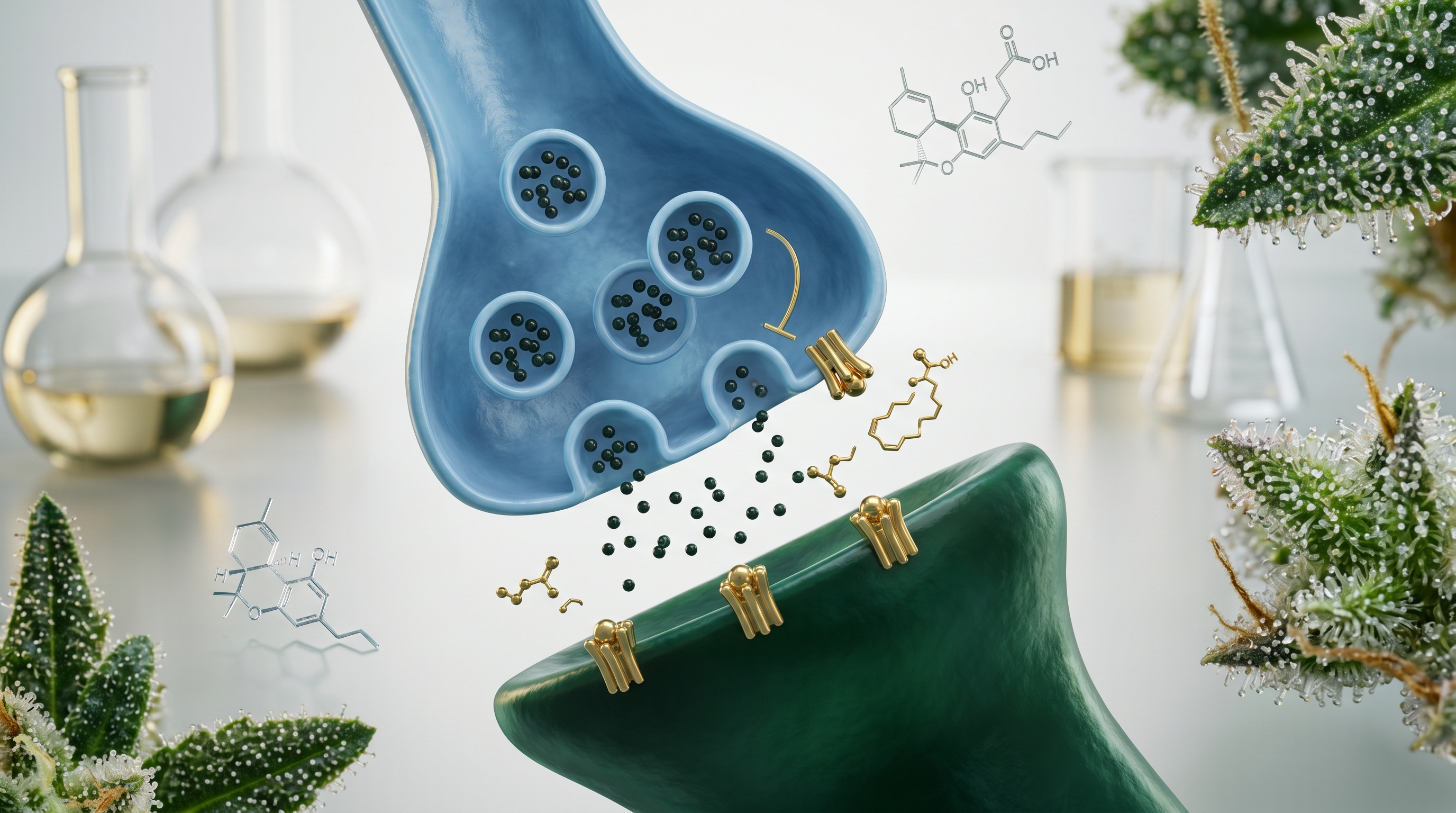
The mechanism is a thing of beauty called retrograde signaling, the backbone of the whole endocannabinoid system. When a neuron gets strongly excited, it makes endocannabinoids on demand on the receiving side. The main one is 2-AG. These molecules then float backward across the synapse, against the normal flow of traffic. They activate CB1 on the sending terminal. CB1 then tells that terminal: ease off, you are firing too hard. It is a negative feedback loop. A built-in volume knob.
When this loop dials down a GABA-releasing (inhibitory) terminal, neuroscientists call it DSI — depolarization-induced suppression of inhibition. When the same loop dials down a glutamate-releasing (excitatory) terminal, it is DSE — depolarization-induced suppression of excitation [Wilson, 2001]. DSE is the glutamate side of the story. It is the under-told half.
Why DSE Is Quieter Than DSI
Here is a crucial subtlety that the cannabis internet almost never mentions: the brain is far more sensitive to cannabinoid suppression of GABA than of glutamate. In cultured hippocampal neurons, excitatory transmission has been estimated to be roughly 30-fold less sensitive to cannabinoids than inhibitory transmission [Ohno, 2002]. The reason is mostly anatomical. CB1 receptors are packed densely onto subpopulations of GABAergic terminals. They appear at far lower levels on glutamatergic terminals.
Practically, that means DSE requires longer, stronger depolarization to kick in than DSI does. THC, however, does not play by the brain’s polite “on-demand” rules. It is a flood, not a feedback signal — it activates CB1 receptors everywhere at once, regardless of which terminal “earned” suppression. That indiscriminate activation is exactly why exogenous THC produces effects the endocannabinoid system never intended, and why the biphasic, dose-dependent weirdness of cannabis exists at all.
The Excitatory–Inhibitory Balance (and the Anxiety Link)
In my GABA article I described the biphasic anxiety curve: low THC doses tend to be calming, high doses can flip into anxiety and paranoia. Glutamate is the missing variable that completes that picture.
Your brain runs on a tightrope between excitation (glutamate) and inhibition (GABA), the so-called E/I balance. Because cannabinoids suppress GABA terminals much more readily than glutamate terminals, a rising THC dose can disinhibit the system — taking the brake off faster than it takes the accelerator off. The net result in vulnerable circuits like the amygdala can be a relative surge of excitation, which may help explain why too much THC pushes some people from relaxed into wired and anxious [Lutz, 2015].
This is also why people respond so differently to the same flower. If your baseline E/I balance, CB1 density, and endocannabinoid tone all differ from your friend’s — and they do — then identical THC hits different. It is the same reason I keep nudging readers toward the endocannabinoid tone framework instead of trusting a label that says “relaxing.”
If anxiety is your main concern, the strains people reach for tend to be high-CBD, low-THC chemovars like ACDC, Harlequin, Cannatonic, and Pennywise — the same Balancing High profiles I flagged in the GABA piece. The logic is that less THC means less indiscriminate disinhibition, and CBD brings its own glutamate story (more on that below).
Glutamate, Memory, and Why You Forget the Movie
Now the part everyone has felt personally. THC’s reputation for fogging short-term memory is real, and it is a glutamate story at heart.
Remember that NMDA-dependent LTP is how the hippocampus encodes new memories. THC blankets hippocampal CB1 receptors. This suppresses the precisely-timed glutamate signaling that LTP depends on. So the “strengthen this connection” handshake misfires. The encoding step stumbles, and the memory never gets filed. That is the core of why you lose the thread of a conversation or forget where the movie was going. I covered the behavioral side in how cannabis affects your memory, but the cellular cause traces right back to disrupted glutamatergic plasticity.
There is a fascinating wrinkle here. A landmark study found that acute cannabinoid impairment of working memory and hippocampal long-term depression depended not on neuronal CB1 but on CB1 receptors expressed by astrocytes — the brain’s support cells — which then modulate glutamate signaling onto neurons [Han et al., 2012]. In other words, part of the “stoned forgetfulness” you experience may be glia talking to glutamate synapses, not neurons alone. The brain, as always, refuses to be simple.
Neuroprotection: When Less Glutamate Is a Lifesaver
Suppressing glutamate is not always a bug. Sometimes it is the whole point.
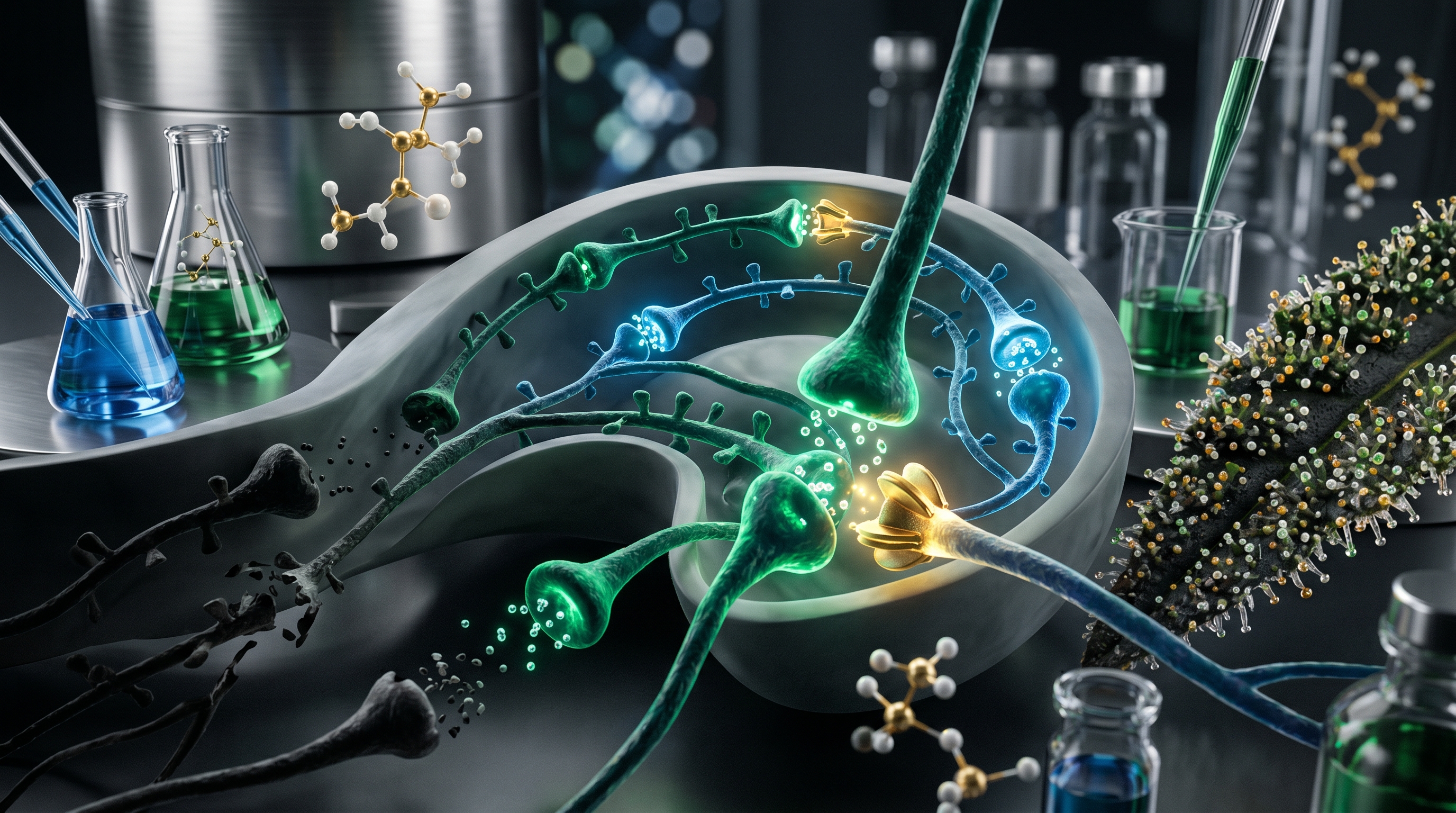
Excitotoxicity is what happens when glutamate signaling runs out of control — too much glutamate, too much NMDA-receptor activation, a flood of calcium into the neuron, and ultimately cell death. It is a major mechanism of damage in stroke, traumatic brain injury, seizures, and neurodegenerative disease. The brain badly needs a way to throttle glutamate when things go haywire, and the endocannabinoid system appears to be exactly that.
The defining experiment came from Marsicano and colleagues, who showed that the endocannabinoid system “provides on-demand protection against acute excitotoxicity” [Marsicano et al., 2003]. When they gave mice the excitotoxin kainic acid, healthy mice rapidly raised brain anandamide levels and activated protective mechanisms. Mice engineered to lack CB1 in their principal forebrain (glutamatergic) neurons suffered far worse, more lethal seizures. Follow-up work confirmed the protective receptors are specifically on glutamatergic, not GABAergic, neurons in the hippocampus [Monory et al., 2006]. That specificity matters: the protection rides on the glutamate terminals themselves.
The logic is elegant: a glutamate storm triggers endocannabinoid release, which activates CB1 on the very terminals dumping the glutamate, which throttles further release. A self-limiting circuit breaker. Broader reviews now describe CB1 (and CB2) as central players in stroke recovery and neuroprotection, partly through reining in excitotoxic glutamate [Marani et al., 2024]. This is also the deeper reason the endocannabinoid system is so conserved across species — it is, in part, a glutamate safety valve.
I want to be careful here. “Neuroprotective in a mouse seizure model” is a long, long way from “smoking weed protects your brain.” The protective findings mostly involve the body’s own endocannabinoids acting precisely and locally — not a blunt THC flood. Please do not read this section as a green light for anything.
CBD’s Separate Glutamate Story
THC is not the only player. CBD touches glutamate through a different set of doors, and largely without getting you high.
First, CBD is a weak FAAH-related modulator that tends to raise anandamide levels, indirectly nudging the protective endocannabinoid tone described above. Second — and this is the older finding — CBD can blunt glutamate-induced neurotoxicity through cannabinoid-receptor-independent routes, acting as a direct antioxidant against the oxidative cascade that NMDA, AMPA, and kainate receptors trigger [Bhunia et al., 2022]. In Alzheimer’s models, where amyloid-β drives excess glutamate onto extrasynaptic NMDA receptors, CBD’s anti-inflammatory and antioxidant actions appear to dampen the resulting damage.
This dual mechanism — quieting glutamate release and protecting against its downstream oxidative fallout — is part of why CBD shows up everywhere from epilepsy research to neurodegeneration studies. It is also why high-CBD, Balancing High chemovars behave so differently from THC-dominant ones at the level of glutamate, not just at the level of “head high.”
The Cautionary Side: Glutamate Hypofunction
I would be doing bad science if I only told you the rosy version. Chronically over-suppressing glutamate is not benign.
Researchers have mapped a physical association between CB1 and NMDA receptors, scaffolded by a protein called HINT1. When cannabinoids excessively activate CB1, they can trigger repeated internalization of NMDA receptors, pulling them off the cell surface and producing persistent glutamatergic hypofunction [Sanchez, 2014]. Glutamatergic hypofunction is one of the leading neurochemical models of psychosis and schizophrenia. The same authors proposed that heavy cannabis use might precipitate schizophrenia-like symptoms in vulnerable individuals by dysregulating this exact CB1–NMDA relationship [Rodriguez, 2016].
So glutamate suppression is genuinely a double-edged sword. On-demand, local, endocannabinoid-driven suppression is protective. A chronic, indiscriminate THC flood — especially in a developing or genetically vulnerable brain — may push the same system toward the harm it normally guards against. This is exactly the kind of nuance that gets flattened into “weed is good for your brain” or “weed causes schizophrenia,” when the honest answer is it depends on dose, frequency, age, and genetics.
How This Changes the Way I Think About Strains
Pulling it together, glutamate reframes a few cannabis truisms:
- “Sativas energize, indicas sedate” is a marketing fiction. What actually shifts your state is how a given chemovar’s THC, CBD, and terpene load tilts your personal E/I balance. Terpenes like linalool and myrcene lean calming; terpinolene leans up.
- Memory effects are dose-dependent and largely transient for occasional adult users, but they are real glutamatergic disruption while you are high — plan accordingly if you need to learn or remember something.
- CBD is not “weak THC.” It is a different actor on the glutamate stage, and its protective, non-intoxicating profile is exactly why it dominates the medical-research conversation.
- Your brain is the variable. Two people, same flower, opposite outcome — because E/I balance, CB1 density, and endocannabinoid tone are individual. There is no universal “calming” strain, only what is calming for your nervous system today.
That last point is the whole reason High IQ exists. A glutamate model tells you why responses differ; it cannot tell you what works for you. The only way to learn that is to track your own sessions — strain, dose, format, and how you actually felt — and let your patterns surface. The science explains the machinery. Your logbook reveals your particular machine.
Professor High’s Bottom Line
Glutamate is the accelerator, GABA is the brake, and cannabis — through CB1 retrograde signaling — has a thumb on both pedals, but a much firmer one on the brake. That asymmetry explains the biphasic anxiety curve, the short-term memory fog, the on-demand neuroprotection, and the genuine risk of overdoing it. It is a system designed for precise, local, on-demand restraint of excitation. THC overrides the “precise and local” part. Respect the dose, respect your own wiring, and remember that the most interesting neurotransmitter in cannabis science might be the one nobody talks about.
This article is educational and is not medical advice. Cannabis affects individuals differently; talk to a qualified healthcare provider about your situation.
Key Takeaways
- Glutamate is the brain’s main excitatory signal. It is the accelerator. GABA is the brake. Most neurons in your brain run on glutamate.
- Cannabis touches glutamate indirectly. THC binds CB1 receptors on the sending terminal. Through retrograde signaling, this suppresses glutamate release. The effect is called DSE.
- The brake is suppressed more easily than the accelerator. CB1 sits more densely on GABA terminals. So a big THC dose can disinhibit the brain and tip some users into anxiety.
- Memory fog is a glutamate story. THC disrupts NMDA-dependent plasticity in the hippocampus, so new memories fail to file properly while you are high.
- The same system protects the brain. On-demand endocannabinoid release can throttle a glutamate storm, guarding against excitotoxicity in seizure and stroke models.
- But over-suppression has a dark side. Chronic, heavy CB1 activation may drive glutamatergic hypofunction, a model linked to psychosis in vulnerable people.
- Your brain is the variable. The honest answer is always it depends on dose, frequency, age, and genetics — which is why tracking your own response beats trusting a label.
Sources
- Wilson RI, Nicoll RA. Endogenous cannabinoids mediate retrograde signalling at hippocampal synapses. Nature, 2001;410(6828):588–592. doi:10.1038/35069076
- Ohno-Shosaku T, Tsubokawa H, Mizushima I, et al. Presynaptic Cannabinoid Sensitivity Is a Major Determinant of Depolarization-Induced Retrograde Suppression at Hippocampal Synapses. Journal of Neuroscience, 2002;22(10):3864–3872. doi:10.1523/JNEUROSCI.22-10-03864.2002
- Marsicano G, Goodenough S, Monory K, et al. CB1 Cannabinoid Receptors and On-Demand Defense Against Excitotoxicity. Science, 2003;302(5642):84–88. doi:10.1126/science.1088208
- Monory K, Massa F, Egertová M, et al. The endocannabinoid system controls key epileptogenic circuits in the hippocampus. Neuron, 2006. doi:10.1016/j.neuron.2006.08.006
- Han J, Kesner P, Metna-Laurent M, et al. Acute Cannabinoids Impair Working Memory through Astroglial CB1 Receptor Modulation of Hippocampal LTD. Cell, 2012. doi:10.1016/j.cell.2012.01.037
- Sánchez-Blázquez P, Rodríguez-Muñoz M, Garzón J. The cannabinoid receptor 1 associates with NMDA receptors to produce glutamatergic hypofunction: implications in psychosis and schizophrenia. Frontiers in Pharmacology, 2014. doi:10.3389/fphar.2013.00169
- Rodríguez-Muñoz M, Sánchez-Blázquez P, Merlos M, Garzón-Niño J. Endocannabinoid control of glutamate NMDA receptors: the therapeutic potential and consequences of dysfunction. Oncotarget, 2016. doi:10.18632/oncotarget.10095
- Bhunia S, Kolishetti N, Arias AY, Vashist A, Nair M. Cannabidiol for neurodegenerative disorders: A comprehensive review. Frontiers in Pharmacology, 2022;13:989717. doi:10.3389/fphar.2022.989717
- Marani C, et al. Effects of Cannabis on Glutamatergic Neurotransmission: The Interplay between Cannabinoids and Glutamate. Cells, 2024;13(13):1130. doi:10.3390/cells13131130
- Lutz B, Marsicano G, Maldonado R, Hillard CJ. The endocannabinoid system in guarding against fear, anxiety and stress. Nature Reviews Neuroscience, 2015. doi:10.1038/nrn4036


