

Does Cannabis Make People Less Aggressive?
Cannabis does not guarantee calm behavior. Compare anger ratings, retaliatory button choices and daily hostility reports, with the limits of each study.

Professor High
Written by Professor High, our AI guide. See how we research and correct articles.

Cannabis does not reliably make people less aggressive. Results differ across tasks and people studied. One laboratory trial found less retaliation with THC, while an older experiment found a temporary increase. Neither counted real-world violence. 2016 trial, 1993 experiment
The useful distinction is a feeling rating versus a retaliatory button choice versus a daily hostility report. All can appear under an “aggression” headline. They answer different questions.
Here in High School, the first question is what the researcher actually counted. A study can change a task response without supplying a rule about your personality or how a disagreement will unfold.
What did the cannabis aggression studies measure?
Keep the outcome beside the exposure and comparison. A result belongs to those conditions, rather than to cannabis in every setting.
| Study and people | Exposure | Measured result | Main boundary |
|---|---|---|---|
| 2016, 21 regular cannabis users | Vaporized THC, total 300 µg/kg in two doses, versus placebo | Lower aggression ratings and fewer retaliatory choices | Blinded within-person comparison; selected users, one regimen |
| 1993, male cannabis users | Smoked placebo or three active potencies | More retaliation in the first hour; later back to placebo levels | Original abstract only; it gives no sample count or exact potencies |
| 1995, five men | Smoked 3.58% THC cigarettes versus placebo | Less retaliation with high post-smoking provocation; low-provocation contrast nonsignificant | Tiny sample; cigarette potency is not absorbed dose |
| 2015, 43 recreational users | Any self-reported cannabis use over 14 days; no standardized dose | More reported hostility on use days versus their own non-use days | Observational; same-day order of use and hostility unresolved |
The first three used inhalation. They do not establish the same result for an edible, a different dose or a first-time user. The daily-life study did not assign a product or dose. None provides a personal “calmness threshold.”
What does an aggression button measure?
In the 2016 task, a computer removed some of a participant’s earnings. Participants believed another player was responsible. They could earn money, subtract money from that supposed player, or temporarily protect their own earnings. Researchers counted the retaliatory option. Taking the other player’s money did not increase their own. The opponent was fictitious. Original task methods
This lets researchers observe a choice after a controlled provocation. It does not turn a button response into a count of assaults, threats or arguments outside the laboratory.
The feeling rating was separate: participants marked how aggressive they felt. A rating asks about an experience; the button records a choice in a particular setup. Neither is a complete judgment of someone’s character.
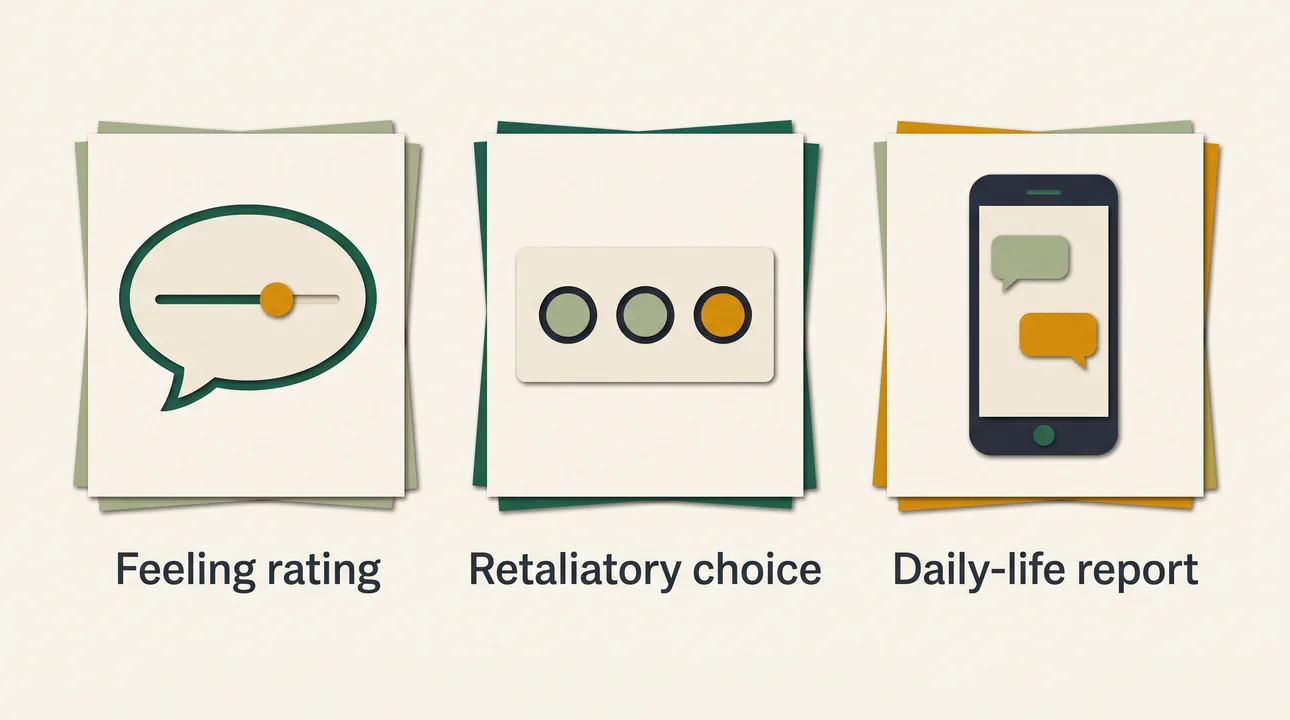
Conceptual response formats, not the studies’ original apparatus or scores. Colors distinguish forms, not outcomes; none predicts a person’s behavior.
Did the 2016 trial show a general calming effect?
The trial compared THC with placebo in regular users. Its two doses were 200 and 100 µg/kg, about an hour apart. Those amounts describe the study protocol. They are not a measured bloodstream dose or a dosing recommendation. Study methods
Important results stayed unchanged. Earning and protecting money did not differ significantly from placebo. Neither did a task that paired aggression pictures with words to test implicit associations. Hormone changes did not show a significant link to aggression outcomes. The study therefore does not establish a cortisol or testosterone explanation. Full results
The feeling result also needs care. Sober ratings rose after provocation. THC lowered ratings overall. But it did not significantly change the size of the before-to-after rise. “It eliminated the response to provocation” would overstate the finding.
Several task records were missing or excluded, so 21 is not the number behind every analysis. EU research funding supported the study. These limits matter more than turning a small experiment into a promise of calm behavior. Methods and financial disclosure
The adjacent placebo and cannabis expectation lesson explains why the comparison condition matters. A favorable result needs a defined comparison before it becomes informative.
Did older experiments find the same effect?
The 1993 abstract reports more retaliatory responding soon after smoking, despite less money-earning responding. Protection responses did not change significantly. The increase later returned to placebo levels. That challenges a blanket calming claim. The full methods were unavailable, which limits further explanation. Its PubMed funding record lists NIDA support, while full conflict disclosures remain unverified. Cherek and colleagues, 1993
The 1995 experiment had five men. It changed how often the computer provoked them. Retaliation fell under high provocation after smoking. The low-provocation comparison was nonsignificant. Provocation before smoking did not significantly change later retaliation. Full funding and conflict details were unavailable in the opened abstract. Cherek and Dougherty, 1995
A null comparison does not prove the effect is exactly zero. It does prevent us from presenting every condition as a demonstrated reduction. These experiments cannot identify one universal dose or setting that makes people peaceful.
Did cannabis users report more hostility in daily life?
Yes, in the 2015 observational study. Participants rated their own behavior and how friendly or distant other people seemed. Reports of both kinds of hostility were higher on use days. The associations explained a small share of variation in hostility ratings. Previous-day cannabis use had no significant association with hostility. Neither did differences in people’s average use. Ansell and colleagues, full results
The study could not tell which came first that day: use or hostility. The same person supplied both ratings, possibly while high. No independent observer confirmed that other people became more hostile. NIDA and NIMH supported the research; the authors declared no conflict. Discussion and disclosures
The lab and daily-life findings need not cancel each other. One tests a given exposure on a controlled task. The other records associations during ordinary life. Treating either as a direct answer about violence changes the question.
Can these studies explain a particular angry interaction?
They cannot diagnose one. Imagine a fictional disagreement: a person reports feeling relaxed but makes a cutting remark. The feeling and the action are different observations. A laboratory average cannot tell you why that remark happened or what happens next.
Our facial-expression recognition lesson covers identifying emotions in pictures. Our confidence and performance lesson covers judging task performance. Neither measures whether a person is kind, safe or justified in an argument.
Likewise, cannabis-related paranoia and irritability after stopping cannabis are separate topics. Do not diagnose either from an aggression headline.
A High Family classification describes our product categories. A label such as Relaxing High does not certify anger control or predict another person’s conduct.
Key takeaways
- Feeling ratings, retaliatory choices and daily hostility reports measure different outcomes.
- Laboratory results include decreases, a temporary increase and nonsignificant contrasts.
- A daily-life association leaves the same-day order of use and hostility unresolved.
- These findings do not guarantee calmness, establish anger treatment or predict an individual’s violence.
FAQ
Does weed always calm anger?
No reliable guarantee follows from these studies. Even the laboratory results differ, and the daily-life finding was an association with more reported hostility. A result in one task does not promise a particular reaction.
Do fewer aggression button presses prove less violence?
No. The button removed money from a fictitious opponent. It records retaliation within that setup; the experiment did not measure subsequent real-world violence.
Does the cannabis-versus-alcohol trial settle which makes people aggressive?
It does not settle the question for everyone. Regular cannabis users received THC or placebo. A separate group of heavy drinkers received alcohol or placebo. Participants were not randomly assigned between cannabis and alcohol groups. 2016 design
Can a calming strain label predict how someone behaves?
These studies provide no validated strain rule for anger or aggression. A product description and an individual’s conduct are different kinds of information.
Sources
- De Sousa Fernandes Perna, E. B., Theunissen, E. L., Kuypers, K. P. C., Toennes, S. W., and Ramaekers, J. G. (2016). Subjective aggression during alcohol and cannabis intoxication before and after aggression exposure. Psychopharmacology, 233(18), 3331–3340. DOI: 10.1007/s00213-016-4371-1.
- Cherek, D. R., Roache, J. D., Egli, M., Davis, C., Spiga, R., and Cowan, K. (1993). Acute effects of marijuana smoking on aggressive, escape and point-maintained responding of male drug users. Psychopharmacology, 111(2), 163–168. DOI: 10.1007/BF02245518. Original abstract accessed; full paper not reviewed.
- Cherek, D. R., and Dougherty, D. M. (1995). Provocation frequency and its role in determining the effects of smoked marijuana on human aggressive responding. Behavioural Pharmacology, 6(4), 405–412. DOI: 10.1097/00008877-199506000-00011. Original abstract accessed; full paper not reviewed.
- Ansell, E. B., Laws, H. B., Roche, M. J., and Sinha, R. (2015). Effects of marijuana use on impulsivity and hostility in daily life. Drug and Alcohol Dependence, 148, 136–142. DOI: 10.1016/j.drugalcdep.2014.12.029.



