Can You Judge Your Performance While High? Confidence and Accuracy
Cannabis can weaken confidence–accuracy alignment on a memory task without raising average overconfidence. See why the task and measure matter.

THC can weaken confidence–accuracy tracking on a memory task without increasing average overconfidence. A small oral-THC trial found this; other tasks gave different results. Adam and colleagues, 2020
The useful distinction is how confident you feel versus how well your confidence identifies correct work. Those are separate questions. Saying “I know I’m high” does not answer either one.
What is confidence accuracy?
Metacognition includes monitoring your thinking. Here, the question is whether confidence distinguishes correct work from mistakes. That is narrower than a feeling of insight. Fleming and Lau, 2014
Consider a fictional color quiz. You give an answer, then say whether you remember it or guessed. When you are more confident on the rounds you get right, that confidence helps distinguish better work from worse work. When confidence moves independently of the score, it supplies less useful information.
That differs from overconfidence, the overall gap between expected and achieved accuracy. You can underestimate your total score yet struggle to spot answers needing checks. You can overestimate your total while recognizing your stronger answers.
| Question | What you would compare | What it cannot tell you alone |
|---|---|---|
| How confident am I? | The strength of a confidence rating | Whether an answer is correct |
| Am I overconfident overall? | Average confidence against overall accuracy | Which answers deserve doubt |
| Does confidence track performance? | Changes in confidence against changes in accuracy across rounds | Whether every kind of judgment works the same way |
This is a conceptual distinction, not a diagnostic quiz. It also differs from forgetting information, accepting a false memory or forgetting a future plan.
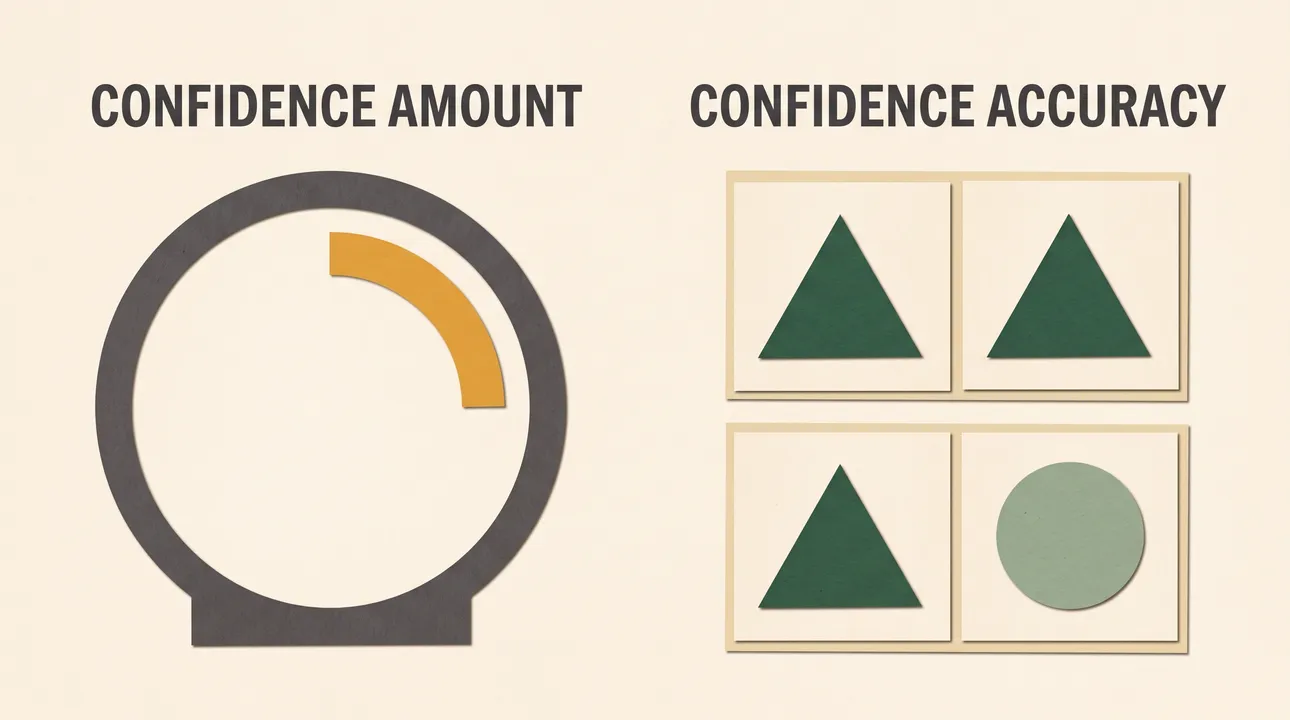
Conceptual illustration: confidence amount describes a rating; confidence accuracy asks how that rating relates to correct work. These are not study results.
What did the cannabis studies measure?
These experiments used different routes, people and scoring rules. Their results should remain attached to those conditions.
| Study | Route and exposure | Confidence endpoint and result | Main limit |
|---|---|---|---|
| Adam, 2020, experiment 2, 23 analyzed adults | Oral 7.5 mg or 15 mg THC, or placebo; blinded crossover | Confidence–accuracy correlation declined at 15 mg; average overconfidence unchanged | One visual-memory task; lower-dose comparison nonsignificant |
| Cuttler, 2021, 80 users | Self-selected smoked/vaped flower or concentrates, or sober control | General-knowledge confidence minus accuracy: no significant group difference | No placebo; variable doses and regular users |
| He, 2024, 74 attended at least one session, 71 both | Self-selected smoking/vaping; sober and cannabis sessions | Reported change in coding performance correlated with actual change | Observational use; session comparison differs from answer-by-answer confidence |
Did THC make people more overconfident?
Not in the oral experiment. Participants recalled colors and marked each answer as remembered or guessed. Researchers correlated each round’s confident answers with its correct answers. Overall bias stayed unchanged. Adam and colleagues, 2020
A weaker tracking relationship is not the same finding as greater average overconfidence. The study also cannot establish that a nonsignificant lower-dose result guarantees preserved judgment at that dose.
The correlation also does not isolate a monitoring problem from worse task accuracy. Metacognition measures can depend on how well people perform the underlying task. Fleming and Lau, 2014
Why did other tasks give different answers?
The general-knowledge study used 15 true/false questions and confidence percentages. It calculated an overall confidence-minus-accuracy score. Its null result therefore concerns bias, rather than replicating the oral study’s round-by-round tracking measure. It does not prove every cognitive skill was unaffected. Cuttler, LaFrance and Stueber, 2021
The programming study offers another boundary. Participants could compare two coding sessions, and their reported performance changes correlated with measured changes. That supports some retained self-assessment in that setting. It does not establish flawless detection of every coding error or validate confidence in unrelated tasks. He and colleagues, 2024
A useful question to bring to any claim is: What did the person judge, and what was that judgment checked against? “I performed worse overall” is a different report from “this particular answer is correct.” Neither score is a universal meter for the other.
What should you do with a confident thought?
Separate the thought from its evaluation. Imagine drafting an idea for a project. Save the idea and the reason it seems useful. Later, check whether its central claim is true, whether it solves the intended problem and whether its details hold together. These are ordinary review habits, not a treatment demonstrated by these cannabis studies.
For a factual statement, find the supporting source. For a calculation, recalculate it. For code, run the relevant checks. For a plan, ask whether the steps actually achieve the goal. A feeling of certainty is information about your feeling; these checks supply information about the work.
Our expectation lesson addresses another question: what happens when people expect THC. The duration lesson addresses timing. Neither supplies a personal confidence test, and the studies here do not establish a universal time when self-assessment becomes reliable again.
Key takeaways
- Confidence amount, overall overconfidence and confidence–accuracy tracking are different measures.
- Identify whether a claim concerns average bias or tracking across rounds.
- General-knowledge and programming findings limit any claim that all self-assessment fails.
- Check the work against evidence or an outcome, rather than treating certainty as proof.
FAQ
Does cannabis improve self-awareness?
These performance studies do not measure personal insight or lasting self-understanding. Feeling reflective is not the same endpoint as correctly identifying an answer. They cannot validate claims that cannabis opens a special window for learning self-awareness.
Does being high make you overconfident?
The evidence here does not justify a general rule that feeling high means being overconfident. Check whether a claim concerns overall bias or confidence–accuracy tracking; those are different endpoints.
Can you tell when your work is worse while high?
Sometimes, on the tasks studied. The coding result supports a retained ability to judge relative session performance. It does not promise that you will spot each error. He and colleagues, 2024
Can confidence tell whether a memory is true?
Confidence is a report to compare with accuracy, not an independent record of events. The color task had correct answers researchers could check. It cannot determine whether a particular personal recollection is true.
Sources
- Adam KCS, Doss MK, Pabon E, Vogel EK, de Wit H. (2020). Δ9-Tetrahydrocannabinol (THC) impairs visual working memory performance: a randomized crossover trial. Neuropsychopharmacology 45:1807–1816. DOI: 10.1038/s41386-020-0690-3. PMID: 32386395.
- Cuttler C, LaFrance EM, Stueber A. (2021). Acute effects of high-potency cannabis flower and cannabis concentrates on everyday life memory and decision making. Scientific Reports 11:13784. DOI: 10.1038/s41598-021-93198-5. PMID: 34215784.
- He W, Parikh M, Weimer W, Endres M. (2024). High Expectations: An Observational Study of Programming and Cannabis Intoxication. ICSE ’24. DOI: 10.1145/3597503.3639145.
- Fleming SM, Lau HC. (2014). How to measure metacognition. Frontiers in Human Neuroscience 8:443. DOI: 10.3389/fnhum.2014.00443. PMID: 25076880. Methodological review, not a cannabis trial.





