Can THC Make Other People's Expressions Harder to Read?
THC can impair facial expression recognition in lab tests. Learn what subtle-face experiments found, which results were null, and what remains untested.


THC can make facial expressions harder to identify in laboratory tests, including subtle expressions in one controlled trial. That finding concerns recognizing an expression on a screen. It does not establish that cannabis removes empathy or reveals what another person is thinking. Hindocha and colleagues, 2015
Keep this distinction: feeling connected to someone and correctly identifying their expression are different questions. A warm conversation is not an accuracy test.
What did the facial-expression studies actually test?
Researchers compared specific tasks after THC and placebo. They did not rate a whole friendship or conversation. These three experiments show why the task matters:
| Study | Route and dose | Endpoint and main result | Main limit |
|---|---|---|---|
| Hindocha, 2015, 48 recruited; 47 in expression analysis | Vaporizer loaded with 8 mg THC, 16 mg CBD, both, or placebo; four separate sessions | Naming emotions in pictures: THC reduced accuracy at 40% expression intensity; CBD improved it at 60%; combination showed no significant impairment | Still pictures; no blood THC or CBD measurements; one dose of each |
| Ballard, 2012, 25 occasional users | Oral 7.5 or 15 mg THC, or placebo | Naming emotions in pictures: lower accuracy; planned comparisons found fear and anger deficits | Small sample; analysis did not show an effect unique to those emotions |
| Phan, 2008, 16 recreational users | Oral 7.5 mg THC or placebo | Matching emotional faces during brain imaging: no significant accuracy or response-time change | Behavioral data available for 14; a different task with high accuracy |
The inhalation study reports amounts loaded into its vaporizer, not THC measured in each person’s bloodstream. One participant was excluded from its expression analysis.
A null result means a comparison did not detect a significant difference. Untested means the experiment did not ask that question. Neither means that every possible effect has been ruled out.
What does a “40% expression” mean?
It describes the test image, not a person’s mood. Researchers blended neutral and full-expression pictures, then asked participants to name the emotion shown. Hindocha’s methods
Think of a fictional portrait that sits between a neutral face and a broad smile. A faint change gives the viewer less obvious information than a large change. The number describes the test image; it does not mean the person is “40% happy.”
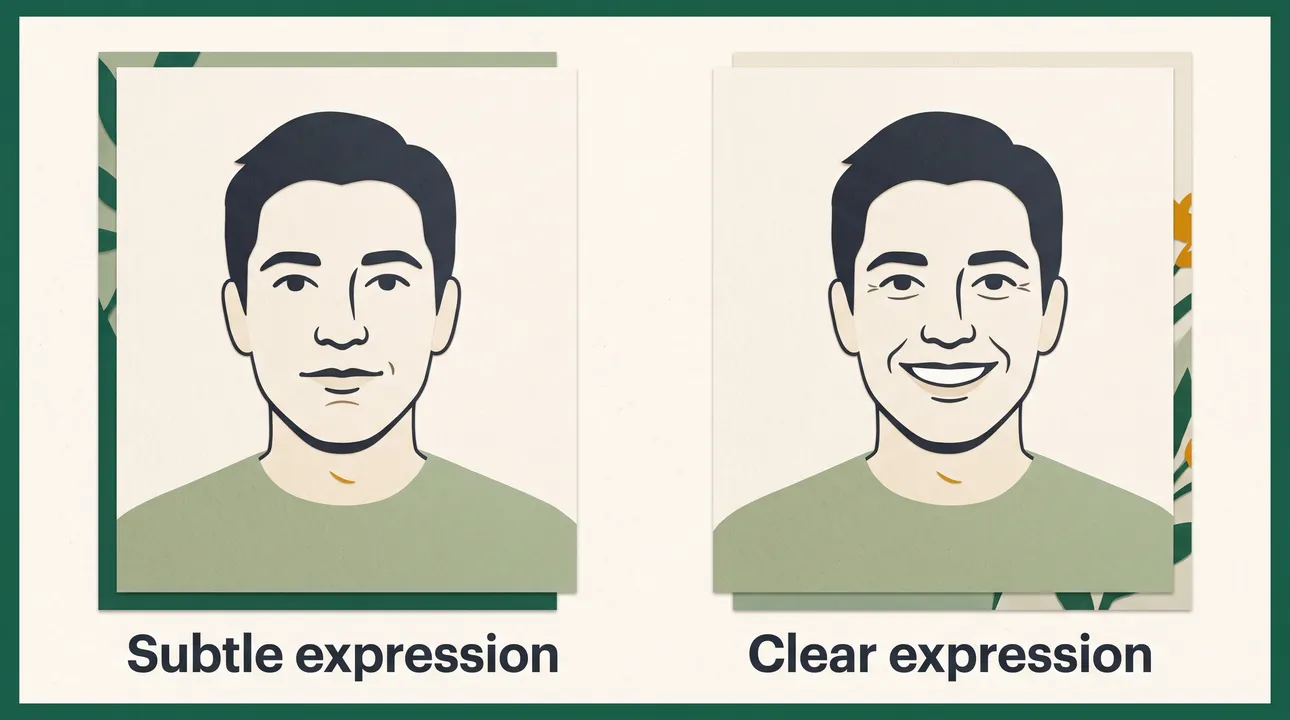
A conceptual expression comparison, not the study’s original stimuli or a THC before-and-after image.
The practical reading lesson is about the question being asked. “Which expression is this image showing?” can have a predefined test answer. “Why did my friend make that face?” adds a question about intent that the photograph test cannot settle.
Did THC only affect negative emotions?
Not consistently across experiments. In the oral-THC study, planned comparisons found poorer recognition of fear at both doses and anger at the higher dose. But the overall analysis did not establish that THC’s effect differed significantly by emotion category. Ratings of emotional scenes also did not show a clear positive shift. Ballard, Bedi and de Wit, 2012
That keeps two tempting shortcuts out of the answer. Failing to label a fearful face correctly is not proof that the observer became kinder. And noticing an effect in an anger comparison is not proof that happiness recognition is universally protected.
For related feelings, our cannabis and paranoia lesson addresses a different question. Here, the outcome is the answer given on a recognition task.
Does a brain scan show how accurately you read people?
A scan and a correct answer are separate measurements. In the 2008 experiment, THC reduced the amygdala’s response to threatening faces. This brain region helps process threats. Face-matching accuracy and response times did not change significantly. That is a useful counterexample to treating a brain-activity result as an automatic performance result. Phan and colleagues, 2008
The endocannabinoid system class explains the wider biology. A biological explanation still needs a measured outcome before it can tell us whether a particular skill improved or worsened.
Does CBD make reading expressions reliable while high?
The combination result does not establish reliable protection. The combination did not significantly impair recognition versus placebo. It did better than THC alone at 40% intensity in a paired comparison. Participants still felt as stoned as with THC alone. Hindocha and colleagues
Doses were given together; this was not a test of CBD taken after THC. A task result with no significant difference does not prove equal performance. It also does not guarantee an effect for everyone or accurate judgment in real conversations.
Our THC and CBD comparison covers the ingredients more broadly. Neither a ratio on a product nor its High Family classification certifies expression-recognition accuracy. High Families describe our product categories.
What can you do with this information in a conversation?
Use it as a reason to leave room for uncertainty. Imagine a fictional friend who briefly frowns while you talk. “They frowned” is an observation. “They dislike me” is an interpretation. The experiments cannot tell you which explanation fits that moment.
A plain question such as “Did I explain that clearly?” can give the other person a chance to answer. This is a communication suggestion, not a tested treatment for THC-related recognition changes. It avoids turning a single expression into a verdict about the relationship.
This lesson also differs from cannabis-related memory effects. Recognizing a pictured emotion and remembering a conversation are different tasks. Neither study result can diagnose a particular disagreement.
Key takeaways
- THC impaired expression identification under some tested conditions; another matching task had a null performance result.
- Expression intensity describes a constructed image, not how strongly someone feels an emotion.
- Face recognition, empathy and understanding a person’s intent are different questions.
- A CBD combination result does not guarantee protection in a real conversation.
FAQ
Does cannabis make you less empathetic?
These experiments do not answer that. Identifying an expression is not a complete measure of empathy, concern or kindness. Do not use a face-task result to label someone’s character.
Can weed make you better at reading body language?
The cited trials do not establish that benefit. They measured responses to pictured faces, not the accuracy of interpreting a person’s gestures, tone and intentions together.
Were obvious expressions unaffected by THC?
There is no universal rule. Results varied by task and emotion, and the oral-THC study included impaired recognition of full-intensity expressions. Ballard and colleagues
Does feeling social prove you are reading faces accurately?
No. Enjoying a conversation does not compare your interpretation with a known correct answer. The studies supply no home test that certifies social judgment.
Sources
- Hindocha, C., Freeman, T. P., Schafer, G., Gardener, C., Das, R. K., Morgan, C. J. A., and Curran, H. V. (2015). Acute effects of delta-9-tetrahydrocannabinol, cannabidiol and their combination on facial emotion recognition. European Neuropsychopharmacology, 25(3), 325–334. DOI: 10.1016/j.euroneuro.2014.11.014.
- Ballard, M. E., Bedi, G., and de Wit, H. (2012). Effects of delta-9-tetrahydrocannabinol on evaluation of emotional images. Journal of Psychopharmacology, 26(10), 1289–1298. DOI: 10.1177/0269881112446530.
- Phan, K. L., Angstadt, M., Golden, J., Onyewuenyi, I., Popovska, A., and de Wit, H. (2008). Cannabinoid modulation of amygdala reactivity to social signals of threat in humans. Journal of Neuroscience, 28(10), 2313–2319. DOI: 10.1523/JNEUROSCI.5603-07.2008.





