Can Placebo Weed Make You Feel High? Expectation vs. THC
Placebo weed can change reported drug effects. Human studies separate expecting THC from receiving it, and explain why feeling high is not the whole story.


Placebo weed can change reported drug effects when someone expects THC, but that does not make it equivalent to receiving THC. Researchers have separated the instruction from the ingredient. What people report, what their heart does, and how they perform on a task do not always move together.
That is the useful lesson here in High School. A feeling can be sincerely reported without telling you exactly what caused it. And a belief about the contents does not replace the contents themselves.
What does “placebo weed” mean in a study?
In the 2009 Brown University pilot, the placebo was a research cigarette with cannabinoids removed. It retained the smoking procedure, rather than being an imaginary joint. A separate instruction told participants whether it contained THC.
Researchers call this a balanced-placebo design. Instead of asking only whether THC differs from a placebo, it asks whether receiving THC and expecting THC have separate effects.
| What the participant was told | What they received | The comparison it allows |
|---|---|---|
| Contains THC | THC | Expectation and ingredient together |
| Contains THC | Placebo | Expectation without THC |
| Contains no THC | THC | THC despite the instruction |
| Contains no THC | Placebo | Neither expected nor received THC |
The two mismatched groups make the design useful. Comparing people who received the same substance under different instructions tests the instruction’s effect. Comparing the ingredients under the same instruction tests the drug’s effect.
“Placebo” here does not mean a retail CBD product, an unidentified herbal blend, or smoke without health risks. Those are different questions. Our THC and CBD comparison explains why the two cannabinoids cannot simply be substituted in an experiment like this.
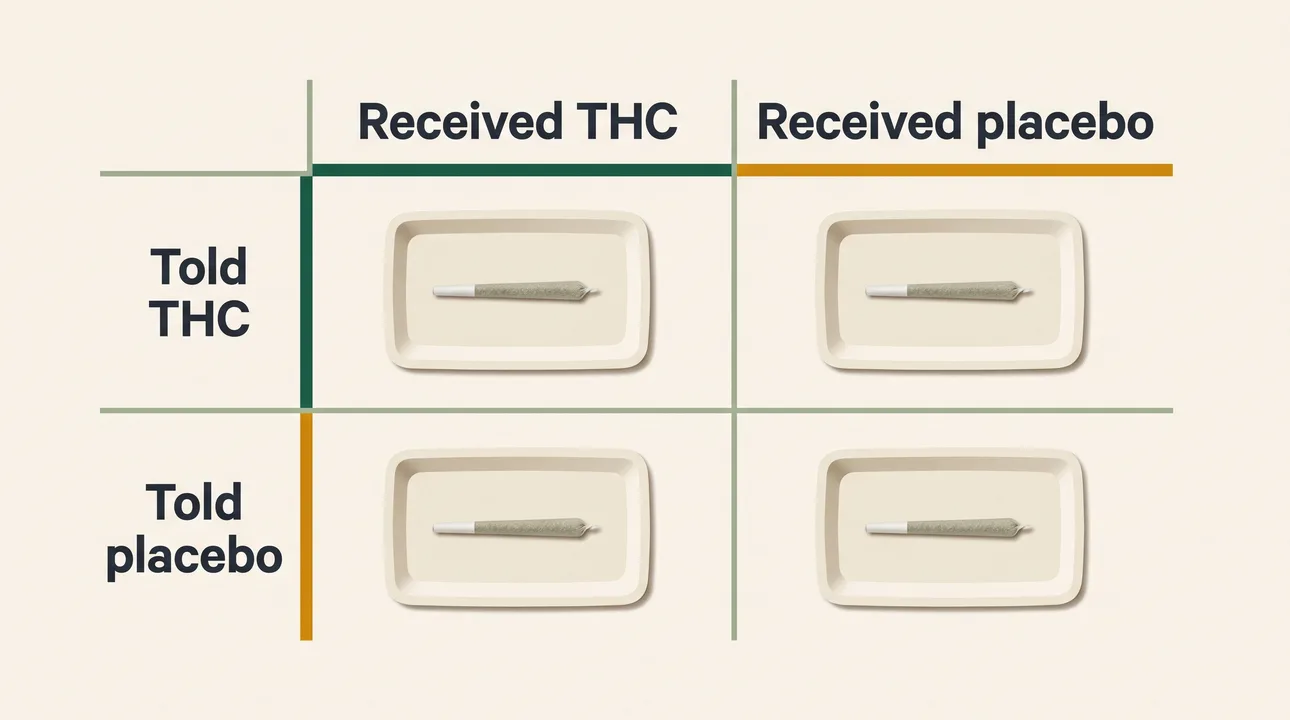
The four groups separate an instruction about THC from actually receiving THC. This is a study design, not a chart of outcomes.
What did the larger experiment find?
The 2012 trial included 136 regular cannabis users. They smoked placebo or research cannabis containing 2.8% THC. Both receiving THC and being told they received THC increased subjective drug-effect scores.
Here is the distinction worth sharing: actual THC increased heart rate, while the instruction had no significant effect on heart rate in this experiment. THC also produced small changes in inhibition and accuracy on two tasks. Expectation did not significantly affect those task outcomes.
The null findings matter too. Neither THC nor the instruction significantly changed performance on the balloon risk-taking task or the hypothetical delayed-reward task. A different delayed-reward task showed an expectancy effect only after excluding participants who detected the deception; the full-sample result was not significant.
So “I feel a drug effect” was one result, not a summary of every result. These findings do not let us calculate what percentage of an individual’s high came from expectation. They also do not establish safety for driving or other demanding activities.
Was the small pilot proof that everyone can get a placebo high?
No. The 2009 pilot had only 20 participants. It primarily tested whether the deception and procedures could work. All five people told THC but given placebo accepted that they had received THC. That is a five-person finding, not a population success rate.
Researchers supported the instructions with other cues, including a saliva-sampling procedure. The trial therefore tested a carefully arranged situation, not whether anyone can become high by thinking hard enough.
The larger study also recruited regular users and kept THC concentration modest enough to make deception possible. Neither experiment tells us how a first-time user would respond to a high-potency concentrate. Cannabis tolerance and route and duration deserve separate attention.
Does expecting impairment make people more reckless?
Not automatically. A 2017 secondary analysis examined the same 136-person dataset. Among those receiving THC, stronger pre-existing expectations of impairment were associated with less risk-taking on the balloon task. That association was absent among placebo recipients.
It was not a new trial or an independent replication. The researchers measured those existing beliefs; they did not randomly assign them. The association therefore does not show that changing a belief would change someone’s behavior. It suggests a question worth testing: might some people become more cautious because they expect difficulty?
That possibility is different from proving they can compensate enough to drive safely. Keep the practical decision separate from the research puzzle; our cannabis and driving guide covers that decision.
How should you interpret a cannabis experience?
Separate three questions when you describe a session:
- What did I expect? Record the promised effect before the session, if you want to compare expectations later.
- What did I feel? Describe the experience plainly, without forcing it into the promised category.
- What can I conclude? A personal impression cannot isolate chemistry from context. A label, a prediction and a feeling are three different pieces of information.
This is a way to ask clearer questions, not a home placebo experiment. Do not give someone a substance under false pretenses. The laboratory design used consent procedures and later explained the deception.
The same strain can feel different between sessions. Expectations also make crowd-sourced strain reviews harder to interpret. Neither point makes someone’s experience worthless. It limits how confidently that experience predicts yours.
High Families is a product classification. A family name can organize a browsing choice; it cannot guarantee a feeling or separate expectation from chemistry.
Key takeaways
- Balanced-placebo experiments cross what people are told with what they receive.
- Subjective ratings, physiology and task performance are separate outcomes.
- Small samples and repeated analyses do not become stronger evidence by being counted twice.
- Treat a reported feeling with respect, and keep conclusions within what was measured.
FAQ
Is a placebo high the same as pretending?
No. These experiments measured reported effects after changing instructions. They did not establish that participants were knowingly inventing a feeling. A report can be sincere while its cause remains uncertain.
Can expecting THC change an oral THC experience too?
An oral-THC experiment with 35 regular users found greater reported pleasurable effects in the group specifically expecting a cannabinoid. Participants received THC or placebo across sessions. That supports a role for expectation; it does not quantify an “expectation dose.”
Can you tell whether someone received THC from how high they say they feel?
A feeling alone cannot separate drug effects from expectation. That is why the study design changes the ingredient and the instruction independently. It is not a reason to dismiss someone’s report or diagnose their substance exposure from a conversation.
Does this prove that indica and sativa differences are placebo?
No. These studies tested instructions about THC, not an identical product relabeled indica or sativa. The separate indica-versus-sativa question needs its own evidence. Do not make one experiment answer a question it did not ask.
Sources
- Metrik J, et al. (2009). Effectiveness of a Marijuana Expectancy Manipulation: Piloting the Balanced-Placebo Design for Marijuana. Experimental and Clinical Psychopharmacology. 2009;17(4):217–225. DOI: 10.1037/a0016502. PMID: 19653787.
- Metrik J, et al. (2012). Balanced placebo design with marijuana: Pharmacological and expectancy effects on impulsivity and risk taking. Psychopharmacology. 2012;223(4):489–499. DOI: 10.1007/s00213-012-2740-y. PMID: 22588253.
- Gunn RL, Skalski L, Metrik J. (2017). Expectancy of impairment attenuates marijuana-induced risk taking. Drug and Alcohol Dependence. 2017;178:39–42. DOI: 10.1016/j.drugalcdep.2017.04.027. PMID: 28641128. Secondary analysis of the 2012 dataset.
- Kirk JM, Doty P, de Wit H. (1998). Effects of expectancies on subjective responses to oral delta9-tetrahydrocannabinol. Pharmacology Biochemistry and Behavior. 1998;59(2):287–293. DOI: 10.1016/S0091-3057(97)00414-0. PMID: 9476972.


