Cannabis Chrono-Pharmacology: Timing Your Dose by Body Clock
Your endocannabinoid system runs on a 24-hour clock. Here is what the research suggests about timing cannabis with your circadian rhythm.

Here is a thought experiment. You take the exact same dose of the exact same flower two days in a row. Same product, same method, same amount. On Tuesday at 8 a.m. it feels jittery and thin. On Wednesday at 9 p.m. it feels warm, heavy, and deeply relaxing. Nothing about the cannabis changed. What changed was you — or more precisely, the version of your nervous system that showed up to greet it.
This is the territory of chrono-pharmacology: the study of how the time of day you take a substance shapes the way your body responds to it. It is well established for some medicines — blood-pressure drugs, certain chemotherapies, and corticosteroids all have documented “best times.” The intriguing question for our community is whether cannabis belongs on that list, given that the very system it acts on appears to keep its own daily schedule.
Let me be honest up front, because this is a wellness topic and you deserve the truth: most of what we know here is mechanistic and preliminary. There are real human studies measuring endocannabinoid rhythms, but there are almost no randomized trials testing morning-versus-evening cannabis dosing head to head. So treat this article as a map of plausible biology and a set of hedged, test-it-yourself ideas — not a prescription. If you want the foundations first, our endocannabinoid system guide is the best starting point.
Your endocannabinoid system has a daily rhythm
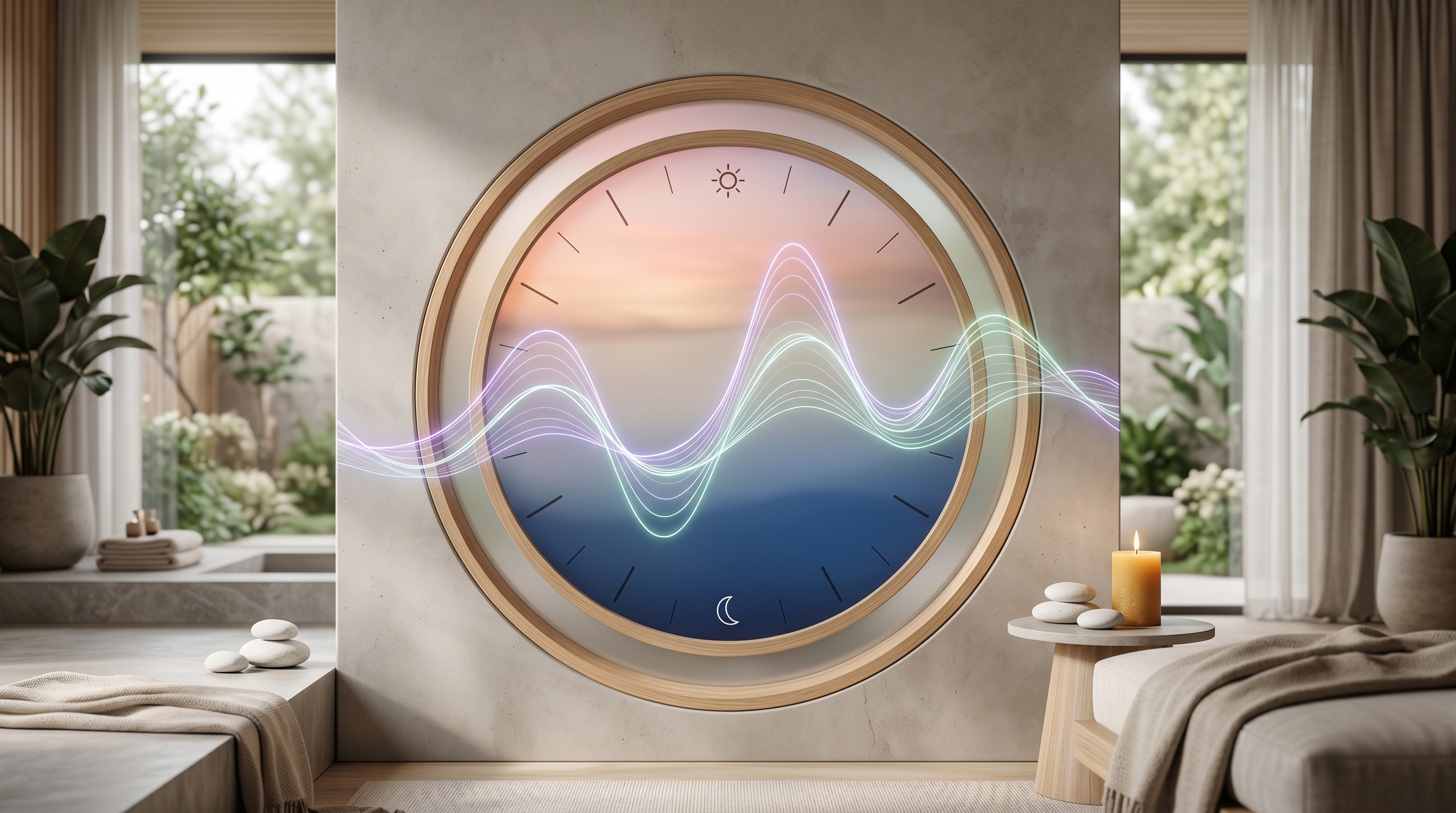
The endocannabinoid system (ECS) is your body’s own cannabinoid network. Its two headline molecules — anandamide (AEA) and 2-arachidonoylglycerol (2-AG) — are made on demand and act as messengers at CB1 and CB2 receptors. Here is the part most people never hear: those molecules do not sit at a flat baseline. They rise and fall across the 24-hour day, and the two of them do it on different schedules.
Working in healthy humans, Vaughn and colleagues reported that plasma anandamide is roughly threefold higher at waking than just before sleep, and that this rhythm gets scrambled by sleep deprivation [Vaughn et al., 2010]. Hanlon’s group later mapped 2-AG, finding a robust daily curve with a nadir in the middle of the night and a peak in the early afternoon [Hanlon et al., 2015]. When they shortened people’s sleep to 4.5 hours, that 2-AG afternoon peak grew larger and arrived later — and participants got hungrier and reached for snacks right as 2-AG climbed [Hanlon et al., 2016].
So your two main endocannabinoids appear to keep different clocks. A follow-up study found anandamide follows a biphasic pattern — a nocturnal peak in early sleep, a mid-morning dip, and a second afternoon peak — distinct from 2-AG’s single afternoon mountain [Hanlon et al., 2020]. This is the kind of receptor-and-tone interplay we explore in the endocannabinoid tone theory.
CB1 receptors may shift too
It is not just the messengers. Animal work suggests the density of CB1 receptors also varies by time of day, and — fascinatingly — it can run almost perfectly out of phase with anandamide. In rat hippocampus and pons, CB1 protein peaks during the inactive (light) phase when AEA is low; during the active phase, CB1 is lower while AEA is high [Vaughn et al., 2010]; [Martinez-Vargas et al., 2003]. Valenti’s team showed AEA and 2-AG move in opposite directions across the light–dark cycle in four brain regions, with AEA higher in the dark phase and 2-AG higher in the light phase [Valenti et al., 2004].
Why this matters for cannabis: THC works largely by activating CB1. If both the receptors available and your background endocannabinoid tone are shifting hour by hour, then the same dose of THC is, in a sense, landing on a different instrument depending on when you play it. For a deeper look at the daily clock itself, see cannabis and circadian rhythms.
Cortisol, melatonin, and the hormones in between
Your ECS does not run this rhythm alone. It is woven into the same daily orchestra as your stress and sleep hormones.
Cortisol is your morning “get up and go” hormone, surging in the first 30–45 minutes after waking (the cortisol awakening response) and tapering toward a nighttime low. Endocannabinoid signaling helps shape the cortisol curve: in rats, blocking CB1 receptors raised stress-hormone output much more strongly in the morning trough than in the evening peak — a clearly time-of-day-dependent effect [Atkinson et al., 2010]. We unpack this loop in detail in cannabis and cortisol and in our guide to strains for stress relief.
Acute THC, meanwhile, tends to raise cortisol in a dose-dependent way in people who do not use often — but that bump is blunted in frequent users [Ranganathan et al., 2009]. Translation: morning cannabis stacked on top of a natural morning cortisol surge may feel more activating or anxious for some people, while the same product at night arrives into a calmer hormonal backdrop.
Melatonin sits on the other end of the day, rising about two hours before your usual bedtime and peaking mid-sleep under the control of the brain’s master clock, the suprachiasmatic nucleus (SCN). Strikingly, neurons in that very clock have been shown to release endocannabinoids that signal to neighboring astrocytes and influence clock timing [Hablitz et al., 2020]. In other words, the ECS is not just downstream of your body clock — it can talk back to it. That bidirectional relationship is the through-line of every chrono-cannabis idea in this article.
What this might mean for timing your dose
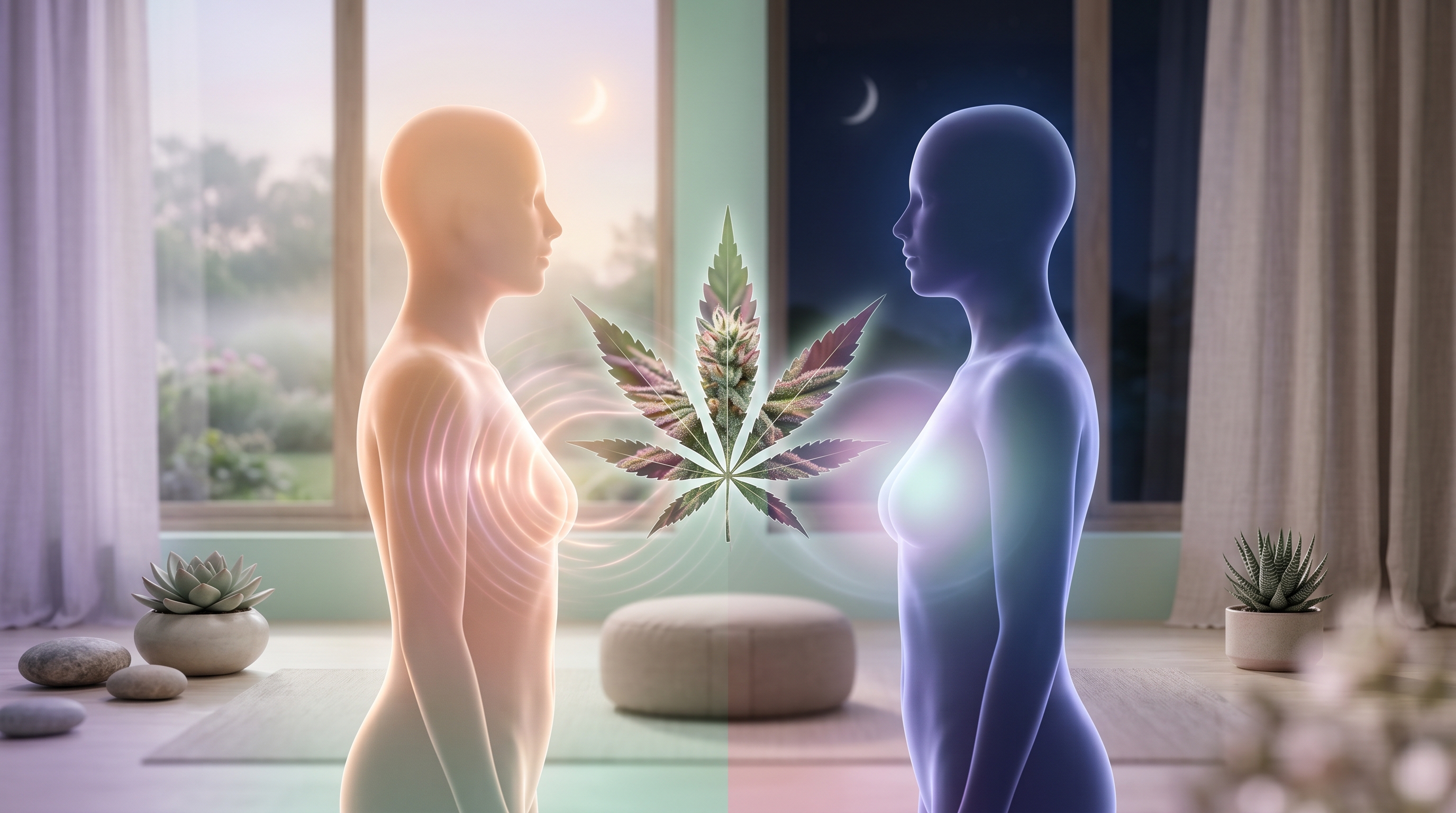
Here is where I have to keep my hedges firmly in place. No solid human trial has compared morning versus evening cannabis dosing for the same goal. What follows is reasoned from mechanism, plus how it tends to line up with what experienced users report. Read it as a hypothesis to test on yourself, not a rule.
Morning
In the morning, cortisol is naturally high and anandamide tone tends to be elevated (it is highest near waking). Layering activating THC on top of an already aroused, “go” state is, for some people, a recipe for racing thoughts or a thin, anxious high — and for others, exactly the focused lift they want. If morning is your window, many find that lower doses and higher-myrcene or balanced profiles sit better than something sharp and racy. Our piece on morning cannabis chemistry and our microdose coffee and tea recipes are built around exactly this idea.
Afternoon
The afternoon is when 2-AG appears to peak — the endocannabinoid most linked to reward, appetite, and a sense of ease. Anecdotally, this is the sweet spot many people describe as the most forgiving time to consume: cortisol is fading, you are not yet trying to sleep, and the body’s own cannabinoid tone is near its high point. If you have noticed snacks hit differently at 3 p.m., that lines up with the 2-AG-and-appetite finding mentioned earlier.
Evening
By night, cortisol is at its floor and melatonin is rising. THC’s sedating, sleep-onset-shortening tendency may have the cleanest runway here, which is why evening is the default for so many people chasing rest. Just remember the catch we cover in cannabis and dreams: THC can suppress REM, so “falls asleep faster” is not the same as “sleeps better.” If sleep is the goal, pair the timing knowledge here with our science-based sleep strain guide, our overview of cannabis and sleep, and the evening wind-down strains. Sleep pressure also has its own clock — see cannabis and adenosine and the CBN sleepy-cannabinoid breakdown.
Timing and tolerance
There is a second clock worth watching: not the daily one, but the one that ticks across days and weeks as tolerance builds.
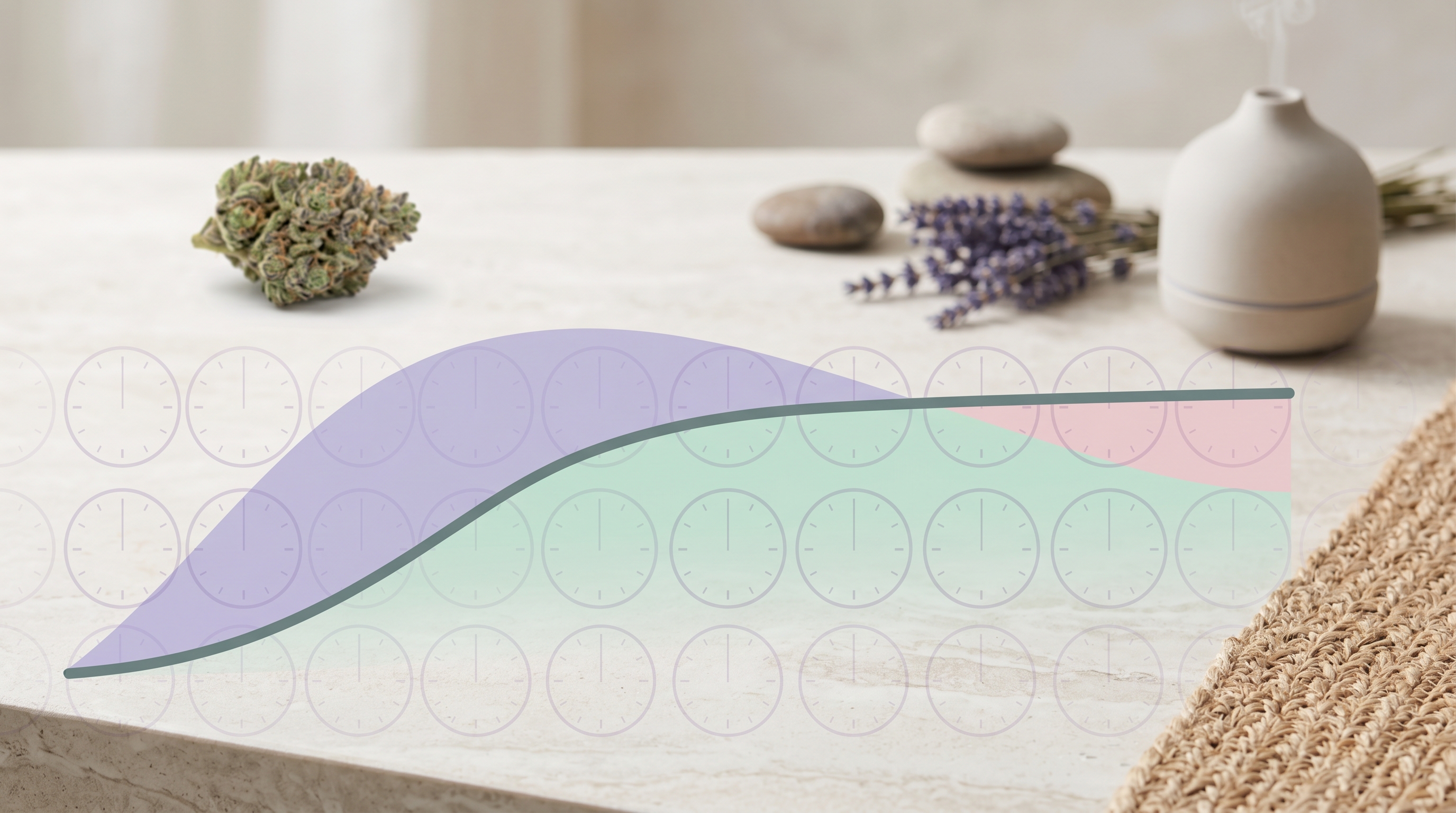
When researchers gave chronic users oral THC around the clock for several days, subjective intoxication climbed at first and then declined even as plasma THC kept rising — a textbook tolerance pattern [Gorelick et al., 2013]. In a related dosing study, six days of around-the-clock THC produced tolerance to subjective intoxication but not to all cardiovascular effects [Bonn-Miller et al., 2013]. And remember that frequent users show blunted cortisol responses to THC [Ranganathan et al., 2009] — a sign the whole stress axis adapts.
The practical takeaway: if you dose at the same time every single day, you may be teaching your receptors to expect it, dulling the effect right when you want it most. Spacing use, varying timing, or taking periodic breaks can help reset sensitivity. We go deep on this in the complete tolerance-break guide and the post-420 reset plan. Tolerance is also intensely individual, which matters for households — see cannabis for couples navigating different tolerance levels.
The honest limitations
I promised you straight talk, so here it is in one place:
- Most rhythm data is from animals or peripheral blood. Brain CB1 and endocannabinoid measurements largely come from rodents; human studies mostly measure molecules in plasma, and the functional meaning of those blood levels is not fully settled [Hanlon et al., 2015].
- No timed dosing RCTs. There is, to my knowledge, no large randomized human trial showing that morning versus evening cannabis produces different therapeutic outcomes. We are extrapolating from biology.
- People differ enormously. Chronotype (night owl versus early bird), tolerance, genetics, dose, product, and method all swamp small timing effects. A pattern that holds at the population level may not hold for you.
- Cannabis can disrupt the very clock it interacts with. This is not a clean, one-way street — see how THC can disrupt your internal clock. Heavier or late-night use may flatten rhythms over time.
None of this means timing is irrelevant. It means the evidence supports curiosity and self-tracking, not confident claims.
Key Takeaways
If you want to experiment thoughtfully, here is how I would approach it. None of this is medical advice — talk to a clinician about your situation, especially if you take other medications or have a health condition.
- Pick one goal and one time window. Trying to optimize morning focus and evening sleep at once just adds noise.
- Hold the product constant, vary only the clock. Same strain, same dose, same method — change only when, so timing is the only moving part.
- Start low, especially in the morning. A high cortisol and anandamide backdrop can make activating products feel sharper than expected.
- Log how it actually felt, not how you expected it to. Patterns only show up with honest, repeated notes over a couple of weeks.
- Mind tolerance. If effects fade, vary your timing or take a break before you simply increase the dose.
This is exactly the kind of personal pattern the High IQ app is built to surface. When you log what you took, when, and how it landed, you stop guessing and start seeing your rhythm — which is the only chrono-pharmacology that ultimately matters for you.
Frequently asked questions
Is there really a “best time of day” to use cannabis? Not in a proven, one-size-fits-all sense. The biology suggests time of day plausibly shapes how cannabis feels, but no randomized human trial has established a universal best time. The honest answer is: it likely depends on you and your goal.
Why does the same dose feel different morning versus night? Several things shift across the day — your endocannabinoid tone (anandamide and 2-AG), possibly CB1 receptor availability, cortisol, melatonin, and your own expectations and activity level. Research has documented daily rhythms in these molecules [Hanlon et al., 2015]; [Vaughn et al., 2010], which offers a plausible mechanism, though the experience is highly individual.
Does morning cannabis cause anxiety? For some people, yes — and the morning cortisol surge plus elevated anandamide may be part of why activating products can feel jittery early in the day. Lower doses and calmer profiles tend to help. Others tolerate morning use just fine. See morning cannabis chemistry.
Is evening genuinely better for sleep? Evening lines up with falling cortisol and rising melatonin, and THC can shorten the time it takes to fall asleep. But THC may suppress REM sleep, so faster sleep onset is not the same as better-quality sleep — details in cannabis and dreams and our sleep science overview.
Can dosing at the same time every day build tolerance faster? Plausibly. Around-the-clock dosing studies show tolerance to subjective effects developing within days [Gorelick et al., 2013]; [Bonn-Miller et al., 2013]. Varying timing or taking breaks may help preserve sensitivity — see the tolerance-break guide.
Sources
- Vaughn LK, et al. Endocannabinoid signalling: has it got rhythm? British Journal of Pharmacology. 2010. DOI: 10.1111/j.1476-5381.2010.00790.x
- Valenti M, et al. Differential diurnal variations of anandamide and 2-arachidonoyl-glycerol levels in rat brain. Cellular and Molecular Life Sciences. 2004. PMID: 15095014
- Hanlon EC, et al. Circadian rhythm of circulating levels of the endocannabinoid 2-arachidonoylglycerol. Journal of Clinical Endocrinology & Metabolism. 2015. DOI: 10.1210/jc.2014-3455
- Hanlon EC, et al. Sleep restriction enhances the daily rhythm of circulating levels of endocannabinoid 2-arachidonoylglycerol. Sleep. 2016. DOI: 10.5665/sleep.5396
- Hanlon EC. Impact of circadian rhythmicity and sleep restriction on circulating endocannabinoid (eCB) N-arachidonoylethanolamine (anandamide). Psychoneuroendocrinology. 2020. DOI: 10.1016/j.psyneuen.2019.104471
- Atkinson HC, et al. Regulation of the hypothalamic-pituitary-adrenal axis circadian rhythm by endocannabinoids is sexually diergic. Endocrinology. 2010. PMID: 20534730
- Ranganathan M, et al. The effects of cannabinoids on serum cortisol and prolactin in humans. Psychopharmacology. 2009. PMID: 19083209
- Kesner AJ, Lovinger DM. Cannabinoids, endocannabinoids and sleep. Frontiers in Molecular Neuroscience. 2020. DOI: 10.3389/fnmol.2020.00125
- Gorelick DA, et al. Around-the-clock oral THC effects on sleep in male chronic daily cannabis smokers. American Journal on Addictions. 2013. DOI: 10.1111/j.1521-0391.2013.12003.x
- Bonn-Miller MO, et al. Tolerance to effects of high-dose oral THC in male daily cannabis smokers. Drug and Alcohol Dependence. 2013. PMID: 23074216
This article is educational and not medical advice. Cannabis affects everyone differently. Consult a qualified healthcare provider before making changes to your routine, especially if you take other medications or have a health condition.


