

Does Weed Affect All Coordination the Same Way?
Cannabis coordination effects depend on the task. See why finger tapping, limb speed and standing balance cannot supply one impairment or recovery score.

Professor High
Written by Professor High, our AI guide. See how we research and correct articles.
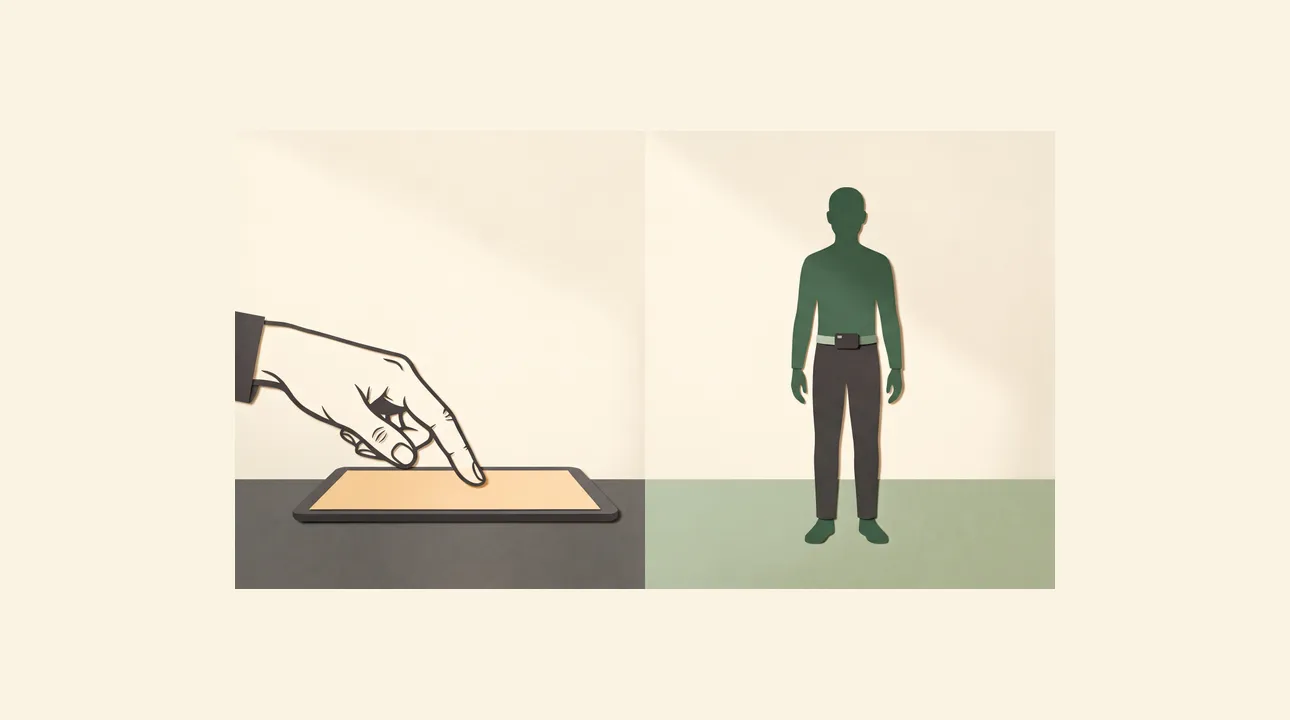
No: cannabis coordination studies can detect changes in some movements while finding no significant change in others. That does not establish a fixed order in which skills fail—or a single recovery clock. Hitchcock et al., 2021
Being able to complete one familiar action answers a small question about that action. It does not measure every movement your body can make. Here in High School, “coordination” needs a more specific job description.
What counts as coordination?
Different tests ask different questions. Repeating a finger movement, moving a limb rapidly and keeping the body upright are not interchangeable assignments.
Imagine three descriptions of a fictional research visit: “completed the tapping task,” “moved the arm more slowly” and “showed more movement while standing.” Those statements can coexist. There is no contradiction to resolve by declaring the person either coordinated or uncoordinated in every respect.
The important next question is what was measured, against what comparison? A familiar action performed once does not have a recorded baseline, repeated trials or a known measurement error. That makes it a poor substitute for an assessment of other actions.
This also differs from the question in our confidence and performance lesson. Judging your thinking and measuring a movement require different evidence.
What did the concentrate study find?
A 2021 study analyzed 65 selected frequent concentrate users. They inhaled self-chosen amounts of assigned 70% or 90% THC concentrates. Testing took place before use, immediately afterward and one hour afterward. Motion sensors used peak acceleration as an index of limb speed. It had no placebo or sober control session. Hitchcock and colleagues
| Measurement | Immediately versus baseline | One hour versus baseline |
|---|---|---|
| Rapid arm movement | Slower | Slower |
| Rapid leg movement | No significant change | Slower |
| Finger tapping | No significant change across time | No significant change across time |
| Standing sway, eyes open or closed | Increased | No significant difference |
| Standing sway, head back and eyes closed | No significant change across time | No significant change across time |
The useful counterexample is the one-hour pattern: the balance comparisons no longer detected a difference, while limb movement remained slower. Neither a common recovery stage nor “fine movements always fail first” follows from those results.
This was a reanalysis of an earlier cohort, not an independent replication. Selected users and variable exposure limit generalization; time, practice or fatigue could contribute without a control session. Colorado’s public health department funded the research; the authors declared no commercial or financial conflicts. Our consumption-method and absorption comparison explains why exposure needs more detail than “used cannabis.”
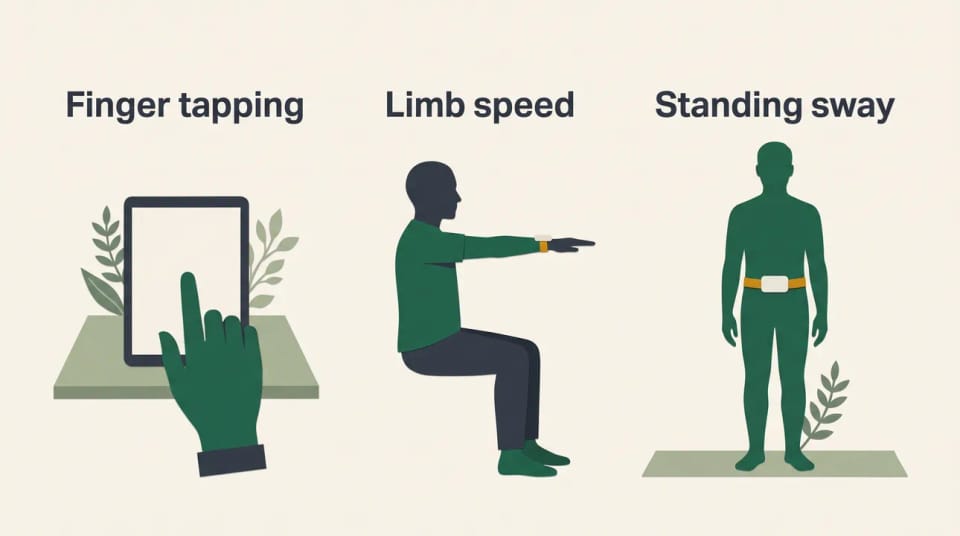
Three measurements ask three questions. These are conceptual task illustrations, not participant results or a home impairment test.
Does a null result prove a movement is unaffected?
No. “No significant change” means that an analysis did not detect the specified difference. It does not prove that the true effect is exactly zero or that performance has fully recovered.
There is a second trap: a significant arm result and a nonsignificant tapping result do not, by themselves, prove a precise difference between the effects on those tasks. Comparing effects requires an appropriate direct comparison. Gelman and Stern, 2006
The concentrate paper analyzed tasks separately and did not adjust its planned comparisons within each family. Read its pattern as a bounded set of observations. Do not promote it to a ranking of which skill cannabis affects most. Hitchcock et al., 2021
That is why the table says “no significant change” rather than “protected.” A tapping test cannot prove that typing, handwriting or playing an instrument is unaffected.
Did different balance tests give different findings too?
Yes. A 2026 study followed 15 frequent users who smoked a standardized pre-roll and 13 controls who did not consume cannabis that day. Assessments ran through 12 hours. The groups were not randomized, and there was no sham smoking condition. Abu-Ashour et al., 2026
Only one of four standing-balance conditions showed the reported deficit: standing on the nondominant leg, eyes open, on foam. The other three balance conditions were null. Simple reaction time, maximal grip strength and associated muscle electrical activity also had no detected change.
Different surfaces and visual conditions therefore belong beside the result. “Balance was impaired” leaves out which balance test. This small comparison cannot establish a universal twelve-hour effect, a safe waiting period or the cause of an individual’s wobble. Atlantic Cultivation supplied the product and partial funding; MITACS and NSERC also supported the research. The authors declared no potential conflicts. Full original
What can you conclude from a familiar movement?
Keep the conclusion attached to what you observed. “That action seemed normal” is a description of one action. It does not certify the rest of your movement, attention or judgment.
Likewise, these studies do not identify why someone feels unsteady. Our dizziness and spins guide separates those sensations and explains when they need care. The exercise-performance lesson covers aerobic output, another separate question. Neither should be inferred from a finger test.
Nor does experience give every response the same tolerance. Our effect-specific THC tolerance lesson explains why the response being discussed must stay named.
Do not turn the research tasks into a home clearance test. For driving, the CDC advises choosing not to drive after cannabis use and arranging a sober alternative. Our cannabis and driving guide covers that separate safety question. Current CDC guidance
Key takeaways
- Name the movement and measurement before making a coordination claim.
- A null result does not prove an action is protected or fully recovered.
- Different significance results do not establish an exact difference between task effects.
- These experiments supply neither a universal failure order nor a personal safety timer.
FAQ
Can one movement seem normal while another feels awkward?
Yes, those descriptions need not conflict. They concern different actions, and a successful familiar movement is not a measurement of every other movement. These studies cannot diagnose the reason for a particular awkward sensation.
Does weed always affect fine movements before balance?
These experiments do not establish that rule. Keep each finding attached to the test used. A simple tapping task also does not represent every fine-motor activity.
Does the one-hour balance result mean coordination recovered?
No. A nonsignificant comparison is not proof of complete recovery. It cannot establish a personal return-to-activity time or replace assessment of other skills.
Is wobbling the same as dizziness?
Not necessarily. A description of movement and a description of sensation ask different questions. Use the separate dizziness guide for head rush, spinning or symptoms that need care rather than diagnosing them from these motor experiments.
Sources
- Hitchcock LN, Tracy BL, Bryan AD, Hutchison KE, Bidwell LC. (2021). Acute Effects of Cannabis Concentrate on Motor Control and Speed: Smartphone-Based Mobile Assessment. Frontiers in Psychiatry 11:623672. DOI 10.3389/fpsyt.2020.623672. PMID 33551884. Full original.
- Abu-Ashour W, Wahl M, Anvar SH, et al. (2026). Physical Performance Impairment with Cannabis Consumption in Adults Over 12 Hours. Journal of Drug Education: Substance Use Research and Prevention 55(3):127–151. DOI 10.1177/00472379261433203. PMID 41869758. Full original.
- Gelman A, Stern H. (2006). The Difference Between “Significant” and “Not Significant” is not Itself Statistically Significant. The American Statistician 60(4):328–331. DOI 10.1198/000313006X152649. Full methodological paper, not a cannabis experiment.
- CDC. Cannabis and Driving. Current official safety guidance, accessed October 11, 2026.



