Cannabis and VO2max: What Exercise Science Actually Shows
Does cannabis help or hurt aerobic fitness? A science-backed look at THC, CBD, VO2max, perceived exertion, recovery, and the runner's high.

One friend swears cannabis turns a treadmill slog into a breeze. Another insists it wrecks their mile time. They might both be right. Cannabis does not change your aerobic engine the way coffee or beetroot juice might. What it may change is how exercise feels, how hard your body works to hit the same effort, and how you recover afterward. Those are separate questions, and the research seems to treat them separately too.
Let me walk you through what exercise science actually shows about cannabis and aerobic capacity. I will split the headline number everyone fixates on, VO2max, from the things that may matter more day to day: perceived exertion, heart rate, motivation, and recovery. And I will keep the hype parked outside.
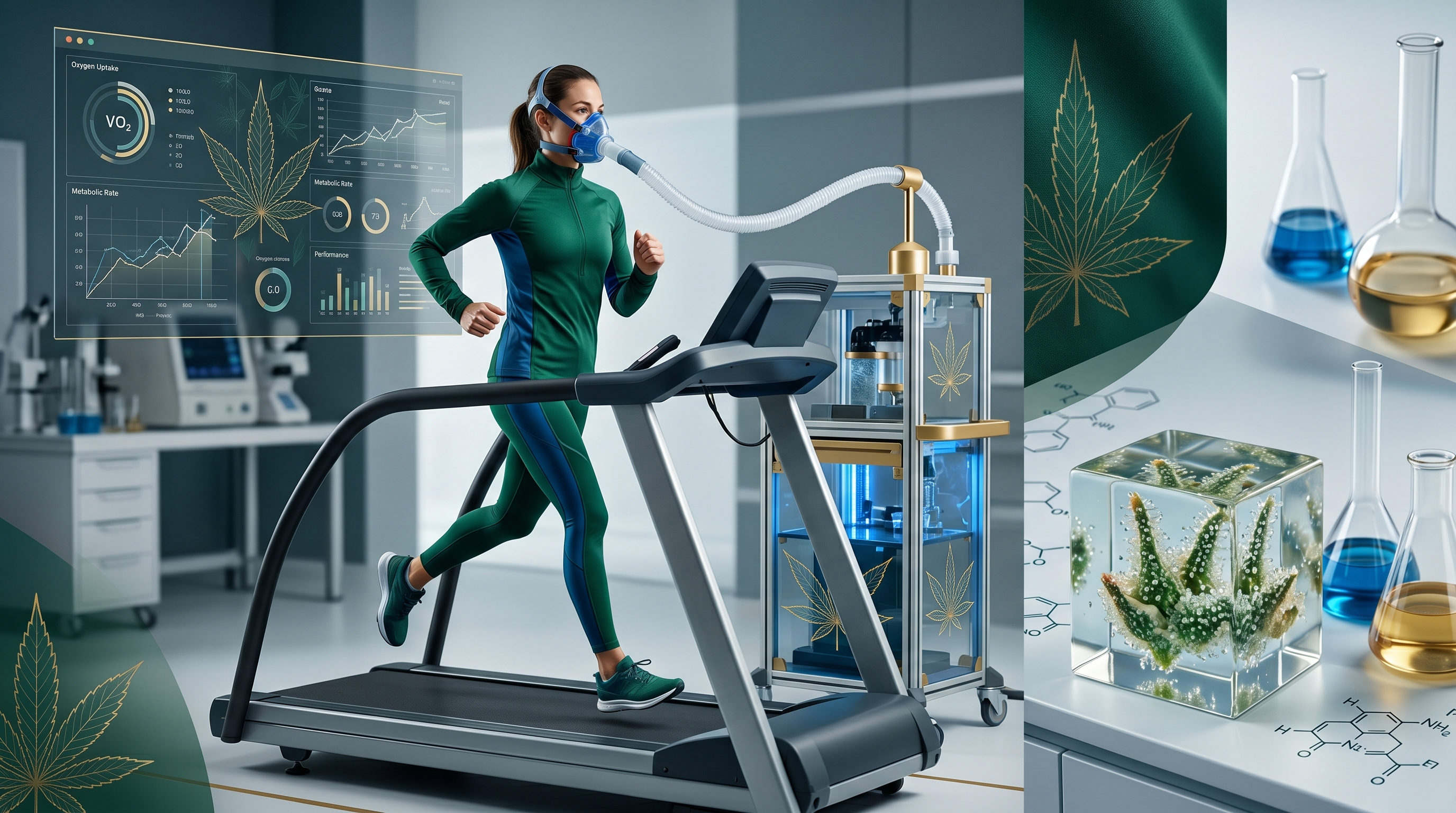
First, what is VO2max?
VO2max is the most oxygen your body can take in and use during all-out exercise. It is measured in milliliters of oxygen per kilogram of body weight per minute. Most experts treat it as the gold-standard measure of cardio fitness and a strong sign of endurance. A trained distance runner might sit near 53 mL/kg/min. An elite cyclist can push past 70.
Here is the key thing. VO2max mostly comes down to your heart, lungs, blood, and muscle cells. You build it over months of training, not minutes of any drug. So the honest question is not “does cannabis raise VO2max.” It is “does cannabis get in the way of the system that already sets it.” The answer, from what we have, is mostly no. But there is real nuance once you ask about day-to-day performance.
The mechanism: your endocannabinoid system already shows up to exercise
Before we get to the supplements, it helps to know that your body runs its own cannabis-like chemistry during a workout. The endocannabinoid system (ECS) is a network of receptors (CB1 and CB2) and signaling molecules your body makes on demand. The two best-studied are anandamide (AEA) and 2-AG.
Exercise reliably mobilizes these compounds. A 2022 systematic review pulled together 21 human studies, or 571 people in all [Siebers, 2022]. It found that 14 of 17 studies measuring anandamide, about 82%, saw a rise after a single bout of exercise (doi:10.1177/10738584211069981). The effect seems to depend on intensity. Moderate-to-vigorous work, in the 70 to 85% of maximum heart rate range, looks like the sweet spot. Very easy walking or all-out sprints did not reliably move the needle.
This is the leading modern explanation for the “runner’s high.” For decades people credited endorphins. But endorphins are too large to cross the blood-brain barrier easily, while endocannabinoids slip through with ease. In mice, a 2015 study blocked cannabinoid receptors and erased running’s calming, pain-dulling effects [Fuss, 2015] (doi:10.1073/pnas.1514996112). Other work found that humans and dogs, both built for endurance, ramp up endocannabinoids after a run, while ferrets do not [Raichlen, 2012] (doi:10.1242/jeb.063677). Research suggests your reward for cardio may be partly an endocannabinoid bath, the same system THC and CBD plug into.
That sets up the obvious question. If exercise already floods your ECS, what happens when you add cannabis on top?
What the evidence shows for THC and aerobic performance
Short version: inhaled THC does not appear to boost aerobic capacity, and during hard sustained efforts it may quietly hurt it.
The cleanest recent data comes from a 2024 crossover trial at the University of Guelph [Cheung, 2024] (doi:10.1152/japplphysiol.00757.2023). Fourteen regular-exercising cannabis users (9 men, 5 women) rode a 20-minute cycling time trial under four conditions: smoked THC cannabis, vaporized THC cannabis, vaporized CBD-rich cannabis, and a control. Mean power output fell sharply in both THC conditions versus control and CBD (p < 0.04). Here is the twist: VO2 and rating of perceived exertion (RPE) at maximal effort were similar across conditions (p > 0.1). So the riders were not working easier. They simply made less power. The authors concluded THC “negatively impacts vigorous exercise performance,” whether smoked or vaped.
Other designs land softer. A 2022 study had 17 habitual users eat a 10 mg THC edible before stationary cycling [Sagar, 2022]. Cardio-respiratory responses to staged exercise looked normal. The THC dose changed neither functional threshold power (placebo 253 vs THC 251 W; p > 0.45) nor peak sprint power (p = 0.864). The verdict there: THC was “neither ergogenic nor ergolytic” (doi:10.3389/fphys.2022.1085822). The likely reason is dose and delivery. An oral 10 mg edible gives a milder, slower hit than inhaled flower at a hard intensity.
Zoom out to chronic use and the picture flattens further. A 2020 systematic review of long-term users found that VO2max and physical work capacity did not differ from non-users in any included study [Kramer, 2020]. Resting heart rate was the only measure that occasionally differed (doi:10.1186/s42238-020-00037-x). A broader 2021 review reached the same cautious place [Burr, 2021]. Whole cannabis and THC show null-to-detrimental effects on performance, but the studies rigorous enough to settle it just do not exist yet (doi:10.1007/s40279-021-01505-x).
The one consistent physiological signal is cardiovascular. THC tends to raise heart rate and can perturb cardiovascular homeostasis, which matters more for sustained intense work than for a casual jog. If you are curious about that angle, our deep dive on cannabis and heart health and the piece on cannabis and heart rate variability go further.
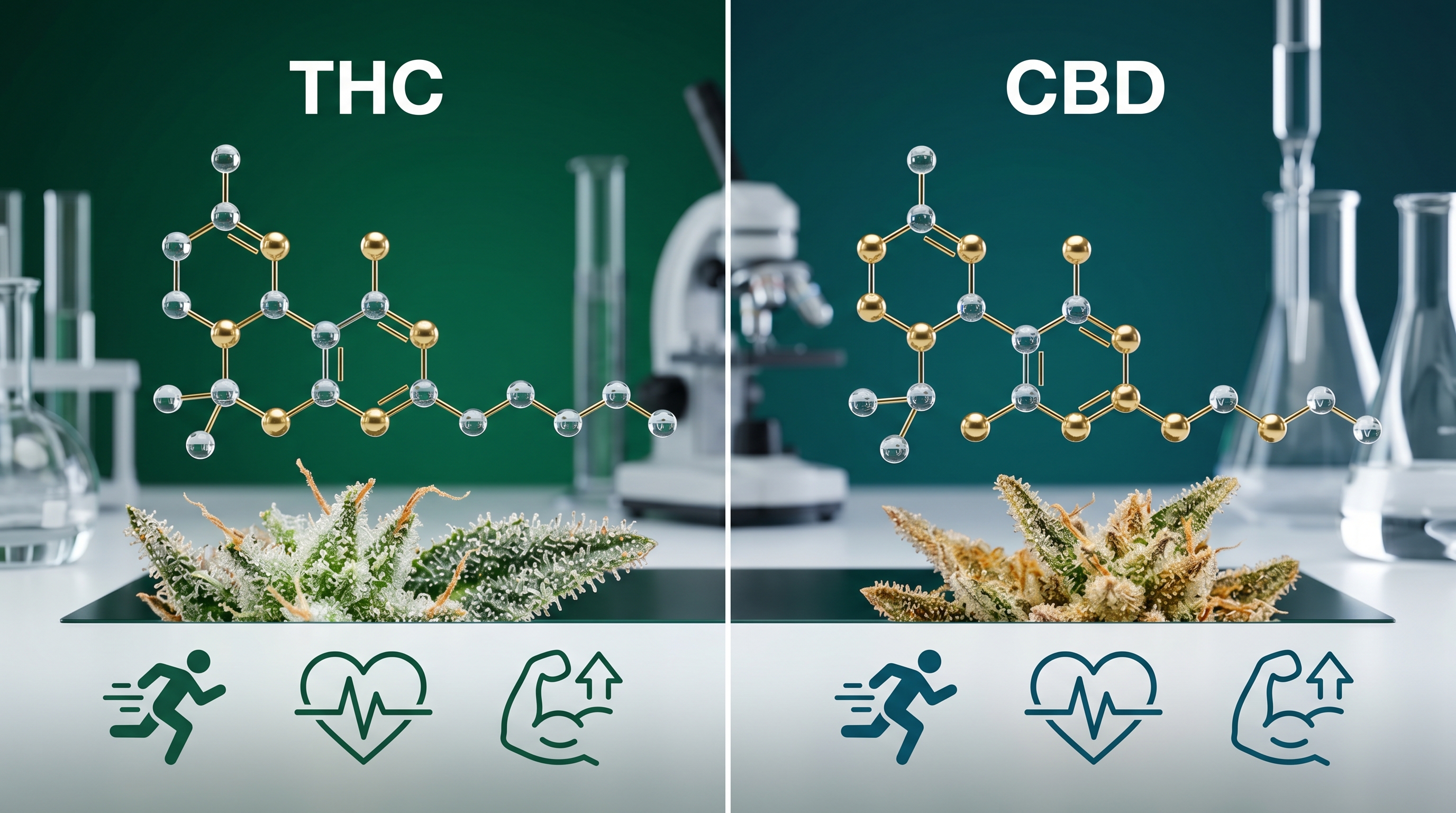
What the evidence shows for CBD
CBD is non-intoxicating and gets most of the athlete attention, usually for recovery rather than raw output. The performance data so far is underwhelming, and that is arguably good news.
A 2025 dose-ranging randomized controlled trial at the University of Sydney tested 25 trained runners (average VO2max 53.1 mL/kg/min) [Sahinovic, 2025]. They got 50 mg, 300 mg, or placebo CBD before a 60-minute easy run and an incremental run to exhaustion (doi:10.1186/s40798-025-00895-w). Neither dose changed perceived exertion, enjoyment, pain, heart rate, exercise efficiency (VO2), VO2peak, or time to exhaustion (all p > 0.05). The only blips were a small drop in respiratory exchange ratio at 300 mg (p = 0.030), hinting at a slight shift toward burning fat, plus a glucose change at 50 mg. So CBD did not help endurance. But it did not hurt it either, and it was well tolerated.
Recovery is where CBD’s promise lives, and even there the evidence is mixed. A controlled trial gave collegiate athletes 5 mg/kg CBD around muscle-damaging exercise and found no real drop in inflammation, muscle damage, or fatigue [Crossland, 2022]. A 2026 topical CBD gel study also found no clear effect on delayed-onset muscle soreness, though it noted a favorable trend for strength recovery (effect sizes 0.85 to 1.0 from 24 to 72 hours). Reviews keep landing on the same note [McCartney, 2020]. CBD’s plausible recovery perks, better sleep, less anxiety, possible anti-inflammatory action, are real research directions but not yet proven in athletes. Our companion guide on cannabis for athletic recovery covers that literature in detail, as does the piece on cannabis and inflammation.
Performance vs. recovery vs. motivation: three different questions
It helps to keep these lanes separate.
- Acute aerobic performance. Inhaled THC may reduce output during hard sustained efforts (the cycling time-trial finding), while having little measurable effect on VO2max itself. CBD appears performance-neutral.
- Recovery. CBD is the more studied candidate here, mainly for sleep, pain, and inflammation. Evidence is preliminary and inconsistent, but the safety profile is reassuring. See cannabis and sleep.
- Motivation and enjoyment. This is the under-measured wild card. Some people genuinely find that a low dose makes a boring run feel novel, or quiets pre-workout anxiety enough to start. A crossover study of commercially available products reported shifts in the subjective experience of running. Whether that translates to showing up more often is exactly the kind of personal pattern worth tracking. The flip side is real too: THC’s effect on dopamine and motivation is dose-dependent and individual.
This is also where terpenes enter. Energizing profiles built around terpinolene or pinene feel different from a heavy myrcene couch-lock chemovar. If you are going to experiment around movement, an uplifting Energy High or Uplift High profile is a more logical starting point than a sedating Relax High one. Our guide to the best cannabis strains for working out and the article on cannabis and hiking lean into the lower-intensity, enjoyment-first use case where the downsides are smallest.

Key takeaways and practical tips
I am not here to tell you to medicate your marathon. But if you are going to combine cannabis and cardio, the science points to a few sensible guardrails.
- Do not expect a fitness boost. Nothing in the literature suggests cannabis raises VO2max or makes you objectively faster. If anything, inhaled THC may shave output during hard efforts.
- Match the product to the goal. For recovery, low-dose CBD or a topical is the better-studied bet than getting high before a workout.
- Mind the heart. THC raises heart rate. For intense aerobic sessions that adds cardiovascular strain on top of exercise’s own demands.
- Save intensity for sober. The performance dip showed up at vigorous, sustained effort, not easy movement. Yoga, a walk, or a gentle outdoor session is a lower-stakes place to experiment.
- Track your own response. Group averages hide individuals. The only data that matters for you is your data.
Limitations of the research
Be skeptical, including of me. Most cannabis-and-exercise studies are small, often 14 to 25 people. Many recruit existing users, which limits how far the findings reach. Doses, products, and timing vary a lot between studies. So “cannabis” in one paper is not “cannabis” in another. Almost none use elite athletes. Endocannabinoid readings also shift with blood-draw timing, fasting, and intensity. That is exactly why the runner’s high mechanism stays linked-but-not-proven in humans. And everyone’s biology differs: the same strain hits people differently. Treat every number here as a signpost, not a finish line.
Frequently asked questions
Does cannabis lower your VO2max? Research suggests chronic cannabis use does not significantly change measured VO2max compared with non-users. The performance hit that does show up is during sustained vigorous effort under inhaled THC, not in the VO2max number itself.
Is the runner’s high actually cannabis-related? Partly, according to current theory. Exercise reliably raises your own endocannabinoids like anandamide, and animal studies show cannabinoid receptors are needed for running’s calming, pain-dulling effects. In humans the link is strongly suggested but not definitively proven. See our endocannabinoid system guide.
Will THC make my workout feel easier? Not reliably. In the controlled cycling study, perceived exertion was statistically similar with and without THC even though power output fell, so people worked just as hard for less result.
Is CBD worth taking for recovery? Maybe, mostly via better sleep and reduced soreness, but the evidence is preliminary and mixed. It is well tolerated, which is why athletes keep experimenting. Read more in cannabis for athletic recovery.
What is a smart way to experiment safely? Start with very low doses, favor recovery contexts over hard training days, avoid combining THC with maximal cardio, and log your sessions so you can spot your own patterns. Our cannabis journaling guide walks through how.
The Professor’s bottom line
Cannabis is not a performance enhancer, and the evidence that it is a performance wrecker is limited to hard, sustained efforts under inhaled THC. For most people, the interesting story is not VO2max at all. It is the enjoyment, the recovery, and the way your own endocannabinoid system already rewards movement. The smartest move is to stop arguing about averages and start tracking how cardio plus cannabis actually lands for you. That is the whole point of knowing exactly why you are high.
Sources
- Cheung CP, Baker RE, Coates AM, Burr JF. Cannabis containing THC impairs 20-min cycling time trial performance irrespective of the method of inhalation. J Appl Physiol. 2024;136(3):583-591. doi:10.1152/japplphysiol.00757.2023
- Sahinovic A, et al. The Acute Effects of Cannabidiol on Physiological and Subjective Responses to Endurance Exercise: A Dose-Ranging Randomised Controlled Crossover Trial. Sports Med Open. 2025. doi:10.1186/s40798-025-00895-w
- Siebers M, Biedermann SV, Fuss J. Do Endocannabinoids Cause the Runner’s High? Evidence and Open Questions. Neuroscientist. 2023;29(3):352-369. doi:10.1177/10738584211069981
- Fuss J, et al. A runner’s high depends on cannabinoid receptors in mice. PNAS. 2015;112(42):13105-13108. doi:10.1073/pnas.1514996112
- Raichlen DA, et al. Wired to run: exercise-induced endocannabinoid signaling in humans and cursorial mammals. J Exp Biol. 2012;215(8):1331-1336. doi:10.1242/jeb.063677
- Sagar DR, et al. (Frontiers) Edible marijuana and cycle ergometer exercise. Front Physiol. 2022;13:1085822. doi:10.3389/fphys.2022.1085822
- Kramer A, et al. Chronic cannabis consumption and physical exercise performance in healthy adults: a systematic review. J Cannabis Res. 2020;2:34. doi:10.1186/s42238-020-00037-x
- McCartney D, et al. Cannabidiol and Sports Performance: A Narrative Review. Sports Med Open. 2020;6:27. doi:10.1186/s40798-020-00251-0
- Burr JF, et al. Cannabis and Athletic Performance. Sports Med. 2021;51(Suppl 1):75-87. doi:10.1007/s40279-021-01505-x


