Cannabis for Restless Leg Syndrome: What Research Shows
What the science actually says about cannabis and restless legs syndrome (RLS): the case studies, the dopamine link, sleep overlap, and why evidence is early.


If you have restless legs syndrome, you already know the feeling that no one else seems to understand. You lie down to sleep and your legs come alive with a crawling, pulling, “I have to move them right now” sensation. You stretch, you walk, you stretch again, and the moment you settle back into bed it starts over. So it is not surprising that some people with RLS have begun asking a fair question: could cannabis help?
The honest answer is that the research is intriguing but very early. A handful of small studies and patient reports suggest cannabis may ease restless legs symptoms for some people. So far there are no large clinical trials, and this preliminary evidence is not proof of a reliable therapy for RLS. Let me walk you through what we actually know, where the science gets interesting, and the cautions that matter before you talk to your doctor.

First, What Is Restless Legs Syndrome?
Restless legs syndrome (RLS), also called Willis-Ekbom disease, is a neurological disorder. It is built around four classic features. There is an irresistible urge to move the legs. It usually comes with uncomfortable sensations like crawling, tingling, or burning. The urge gets worse during rest or inactivity. Movement gives short-term relief. And it follows a daily rhythm, getting worse in the evening and at night.
That last point is the cruel part. RLS peaks exactly when you are trying to wind down, which is why it so often wrecks sleep. In its moderate-to-severe form, RLS affects roughly 3% of people in North America and Europe, and it takes a real toll on quality of life.
Doctors usually reach for dopamine-related medications first. They may add anticonvulsants (like gabapentin) or, in tougher cases, opioids. These work for many people. But a meaningful subset stays “refractory.” That means standard treatments either stop working or bring side effects that are hard to live with. One of the most frustrating is augmentation, where dopamine drugs eventually make symptoms worse over time. It is this refractory, frustrated group that has driven much of the curiosity about cannabis.
The Endocannabinoid System, Dopamine, and RLS
To understand why cannabis even enters this conversation, you have to look at how RLS is thought to work in the brain. The exact cause is still not fully understood, but two threads keep coming up: dysfunction in the brain’s dopamine system, and brain iron deficiency affecting that same dopamine machinery.
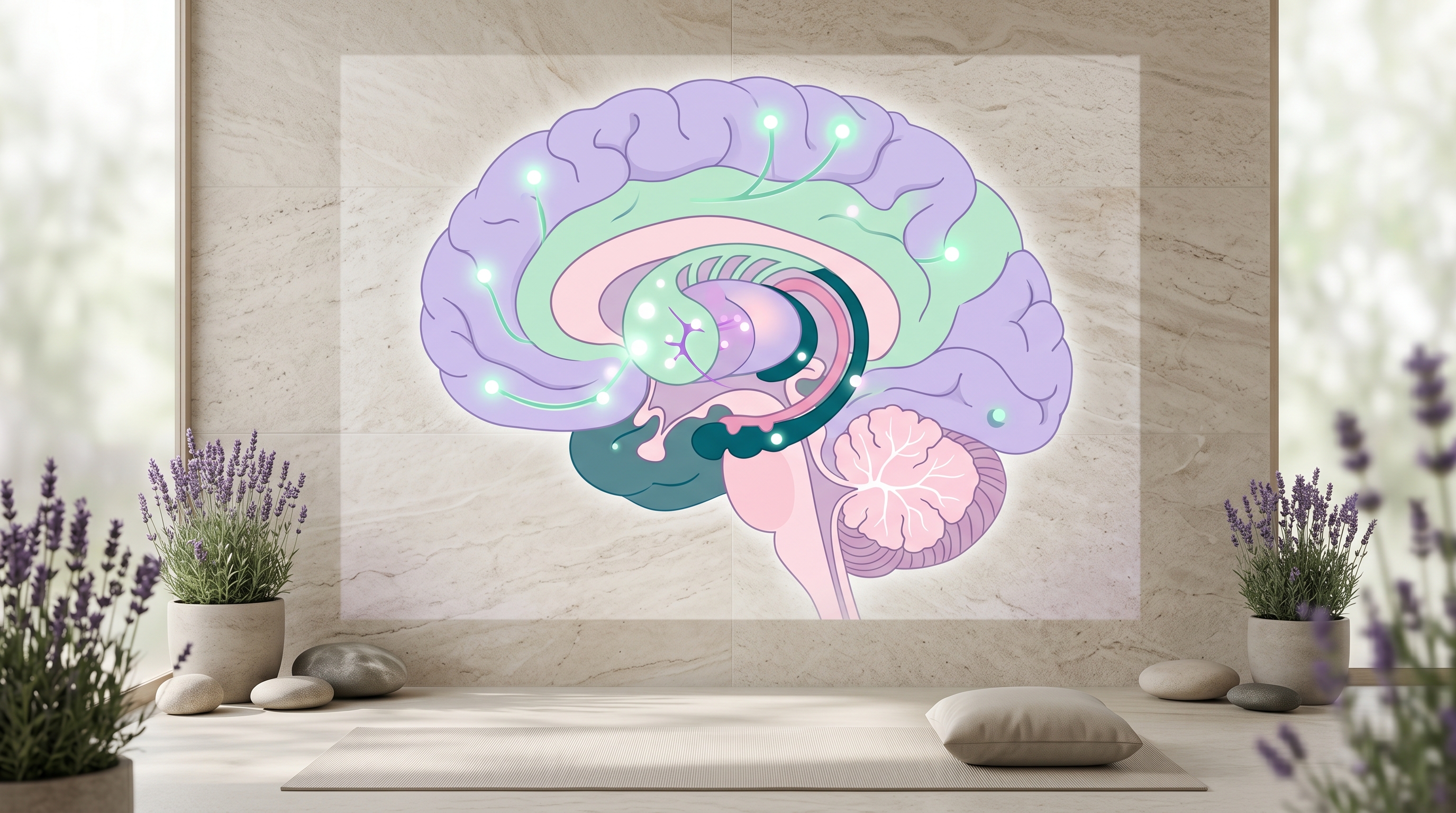
Here is where it gets interesting. Your body has its own endocannabinoid system (ECS). It is a network of receptors and signaling molecules that helps regulate movement, pain, mood, and sleep. CB1 receptors, the main target of THC, sit on dopamine neurons in the basal ganglia. Those are the very brain regions tied to RLS. So in principle, cannabinoids could nudge dopamine signaling in the same neighborhood where RLS goes wrong. We dig deeper into that relationship in cannabis and dopamine: what neuroscience actually shows and how 2-AG controls dopamine decisions.
There may also be a pain angle. Some RLS discomfort appears to involve overactive pain signaling in the spinal cord. CBD interacts with TRPV1 receptors and other pain pathways, which researchers have proposed might dampen the burning, tingling sensations. The antinociceptive (pain-blunting) effects of cannabis are well documented in other neurological conditions, and that is part of why scientists think it is worth a closer look here.
Researchers behind the main RLS case reports went so far as to suggest their findings “may open a new conceptual framework to understand the role of coordinated endocannabinoid signaling in the central nervous system.” That is exciting language, but notice the word may. This is a hypothesis worth testing, not a settled mechanism.
What the Research Actually Shows
This is the heart of it, and I want to be very clear about the quality of evidence. The cannabis-and-RLS story rests almost entirely on small case reports and surveys, not controlled trials.
The Megelin & Ghorayeb 2017 case series. This was the first report, published in Sleep Medicine [Megelin, 2017]. It described six patients with severe RLS that had failed to respond to standard treatment. All six had previously tried dopamine agonists without lasting success; several had also failed alpha-2-delta drugs (like gabapentin) and opioids. After using cannabis (five by smoking, one via sublingual CBD), these patients reported complete relief of their RLS symptoms and improved sleep quality. One patient experienced nausea and limited use to flare-ups.
The Ghorayeb 2020 case series. Published in Sleep and Breathing [Ghorayeb, 2020], this follow-up reported on 12 additional patients with severe, refractory RLS who spontaneously mentioned smoking cannabis. All but one reported total relief of symptoms after bedtime cannabis. Among patients who tried both, smoked cannabis was generally rated more effective than sublingual CBD, and a few who switched to CBD alone reported mixed results (one got around 70-90% relief, another reported none). The reported side effect was a panic attack in one patient; otherwise, bedtime use was described as well tolerated.
Survey data. Larger surveys hint at the same pattern. In one survey of RLS patients, a notable share who had tried cannabis reported improvement in symptoms, sleep, and a general sense of calm. A separate survey of dialysis patients (who often suffer RLS) found that among the few who had tried cannabis, roughly half reported benefit [Samaha, 2020]. Surveys capture real-world experience, but they cannot separate a true drug effect from expectation, placebo, or recall bias.
The CBD trial that did not pan out. It is just as important to report the misses. A post hoc analysis of a small phase 2/3 trial looked at CBD (75-300 mg) for RLS in Parkinson’s patients with REM sleep behavior disorder [de Almeida, 2023]. CBD showed no significant improvement over placebo for RLS severity. That is a meaningful counterpoint: the most rigorous (though still small and indirect) data point we have did not show a benefit for CBD alone.
So where does that leave us? A 2020 systematic review of cannabinoids for sleep disorders concluded there is currently insufficient evidence to support routine clinical use for any sleep disorder, RLS included, while calling the early signals “promising” and worthy of proper randomized controlled trials [Kuhathasan, 2020]. That is the most accurate summary I can give you: promising anecdotes and small reports, no confirmation.
The Sleep Overlap
Even setting aside any direct effect on RLS, there is a second pathway worth naming: sleep itself. RLS is, at its core, a sleep destroyer. If something helps you fall and stay asleep, the nighttime suffering shrinks even if the underlying leg sensations are unchanged.
This is where cannabis has somewhat more (still imperfect) support. We cover it in depth in cannabis and sleep: the science behind better rest and our guide to the best cannabis strains for sleep. The short version: certain cannabinoids and terpenes are associated with sedation and easier sleep onset for some people, through pathways like adenosine, the sleep-pressure system.
A few players come up often. Myrcene, the sedating terpene behind couch-lock, is associated with relaxation and muscle-loosening effects, which is why it shows up in our Relax High family. Linalool, the lavender terpene, is linked to calm. And CBN, the so-called sleepy cannabinoid, gets a lot of marketing attention, though the facts are more modest than the hype. It is also worth knowing that CBD can be stimulating rather than sedating at low doses, which may explain why CBD-only results for RLS have been so inconsistent.
If you do experiment, finding your THC-to-CBD ratio and starting with a sensible beginner dose matters more than chasing high THC numbers. As we always say, THC percentage is a terrible way to choose cannabis.

Why the Evidence Is Still So Limited
I keep hedging for a reason, so let me explain exactly why you should treat these findings as preliminary.
The case series are unblinded and uncontrolled. There was no placebo group, no baseline comparison, and no objective measurement of leg movements (like a sleep lab study). Patients knew they were using cannabis and reported their own results. That invites strong placebo and reporting bias. The researchers themselves flagged this “strong risk of bias.”
The numbers are tiny. Six patients here, twelve there. Real treatments are validated in hundreds or thousands of participants. And the one piece of more controlled data (the CBD Parkinson’s analysis) was negative.
Cannabis is also not one thing. THC, CBD, dozens of minor cannabinoids, and a shifting cast of terpenes all behave differently. “Cannabis helped” tells us little about which compounds, what dose, or which delivery method actually mattered. This is the same nuance that makes the whole field hard to study, as we explore in the science of terpene synergy.
Until there are large, placebo-controlled, randomized trials with objective sleep measures, cannabis for RLS remains an interesting lead, not an established therapy.
Cautions and Talking to Your Doctor
This article is educational and not medical advice. RLS is a real neurological condition that deserves proper medical care. Please talk to your doctor before changing or adding any treatment.
A few specific cautions are worth your attention:
- Do not stop your prescribed RLS medication. In the case reports, patients did not discontinue their existing treatment. Abruptly stopping dopamine or anticonvulsant drugs can be harmful.
- Rule out the basics first. RLS is sometimes driven by iron deficiency, kidney disease, pregnancy, or certain medications (including some antidepressants and antihistamines). Your doctor may run an iron panel before anything else.
- Watch for interactions. CBD can affect how your liver metabolizes other drugs, which matters if you take RLS or other prescription medications. See cannabis and medication interactions: what your doctor won’t always tell you.
- Side effects are real. Even in the small case series, one patient had a panic attack and another had nausea. THC can cause anxiety, dizziness, and next-day grogginess.
- RLS often overlaps with other conditions. If your RLS is tied to Parkinson’s, the picture is more complex; see cannabis for Parkinson’s disease: what research says about treatment. RLS is also common in chronic kidney disease.
If you and your doctor decide it is reasonable to try, the practical wisdom from sleep research applies: go low, go slow, and pay attention to your own response rather than someone else’s strain recommendation. Tracking how a given terpene profile actually affects your legs and your sleep, night after night, is the only way to find your own pattern. That is exactly the kind of personal data the High IQ app is built to help you capture.
Frequently Asked Questions
Can cannabis make RLS go away for good? No. Research does not show that cannabis is a cure for RLS. Some small case reports describe symptom relief in treatment-resistant patients, but these are preliminary findings, not proof of a reliable therapy.
Is CBD or THC better for RLS? We don’t know for sure. In the case reports, smoked cannabis (which contains THC) was generally rated more effective than CBD alone, and a controlled analysis of CBD by itself showed no benefit over placebo. CBD’s effects also vary by dose. This is a question that needs proper trials.
Could cannabis make RLS worse? Possibly, indirectly. THC can disrupt sleep architecture in some people and cause anxiety or next-day grogginess, which could compound the fatigue RLS already causes. Reactions are highly individual.
Why does RLS get worse at night? RLS follows a circadian (daily) rhythm and naturally peaks in the evening and at night, which is why it interferes so badly with sleep. The exact reason is tied to the brain’s dopamine cycle.
Should I tell my doctor if I’m trying cannabis for RLS? Yes, absolutely. Your doctor needs the full picture, especially because of possible interactions with RLS medications and the importance of ruling out treatable causes like iron deficiency.
Key Takeaways
Restless legs syndrome is exhausting, and it is completely understandable to look for relief wherever you can find it. The cannabis story here is genuinely interesting: there may be a plausible mechanism through the dopamine system, a real sleep-overlap benefit, and a small but striking set of patient reports describing dramatic relief in otherwise refractory cases. But “interesting and plausible” is not the same as “proven.”
To summarize what the research suggests so far:
- The evidence is preliminary. Two small case series suggest cannabis may relieve refractory RLS, but they are uncontrolled and prone to bias.
- There is a plausible mechanism. Cannabinoids may interact with the dopamine and pain pathways that RLS involves, though this is a hypothesis, not a proven effect.
- CBD alone underwhelmed. The one controlled analysis showed no benefit over placebo, so CBD-only results appear inconsistent.
- Sleep is the clearer win. Even if it does not touch the legs directly, cannabis may help some people sleep through the night.
- Talk to your doctor first. Rule out treatable causes like iron deficiency, never abandon a working treatment, and if you do explore cannabis, treat it as a careful personal experiment rather than a guaranteed fix.
Sources
- Megelin T, Ghorayeb I. Cannabis for restless legs syndrome: a report of six patients. Sleep Medicine. 2017;36:182-183. DOI: 10.1016/j.sleep.2017.04.019
- Ghorayeb I. More evidence of cannabis efficacy in restless legs syndrome. Sleep and Breathing. 2020;24(1):277-279. DOI: 10.1007/s11325-019-01978-1
- de Almeida CMO, Brito MMC, Bosaipo NB, et al. The Effect of Cannabidiol for Restless Legs Syndrome/Willis-Ekbom Disease in Parkinson’s Disease Patients with REM Sleep Behavior Disorder: A Post Hoc Exploratory Analysis of Phase 2/3 Clinical Trial. Cannabis and Cannabinoid Research. 2023;8(2):374-378. DOI: 10.1089/can.2021.0158
- Kuhathasan N, Dufort A, MacKillop J, et al. Cannabinoid therapies in the management of sleep disorders: A systematic review of preclinical and clinical studies. Sleep Medicine Reviews. 2020;53:101339. DOI: 10.1016/j.smrv.2020.101339
- Suraev A, et al. Is There a Place for Medicinal Cannabis in Treating Patients with Sleep Disorders? What We Know so Far. Nature and Science of Sleep. 2020. PMC: PMC9124464
- Samaha D, Kandiah T, Zimmerman D. Cannabis Use for Restless Legs Syndrome and Uremic Pruritus in Patients Treated With Maintenance Dialysis: A Survey. Canadian Journal of Kidney Health and Disease. 2020;7. DOI: 10.1177/2054358120954944


