

Cannabis in Video Games: Power-Up, Prop or Plot?
Cannabis in video games shows up as a power-up, a prop or a plot. The power-up version gets THC backwards: lab trials show slower reactions, not faster.

Professor High
Written by Professor High, our AI guide. See how we research and correct articles.

Video games use cannabis in three ways: as a power-up that helps you play, as a prop that tells you who a character is, or as the subject of the story itself, and only the power-up version clashes with what THC does in controlled trials. In the 2005 game Narc, lighting a joint turns the screen hazy green and slows time so your character can chase down criminals. CNN, 2005 In a double-blind trial of 24 men, reaction time got slower in a straight line as the THC dose went up, in every task tested. Hunault et al., 2009
So the game hands you a speed boost where the lab measured a speed penalty. That gap is the heart of this lesson. Here in High School, we sort the portrayals into three bins and check each against the evidence.
This article is about how games show cannabis. If you want to know about playing while high yourself, our guide on how play style and dose interact for gamers covers that question. For the film side of the story, see how cinema gave cannabis users the lead role.
How do video games portray cannabis?
Most portrayals fall into one of three types. Each one asks a different question of the evidence.
| Type | What the game does | Example | Does THC evidence apply? |
|---|---|---|---|
| Power-up (mechanic) | Cannabis changes what your character can do | Narc (2005): a joint slows time for enemies | Yes, and it points the other way |
| Prop (set dressing) | Cannabis signals a mood, a place or a character | Grand Theft Auto V: optional bong and joint sequences | Partly; the haze is a visual shorthand |
| Plot (subject) | Cannabis is the business or story the game is about | Weedcraft Inc (2019): a growing and selling sim | No; it simulates economics, not a high |
No peer-reviewed study counts how often each type appears in games, so this table names individual games rather than claiming a share. The closest academic work is older content analysis that lumps alcohol, tobacco and other drugs together as “substances.” Haninger and Thompson, 2004
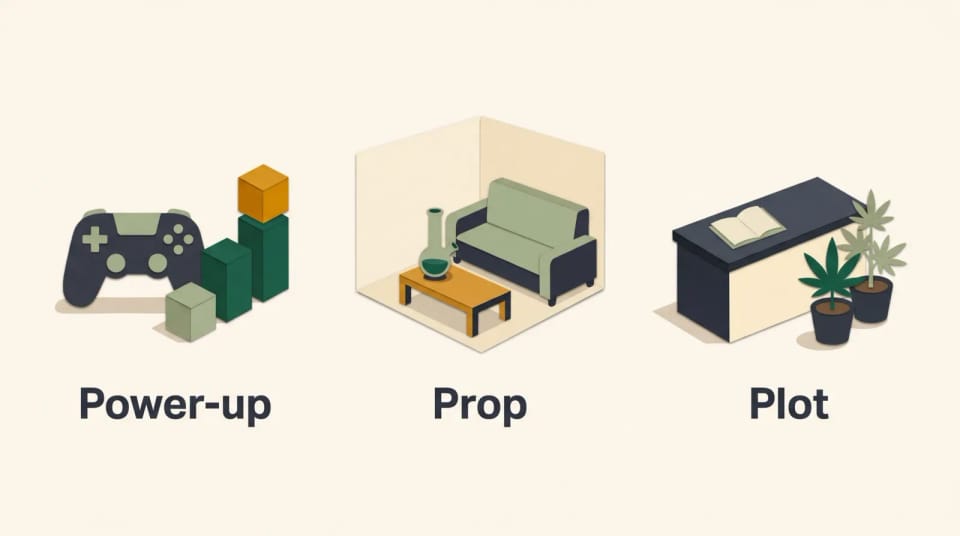
Three ways games use cannabis. Only the power-up claims a performance effect, which is why it is the one controlled THC trials can test.
What do games get wrong about being high?
The biggest error is the power-up. Narc is the clearest case. Its publisher, Midway, told CNN that “the drugs in Narc affect game play” and that “players who choose to take drugs will face consequences.” CNN, 2005 In the moment, though, the joint works like a slow-motion button.
Controlled trials point the other way.
- Reaction time slows with dose. In the Hunault trial, 24 non-daily male users smoked cannabis and tobacco joints with 0, 29, 49 or 69 mg of THC on separate days. Response time slowed in a straight line as dose rose, across simple reaction, attention and short-term memory tasks. Motor control also worsened with dose. Hunault et al., 2009
- Control and stopping get worse. In a trial of 20 recreational users given high-potency cannabis, people tracked a moving target less accurately, made fewer correct planning decisions and were slower to stop an action. The impairment lasted up to six hours. Ramaekers et al., 2006
- Psychomotor skills take the biggest hit. A systematic review of research from 2004 to 2015 found that psychomotor function is the most affected area during acute intoxication. Broyd et al., 2016
There is an honest nuance. In a 2021 trial of 20 infrequent users, low oral and vaporized doses did not impair performance compared with placebo, while high doses did. Spindle et al., 2021 So “cannabis always wrecks your skills” is also wrong. What none of these trials show is a speed gain. The game invents the one result the lab never found.
A boundary matters here. These trials used lab tasks, not commercial video games. They tell us THC slows reaction and control; they do not measure your score in a shooter. People also misjudge their own performance while high, which is a separate lesson on whether you can judge your own performance under THC.
Why does weed slow down time in video games?
The slow-time trick has a real root. Some people feel time stretch while high. In a pooled analysis of 44 people given intravenous THC, infrequent users overestimated short intervals, while frequent users showed no difference. Sewell et al., 2013 A critical review found that most time-estimation studies report overestimation, but called the wider evidence inconclusive. Atakan et al., 2012
The full science lives in our lesson on why a joint can seem to stretch time. The key point for games is this: a change in how time feels is not a change in how fast you act. Narc takes a perception effect and turns it into a performance advantage. The world seems slower, so the game lets you move faster than it. The reaction-time data say the opposite happens to your body.
Why is the screen blurry and green when you smoke in games?
Haze, blur and a green tint are the most common visual shorthand for “high.” They are a look, not a measurement.
The US rating board’s summary for Grand Theft Auto V says some sequences let the player’s character use drugs, “smoking from a bong, lighting a marijuana joint, hallucinating from peyote,” and that cocaine use is also shown. ESRB, Grand Theft Auto V In a 2025 update, Rockstar described a mission where a burning van is “clouding Lamar’s mind and vision” during a chase. Rockstar Games, 2025 In Saints Row (2006), a GameSpot feature notes you can fill a bong bowl or blunt paper, then cough while your vision clouds over. GameSpot, 2019 Fan-maintained wikis describe extra stat effects in that game, but no developer or rating source we found confirms them, so treat those as unverified.
How do these props compare with real effects?
- The cough is grounded. Smoke irritates the airway, and coughing is a common real response. Our lesson on why weed makes you cough explains the reflex.
- The blur is a stylized guess. Evidence on cannabis and vision is thin and mixed. See what the evidence says about blurry vision and halos.
- The green tint is pure convention. It tells the player “your character is high.” No study measures green vision.
Prop portrayals are the least misleading type, because most of them claim no effect on skill. They simply signal a mood.
Why do some games use made-up drugs instead of weed?
Ratings and classification rules make real drug names costly, especially when the drug gives a reward.
In 2008, the Australian Classification Board refused to classify Fallout 3. Reuters quoted the board’s view that the game’s drug use “is related to incentives and rewards,” because taking the drugs helped the player progress and raised the character’s abilities. Reuters, 2008 Those were fictional “chems” and morphine, not cannabis. But the case shows what regulators react to: a drug tied to a reward, which is exactly the power-up design.
In the US, the Entertainment Software Rating Board (ESRB) defines “Use of Drugs” as “the consumption or use of illegal drugs,” and “Drug Reference” as references to or images of illegal drugs. ESRB ratings guide An ESRB spokesperson told GameSpot that cannabis present only as a crop “may not result in a more restrictive rating,” but that active smoking or consumption could. GameSpot, 2019

An ESRB spokesperson told GameSpot that cannabis shown as a crop may not raise a rating, while active smoking or consumption could. That is a consideration, not a fixed rule.
Older research suggests labels have not always matched what is on screen. A content analysis of 81 teen-rated games released by 2001 found substances in 12 of them, but the substance descriptor matched observed content in only one. Haninger and Thompson, 2004 That study predates current practice and does not separate cannabis, so it is history, not a verdict on today’s labels.
Are cannabis tycoon games realistic?
Nobody has tested that. Weedcraft Inc, developed by Vile Monarch and released by Devolver Digital in April 2019, is about “the business of producing, breeding and selling weed in America,” with cops and politicians “working their own angles.” Devolver Digital We found no audit of how well it models real growing, pricing or policy.
What it skips is just as telling. A business sim does not depict a high at all, so THC pharmacology does not apply. In that narrow sense, the plot type makes the fewest effect claims of the three.
It did run into platform limits. Ars Technica reported that YouTube demonetized videos of the game and that the publisher was told it could not advertise on Facebook or Instagram. A YouTube spokesperson said content featuring “the sale or use of illegal drugs or regulated drugs or substances is not suitable for advertising.” Ars Technica, 2019 That is one reported case from 2019. Policies change, and it does not show that cannabis games are banned in general. Meta’s current cannabis ad policy targets ads selling THC products and paraphernalia, and its page does not mention games. Meta Business Help Center
Do games make people use cannabis?
The evidence cannot say. A 2025 scoping review of 25 studies found that most report a positive link between gaming and cannabis use, some found none, and a few found a negative link. The authors said the evidence cannot define what kind of relationship it is. Jobin et al., 2025 Those studies measured players’ own habits, not exposure to cannabis scenes. We found no study that tests whether seeing cannabis in a game changes real use.
If you do combine the two, the same impairment data apply off-screen. Never drive after using; our guide on how long to wait before driving after cannabis walks through the timelines. If you want to see how a strain actually worked for you rather than how a game says it should, the High IQ app lets you log each session and compare.
When to talk to a clinician: if cannabis use alongside gaming starts crowding out sleep, school, work or relationships, or if you get a racing heart, panic or vomiting after using, talk to a doctor or another qualified clinician.
Key takeaways
- Games use cannabis as a power-up, a prop or a plot.
- The power-up is the big mismatch: controlled trials show slower reactions and worse control at higher doses, never a speed gain.
- Slow-time mechanics borrow a real perception effect, time feeling stretched, and wrongly turn it into a performance edge.
- Haze, blur and green tints are visual shorthand; the cough is the most grounded prop.
- Regulators react most to drugs tied to rewards, which is one reason designers invent fictional drugs.
- No study shows that cannabis scenes in games change real-world use.
FAQ
Does weed make you better at video games?
No controlled study shows that. Lab trials found slower reaction time and weaker motor control as THC dose rose, though low doses did not impair performance in one trial. Those trials used lab tasks, not commercial games, so they cannot predict your exact score.
Which video games let you smoke weed?
Narc (2005) used a joint as a slow-time power-up, Saints Row (2006) let players fill bongs and blunts, and Grand Theft Auto V includes optional bong and joint sequences, per its ESRB summary. Weedcraft Inc (2019) is a business sim about growing and selling cannabis rather than smoking it.
Is weed treated as worse than violence in games?
Rating bodies treat them as separate content categories. The ESRB says actively smoking cannabis in a game could lead to a more restrictive rating, while a crop alone may not. In one reported 2019 case, Weedcraft Inc hit ad limits on YouTube and Facebook, so platform rules can matter as much as rating labels.
Why do games use made-up drugs instead of weed?
Real drug names tied to in-game rewards draw regulators’ attention. Australia refused to classify Fallout 3 in 2008 because its drug use was linked to rewards, and the board said realistic delivery brought the fictional drugs in line with real ones. Fictional drugs give designers more room, though they do not guarantee a rating.
Sources
- Hunault CC, et al. Cognitive and psychomotor effects in males after smoking a combination of tobacco and cannabis containing up to 69 mg THC. Psychopharmacology. 2009. PubMed 19099294
- Ramaekers JG, et al. High-potency marijuana impairs executive function and inhibitory motor control. Neuropsychopharmacology. 2006. PubMed 16572123
- Broyd SJ, et al. Acute and chronic effects of cannabinoids on human cognition: a systematic review. Biological Psychiatry. 2016. PubMed 26858214
- Spindle TR, et al. Cognitive and psychomotor impairment after oral and vaporized cannabis. Journal of Psychopharmacology. 2021. PubMed 34049452
- Sewell RA, et al. Acute effects of THC on time perception in frequent and infrequent cannabis users. Psychopharmacology. 2013. PMC3581701
- Atakan Z, et al. The effect of cannabis on perception of time: a critical review. Current Pharmaceutical Design. 2012. PubMed 22716134
- Haninger K, Thompson KM. Content and ratings of teen-rated video games. JAMA. 2004. PubMed 14970065
- Jobin EY, et al. Video gaming and cannabis use: a scoping review. Journal of Behavioral Addictions. 2025. PMC12231461
- Entertainment Software Rating Board. Ratings guide and Grand Theft Auto V rating summary.
- Australian Classification Board decision on Fallout 3, as reported by Reuters, 2008.



