Why Cannabis Makes You Cough—and What Actually Helps
Learn why cannabis smoke and vapor trigger coughing, which quick fixes may help, when to stop, and why a smoother hit is never a safer hit.


Cannabis makes you cough because hot smoke or aerosol carries particles and chemicals into your throat and airways. Those stimuli can activate sensory nerves. Your cough reflex then tries to clear the intrusion. A large hit, a long breath-hold, combustion, an overheated device, or an irritated airway can make the response more likely.
If a hit starts a coughing spell, stop inhaling, secure the device, sit upright, breathe normally, and sip water for throat dryness. Do not force another hit or hold the next one longer. Comfort does not undo the exposure.
If coughing keeps happening, reducing or stopping inhaled cannabis is more evidence-based than engineering a smooth hit. Smoking is not safe, vapor is not harmless, and “smooth” describes sensation—not toxicology.

The short version: five things that matter most
| What changes the cough | Why it matters | What to do |
|---|---|---|
| Combustion | Burning plant material creates smoke, fine particles, carbon monoxide, and other irritants | The only way to avoid smoke exposure is not to burn cannabis |
| Puff size | A larger puff delivers more aerosol or smoke at once | Take a smaller puff instead of testing your lung capacity |
| Breath-holding | It extends contact with inhaled material without reliably increasing the subjective high | Inhale comfortably and exhale without a long hold |
| Device or product condition | High heat, residue, damaged hardware, or contaminated oil may make an aerosol harsher or riskier | Stop using anything burnt, damaged, leaking, or unregulated |
| Your airway today | Asthma, infection, allergies, repeated smoke exposure, and other conditions can change sensitivity | Skip inhalation when your breathing is not at baseline and seek care for warning signs |
For the longer-term evidence, read our review of cannabis and lung health. Our consumption-method comparison covers onset, duration, and respiratory trade-offs.
What the cough reflex is doing
Coughing is not your body being dramatic. It is a defense system.
Sensory nerves monitor the larynx, trachea, and lower airways for disturbances. Different pathways respond to touch, chemicals, and irritated tissue. The brainstem then coordinates a fast expiration intended to move unwanted material outward [Canning and Spina, 2009].
Cannabis studies rarely isolate temperature, particles, chemicals, or technique while holding every other part of a hit constant. The best explanation therefore combines cannabis evidence with general cough physiology:
- Smoke or aerosol enters an airway built for clean air.
- Heat, particles, and chemicals stimulate or irritate airway tissue.
- Sensory nerves detect the disturbance.
- The cough reflex attempts to expel it.
Cough being protective does not make repeated irritation harmless. Not coughing does not prove there was no exposure.
Why cannabis smoke is especially irritating
Combustion creates more than cannabinoids
A flame does not selectively release THC. It breaks plant material down into a complicated smoke mixture.
A machine-smoking study found broad similarities between cannabis and tobacco smoke. The amounts of individual compounds differed. Cannabis smoke contained carbon monoxide, ammonia, hydrogen cyanide, nitrogen oxides, aromatic amines, and polycyclic aromatic hydrocarbons [Moir et al., 2008]. A smoking machine cannot tell you the exact human dose. It does establish that cannabis smoke is a combustion aerosol—not purified cannabinoid vapor.
The CDC’s cannabis lung-health guidance likewise warns that smoked cannabis contains many of the same toxins and irritants found in tobacco smoke. This does not mean the two products have identical exposure patterns or identical disease risks. It means “natural” is not a shield against combustion chemistry.
Heat can contribute, but it is not the whole story
Temperature can affect throat sensation and airway responses, but real cannabis smoke arrives with particles and reactive chemicals too. Current evidence cannot assign a neat share of a cough to heat versus chemistry. Cooling smoke through glass or water may change the feeling without removing combustion; our guides to hot versus cold bong water and water pipes versus dry pipes explain the distinction.
Larger puffs increase the challenge
Two small controlled studies each included seven regular users. Larger puffs produced higher plasma THC, more carbon monoxide, and stronger subjective effects. Holding smoke for zero, 10, or 20 seconds increased plasma THC but did not increase subjective effects [Azorlosa et al., 1995].
That does not provide a recipe for an “efficient” hit. It shows that smoking behavior changes exposure. Deliberately taking an oversized puff to feel more also means delivering more smoke at once—exactly the direction a cough-prone airway does not need.
Acute coughing and recurring coughing are different problems
An immediate cough after a large hit and a morning cough that shows up most days should not be treated as the same thing.
| Pattern | A reasonable interpretation | Best next move |
|---|---|---|
| One short spell after an unusually large or harsh hit | An acute response to that exposure is plausible | Stop the session and let breathing return to normal |
| Cough occurs with one device or product but not others | Product temperature, condition, formulation, residue, or technique may matter | Stop using the suspect product; do not keep testing it |
| Morning cough, mucus, or wheeze develops with frequent smoking | Repeated airway irritation or another respiratory problem may be involved | Reduce or stop smoking and discuss persistent symptoms with a clinician |
| Sudden breathing trouble, chest pain, confusion, or coughing blood | This is not a routine “weed cough” | Get urgent medical help |
A 2018 systematic review found low-strength evidence associating cannabis smoking with cough, sputum, and wheeze. Evidence about obstructive lung disease and pulmonary function was insufficient [Ghasemiesfe et al., 2018]. That is more accurate than either “cannabis destroys your lungs” or “weed cough is nothing.”
A cohort study followed 1,037 young adults across multiple ages. Frequent cannabis use was associated with morning cough, sputum, and wheeze. Reducing or quitting was associated with those symptoms falling toward levels reported by nonusers [Hancox et al., 2015]. The study was observational, so it cannot predict every individual’s result. It still gives reduction and cessation a stronger basis than smooth-hit tricks.
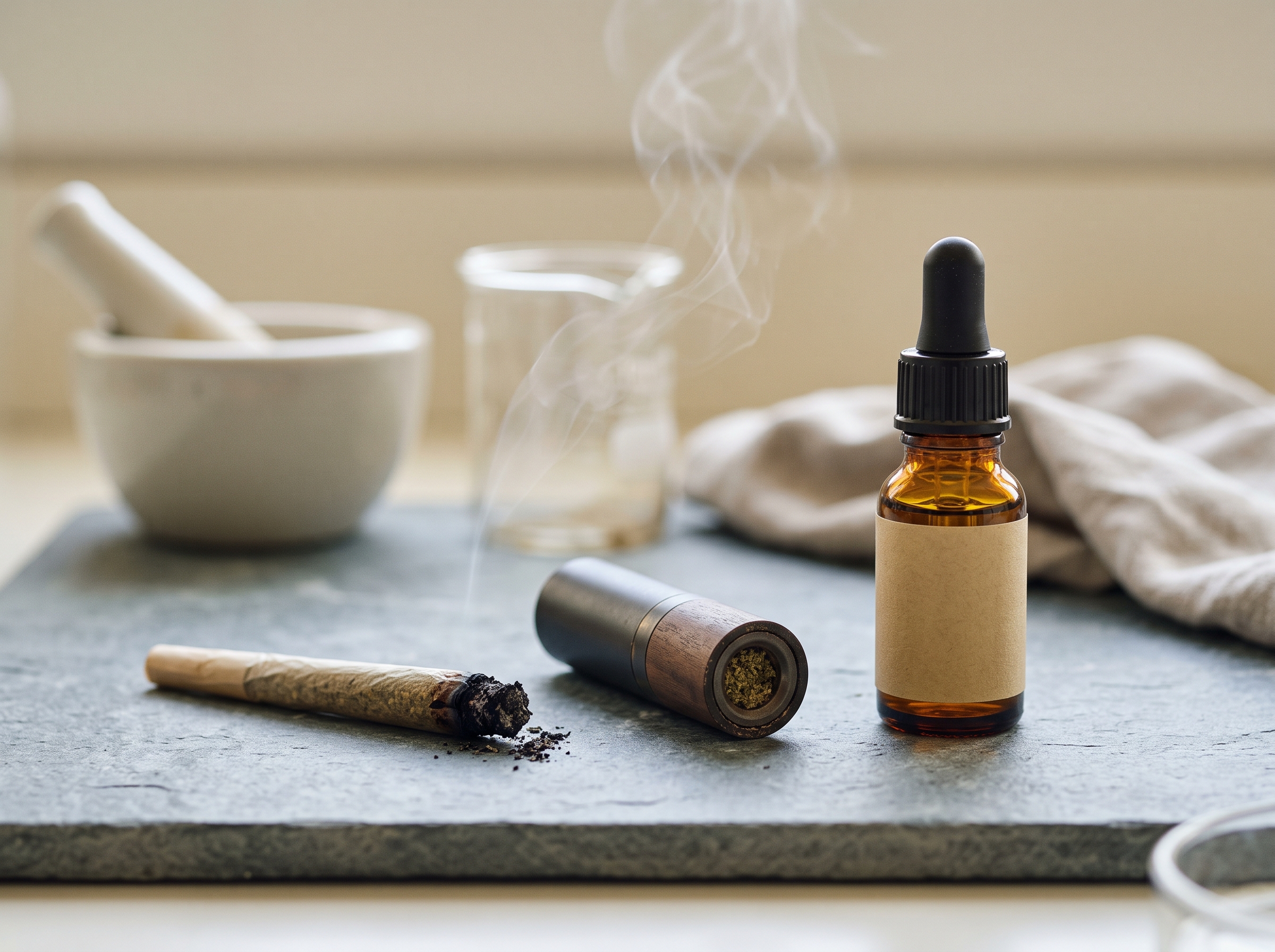
Does vaping stop the cough?
Sometimes vapor feels less harsh than smoke. That does not make every vape safer, and it does not guarantee you will not cough.
An 18-person pilot study tested one dry-herb vaporizer. It delivered THC exposure similar to smoking with less expired carbon monoxide [Abrams et al., 2007]. A later crossover study also found more expired carbon monoxide after smoking than vaporizing [Newmeyer et al., 2017]. These findings support a narrow conclusion: avoiding combustion can reduce carbon-monoxide exposure under tested conditions.
They do not prove that vapor is safe for long-term lung health. They cannot cover every cartridge, concentrate, temperature, coil, additive, or informal product. A lab analysis tested 13 commercial cannabis cartridges. It found several metals in the oil and aerosol, with the heating device as one possible source [McDaniel et al., 2021].
Dry-herb devices heat flower; cartridges aerosolize a manufactured oil through a coil; dabbing rapidly heats concentrates. These are not interchangeable exposures.
Our smoking-versus-vaping science comparison, dry-herb vaporizer comparison, and vaporizer temperature guide go deeper into those distinctions. If a cartridge is unregulated, leaking, discolored, unusually harsh, or producing a burnt taste, stop using it; the counterfeit cart guide covers additional warning signs.
Does coughing make you higher?
There is no good evidence that coughing itself increases the high.
The myth bundles three events: a large puff delivers more THC, a long hold may feel lightheaded, and the cough is intense. Their timing is not proof that coughing improved absorption.
In a randomized study of eight regular cannabis users, holding smoke for zero, 10, or 20 seconds produced the expected cannabis effects in every condition, but there was little evidence that breath-hold duration changed the subjective response [Zacny and Chait, 1989]. The later Azorlosa experiment reached a similar practical result: longer holds did not increase subjective “high” ratings even though some biological measurements changed [Azorlosa et al., 1995]. Both studies were small and used lower-potency research cannabis from an earlier era, so they do not settle every modern product question. They do undercut the idea that prolonged breath-holding is a useful ritual.
The “head rush” during coughing is not a dependable sign of more THC reaching the brain. Do not chase it.
What to do during a cannabis coughing spell
These are comfort and safety steps, not a cure:
- Stop inhaling. Set down the product and place any burning material in a stable, fire-safe ashtray.
- Sit upright. Give yourself space and return to ordinary breathing. Do not immediately stack deep, forceful breaths on top of the irritation.
- Sip water if your mouth or throat is dry. Water may soothe dryness; it does not wash smoke out of the lungs.
- Move away from smoke or aerosol. Fresh, comfortable air may reduce added exposure. Do not crowd into an unventilated car or room.
- End the session if the cough returns. Repeatedly “testing” the same product only adds exposure.
If the first puff feels wrong, stop. You do not need a second puff to prove it.
Avoid improvised inhaled remedies, essential oils, or another substance intended to “open” the lungs. Do not take someone else’s inhaler. If you have a prescribed respiratory action plan, follow the instructions from your own clinician.
How to reduce the chance of coughing next time
1. Use less inhaled material at once
Choose a small, comfortable puff, exhale normally, and give the effect time to develop before taking more.
2. Do not use smoothness as a safety meter
Ice, warm water, a long glass path, flavoring, or menthol-like cooling may make inhalation feel easier. None replaces exposure data. Clean glass helps hygiene and airflow—see our bong cleaning guide—but does not guarantee clean lungs.
3. Stop when something tastes burnt or abnormal
A burnt taste may signal overheating, a dry wick, residue, or damaged hardware. Lowering a device setting may change aerosol production, but no temperature is proven harmless. Never keep inhaling solely to avoid wasting a cartridge or bowl.
4. Avoid tobacco mixtures
Blunts, spliffs, and other tobacco combinations add tobacco smoke and may add nicotine exposure. If you are comparing formats, start with our guide to joints, blunts, and spliffs.
5. Consider a non-inhaled route
Edibles, capsules, and tinctures avoid direct smoke or aerosol exposure to the lungs. They create different risks: delayed onset, longer effects, accidental overconsumption, and harder dose correction. Review flower, edible, and concentrate trade-offs and follow the two-hour edible dosing rule rather than redosing early.
6. Track patterns instead of guessing
Write down the route, product, approximate dose, device setting, cough severity, and any wheeze or chest discomfort. High IQ can help you track products and personal response patterns, but the record is for pattern recognition—not for diagnosing a lung condition.
High Families describe experience, not respiratory safety
Cannabis marketing often turns flavor into a health claim: citrus is called “clean,” pine is called “fresh,” and a floral hit is described as gentle on the lungs. Aroma does not establish respiratory safety.
Our High Families organize profiles around chemistry and reported experience. An Entourage High label does not make smoke or vapor safer. A pleasant smell cannot certify a safe temperature, clean hardware, or contaminant-free product. Browse the terpene guide for chemistry and aroma—not as a cough-treatment menu.
When coughing needs medical attention
Do not write off every symptom as “just weed.” According to MedlinePlus cough guidance, breathing difficulty needs emergency attention, while coughing blood, fever, or a cough that persists should be assessed by a healthcare professional.
Call emergency services for severe or sudden breathing trouble. Other emergency signs include blue or gray lips, confusion, fainting, significant chest pain, or being unable to speak normally. Seek prompt medical care for coughing blood, persistent wheeze, fever, worsening chest symptoms, or a cough that continues after you stop inhaling cannabis.
People with asthma or another lung condition should discuss cannabis use and route of administration honestly with their clinician. A product that felt tolerable once is not a substitute for an asthma action plan or medical evaluation.
A cough is the immediate airway response. What researchers tested for CBD and nicotine is a brain finding, and it does not mean a product undoes smoking.
Key takeaways
- Cannabis smoke and vapor can trigger sensory nerves that initiate a protective cough reflex.
- Combustion produces irritants and toxicants; cooling or filtering smoke may change sensation without making it safe.
- Larger puffs increase exposure, while prolonged breath-holding has not reliably increased subjective effects in small controlled studies.
- Dry-herb vaporization can reduce carbon-monoxide exposure compared with smoking under tested conditions, but vapor and cartridges are not harmless.
- For recurring cough, reducing or stopping inhaled cannabis has better evidence than smooth-hit hacks.
- Coughing does not prove a hit was potent, and not coughing does not prove it was safe.
FAQs
Why do I cough from weed when my friends do not?
Cough sensitivity, airway health, technique, product condition, and recent exposures differ. Someone else’s smaller reaction does not prove they received no irritants. If you cough repeatedly, reduce or stop the exposure.
Does water in a bong filter out what makes you cough?
Water can cool smoke and capture some material, but it does not remove combustion or make the remaining smoke safe. It is a device feature, not a respiratory safety certification.
Is dry-herb vapor safer than smoking?
Controlled studies found less carbon-monoxide exposure with specific dry-herb vaporizers than with smoked cannabis. That supports a relative harm-reduction claim for combustion products, not a declaration of safety. Long-term respiratory evidence remains limited, and device temperature, maintenance, and product quality matter.
Will holding in a hit get me higher?
Small controlled studies found little evidence that longer breath-holding increased the subjective high. It does keep inhaled material in contact with your lungs longer. Exhale normally instead of using breath-holding as a potency technique.
What is the best cannabis strain for people who cough?
No strain is proven cough-safe. Cannabinoid percentage, terpene aroma, indica/sativa label, and High Family do not eliminate smoke or aerosol exposure. If inhalation repeatedly makes you cough, the useful decision is about route and exposure—not a new strain name.
Sources
- Canning, B. J., & Spina, D. (2009). Sensory nerves and airway irritability. Handbook of Experimental Pharmacology, 194, 139–183. DOI
- Moir, D., Rickert, W. S., Levasseur, G., Larose, Y., Maertens, R., White, P., & Desjardins, S. (2008). A comparison of mainstream and sidestream marijuana and tobacco cigarette smoke produced under two machine smoking conditions. Chemical Research in Toxicology, 21(2), 494–502. DOI
- Ghasemiesfe, M., Ravi, D., Vali, M., Korenstein, D., Arjomandi, M., Frank, J., Austin, P. C., & Keyhani, S. (2018). Marijuana Use, Respiratory Symptoms, and Pulmonary Function: A Systematic Review and Meta-analysis. Annals of Internal Medicine, 169(2), 106–115. DOI
- Hancox, R. J., Shin, H. H., Gray, A. R., Poulton, R., & Sears, M. R. (2015). Effects of quitting cannabis on respiratory symptoms. European Respiratory Journal, 46(1), 80–87. DOI
- Azorlosa, J. L., Greenwald, M. K., & Stitzer, M. L. (1995). Marijuana smoking: effects of varying puff volume and breathhold duration. Journal of Pharmacology and Experimental Therapeutics, 272(2), 560–569. PubMed
- Zacny, J. P., & Chait, L. D. (1989). Breathhold duration and response to marijuana smoke. Pharmacology Biochemistry and Behavior, 33(2), 481–484. DOI
- Abrams, D. I., Vizoso, H. P., Shade, S. B., Jay, C., Kelly, M. E., & Benowitz, N. L. (2007). Vaporization as a smokeless cannabis delivery system: a pilot study. Clinical Pharmacology & Therapeutics, 82(5), 572–578. DOI
- Newmeyer, M. N., Swortwood, M. J., Abulseoud, O. A., & Huestis, M. A. (2017). Subjective and physiological effects, and expired carbon monoxide concentrations in frequent and occasional cannabis smokers following smoked, vaporized, and oral cannabis administration. Drug and Alcohol Dependence, 175, 67–76. DOI
- McDaniel, C., Mallampati, S. R., & Wise, A. (2021). Metals in Cannabis Vaporizer Aerosols: Sources, Possible Mechanisms, and Exposure Profiles. Chemical Research in Toxicology, 34(11), 2331–2342. DOI
- Centers for Disease Control and Prevention. Cannabis and Lung Health. CDC
- MedlinePlus. Cough. U.S. National Library of Medicine. MedlinePlus

