Can Cannabis Make Vision Blurry? Contrast, Focus and Halos
Cannabis can affect contrast, focusing and halos after smoking. See what small human studies measured, which tests were null, and what blur cannot tell you.

Cannabis can make vision less clear after smoking, but contrast, focusing and halos are different measurements—not a diagnosis of someone’s blurry vision. A small human experiment found changes in all three areas. It also found important null results. Ortiz-Peregrina et al., 2021
The useful specific: only two of six tested contrast frequencies showed a significant decline. And the study’s halo score did not measure a percentage of eyesight lost. Here in High School, knowing the test makes the headline much easier to judge.
What did researchers measure after smoking cannabis?
The main study tested 31 occasional users in separate baseline and smoking sessions, with session and test order randomized. Participants smoked a cigarette prepared in their usual way. Testing began within 20 minutes and lasted about 75 minutes. There was no standardized THC dose or placebo smoking condition. Full study methods
| Endpoint | Route and dose | Finding | Main limit |
|---|---|---|---|
| Contrast sensitivity: seeing faint stripes | Smoked, self-prepared cannabis; dose unstandardized | Lower overall; significant at 0.75 and 12 cycles per degree | Four other frequencies did not differ significantly |
| Near focusing accuracy | Same smoking session | Greater focusing lag at 20 and 40 cm | Accuracy at fixed distances, not every focusing skill |
| Straylight and halo task | Same smoking session | More straylight; higher visual-disturbance index | Laboratory glare task, not a mapped loss of visual field |
Source: original methods, Table 1 and Figure 1. These are group findings, not a prediction for every person or product.
Why is faint detail different from fine detail?
Imagine two crisp gray stripes on white paper. Make one almost as pale as the paper while leaving its edge perfectly sharp. The second stripe is harder to distinguish because the difference between stripe and background is smaller. You have changed contrast, without making the edge blurry.
Now keep the stripe dark but make it much narrower. That asks a different question: how fine a detail can you resolve? Visual acuity concerns fine detail; contrast sensitivity concerns distinguishing a target from its background. A statement such as “I can read that big dark letter” does not answer every contrast question.
The experiment varied stripe spacing as well as contrast. “Cycles per degree” describes how many stripe cycles fit across one degree of vision. Its significant effects at two frequencies do not justify saying every stripe size became harder to see. A null result means no significant difference was detected in that comparison; it does not prove the two conditions were identical.
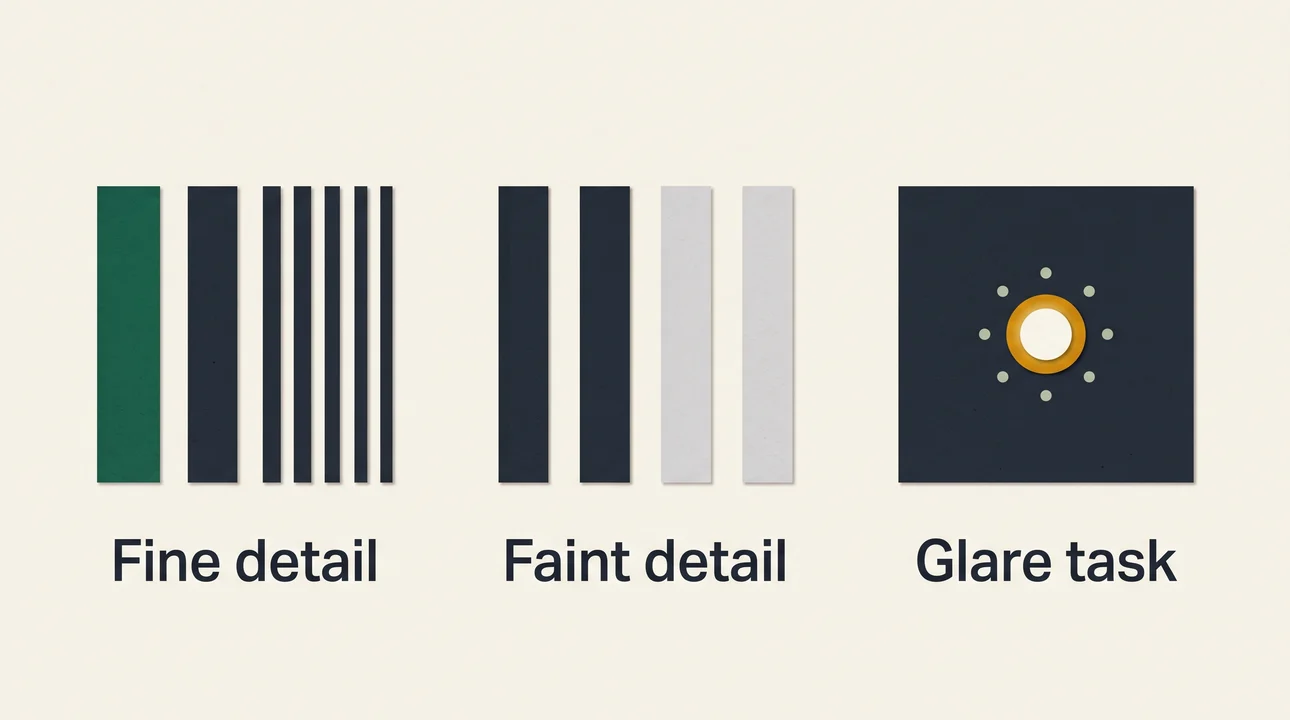
Fine detail, faint detail and targets beside glare ask different questions. Colors and patterns are illustrative; this is not a study result or a vision test.
Can cannabis affect switching focus between near and far?
Accommodation is the eye’s adjustment for viewing distance. A focusing lag means the response falls short of what a near target requires. It differs from the speed of changing focus, just as arriving at the right place differs from how quickly you get there.
Ortiz and colleagues measured focusing dynamics in a second experiment with 19 occasional users. Mean focusing and unfocusing velocity changed after smoking, with effects depending on factors including target distance. Pupil size did not change significantly. Dynamic accommodation study
That study used cannabis mixed with tobacco, had no controlled THC dose, and could not separate every effect of attention from the focusing response. It also could not measure response delay with its sampling method. “Every part of focusing slows down” would be too broad. The same research group conducted both papers; these are related experiments, not proof of independent replication.
Do halos mean your peripheral vision shrank?
The main study’s halo task asked participants to detect small targets around a bright central light. Its visual-disturbance index, or VDI, rose from 0.13 to 0.15 on a scale from 0 to 1. A higher score means greater difficulty on that glare-related task. Halo methods and results
A VDI of 0.15 does not mean 15% of vision disappeared. The score is not the fraction of a person’s visual field lost. Missing a dot beside glare also does not establish literal tunnel vision. Those interpretations would require measurements that answer those questions.
Think of trying to notice a small point beside a bright lamp. The task concerns how well the point stands out in that setting. It does not draw the outer boundary of everything you can see. This is why a dramatic shrinking-circle graphic would tell the wrong story here.
What can these studies tell you about your own blur?
They support a bounded answer about acute testing after smoked cannabis. They do not supply a milligram threshold, an edible comparison, a recovery deadline or a diagnosis of lasting symptoms. The 31-person study also found no significant pupil change at two brighter lighting levels. “Every measure worsened” leaves that out.
Both papers reported Spanish public research funding and loaned Dräger drug/alcohol testing equipment. They reported no competing interests. These disclosures are useful context, while the small samples and uncontrolled exposure remain limits on the answer.
If you are trying to interpret symptoms, describe what changed: distant edges, faint detail, shifting focus or lights with halos. That description helps explain the question; it cannot tell you the cause. Our red-eye lesson covers surface redness and comfort, while cannabis and eye health addresses the separate glaucoma question.
New blur deserves clinical advice rather than automatic attribution to cannabis. The NHS advises urgent assessment for new vision changes, including blurring, flashes or a moving dark shadow. Sudden inability to see or sudden severe eye pain requires emergency care. NHS guidance
The broader reading skill carries to other senses. Our human smell-test lesson separates performance from experience; facial-expression recognition separates a correct answer from brain activity. The endocannabinoid system lesson explains the wider biology, but a mechanism alone cannot diagnose a symptom or predict an individual result.
Key takeaways
- Small studies found acute changes after smoked cannabis, with uncontrolled doses.
- Fine detail, faint detail, focusing and targets beside glare require different tests.
- Preserve the null comparisons; the results do not show a uniform decline across every measure.
- A halo index is not a percentage of vision lost or proof of tunnel vision.
- New vision changes need clinical advice; these experiments cannot explain persistent blur.
FAQ
Can weed make your vision blurry?
Yes, acute visual changes are plausible and small smoking studies found changes on several tests. That does not establish the cause of a particular person’s blur. New vision changes should be assessed rather than dismissed as an expected high.
Does cannabis improve night vision?
The glare and contrast findings here do not establish an improvement. They also do not measure every aspect of seeing at night. Reading one test as a universal night-vision upgrade—or a quantified loss—overstates what it measured.
Do edibles cause the same focusing or halo changes?
These experiments studied smoking. They do not establish the size, timing or duration of corresponding edible effects. An edible question needs route-specific evidence; changing the route in the headline is not enough.
Why is my vision still blurry after the high wears off?
These acute experiments cannot answer that. They did not diagnose persistent symptoms or establish a recovery deadline. Contact an eye-care professional about ongoing blur and seek urgent care for new vision changes, as the NHS guidance advises.
Sources
- Ortiz-Peregrina S, Ortiz C, Casares-López M, Jiménez JR, Anera RG. (2021). “Effects of cannabis on visual function and self-perceived visual quality.” Scientific Reports, 11, 1655. DOI: 10.1038/s41598-021-81070-5. PMID: 33462319.
- Ortiz-Peregrina S, Ortiz C, Martino F, Castro-Torres JJ, Anera RG. (2021). “Dynamics of the accommodative response after smoking cannabis.” Ophthalmic and Physiological Optics, 41(5), 1097–1109. DOI: 10.1111/opo.12851. PMID: 34382240.
- NHS. Vision loss: symptoms and when to seek help. Accessed October 11, 2026.





