

Cannabis Light Schedules: Why the Dark Hours Matter More Than 12/12
Cannabis light schedule by stage: 16 to 18 hours of light in veg, then long, unbroken nights to flower. Why 12/12 works, and why autoflowers ignore it.

Professor High
Written by Professor High, our AI guide. See how we research and correct articles.
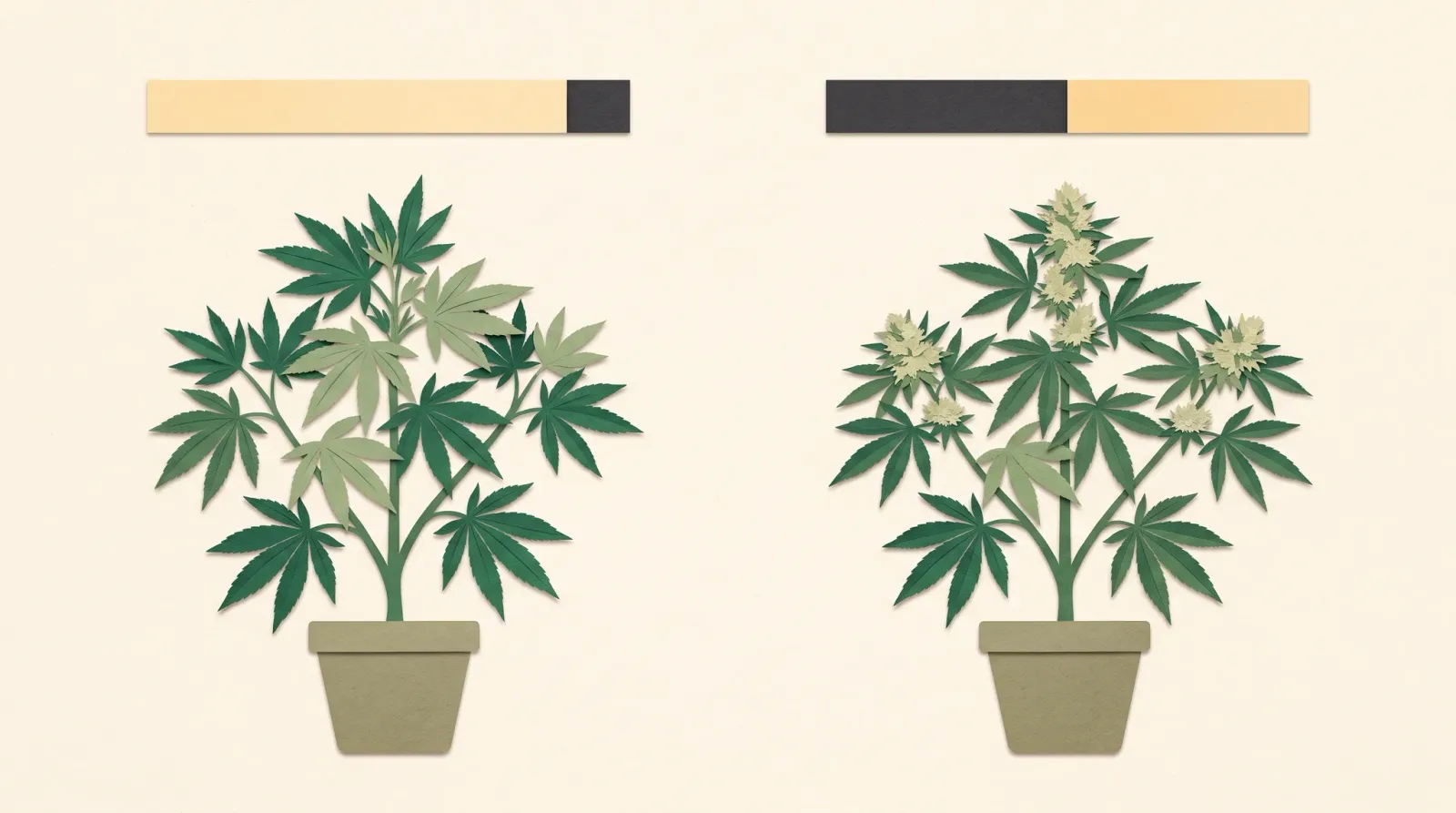
Photoperiod cannabis grows on long days, usually 16 to 18 hours of light, and starts to flower when its nights become long enough: about 10 to 12 hours of unbroken darkness for most drug-type plants. Growers set 12/12 because it reliably delivers that long night. Autoflowers ignore the clock and flower by age. Canadian Food Inspection Agency biology document
Here is the part most schedule charts leave out. 12/12 is a tradition, not a switch. In a University of Guelph chamber test of 10 drug-type cultivars, every one started to flower with up to 14 hours of light a day. Ahrens et al., 2023 In a follow-up, two cultivars given 13 hours of light instead of 12 produced 1.35 and 1.50 times more flower. That second result comes from two cultivars, three plants per treatment, one lab. Treat it as a reason to understand the mechanism, not as an instruction to change your timer. Ahrens et al., 2024
This High School lesson gives you the schedule for each stage, explains what the plant actually senses, and grades every number by how well the evidence backs it.
What light schedule does cannabis need in each stage?
Most indoor growers run one long day for seedlings, clones and veg, then a 12/12 day to flower. Autoflowers run one long day from seed to harvest. The table shows the usual setting and how strong the support for it is.
| Stage | Typical setting | How well the evidence backs it |
|---|---|---|
| Seedling and clone | Same long day as veg, commonly 18/6 | Grower convention. No cannabis trial of seedling-specific hours was found. |
| Veg (photoperiod plants) | 16 to 18 hours of light | Standard practice in research protocols; no trial found that tests 18/6 against other veg schedules for drug-type yield |
| Veg, longer days (20/4, 24/0) | Plants grow, but no proven gain | Small, mixed physiology studies; none measured flower yield |
| Flower (photoperiod plants) | 12/12 | Well supported as a working setting; the real threshold depends on the cultivar |
| Flower, longer days (13/11) | Experimental | Emerging and small; may raise yield, may lower THC concentration |
| Back to long days mid-flower | Avoid | Supported by a mechanism study |
| Autoflower, whole grow | 18/6 to 20/4, some run 24/0 | Grower convention; no trial found comparing hours for autoflower yield |
Two published research protocols show the usual pattern. One group held clones at 18 hours of light for 18 days before the flowering treatments. Peterswald et al., 2023 Another describes the typical vegetative photoperiod as 16 to 18 hours. Grover et al., 2025
For the full stage-by-stage grow, see the seed-to-harvest timeline. New to growing? Start with the beginner’s home grow guide, which also covers where home growing is legal.
Why does 12/12 make cannabis flower?
Because 12/12 gives the plant a night long enough to trigger flowering. Cannabis is a short-day plant, but the name misleads. The Canadian regulator’s biology document states the trigger plainly: what matters is the length of uninterrupted darkness. For most drug-type plants, flowering starts once that dark period reaches 10 to 12 hours for some weeks. CFIA
So the grower sets light hours, but the plant measures dark hours. A 24-hour day makes the two numbers mirror images, which is why the difference rarely gets mentioned. It starts to matter when something interrupts the night.
The threshold is not the same for every plant. In a study of 27 hemp cultivars, the shortest critical day lengths found were 13 hours 45 minutes to 14 hours. Those are hemp and CBD-type cultivars, not high-THC plants. Even very dim twilight light affected flowering time in that work. Zhang et al., 2021 Hemp extension guidance gives a similar range: plants stay vegetative while days run longer than about 13 to 14 hours, depending on the variety. NC State Extension
For drug-type plants, the Guelph work found flowering started at every day length up to 14 hours, with delays of zero to about four days at 14 hours compared with 12. Some cultivars began at 15 hours, but those flowers did not develop further. Starting to flower is not the same as producing a good harvest, and the authors suggest growers test their own cultivars. Ahrens et al., 2023
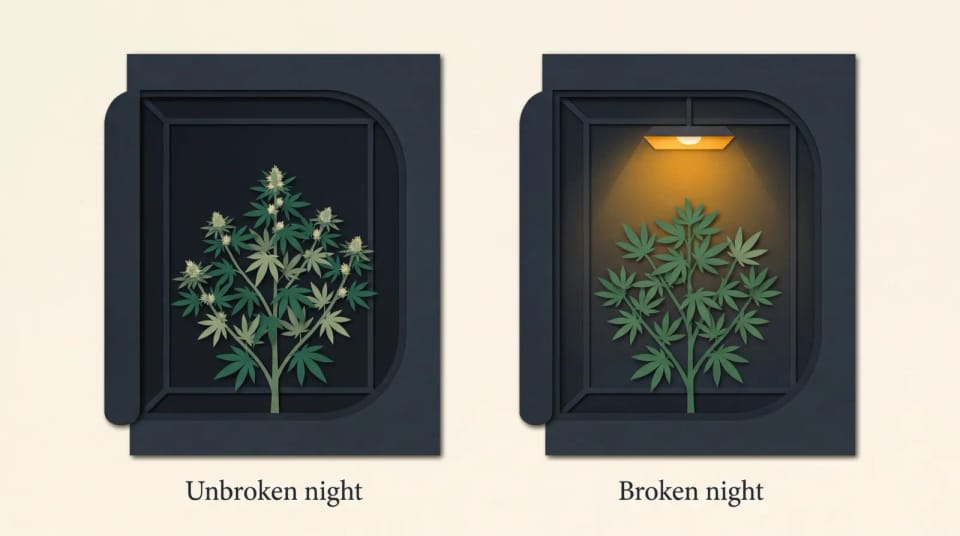
The plant measures the night. In a hemp study, a one-hour bright light pulse in the middle of a 12-hour night kept plants vegetative; that pulse was far brighter than a stray leak.
What happens if you break the dark period?
Bright light in the middle of the night can stop flowering. In a 2025 study, growers gave a CBD hemp cultivar 12 hours of light plus a one-hour pulse of bright light in the middle of the dark period. The plants stayed vegetative, the same as plants on 18 hours of light. Grover et al., 2025 That pulse was strong grow light, about 450 µmol per square metre per second, not a stray glow.
Even light you cannot see well can matter. Near-infrared LEDs run during the dark period delayed cannabis flowering by up to 12 days in a growth-chamber study. Those were deliberate, high-output fixtures, not the indicator light on a power strip. Kusuma et al., 2021
What the research does not tell you is how much stray light a plant tolerates. No study found in this research tested a door gap, a pinhole in a tent or a status LED at a stated brightness. Many grow guides say light leaks cause hermaphrodite plants; no primary source supporting that claim turned up either. The practical answer is cheap insurance: seal the tent so the dark stays dark and keep the night consistent.
When should you switch from 18/6 to 12/12?
Switch when the plant is the size you want, allowing room for growth after the flip. There is no single correct veg length. A meta-analysis of 26 studies found the most flower biomass with a short long-day period of about 14 days, while THC and CBD concentration peaked after longer vegetative periods of roughly six to seven weeks. That pooled analysis shows a trade-off, not a cause, and the studies varied widely. Dang et al., 2022
When you make the switch, the order matters more than the date.
- Set the timer for long nights. Change from the vegetative day to 12 hours on and 12 hours off.
- Keep the dark period dark. Seal seams and doors, and do not open the tent under a bright room light during lights-off.
- Hold the schedule every day. In a mechanism study, plants needed at least three short days in a row to start forming a true inflorescence. Alter et al., 2024
- Do not drop back to long days. The same study found short days were needed right through flower maturation.
- Watch for the first clusters. In one cultivar, the first visible inflorescence appeared 12 days after the switch. Your plants may differ. Spitzer-Rimon et al., 2019
Lights-off hours also affect temperature and humidity in a small space. The grow-room climate guide covers the night-time swing.
What if a flowering plant goes back to 18/6?
The flowers can fall apart. In female plants switched back to long days, researchers measured a rise in the growth hormone GA4 and auxin at the shoot tip, and the developing inflorescence broke down. Alter et al., 2024 That is why the advice is to keep short days through harvest once you flip.
The same study answers a common puzzle. Young plants on long days sometimes show a few single flowers at the nodes. That is normal. Seedlings form these solitary flowers by age, whatever the photoperiod. A long day is not purely vegetative. Spitzer-Rimon et al., 2019
Is 24/0 or 20/4 better for veg?
Neither has been shown to be better for the harvest. A longer day delivers more total light at the same intensity, so plants may grow faster. That is daily light at work, and your fixture’s intensity matters as much as its hours; the LED grow light guide covers intensity.
The plant-stress evidence is small and pulls both ways:
- In two hemp cultivars, 16/8 gave the most efficient photosynthetic response, and longer photoperiods raised markers of oxidative stress. Šrajer Gajdošik et al., 2022
- In tissue-culture plantlets of a medicinal cultivar and its autoflower version, 20 hours a day at moderate intensity gave the best growth, while 24 hours caused damage at the highest intensity. Liang et al., 2025
Neither study measured flower yield. So 24/0 works, 18/6 works, and nobody has shown which one gives you more at harvest.
Can you run 13 hours of light in flower?
You can, and early research suggests some cultivars yield more, but the trade-offs are real. In the Guelph 13-hour trial, two high-THC cultivars produced 1.35 and 1.50 times more flower than at 12 hours, with cannabinoid concentrations higher or unchanged. Plants at 12 hours ripened sooner, and harvest was timed to them, so the 13-hour plants were slightly less mature. Ahrens et al., 2024
An Australian group found something that cuts the other way. Starting flower at 14 hours of light gave the highest flower yield in all three lines they tested. But in both THC lines, a steady 14-hour day significantly lowered THC concentration. In the CBD line, it raised CBD. Peterswald et al., 2023
| Study | Longer day tested | Yield | Cannabinoid concentration |
|---|---|---|---|
| Ahrens 2024, two THC cultivars | 13 h light | 1.35 to 1.50 times higher | Higher or no difference |
| Peterswald 2023, two THC lines | 14 h light | Highest of all treatments | THC significantly lower |
| Peterswald 2023, one CBD line | 14 h light | Highest of all treatments | CBD higher |
Both are small studies in controlled rooms. If you test a longer day, test it on a cultivar you know and compare against your usual 12/12.
Do autoflowers need a light schedule?
Autoflowers do not need long nights to flower. They carry genes that make flowering independent of day length, and researchers have recorded them flowering under continuous light. Toth et al., 2022 One study traced the trait in drug-type plants to a mutation in a clock gene called CsPRR37. Leckie et al., 2024 Cornell’s hemp program puts it simply: autoflowering cultivars flower regardless of day or night length. Cornell Hemp
Most growers keep autoflowers on one long day, 18/6 to 20/4, from seed to harvest. That is convention. No trial found here compared 18/6, 20/4 and 24/0 on autoflower yield. The week-by-week autoflower guide covers picking one schedule and keeping it, and the ruderalis and autoflowering trait lesson explains where the genetics came from.
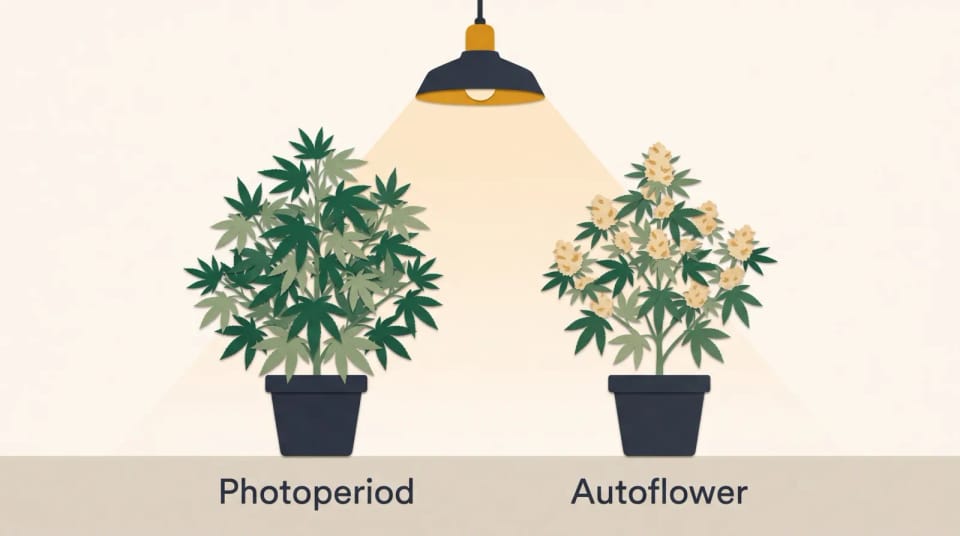
Same lamp, same long day. The photoperiod plant waits for long nights; the autoflower flowers on its own timetable.
Choosing between the two? The autoflowering vs photoperiod comparison and the guide to feminized vs autoflower seeds walk through the decision.
Key takeaways
- Photoperiod cannabis flowers when its nights reach about 10 to 12 hours of unbroken darkness. The exact threshold depends on the cultivar.
- 18/6 in veg and 12/12 in flower are reliable conventions, not proven optimums.
- Bright light in the middle of the night can stop flowering, so keep the dark period dark and consistent.
- Do not switch a flowering plant back to long days.
- Autoflowers flower by genetics and age. Their schedule is a choice, not a trigger.
FAQ
Does 12/12 really trigger flowering?
Yes, for photoperiod plants, because it gives them a long, unbroken night. The night is the signal, not the 12 hours of light. Many drug-type cultivars in a chamber study also started flowering at 13 or 14 hours of light, so 12/12 is a safe setting rather than an exact threshold.
Can a light leak ruin flowering?
Bright light during the night can keep a plant vegetative; a one-hour grow-light pulse did that in a hemp study. No study found here measured how much a small leak or indicator light matters. Seal the tent and keep the dark period consistent, since that costs little.
Do autoflowers need 18/6 or 24/0?
Neither is required, because autoflowers flower regardless of day length. Most growers run 18/6 to 20/4, and some run 24/0. No trial found here compared these schedules for autoflower yield.
Can I flower under 13 hours of light and 11 hours of dark?
Many cultivars will still flower, and one small study found higher yield at 13 hours in two cultivars. Another found a 14-hour day lowered THC concentration in two THC lines. Test it on a cultivar you know before changing a whole grow.
Will switching from 12/12 back to 18/6 cause revegetation?
It can disrupt flowering. Researchers found that moving flowering plants back to long days broke down the developing inflorescence. Keep the short-day schedule through harvest once you flip.
Sources
- Ahrens A, Llewellyn D, Zheng Y (2023). “Is Twelve Hours Really the Optimum Photoperiod for Promoting Flowering in Indoor-Grown Cultivars of Cannabis sativa?” Plants. PubMed record
- Ahrens A, Llewellyn D, Zheng Y (2024). “Longer Photoperiod Substantially Increases Indoor-Grown Cannabis’ Yield and Quality: A Study of Two High-THC Cultivars Grown under 12 h vs. 13 h Days” Plants. PubMed record
- Peterswald TJ, et al. (2023). “Moving Away from 12:12; the Effect of Different Photoperiods on Biomass Yield and Cannabinoids in Medicinal Cannabis” Plants. PubMed record
- Zhang M, Anderson SL, Brym ZT, Pearson BJ (2021). “Photoperiodic Flowering Response of Essential Oil, Grain, and Fiber Hemp (Cannabis sativa L.) Cultivars” Frontiers in Plant Science. PubMed record
- Alter H, et al. (2024). “Inflorescence development in female cannabis plants is mediated by photoperiod and gibberellin” Horticulture Research. PubMed record
- Grover EF, Haiden SR, Berkowitz GA (2025). “Examining the ‘Night Break’ Method in Cannabis sativa Horticulture: Vegetative Daily Light Integral Affects Yield of Extractable Biomass in C. sativa” Plants. PubMed record
- Dang M, Arachchige NM, Campbell LG (2022). “Optimizing Photoperiod Switch to Maximize Floral Biomass and Cannabinoid Yield in Cannabis sativa L.: A Meta-Analytic Quantile Regression Approach” Frontiers in Plant Science. PubMed record
- Toth JA, Stack GM, Carlson CH, Smart LB (2022). “Identification and mapping of major-effect flowering time loci Autoflower1 and Early1 in Cannabis sativa L.” Frontiers in Plant Science. PubMed record
- Leckie KM, et al. (2024). “Loss of daylength sensitivity by splice site mutation in Cannabis pseudo-response regulator” The Plant Journal. PubMed record
- Šrajer Gajdošik M, Vicić A, Gvozdić V, Galić V, Begović L, Mlinarić S (2022). “Effect of Prolonged Photoperiod on Light-Dependent Photosynthetic Reactions in Cannabis” International Journal of Molecular Sciences. PubMed record
- Liang J, Ji F, Zhou Q, He D (2025). “Optimizing LED Light Intensity and Photoperiod to Promote Growth and Rooting of Medicinal Cannabis in Photoautotrophic Micropropagation” Biology. PubMed record
- Spitzer-Rimon B, Duchin S, Bernstein N, Kamenetsky R (2019). “Architecture and Florogenesis in Female Cannabis sativa Plants” Frontiers in Plant Science. PubMed record
- Kusuma P, Westmoreland FM, Zhen S, Bugbee B (2021). “Photons from NIR LEDs can delay flowering in short-day soybean and Cannabis: Implications for phytochrome activity” PLoS One. PubMed record
- Canadian Food Inspection Agency. The biology of Cannabis sativa L. (BIO2020-02).
- Cornell Hemp. Flowering time in hemp.
- NC State Extension. Optimizing floral hemp biomass through proper transplant timing and density.



