

Cannabis Nitrogen Deficiency: What Yellow Lower Leaves Really Mean
Cannabis nitrogen deficiency yellows the oldest, lowest leaves first, evenly, then climbs. See the trial evidence, the look-alikes and the late-flower fade.

Professor High
Written by Professor High, our AI guide. See how we research and correct articles.
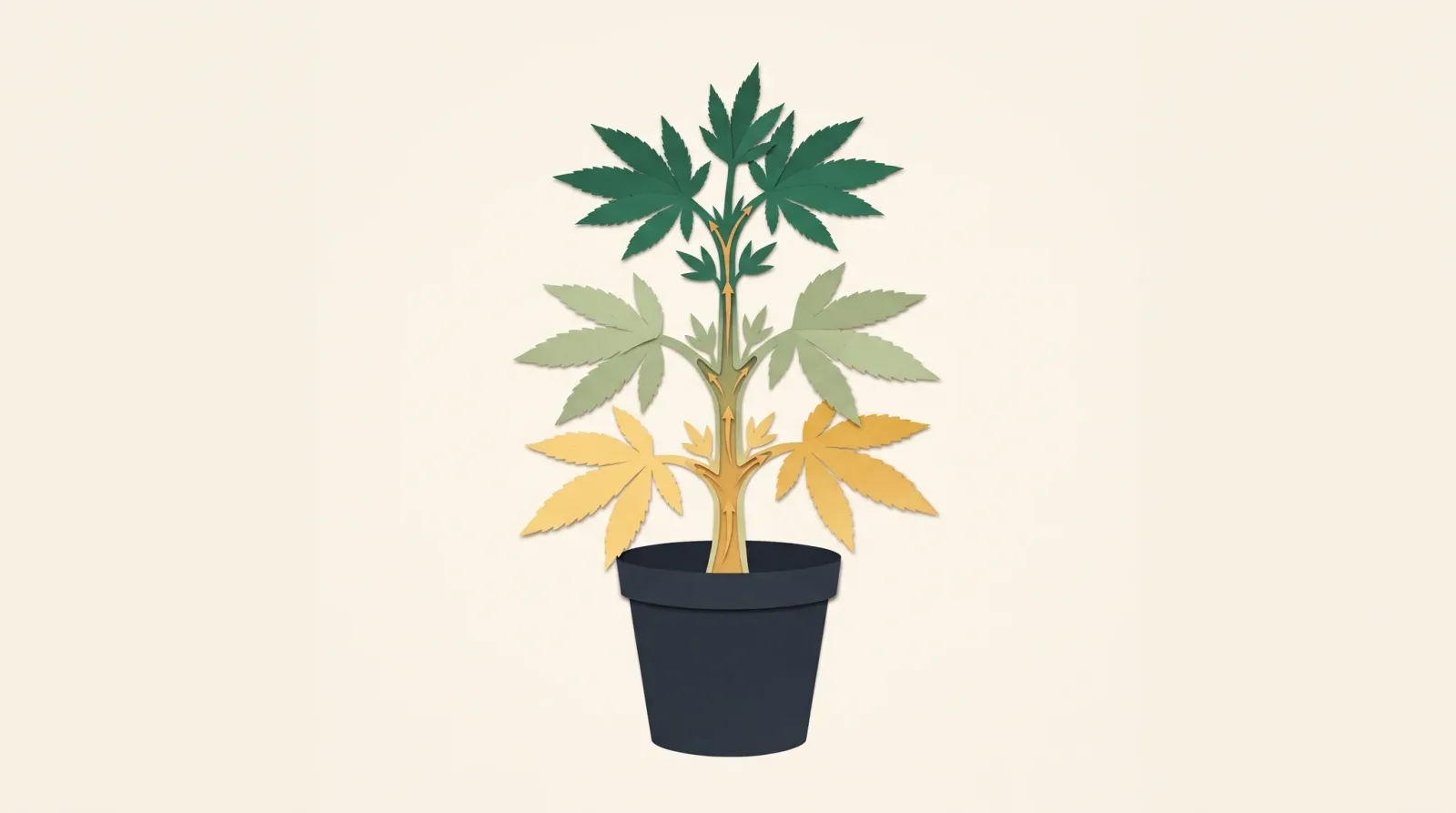
Cannabis nitrogen deficiency yellows the oldest, lowest leaves first, evenly across the whole leaf, and then the yellowing climbs the plant. That happens because nitrogen is mobile: the plant moves it out of old leaves and into new growth (Montana State University Extension). In controlled trials, plants grew best at about 160 mg/L of nitrogen in the feed solution, and more than that added nothing. The catch: the same lower-leaf yellowing in the last weeks of flower can be normal, and nobody can tell the two apart by eye.
Here is the short version you can send to a friend. Which leaves turn yellow tells you which problem you have. Bottom leaves first, whole leaf: nitrogen. Top leaves first, yellow between green veins: an iron or manganese problem, often linked to high pH. Bottom leaves in late flower: probably the fade.
This High School lesson stays on nitrogen. For the wider list of causes, such as water, light and pests, see common cannabis growing problems.
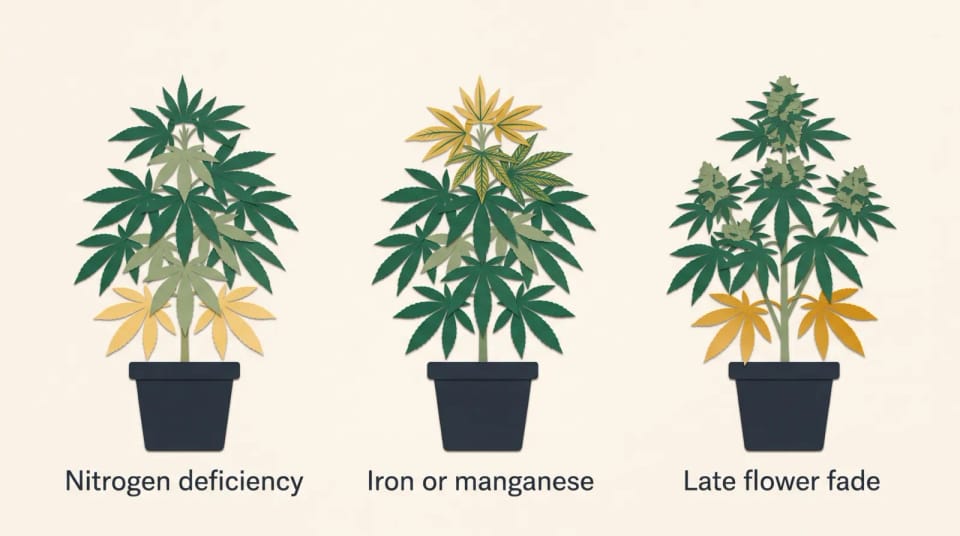
Where the yellow starts matters. Nitrogen shows at the bottom, iron and manganese problems at the top, and late-flower fade at the bottom only near harvest.
Which leaves turn yellow first with nitrogen deficiency?
The oldest, lowest leaves turn yellow first. In a sand-culture trial that withheld nitrogen, the lower leaves went pale, the yellow got stronger and moved from the bottom leaves to the middle of the plant, and the worst leaves turned fully yellow, died and dropped (Cockson et al., 2019). A hemp trial at Cornell saw the same order: lighter green on lower mature leaves, then even yellowing across the leaf blade, then leaf drop and a smaller plant (e-GRO Alert 8(11)).
The mechanism is simple. When the roots cannot supply enough nitrogen, the plant takes it back from older, shaded leaves and sends it to the young leaves at the top (Montana State University Extension). Oregon State’s horticulture reference lists nitrogen as mobile in plants, with symptoms first on older growth (Oregon State University Extension).
Two details help you spot it:
- The whole leaf fades. Nitrogen yellowing is even across the blade. Utah State notes it often starts at the leaf tips and moves inward (Utah State University Extension).
- The plant often grows slowly first. In the sand trial, the deficient plants were slightly stunted before the color change was obvious (Cockson et al., 2019).
Is it nitrogen, magnesium or something else?
Compare where the yellow starts and how it sits on the leaf. This table holds the nitrogen view. For calcium and magnesium in detail, see the cal-mag deficiency guide.
| What you see | Which leaves first | Leaf pattern | Most likely cause |
|---|---|---|---|
| Nitrogen deficiency | Oldest, lowest leaves | Whole leaf pales evenly, then climbs the plant | Too little nitrogen reaching the roots |
| Magnesium deficiency | Oldest leaves | Yellow between green veins | Too little magnesium |
| pH-linked micronutrient problem (iron, manganese) | Youngest leaves at the top | Yellow between green veins; manganese can leave dark green margins | High root-zone pH can tie up iron and manganese |
| Late-flower fade | Lower leaves, last weeks of flower | Yellowing that spreads as harvest nears | Expected leaf senescence and nutrient movement |
Sources for the table: magnesium and the nitrogen pattern from e-GRO and Utah State; the iron and manganese pattern from Utah State, which notes manganese deficiency may occur above pH 6.5; the fade from the flowering trials below.
Not every yellow leaf is a nutrient problem. Montana State lists poor drainage, compacted soil, root disease and pests as other causes, and it says to diagnose before you treat, including a look at the roots (Montana State University Extension). The e-GRO authors add that a lab tissue test is the way to confirm a deficiency for certain (e-GRO Alert 8(11)).
Can pH cause nitrogen deficiency?
You will often read that a pH problem “locks out” nitrogen. No cannabis study we found tests that claim. What extension sources do support is different: high pH ties up iron and manganese, and those problems show first on young leaves at the top (Utah State University Extension; Oregon State University Extension). That is the opposite end of the plant from nitrogen.
So pH still matters. A pH problem tends to show up in the wrong place for nitrogen, and that is a useful clue. Before you change the feed, measure pH and runoff so you know what the roots actually get.
How fast does a nitrogen-deficient plant decline?
With nitrogen removed completely, the decline took weeks, not days. In a deep-water culture trial on ‘Gelato 29’, the plants went through these stages after nitrogen was withheld (Llewellyn et al., 2023):
- Week 3: slight yellowing at the tips of the lower fan leaves.
- Week 4: yellowing on most fan leaves of the lower two-thirds of the plant.
- Week 5: nearly all fan leaves yellow, some brown and dead, petioles red-brown, and sugar leaves start to yellow.
- Weeks 6 to 7: almost all fan leaves dead and stems brown.
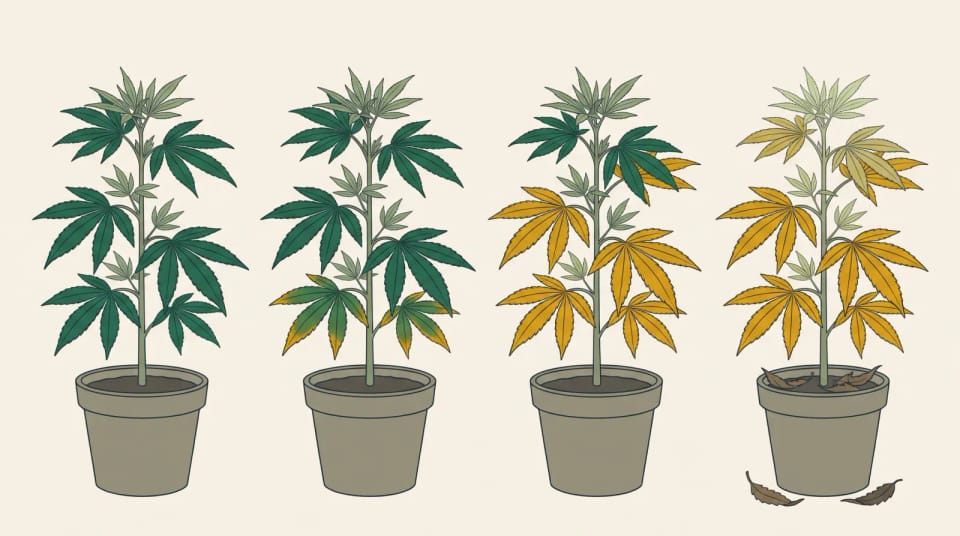
In a trial that removed nitrogen completely, yellowing started at the lower leaf tips in week 3 and reached nearly every fan leaf by week 5. A partial shortfall usually moves more slowly.
Read that timeline as a worst case. The plants got no nitrogen at all, under 12-hour days, with three systems per treatment. The authors note that a complete absence of nitrogen is unlikely in real grows (Llewellyn et al., 2023). A partial shortfall can sit quietly for longer. At 80 mg/L, one trial saw restricted growth and yellowing on the lower, older leaves of plants that were otherwise still growing (Saloner and Bernstein, 2020).
The cost was large. Vegetative fresh weight was 73% lower than the control in the Gelato trial, and flower fresh weight was 315 g against 1,110 g (Llewellyn et al., 2023). The sand trial reported 50% less biomass (Cockson et al., 2019).
How much nitrogen is enough, and can you give too much?
Four trials landed in the same zone. In a five-level vegetative trial (30 to 320 mg/L N), growth peaked at 160 mg/L. At 30 mg/L the plants were visibly deficient with about 75% less biomass, and leaf nitrogen did not rise above 160 mg/L (Saloner and Bernstein, 2020). In flower, the same team found yield rose up to 160 mg/L and then stayed flat (Saloner and Bernstein (2021)). A response-surface trial put the flowering optimum at 194 mg/L, with yield falling off outside 160 to 230 mg/L (Bevan et al., 2021). A glasshouse pilot on CBD-type clones saw flower biomass peak at 160 mg/L, with no change above it and no rise in tissue nitrogen (Dilena et al., 2025).
Those numbers come with a big caveat. They are nitrogen in the feed solution, in mg/L, in inert or water-based media: perlite, sand, rockwool and deep-water culture. They are not the NPK numbers on a bottle, and they are not a soil rate. No trial here used soil, coco or living soil. For stage-by-stage feeding, use the feeding schedule by growth stage; if you grow in water, the hydroponics beginner’s guide explains how mg/L feeds work.
Too much nitrogen has its own look. At 320 mg/L, vegetative plants were smaller and dark green (Saloner and Bernstein, 2020). Oregon State describes excess nitrogen as soft, dark green growth (Oregon State University Extension).
The form of nitrogen matters too. At the same 200 mg/L, flower biomass fell as the ammonium share of the feed rose. At 50% ammonium, leaves died and wilted and 40% of plants died in the last week. At 100% ammonium, plants died (Saloner and Bernstein, 2022). So “just add more nitrogen” can backfire if the extra comes mostly as ammonium.
What about potency? The studies disagree. One found the highest cannabinoid concentrations at the lowest nitrogen level, but yield collapsed there (Saloner and Bernstein, 2021). Another found no nitrogen effect on cannabinoid content (Bevan et al., 2021), and a third found clone source mattered more than nitrogen (Dilena et al., 2025). The reliable result is lost yield, so starving the plant is not a potency plan.
Is yellowing in late flower normal?
Usually, yes. A flowering trial found that nutrient deprivation during flower can trigger nutrients to move out of the leaves, and leaves showed obvious color loss by the final harvest, stronger at lower feed levels (Massuela et al., 2023). That study also found more feed meant more flower: 16.1, 22.6 and 26.3 g per plant at 80, 160 and 240 mg/L N.
You may hear that the buds are “pulling nutrients from the leaves.” Part of that is true: nutrients do move. But no trial we found measured how much leaf nitrogen ends up in the flowers. The Gelato authors also note that natural senescence and deficiency look alike on the leaf, and that flushing before harvest may make the symptoms stronger or speed them up (Llewellyn et al., 2023). For that debate, read what the science says about flushing.
A practical rule: if the yellowing arrives in the last weeks, starts at the bottom and the buds keep developing, do not chase it with extra nitrogen. Yellowing in veg or early flower is a different story, because the plant still has to grow. The growth stages timeline shows where those windows fall.
How do you fix nitrogen deficiency?
Diagnose first, then change one thing. These steps follow the evidence above.
- Find where the yellowing starts. Bottom leaves first points to nitrogen. Top leaves first points somewhere else.
- Read the leaf pattern. Even yellow across the blade fits nitrogen. Yellow between green veins fits magnesium (old leaves) or iron and manganese (young leaves).
- Check the growth stage. In the last weeks of flower, expect some lower-leaf yellowing.
- Check the feed and the equipment. Confirm the mix strength, the doser or injector, and the pH and EC of input and runoff before you add anything. A clogged line or a mixing mistake looks the same on the leaf as a shortfall.
- Correct the feed without overshooting. Bring nitrogen back to a normal level for the stage with a mostly nitrate source. The trials show no gain past the plateau, and ammonium-heavy feeds caused harm.
- Watch the new growth. No study we found tested whether yellowed leaves turn green again, so judge the fix by the new leaves. If they stay green and the yellowing no longer climbs, the plant is likely getting enough nitrogen again. If the pattern stays unclear, a tissue test settles it (e-GRO Alert 8(11)).
Key takeaways
- Nitrogen deficiency starts on the oldest, lowest leaves, yellows the whole leaf and climbs.
- Yellow on the newest leaves, between green veins, points to iron or manganese, often with high pH.
- Trials in inert media found no extra yield above about 160 mg/L N in the feed.
- Ammonium-heavy feeds harmed plants, so more nitrogen is not always better.
- Lower-leaf yellowing in late flower is usually expected and cannot be told from deficiency by eye.
FAQ
Why are my lower cannabis leaves turning yellow?
The most common nutrient cause is nitrogen deficiency, because the plant moves nitrogen from old leaves to new growth. Other causes include poor drainage, compacted soil, root disease and pests. In the last weeks of flower, it can be normal fade. Check where it starts and how the leaf yellows before you change the feed.
Can yellow cannabis leaves turn green again?
No study we found tested this in cannabis. Judge the fix by the new growth instead: new leaves that stay green and yellowing that no longer climbs are the signs to watch. Heavily yellowed leaves often die and drop, as the trials describe.
What does nitrogen toxicity look like?
Too much nitrogen gives soft, dark green growth. In one trial, plants at the highest nitrogen level were smaller and dark green. An ammonium-heavy feed caused dying, wilted leaves and plant death in another trial.
Should I add nitrogen during flowering?
Plants still need nitrogen in flower, and flowering trials found yield rose up to about 160 mg/L N in the feed. Past that, extra nitrogen added nothing. Lower-leaf yellowing in the final weeks is usually expected, so do not raise nitrogen just to keep those leaves green.
Sources
- Cockson P, Landis H, Smith T, Hicks K, Whipker BE. Characterization of Nutrient Disorders of Cannabis sativa. Applied Sciences. 2019;9(20):4432. doi:10.3390/app9204432
- Llewellyn D, Golem S, Jones AMP, Zheng Y. Foliar Symptomology, Nutrient Content, Yield, and Secondary Metabolite Variability of Cannabis Grown Hydroponically with Different Single-Element Nutrient Deficiencies. Plants. 2023;12(3):422. PMC9920212
- Saloner A, Bernstein N. Response of Medical Cannabis (Cannabis sativa L.) to Nitrogen Supply Under Long Photoperiod. Frontiers in Plant Science. 2020;11:572293. PMC7704455
- Saloner A, Bernstein N. Nitrogen supply affects cannabinoid and terpenoid profile in medical cannabis (Cannabis sativa L.). Industrial Crops and Products. 2021;167:113516. doi:10.1016/j.indcrop.2021.113516
- Bevan L, Jones M, Zheng Y. Optimisation of Nitrogen, Phosphorus, and Potassium for Soilless Production of Cannabis sativa in the Flowering Stage Using Response Surface Analysis. Frontiers in Plant Science. 2021;12:764103. PMC8635921
- Dilena E, Hunt I, Close DC. Optimal nitrogen rates and clonal effects on cannabinoid yields of medicinal cannabis. Scientific Reports. 2025;15:12341. PMC11985917
- Massuela DC, Munz S, Hartung J, Nkebiwe PM, Graeff-Hönninger S. Cannabis Hunger Games: nutrient stress induction in flowering stage. Frontiers in Plant Science. 2023;14:1233232. PMC10547009
- Saloner A, Bernstein N. Nitrogen Source Matters: High NH4/NO3 Ratio Reduces Cannabinoids, Terpenoids, and Yield in Medical Cannabis. Frontiers in Plant Science. 2022;13:830224. PMC9198551
- Hajarian H, Mattson N. Visual symptoms of N, P, K, and Mg deficiency in hemp. e-GRO Alert 8(11), 2023. e-GRO PDF
- Utah State University Extension. Hemp nutrient deficiencies. USU Extension
- VanDerZanden AM. Environmental factors affecting plant growth (EM 9903). Oregon State University Extension. OSU Extension
- Perez-Hernandez O, Jones C. What Does Yellowing or Chlorosis Tell Us About the Health of a Plant? Montana State University Extension, 2022. MontGuide



