Cannabis Hydroponics: A Beginner's Guide to Water-Grown Weed
Learn cannabis hydroponics the right way: DWC vs other systems, growing media, pH 5.5-6.5, EC/PPM by stage, equipment, and how to dodge root rot.

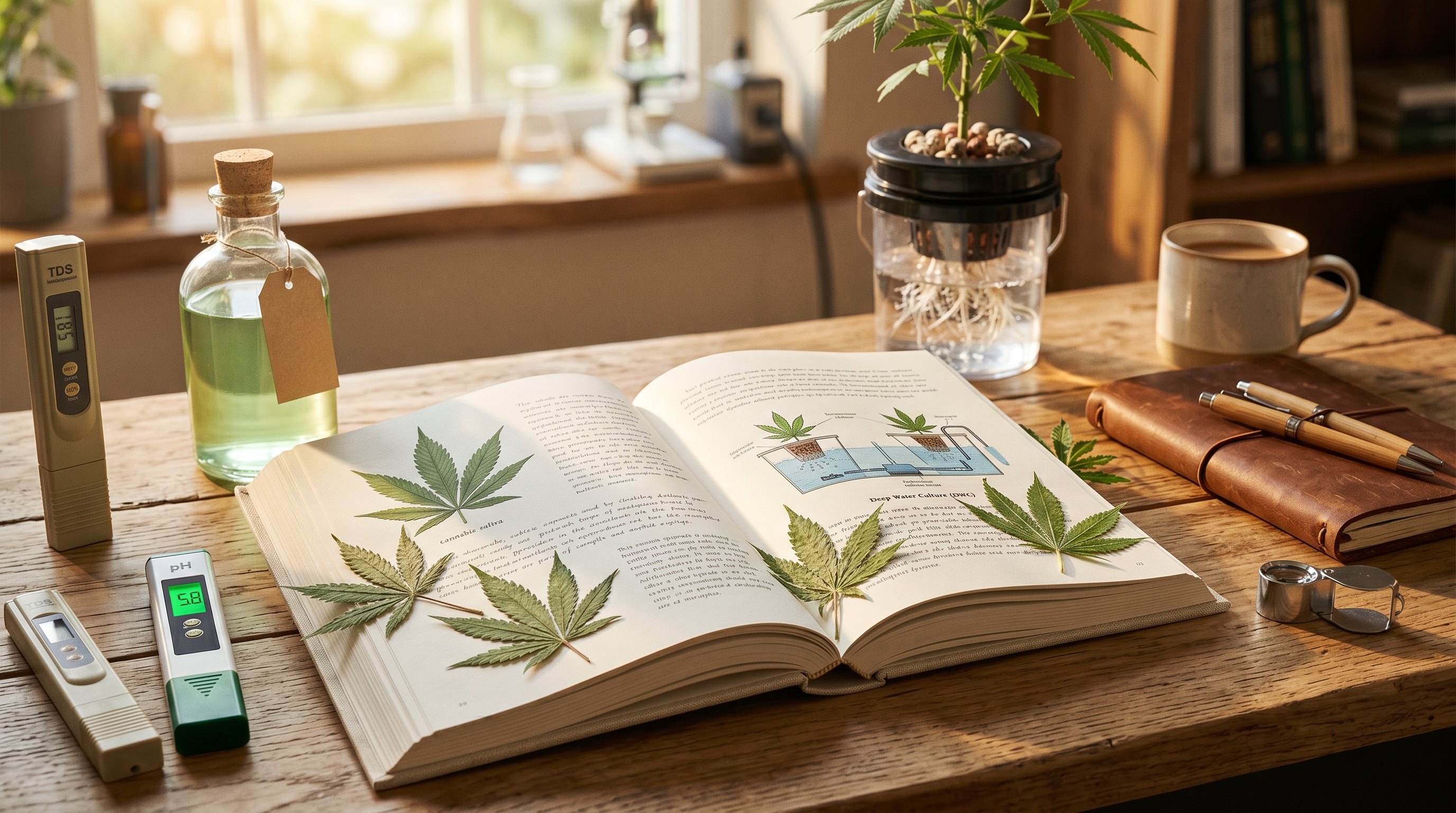
If you have ever watched a cannabis plant explode out of a bucket of bubbling water and wondered whether you were doing something wrong by growing in dirt, I have good news: you weren’t doing anything wrong. But you were leaving some serious speed on the table.
Welcome to hydroponics — growing weed with no soil at all, where the roots dangle directly into an oxygenated, nutrient-rich water solution that you control down to the part-per-million. Done right, it produces faster growth and bigger yields than soil. Done wrong, it can kill a healthy plant in 24 hours. This guide walks you through the whole picture so you go in with your eyes open.
I’m Professor High, and today we’re getting our (figuratively) wet.
What “Hydroponics” Actually Means
Hydroponics is simply growing plants without soil. Instead of dirt holding nutrients that roots slowly mine, you dissolve mineral nutrients directly into water and deliver that solution straight to the roots. The plant doesn’t have to work to find food — it’s swimming in it.
There’s a catch that trips up every beginner: soil is a buffer. It forgives. It holds moisture, releases nutrients slowly, and resists wild pH swings. Water has none of that cushion. In hydro, you are the soil. Every variable that dirt used to manage automatically is now your job: pH, nutrient concentration, oxygen, and temperature.
That’s the trade. You get precision and speed, and in exchange you accept a steeper learning curve and faster failure when something goes sideways. If you’ve already grown a round or two in soil — say you followed our cannabis growing stages guide — you’ll find the plant biology familiar and the plumbing new.
The Main Hydroponic Systems
There isn’t one “hydroponics.” There are several methods that all share the no-soil principle but differ wildly in plumbing, cost, and difficulty. Here’s the lay of the land.
| System | How It Works | Difficulty | Main Risk | Best For |
|---|---|---|---|---|
| Deep Water Culture (DWC) | Roots hang directly in a bucket of aerated nutrient water | Beginner ⭐ | Root rot if aeration fails | First-time hydro growers |
| Ebb & Flow (Flood & Drain) | Tray periodically floods with solution, then drains back | Beginner | Overwatering, pump timing | Multiple plants in one tray |
| Drip Irrigation | Emitters drip solution onto each plant’s base | Beginner-Intermediate | Clogged emitters, uneven feed | Scaling to many plants |
| Nutrient Film Technique (NFT) | Thin film of solution flows past roots in sloped channels | Intermediate | Plants dry out fast if flow halts | Water-efficient setups |
| Aeroponics | Roots suspended in air, misted with solution on a timer | Advanced | Total crop loss in minutes if mister fails | Experienced pros chasing max yield |
A quick note on each, because the table only tells half the story.
Ebb and flow is genuinely beginner-friendly and inexpensive, but the flood-and-drain cycle has to be timed correctly or you’ll either drown roots or starve them. Drip systems conserve water and scale beautifully, which is why commercial grows love them, but the emitters clog and need regular cleaning. NFT uses up to 60% less water than DWC and exposes roots to tons of oxygen, lowering root-rot risk — but if the pump quits, that thin film evaporates and your plants dehydrate within hours. Aeroponics delivers the most oxygen of any method and the most explosive growth, but it’s the secret weapon of the pros for a reason: a clogged nozzle or a 20-minute power blip can wipe out a whole crop. It is not where you start.
Why DWC Is the Beginner’s Pick
For your first water-grown plant, start with Deep Water Culture (DWC). It’s the most forgiving hydro system, the cheapest to build, and the most direct way to learn the fundamentals of water chemistry without a tangle of pumps and timers.
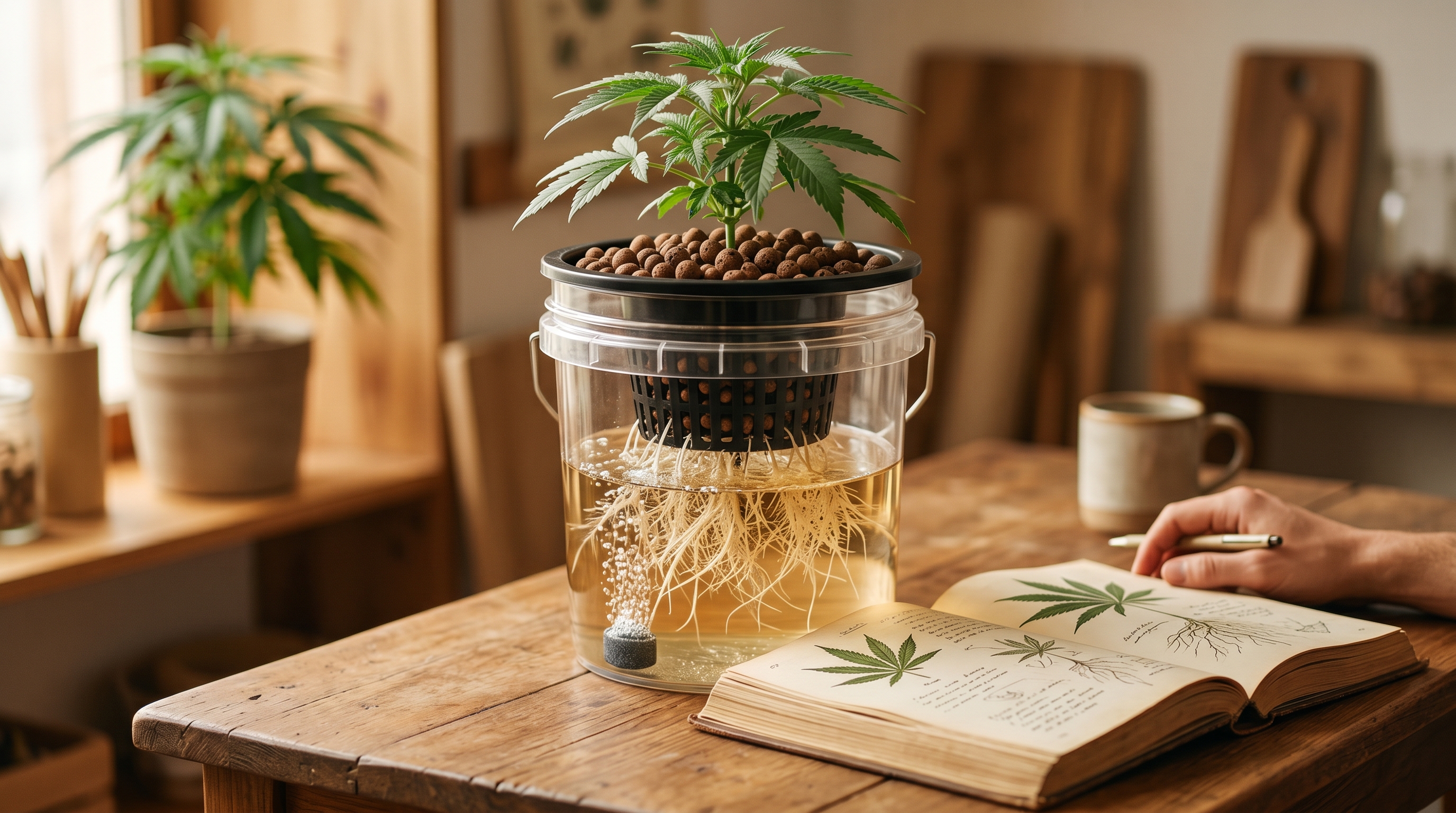
In DWC, the plant sits in a net pot at the top of an opaque bucket. Its roots descend through an inert growing medium and into a reservoir of nutrient solution. An air pump pushes oxygen through air stones at the bottom, creating that signature curtain of bubbles. Those bubbles aren’t decoration — they’re life support. They keep the water saturated with dissolved oxygen so the submerged roots can breathe.
Master DWC and every other system becomes a variation on a theme you already understand. That’s why I always point new growers here first.
Growing Media: What Holds the Plant Up
“No soil” doesn’t mean “nothing.” The plant still needs something to anchor in and to wick moisture up to the seedling before its roots reach the reservoir. These media are inert — they hold zero nutrients of their own, so they don’t interfere with the chemistry you’re controlling.
- Clay pebbles (hydroton / LECA): Round, baked-clay balls that drain freely and hold tons of air around the roots. Reusable after a rinse and sterilize. The default choice for DWC net pots.
- Rockwool: Spun mineral-fiber cubes, fantastic for starting seeds and clones. Holds moisture well but must be pH-balanced before use (it ships alkaline) and worn with a mask when dry.
- Coco coir: Technically a hybrid — it behaves more like a soilless container medium than true hydro, but many growers run it in drip systems. More forgiving than pure water culture, a nice halfway step.
Whatever you choose, rinse it. New clay pebbles are dusty, and that dust clouds your reservoir and clogs pumps.
The Two Numbers That Rule Your Grow: pH and EC
Here’s where hydro lives or dies. Master two measurements and you’ve won most of the battle.
pH: The Nutrient Gatekeeper
pH measures how acidic or alkaline your solution is, and it controls which nutrients your plant can actually absorb. Lock the pH wrong and your plant starves even when the reservoir is full of food — that’s nutrient lockout.
For cannabis in hydroponics, keep your solution in the 5.5 to 6.5 range. Many growers fine-tune within that band by stage:
| Stage | Target pH | EC | PPM (500 scale) | Nutrient Focus |
|---|---|---|---|---|
| Seedling / Clone | 5.8 – 6.2 | 0.8 – 1.2 | 400 – 600 | Light, gentle |
| Vegetative | 5.8 – 6.2 | 1.2 – 1.4 | 600 – 850 | Nitrogen-heavy |
| Early Flower | 6.0 – 6.3 | 1.4 – 1.6 | 850 – 1100 | Phosphorus / Potassium |
| Late Flower | 6.0 – 6.3 | 1.6 – 2.0 | 1100 – 1400 | P/K, then flush |
Water has almost no buffer, so pH drifts constantly as the plant drinks and eats. Test it at least every day or two, and adjust slowly with small amounts of pH Up or pH Down. Chase it gently — dumping in adjuster overshoots and stresses the plant. Our cannabis nutrients guide covers how the feeding side connects to all this.
EC and PPM: How Much Food
EC (electrical conductivity) and PPM (parts per million, often called TDS) both measure how concentrated your nutrient solution is — how much dissolved food is in the water. They’re two scales for the same thing.
A word of warning: PPM is measured on different scales (500 vs. 700), so a “1000 PPM” reading on one meter isn’t the same as another. EC is the universal, unambiguous number — I recommend beginners think in EC and ignore the PPM confusion entirely.
Start low. Seedlings burn easily, and overfeeding is the single most common rookie mistake. You can always add more food; you can’t un-burn a leaf. Watch the plant, not just the meter — dark, clawed, glossy leaves mean you’re overdoing it. If you’re running into trouble, our common cannabis growing problems guide covers the visual symptoms in detail, and a Cal-Mag deficiency is especially common in hydro and with filtered water.
The Equipment You Actually Need
For a basic single-plant DWC build, here’s the shopping list:
- An opaque, food-grade bucket (5 gallons is the sweet spot). Opaque matters — light in the reservoir grows algae that competes with your roots for oxygen.
- A net pot (3–6 inches) to hold the medium and plant at the top.
- Inert growing medium — clay pebbles, with a rockwool cube to start the seed.
- An air pump and air stones. Buy bigger than you think you need; aeration is non-negotiable.
- Airline tubing and a check valve (the valve blocks water from siphoning back into the pump during an outage).
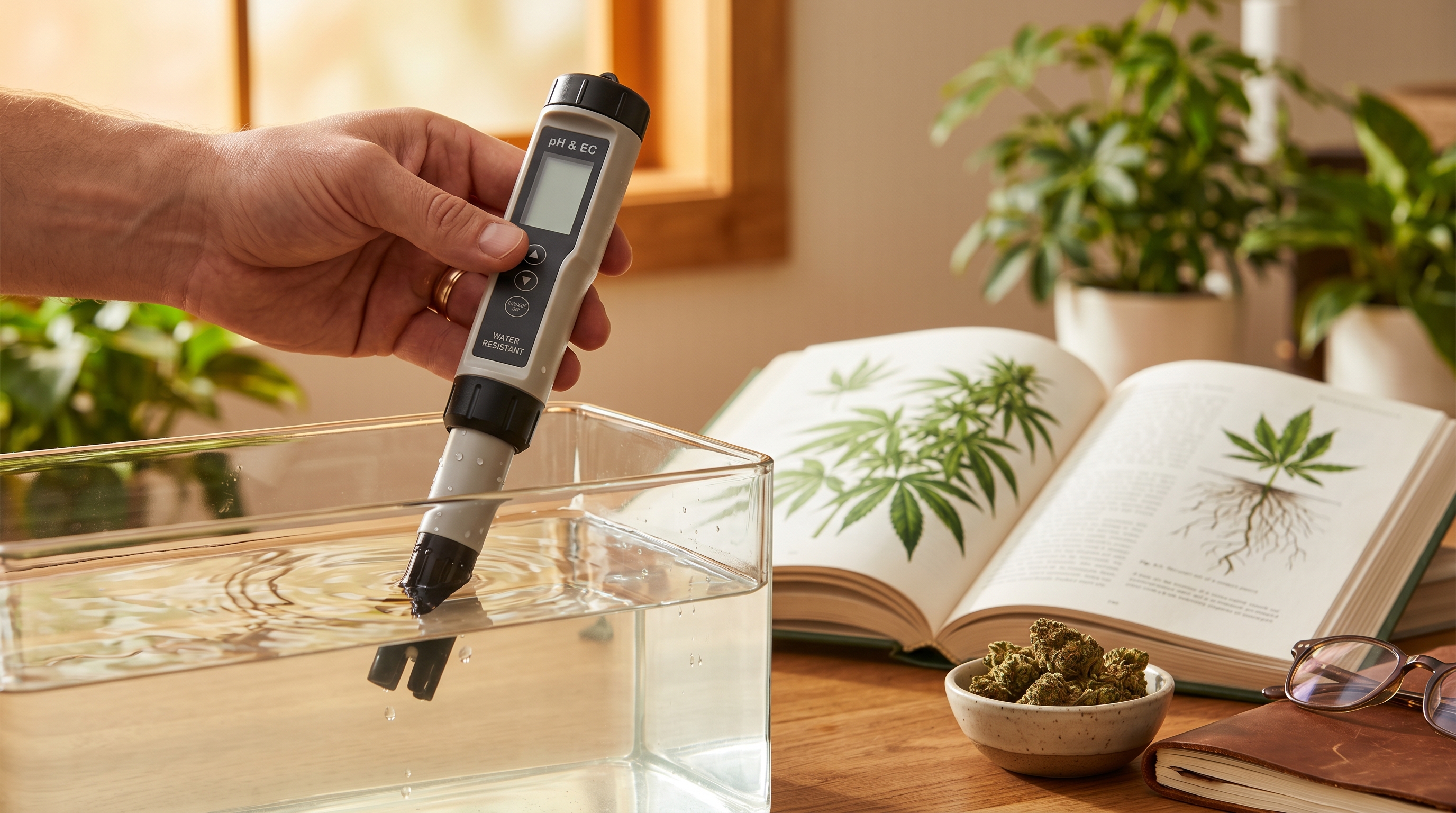
- A pH meter and an EC/TDS meter — calibrated, with backup calibration solution.
- Hydroponic nutrients formulated for water culture (not generic soil ferts).
- A thermometer for your reservoir water.
- Ideally, filtered or reverse-osmosis water as your starting point, so you control the chemistry from zero.
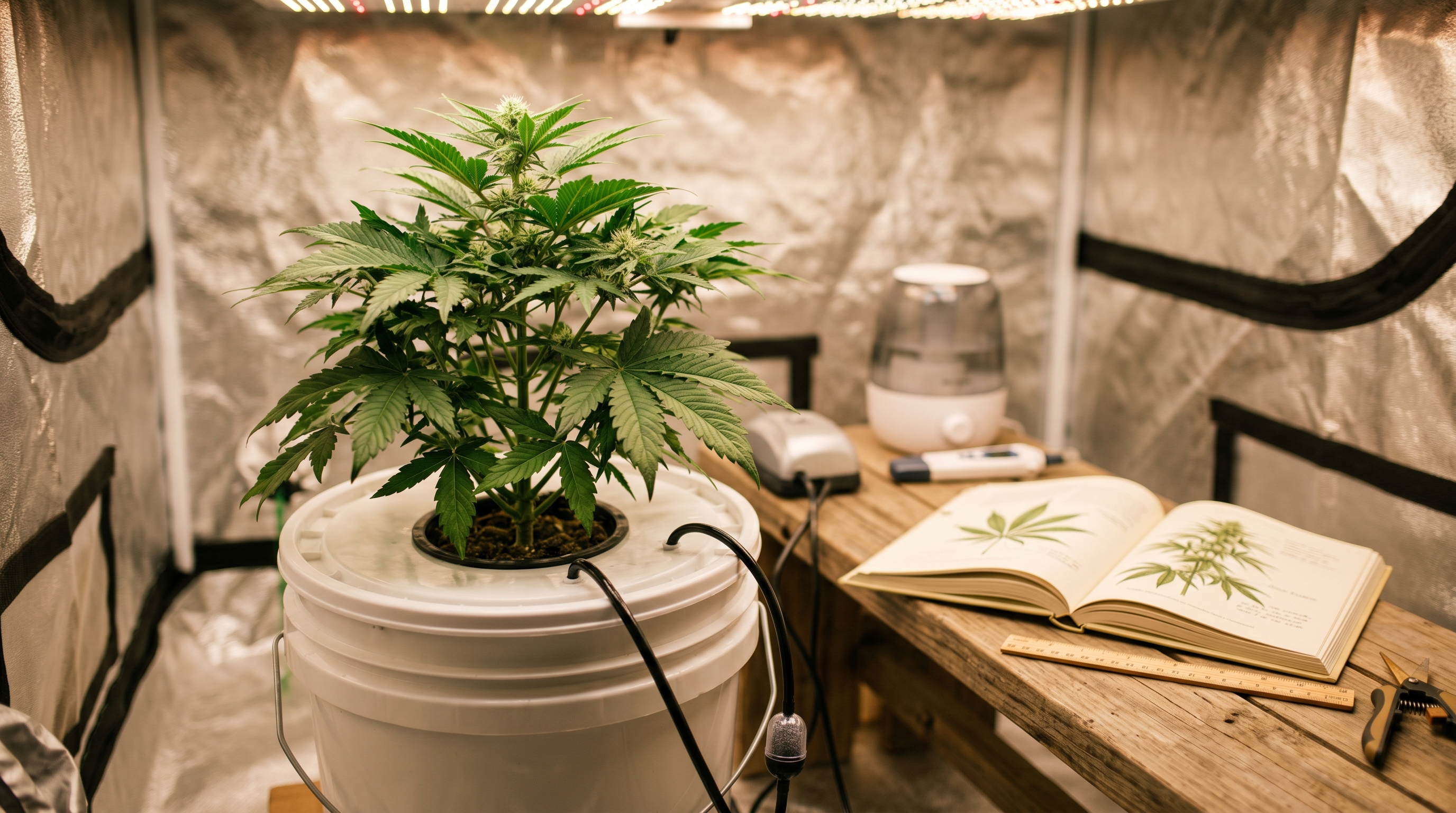
You’ll house all this inside a controlled environment with lighting and airflow. If you haven’t dialed that in yet, start with our grow tent setup guide and LED grow lights buyer’s guide. Hydro plants grow fast and hungry for light, so don’t cheap out on the canopy.
The Hydro Boogeyman: Root Rot
Let’s talk about the thing that kills more DWC grows than anything else.
Root rot is a slimy, brown, foul-smelling decay of the root mass, usually caused by Pythium and friends. Healthy hydro roots are bright white or cream and smell clean. Rotted roots are brown, mushy, and reek like a swamp. Once it takes hold in a warm, low-oxygen reservoir, it can crash a plant astonishingly fast.
Two factors drive almost every case:
- Low dissolved oxygen. This is why aeration is sacred. If your air pump fails — or is undersized, or the air stone clogs — oxygen crashes and rot can begin within hours. A check valve and a quality pump are cheap insurance.
- Warm water. Warm water holds far less dissolved oxygen and breeds pathogens. Keep your reservoir at 65–72°F (18–22°C). Above 75°F is the danger zone, especially in summer. Below 60°F slows growth.
Prevention beats cure: keep water cool, keep aeration vigorous, change your full reservoir every 1–2 weeks rather than just topping off (topping off compounds imbalances), and check root color weekly. For the full breakdown — including beneficial-microbe approaches and how rot compares to other moisture diseases like bud rot (botrytis) — keep that troubleshooting guide bookmarked.
Hydro vs. Soil: An Honest Comparison
Hydro isn’t automatically “better.” It’s a different set of trade-offs. Here’s the straight talk.
| Factor | Hydroponics | Soil |
|---|---|---|
| Growth speed | 30–50% faster | Slower, steadier |
| Yield potential | Higher when dialed in | Solid, reliable |
| Forgiveness | Low — mistakes punish fast | High — soil buffers errors |
| Water use | Up to 90% less (recirculating) | More |
| Pests / soil pathogens | Largely eliminated | Possible |
| Setup cost | Higher (pumps, meters) | Lower |
| Terpene / flavor | Excellent with care | Often praised as richer |
| Learning curve | Steep | Gentle |
The honest summary: soil is the better teacher; hydro is the better racecar. If you’ve never grown before, a forgiving soil run first will build the plant-reading instincts that make hydro click. If you already know what a happy plant looks like and you want speed and control, hydroponics rewards you handsomely. (And if you’re curious how growing conditions shape the final chemistry, our piece on why sun-grown cannabis has better terpenes is a fun counterpoint to the indoor-control philosophy.)
Genetics Matter As Much As Your Setup
A perfect reservoir won’t fix a poorly chosen seed. Vigorous, stable genetics handle the demands of hydro far better. Fast, compact plants like autoflowers can do well, though their fixed life cycle means recovery time from a hydro mishap is limited — our autoflower vs. photoperiod guide explains the difference, and the ruderalis genetics behind autoflowering.
Resilient, popular strains are a smart first hydro choice. Reliable producers like Blue Dream, Northern Lights, White Widow, Gorilla Glue, and Wedding Cake are forgiving enough to teach you the system without punishing every wobble.
How a strain feels still comes down to its chemistry, not its growing method. The relaxing body load of a myrcene-dominant cut and the bright lift of a limonene-forward one are baked into the genetics — what we map across our High Families system, from the deeply calming Relax profile to the bright, mood-elevating Uplift one. A clean hydro grow simply lets those terpenes express to their fullest.
A Realistic First-Grow Game Plan
- Build small. One bucket, one plant. Learn the system before you scale.
- Start your seed in rockwool, then transplant the cube into a net pot of clay pebbles once roots show.
- Mix a weak nutrient solution — low EC for seedlings — with pH dialed to ~5.8.
- Run the air pump 24/7. Confirm strong bubbling every single day.
- Test pH and EC daily at first. Adjust slowly. Keep a log.
- Watch reservoir temperature like a hawk in warm weather.
- Full reservoir change every 1–2 weeks. Don’t just top off.
- Inspect roots weekly. White and clean = winning.
Then move through the same life stages any grower does — veg, flower, harvest timing by trichomes, and finally drying and curing. The hydro part ends at harvest; the rest is universal.
Key Takeaways: The Professor’s Bottom Line
Hydroponics isn’t magic and it isn’t cheating — it’s just removing the middleman (soil) and taking direct responsibility for everything that middleman used to handle. The plants reward that responsibility with speed and size. They punish neglect just as quickly.
Start with DWC, obsess over pH and EC, keep your water cool and bubbling, and you’ll be amazed what a cannabis plant can do when its roots never have to search for a meal.
Whatever method you grow with, the most useful habit is paying attention to which flower actually works for your body. That’s exactly what the High IQ app is built for — logging strains, tracking effects, and learning your own terpene patterns over time. Grow it, smoke it, log it, learn. Stay curious. — Professor High 🌱
Sources
- I Love Growing Marijuana — Beginner’s Guide to Cannabis Hydroponics. https://ilgm.com/resources/guides/beginner-guide-to-cannabis-hydroponics
- Soil Free Harvest — Complete Guide to DWC Hydroponics. https://soilfreeharvest.com/complete-guide-to-dwc-hydroponics-how-to-master-deep-water-culture/
- FloraFlex — Hydroponic Systems for Growing Cannabis: Which One Is Right for You? https://www.floraflex.com/blogs/floraflex-media/hydroponic-systems-for-growing-cannabis-which-one-is-right-for-you
- Atlas Scientific — Deep Water Culture (DWC) Hydroponics Starter Guide. https://atlas-scientific.com/blog/deep-water-culture-dwc-hydroponics/
- Mars Hydro — Mastering DWC Hydroponics for Beginners. https://www.mars-hydro.com/info/post/mars-hydro-dwc-hydroponic-system-kit-a-beginners-guide-to-hydroponics


