Cold-Cure Rosin vs Fresh Press: Two Techniques Compared
Cold-cure rosin sets up in a sealed jar at 50-70F until it budders; fresh press dabs sappy and bright. How each technique changes texture and flavor.

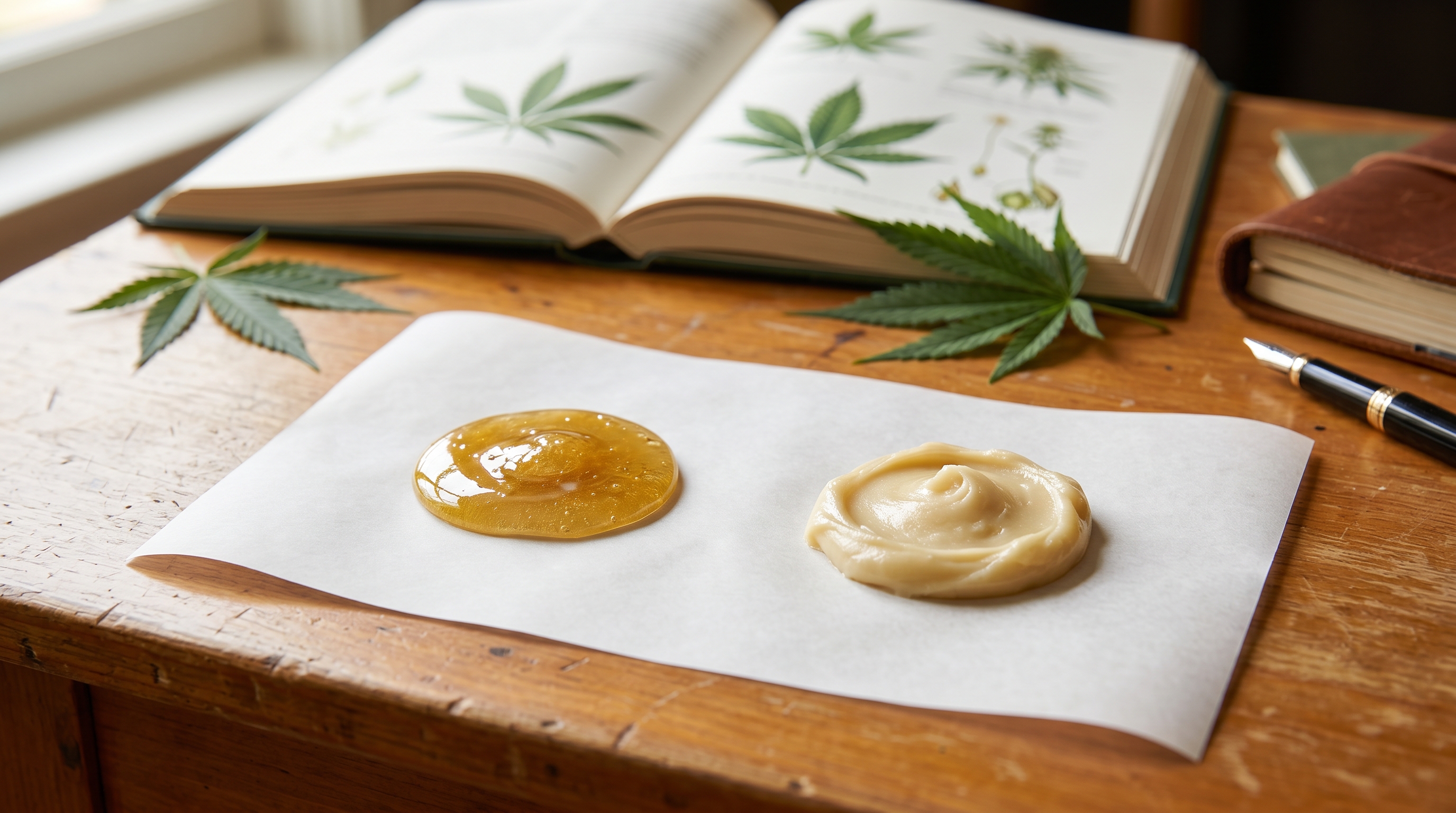
Here is the thing nobody tells you when you buy your first jar of hash rosin: the same press, the same hash, and the same person operating it can produce two wildly different products depending on what happens in the hours after the plates close. One person scoops a glassy, sappy oil straight off the parchment and dabs it that night. Another scrapes the exact same rosin into a tiny glass jar, tucks it somewhere cool, and waits three days for it to transform into a creamy, opaque budder. Both are real. Both are correct. They just answer different questions.
Welcome to one of the most misunderstood forks in all of solventless cannabis: fresh press versus cold cure. If you have ever stood at a dispensary counter wondering why one rosin looks like liquid amber and the one right next to it looks like cake frosting, this guide is for you. I am going to walk you through what each technique actually does, the physics of why rosin “budders up,” the temperatures and timing that matter, and how to decide which one belongs on your dab tool tonight.
Start with what they have in common
Before we split them apart, let us be clear about what is not different. Both fresh press and cold cure begin life as the exact same thing: hash rosin, the amber oil that comes out when you press bubble hash or dry sift between two heated plates. No solvents, no butane, no ethanol — just heat and pressure squeezing the resin out of trichome heads. If you want the full primer on how that squeeze happens, our home rosin press guide covers the micron bags, temperatures, and yields.
So the raw material is identical. Fresh press and cold cure are not different extractions. They are different post-processing choices applied to the very same oil. That distinction is the whole ballgame, and it is why so many people get confused — they assume “cold cure” is a kind of plant or a kind of press. It is neither. It is a curing technique.
Fresh press: the raw, unedited version
Fresh press rosin is exactly what it sounds like. You press, you collect, you store cold (or dab it more or less immediately). There is no waiting period and no transformation step. What comes off the plates is what you consume.
Because it has not been agitated or aged, fresh press tends to be glassy and translucent, ranging from pale gold to rich amber. Its consistency is temperature-sensitive in a way that surprises newcomers: warm it slightly and it goes sappy and oily, almost like honey; chill it and it firms up into a brittle “snap and pull” or shatter-like state. Many people keep fresh press cold precisely to keep it workable.
The big selling point of fresh press is flavor immediacy. The terpenes — the aromatic limonene, myrcene, caryophyllene, and terpinolene that give each cultivar its signature nose — are still fully integrated and have not been disturbed. A fresh press dab is bright, loud, and strain-faithful. It tastes the most like the living plant. The tradeoff is that those volatile terpenes are also the most fragile, so fresh press does not hold its peak flavor or texture for long. It is a “consume it soon” product.
Cold cure: letting the rosin reorganize itself
Cold cure takes the opposite approach. Instead of dabbing the fresh oil, you scrape it into a small airtight glass jar and store it in a cool, dark place — typically somewhere in the 50-70°F (roughly 15-21°C) range — for anywhere from about 72 hours up to a week or more. Some processors refrigerate, many do not. Over those days, something genuinely fascinating happens: the clear, glassy oil slowly turns opaque, pale, and creamy, settling into the texture connoisseurs call budder, badder, or batter (those three words are basically interchangeable).
This is not the rosin “going bad.” It is the rosin organizing itself into a more thermodynamically stable arrangement. And the engine behind it has a name.
The science: nucleation, lipids, and why it turns to butter
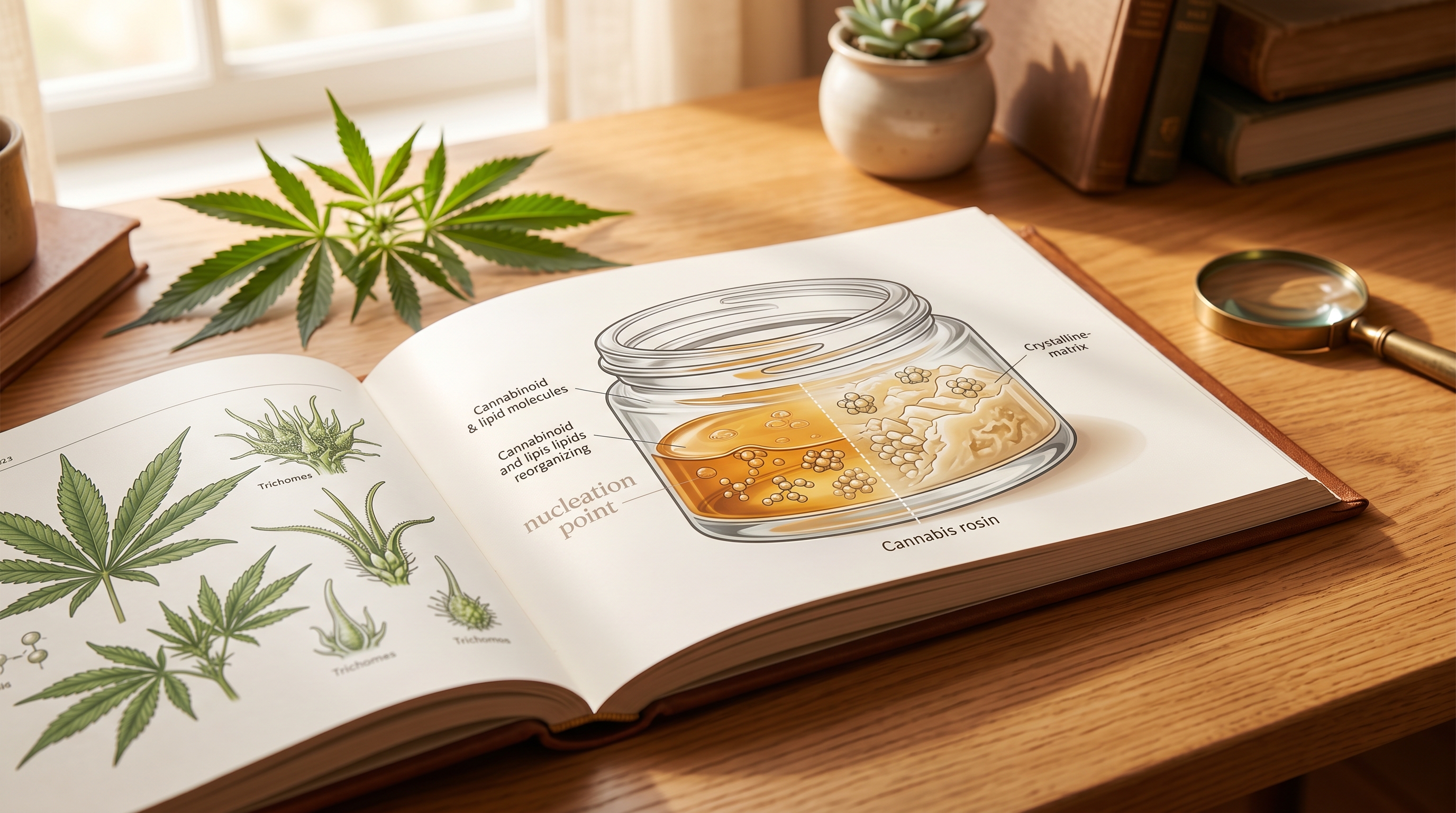
The transformation in a cold-cure jar is driven by nucleation — the same physical process behind crystals forming in honey or sugar syrup. In materials science, nucleation is the moment a new, more ordered phase starts to form inside a “metastable parent phase,” which is a fancy way of saying a liquid that is technically unstable and just needs a nudge to reorganize.
Fresh rosin is a supersaturated jumble: cannabinoids (mostly THCA), plant lipids, waxes, and terpenes all dissolved together in a clear glassy state. That glassy state looks stable, but it is not the lowest-energy arrangement. Given a little time and the right temperature, the dissolved fats, waxes, and cannabinoids begin to separate and self-assemble into tiny structured domains. As those micro-structures multiply throughout the oil, they scatter light — which is why the rosin shifts from clear to opaque — and they give the mass body and structure, which is why it firms from runny sap into scoopable budder.
The temperature window matters a lot here. Cure too warm (above roughly 75°F) and the process races, terpenes evaporate, and cannabinoids can oxidize — that is closer to a hot cure, which intentionally drives separation into sauce and THCA diamonds swimming in a terp pool. Cure too cold (below roughly 55°F) and nucleation may stall out and never properly set up. The 50-70°F sweet spot lets the structure build gradually, preserving terpenes while still achieving a stable, uniform texture.
There is a terpene-redistribution wrinkle, too. As the matrix forms, terpenes often get squeezed out and pool on top of the rosin as a visible liquid layer. Processors fix this with two moves: whipping (more aggressive stirring, often at the 24- and 72-hour marks, which costs a little terpene volume but boosts stability) or gentle spinning with a dab tool (slower, gentler, re-incorporating the terps with less loss). The payoff is a concentrate where the flavor is woven evenly through the whole jar rather than concentrated in one greasy pool.
Cold cure vs hot cure (and where “live” fits in)
Quick clarification, because the terms get muddled. Cold cure uses cool temperatures to preserve terpenes and produce that smooth budder/batter. Hot cure (or warm cure) deliberately uses warmth to accelerate separation and produce sauce, jam, or diamond-and-sauce textures — a different aesthetic with different flavor dynamics and generally more terpene loss.
And live rosin? That word describes the starting material, not the cure. “Live” means the cannabis was flash-frozen fresh rather than dried and cured, preserving a richer, more volatile terpene profile in the hash before it is ever pressed. You can cold-cure live rosin, fresh-press live rosin, or hot-cure it. For the full breakdown of solventless terminology, see our explainer on live resin vs live rosin and the related look at cured resin vs live resin.
Side-by-side comparison
| Factor | Fresh Press | Cold Cure |
|---|---|---|
| Post-press step | None — collect and consume | Sealed glass jar, 50-70°F, ~72 hrs to 1+ week |
| Appearance | Glassy, translucent, gold to amber | Opaque, pale, creamy |
| Texture | Sappy when warm, brittle when cold | Stable budder / badder / batter |
| Driving process | None (raw oil) | Nucleation (lipids + cannabinoids reorganize) |
| Flavor character | Bright, loud, most strain-faithful | Rounded, even, complex |
| Terpene handling | Fully integrated but most volatile | Redistributed via whip/spin, more evenly held |
| Shelf stability | Lower — best consumed soon | Higher — packages and ships well |
| Handling on a tool | Can be drippy and awkward | Scoops clean, holds its shape |
| Best for | Purists chasing peak fresh flavor | Everyday use, consistency, retail |
Why connoisseurs prize cold cure
If fresh press is the most “honest” version of the plant, why has cold cure become the darling of the solventless scene? A few reasons:
It is easier to handle. Anyone who has chased a puddle of warm sappy rosin around a piece of parchment knows the appeal of a budder you can simply scoop. Cold cure holds its shape on the dab tool and behaves itself.
It is more shelf-stable. That stable nucleated matrix resists the rapid degradation fresh press is prone to, which is why nearly all retail hash rosin you see on a dispensary shelf is cold-cured. It can be jarred, shipped, and stored with far less risk of turning into a separated mess.
The flavor matures. Many tasters describe cold cure as rounder and more complex than fresh press — less of a sharp top note, more of a full, even profile that carries from the first dab to the last. The terpene redistribution is doing real work here.
None of this makes fresh press “worse.” It makes it different. Fresh press is the closest thing to tasting the press itself; cold cure is a refined, stabilized, crowd-friendly edit of the same material.
How the terpene profile drives the experience
Here is where I have to put on my Professor High hat and remind you of the thing this whole site is built on: the cure changes the texture and tilts the flavor, but the terpene profile of the hash is what actually steers your high. A cold-cured budder loaded with myrcene is going to lean heavy and couch-locked no matter how pretty it looks — that is classic Relax High territory. A terpinolene-forward fresh press will feel bright and heady, the hallmark of the Energy High family. Caryophyllene-dominant material trends toward physical, body-centered Relief High effects, while limonene-rich profiles push the mood-lifting Uplift High direction.
This is also why two cold-cure budders can hit completely differently. The texture is the same; the chemistry underneath is not. Strains like GMO Cookies, Papaya, Sundae Driver, and Apples and Bananas are popular hash-rosin cultivars precisely because they wash well and carry distinctive terpene loads — but each will produce a budder with its own personality. Want to feel calm and focused? Look at the calm effect and focused effect profiles rather than fixating on whether the jar says “cold cure.”
If you are newer to all of this, do not let the terminology intimidate you. Start with our dabbing 101 beginner’s guide and the broader complete guide to cannabis concentrates, then come back here once the vocabulary feels comfortable.
Practical tips if you want to cold cure at home
If you press your own and want to try cold curing, the rules are refreshingly simple:
- Use airtight glass only. No silicone, no plastic. Terpenes interact poorly with those materials, and you want a clean, non-reactive container sized close to your rosin volume to minimize oxygen headspace.
- Hold the temperature. Aim for that 50-70°F band. A cool cupboard often works; a wine fridge is even better. If you refrigerate, let the sealed jar return to room temperature before opening so condensation does not form on your rosin.
- Keep it dark. Light degrades cannabinoids and terpenes. Treat your curing jar like a fine olive oil.
- Redistribute as needed. If terpenes pool on top, gently spin them back in with a clean dab tool, or whip more aggressively if you want maximum stability and do not mind a small terpene cost.
- Be patient. Most rosin sets up in 72 hours to a week. Resist the urge to keep opening the jar — every open is an oxygen and condensation event.
For the dabbing side of things, the temperature you vaporize at matters as much as the cure. Both fresh press and cold cure shine at low temps; our banger vs nail dab setup guide and the dab rigs buyer’s guide will help you dial it in.
So which one should you choose?
There is no universally “better” answer — only a better answer for you, right now.
Choose fresh press if you are a flavor chaser who wants the brightest, most strain-faithful expression possible and you plan to consume it quickly. It is the truest snapshot of the plant.
Choose cold cure if you want a stable, scoopable, easy-to-handle concentrate with a rounded, mature flavor that holds up over time — basically, the everyday connoisseur’s default and the reason most premium retail rosin looks like budder.
And remember the meta-lesson: the cure is a finish, not a personality. The personality lives in the terpenes. The smartest move is to stop guessing from a label and start tracking how specific terpene profiles actually make you feel — which budder calmed you, which fresh press wired you up, which cultivar you keep reaching for. That is exactly what the High IQ app is built to help you do: log your sessions, surface your patterns, and figure out your personal map across the High Families instead of trusting a sticker. The technique gets you a texture. Tracking gets you a routine that works.
Key Takeaways
- Same starting material. Fresh press and cold cure are both hash rosin — the difference is entirely in what happens after pressing, not in the extraction itself.
- Fresh press = raw and bright. Glassy, sappy, most strain-faithful flavor, but volatile and best consumed quickly.
- Cold cure = stable and rounded. A few days in a sealed glass jar at 50-70°F triggers nucleation, turning glassy oil into a creamy, scoopable budder with evenly distributed terpenes.
- Temperature decides the texture. The 50-70°F window preserves terpenes; warmer pushes toward sauce and diamonds (hot cure), colder may never set up.
- “Live” is the input, not the cure. You can cold-cure or fresh-press live rosin alike.
- Terpenes steer the high, not the texture. Track which profiles work for you rather than trusting a label.
Sources
- LowTemp Plates — “Fresh Press Rosin vs Cold Cure Rosin”: https://www.lowtemp-plates.com/blogs/knowledge/fresh-press-rosin-vs-cold-cure-rosin
- LowTemp Plates — “How to Cure Rosin: Cold Curing vs Heat Curing”: https://www.lowtemp-plates.com/blogs/knowledge/how-to-cure-rosin
- The Press Club — “How To Cold Cure Rosin”: https://thepressclub.co/blogs/tips-tricks/how-to-cold-cure-rosin
- The Press Club — “Cold Curing vs Warm Curing Rosin”: https://thepressclub.co/blogs/tips-tricks/cold-curing-vs-warm-curing-rosin
- Respect My Region — “Hash Rosin Consistencies Explained: Fresh Press, Cold Cure”: https://respectmyregion.com/hash-rosin-consistencies-information-2025/
- Triminator — “How to Cold Cure Rosin”: https://thetriminator.com/how-to-cold-cure-rosin/
- Herb — “The Rise of Cold-Cured Rosin”: https://herb.co/learn/herbworthy/cold-cured-rosin-vs-live-resin


