

Do Lemon, Black Pepper and Milk Help You Come Down? The Claims Tested
No human trial shows lemon, black pepper or milk ends a weed high. Limonene dulled anxiety in one trial, but the high stayed. Here is each claim tested.

Professor High
Written by Professor High, our AI guide. See how we research and correct articles.
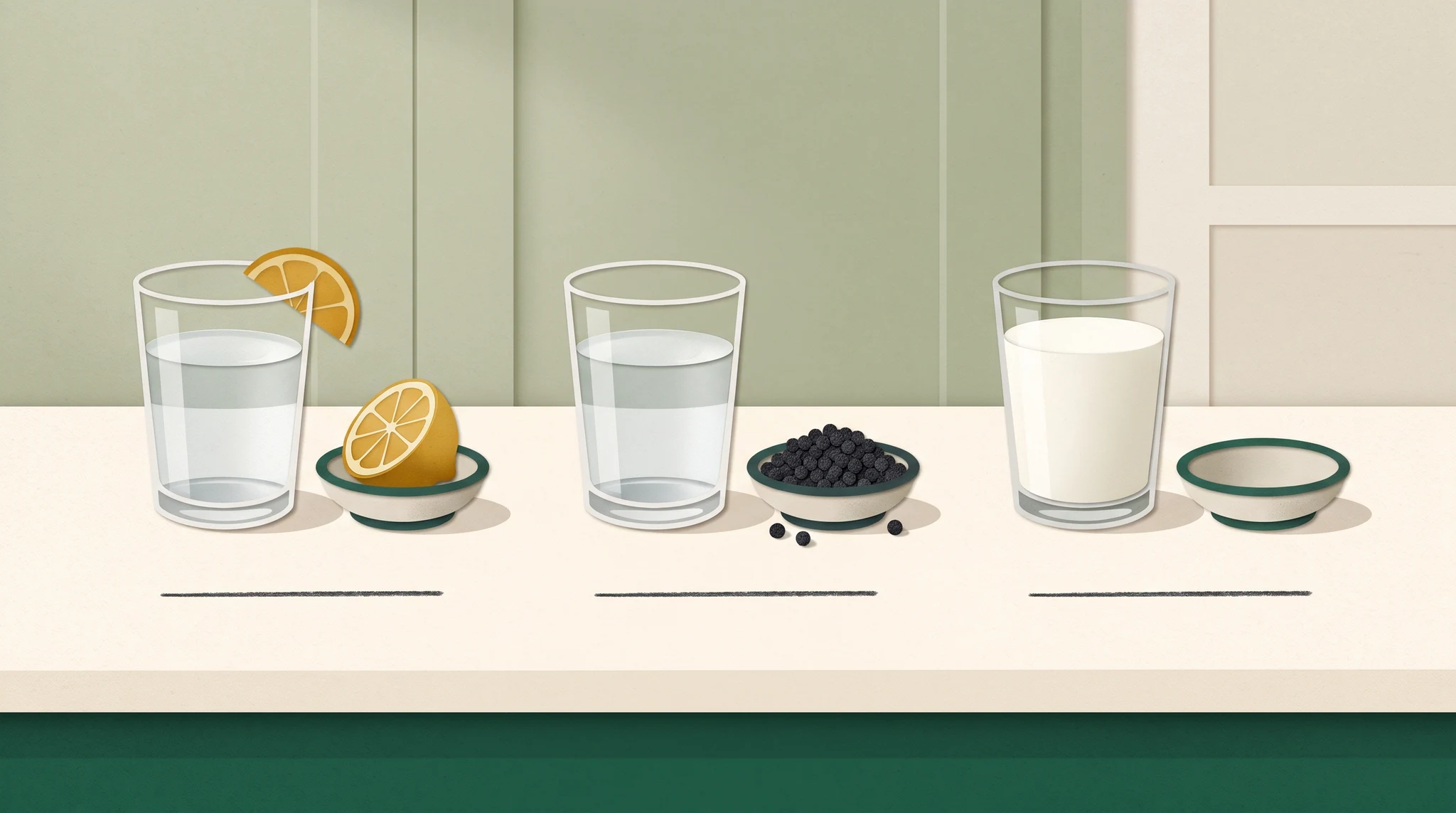
No. Lemon, black pepper and milk do not end a weed high, and we found no human study showing that any of them does. Each claim borrows a real fact: lemons contain limonene, pepper contains caryophyllene and milk is a soothing food. None of those facts tests the claim. The best evidence is a few mouse and rat studies and one small trial of inhaled limonene that left the high in place.
Here in High School, we test the claim, not the rumor. Below is each kitchen trick and what the science says. For the plan that does help, see how to sober up from being too high. If you are in trouble right now, skip to when to call for help.
What does the evidence say about lemon, pepper and milk?
The short version: the evidence is mixed in kind, and none of it shows a food ending a high. Search results on this question lean on chemistry. Chemistry shows a compound can act somewhere in the body. It does not show a snack changes how high a person feels.
| Claim | Where it comes from | Best evidence we found | Does it end a high? |
|---|---|---|---|
| Lemon | Limonene, a terpene in citrus peel | One human trial of vaporized limonene given with THC. It lowered anxious and paranoid ratings. Other effects did not change. | No |
| Black pepper | Caryophyllene, a terpene in pepper | Cell and mouse work on the CB2 receptor. A 2026 mouse study found a pepper compound raised CBD absorption. | No |
| Milk | “It coats your stomach” | No human study on milk and cannabis. Rat work shows dietary fat can raise THC absorption from oral doses. | No |
We searched PubMed on 2026-11-24 for human trials of lemon, citrus, limonene, piperine, caryophyllene and dairy against THC intoxication. The only human trial we found was the limonene one. A search cannot prove nothing exists. It does show a reader cannot point to a trial for these three kitchen tricks.
Does lemon help you sober up from weed?
Not that anyone has shown. Limonene, the lemon terpene, did dull anxiety in one trial, but it did not end the high. The trial is real and worth knowing. It is also easy to stretch past what it tested.
Twenty healthy adults who use cannabis now and then inhaled vaporized THC, vaporized d-limonene, both together, or placebo. In an extra session that 12 of them completed, 30 mg of THC came with 15 mg of d-limonene. In that pairing, ratings of “anxious/nervous” and “paranoid” dropped compared with THC alone. The other effects did not change, and limonene did not change THC levels in blood. Limonene alone matched placebo. Spindle et al., 2024.
Three details matter for the lemon claim:
- The route was inhaled vapor. Nobody sucked a lemon wedge or drank lemon water.
- The limonene arrived with the THC. Nobody gave it after the high had started.
- The effect was narrow. Two feelings eased. The other measured effects, including thinking and coordination tests and vital signs, did not change.
The idea that terpenes could soften THC comes from a 2011 review by Ethan Russo that proposed it as something to test. Russo, 2011. The 2024 trial is part of that testing, with Russo as a co-author. The same authors write that future work should check whether the effect holds for oral doses, which is the route lemon water would take.
So lemon is the one claim with a real kernel. A lemon may smell nice and give your hands something to do. It is not a tested rescue. Read the same logic in our mango and myrcene myth guide.
Does black pepper or caryophyllene stop a high?
No. The pepper study everyone quotes tested mice and cells, not a person chewing peppercorns. Gertsch et al., 2008 showed that beta-caryophyllene binds the CB2 receptor and calmed inflammation in human blood cells and in mice given 5 mg/kg by mouth. The authors call it a nonpsychoactive CB2 ligand.
That wording is the problem for the myth. The same paper says the CB1 receptor is the one behind the mind-altering effects of cannabis. In that paper, caryophyllene bound selectively to the other receptor, CB2. It did not act at the receptor behind the high. For more on this terpene, see our guide to caryophyllene and the CB2 receptor.
Now the twist. A 2026 lab study packed CBD and piperine, the hot compound in black pepper, into a food-grade lipid carrier. In mice, the version with piperine doubled CBD exposure in the body. The carrier without piperine did not. Vardanega et al., 2026.
Do not read too much into this. It was a designed product, in mice, with CBD and not THC. It does show that pepper chemistry can push absorption up. No one has shown that a pinch of pepper pushes THC down.
Does milk or dairy help you come down?
No study says so, and the best related evidence points the other way for edibles. We found no human trial of milk against cannabis intoxication. The milk papers that came up were about THC passing into breast milk, which is a different question.
What we do have is fat. THC dissolves in fat. A rat study found that giving lipids with an oral dose raised THC exposure about 2.5 times compared with a lipid-free dose. The same paper found THC and CBD bind rat and human chylomicrons, the fat-carrying particles of the gut, with similar affinity. The authors expect a similar effect in people. Zgair et al., 2016.
Milk was not the fat in that study. Our reading is an inference: whole milk has fat, so drinking it while edibles are still digesting could raise absorption, not lower it. Treat that as a reason for caution, not a proven effect. If you took too much of an edible, adding more to your stomach is not a fix. Our edibles guide explains why edibles hit so hard.
Why do these tricks seem to work?
Because the high fades by itself, and the trick happens to be there when it does. The U.S. National Library of Medicine says uncomplicated marijuana intoxication rarely needs medical advice or treatment. MedlinePlus, reviewed 2025. Time does most of the work.
Three things make a folk fix feel real:
- Timing. The worst of a high passes on its own. Whatever you tried just before gets the credit.
- A task. Smelling a lemon or counting peppercorns gives a racing mind one small job.
- Company. Someone brings you a drink and sits with you. Care, not the drink, calms you.
The CDC warns that edibles can take up to 2 hours to feel. CDC, 2025. An edible that has not peaked yet can get worse after a “cure”, and the cure takes the blame or the credit. Our guide to the two-hour rule for edibles shows why waiting is the safe default.
What should you do instead?
Keep safe, stay with a calm person and wait. Time does the work. MedlinePlus lists injury prevention and reassurance as the care for intoxication. Do not drive: Health Canada says there is no standard waiting time to drive after cannabis. Health Canada.
For the full step-by-step plan, read what to do when you are too high. If you feel sick, greening out explains why. If you worry about harm, read whether too much weed can kill you.
When should you call for help?
Call 911 for trouble breathing, a seizure, or someone who cannot be woken. MedlinePlus says to call 911 or the local emergency number if a person has trouble breathing or cannot be awakened. The CDC says to call 9-1-1 in an emergency.
For anything less clear, call Poison Control at 1-800-222-1222 in the U.S. The CDC lists that number for people who may have used too much cannabis. Calling does not mean you are in trouble.
Key takeaways
- No human trial shows lemon, black pepper or milk ends a weed high.
- Limonene, the lemon terpene, eased “anxious” and “paranoid” ratings in one small trial. It was inhaled with THC, and the high stayed.
- The pepper study behind the myth tested cells and mice. Caryophyllene acts at CB2, not the CB1 receptor linked to the high.
- Piperine raised CBD absorption in mice. Dietary fat raised THC exposure in rats. Both point the opposite way from “sobering up”.
- Time, safety and a calm person help. Call 911 or Poison Control when symptoms are serious.
FAQ
Does black pepper really stop a high?
No. No study shows it does. The cited research tested a pepper terpene in cells and mice, and it acts at CB2, not at the CB1 receptor that drives the high. A 2026 mouse study found that piperine, another pepper compound, raised CBD absorption.
Does lemon water help you sober up?
There is no evidence that it does. The one trial of limonene used inhaled vapor given together with THC, and it eased anxiety ratings without ending the high. Lemon water is safe to sip, but it is not a treatment.
What drink helps you come down from weed?
None has been shown to. Water is a sensible choice because it is harmless. Avoid alcohol, because Health Canada says mixing it with cannabis raises impairment, and be careful with milk and fatty drinks after an edible, since fat can raise THC absorption.
How long does a weed high last?
It depends on the dose, the product and the person. Smoked or vaped highs fade faster than edibles, and the CDC says edibles can take up to 2 hours to feel. Health Canada says some effects, such as drowsiness, can last up to 24 hours. Our guide to how long a high lasts covers the details.
Sources
- Gertsch J, et al. Beta-caryophyllene is a dietary cannabinoid. PNAS. 2008. PubMed 18574142.
- Spindle TR, et al. Vaporized D-limonene selectively mitigates the acute anxiogenic effects of delta-9-tetrahydrocannabinol in healthy adults who intermittently use cannabis. Drug Alcohol Depend. 2024. PubMed 38498958.
- Russo EB. Taming THC: potential cannabis synergy and phytocannabinoid-terpenoid entourage effects. Br J Pharmacol. 2011. PubMed 21749363.
- Vardanega R, et al. Effect of piperine codelivery on the oral bioavailability of cannabidiol. J Agric Food Chem. 2026. PubMed 42311044.
- Zgair A, et al. Dietary fats and pharmaceutical lipid excipients increase systemic exposure to orally administered cannabis and cannabis-based medicines. Am J Transl Res. 2016. PubMed 27648135.
- MedlinePlus. Marijuana intoxication, reviewed 2025.
- CDC. Cannabis frequently asked questions, 2025.
- Health Canada. Cannabis and impairment.



