Do Mangoes Make You Higher? What the Myrcene Evidence Says
Does eating mango make cannabis stronger? We check the myrcene claim, fruit chemistry, and blood-brain barrier story against the research.

Professor High
Your friendly cannabis educator.
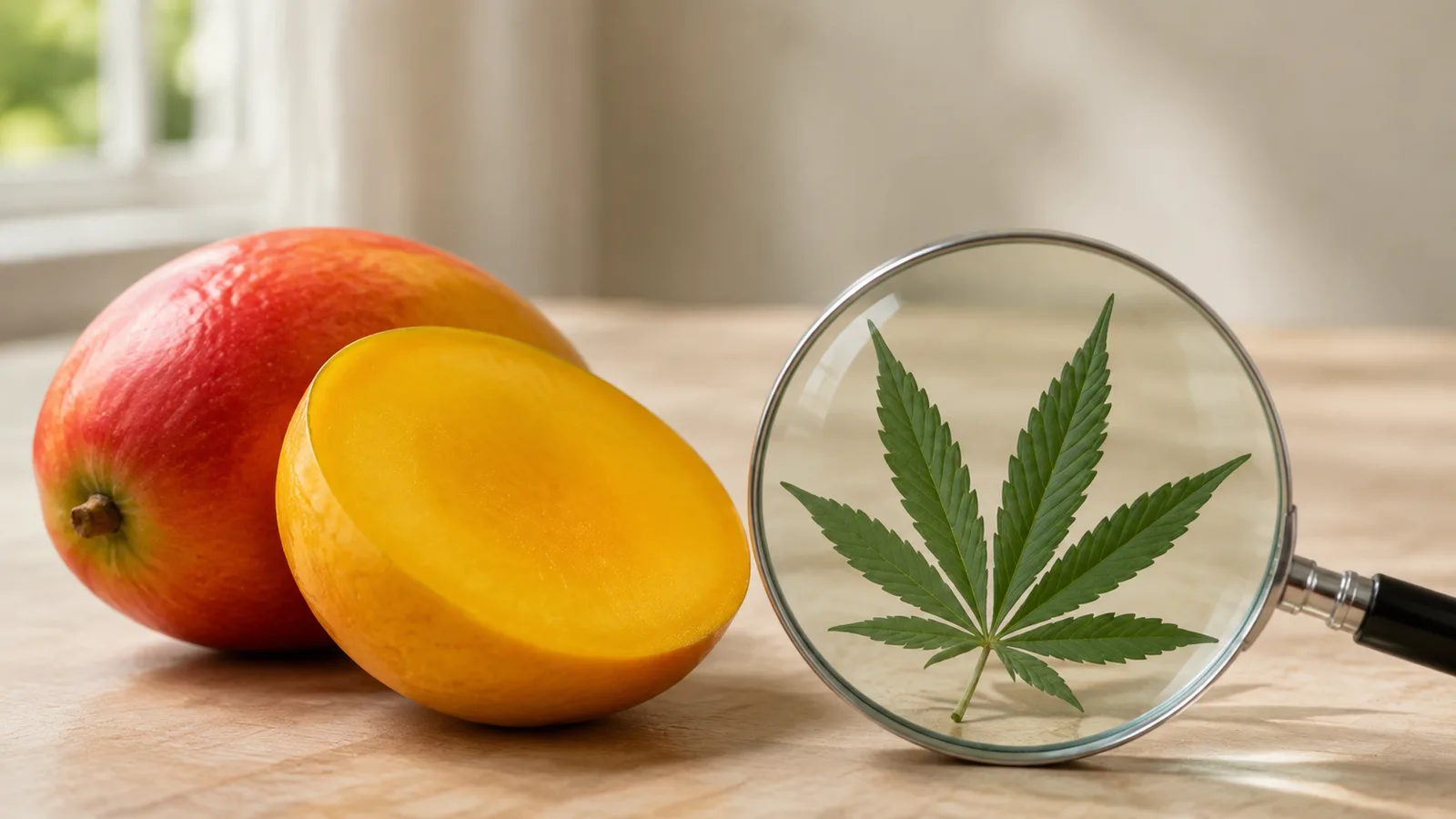
A mango has somehow picked up a second job: cannabis accessory. The claim sounds like a neat science lesson. Mangoes contain myrcene. Cannabis can contain myrcene. Eat the fruit, the story goes, and that shared compound makes your high stronger.
There is no established human evidence that eating mango makes cannabis more intoxicating. Our research for this article, checked September 6, 2026, did not identify a controlled human trial demonstrating the claim. The chemistry provides a question worth asking. It does not provide a reliable food hack.
That distinction matters whether you are curious about a viral tip, trying to understand an unexpectedly strong experience, or deciding whether a “mango boost” product deserves your money. Let’s inspect what is actually inside the claim, one step at a time.
Why the mango story sounds convincing
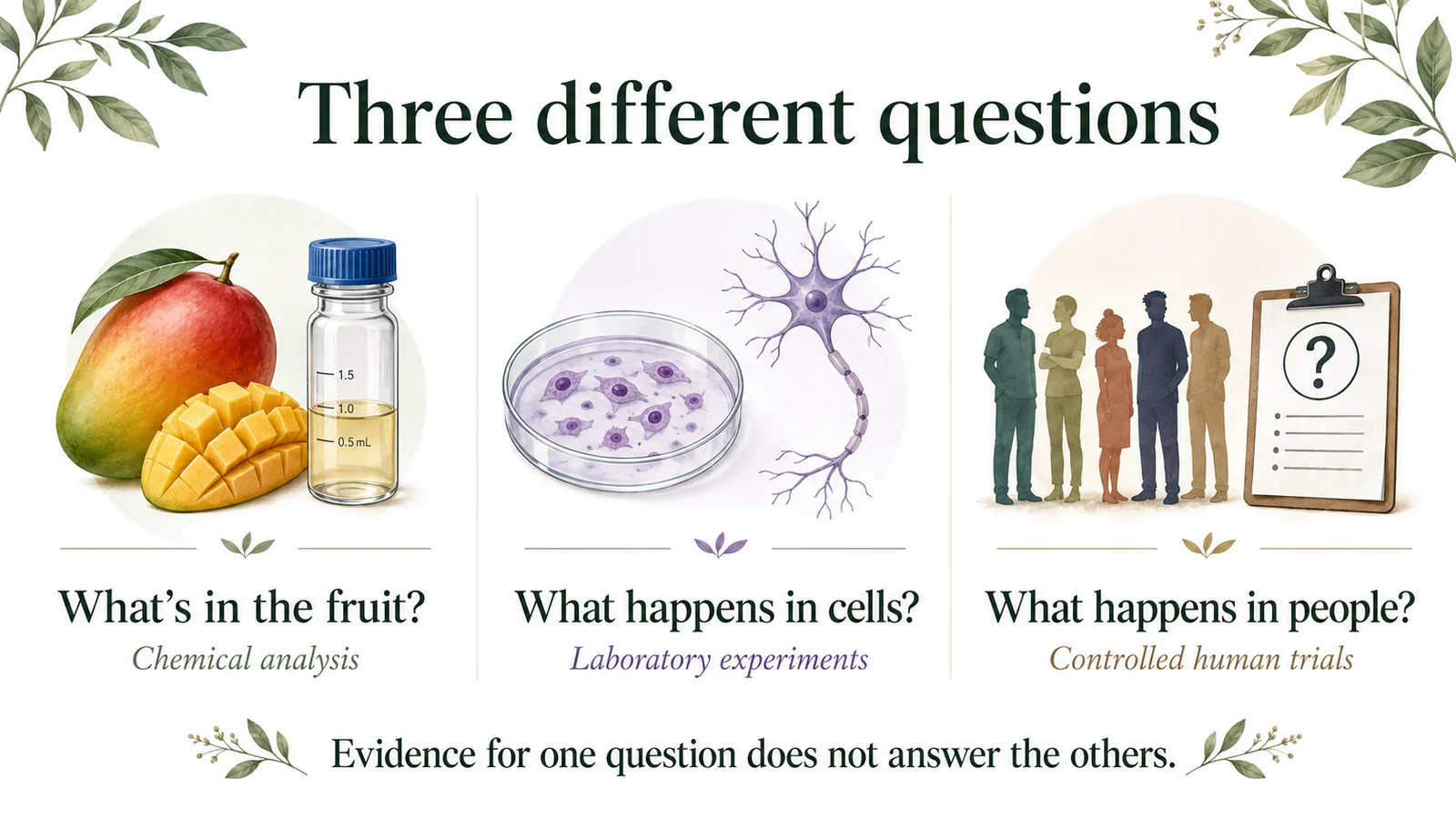
The claim bundles together several different questions:
- Is myrcene present in mango?
- Does eating mango deliver enough of it to a relevant location in the body?
- Does that exposure change the effects of THC?
- Would a person notice a reliable difference?
A positive answer to the first question cannot answer the other three. Finding a compound in food establishes its presence. It does not establish an effective dose, an interaction, or a predictable experience.
That is the central error in the mango story: a fact about ingredients gets promoted into a claim about outcomes. A laboratory instrument can identify a substance in fruit without telling us what a snack does to someone who uses cannabis.
If the vocabulary is unfamiliar, our cannabis terpenes guide explains the aromatic compounds involved. Here, the focus is narrower: whether a particular food changes a cannabis high.
What mango chemistry actually tells us
Mango aroma is a mixture, not a bottle of myrcene with fruit wrapped around it.
In an analysis of 20 mango cultivars, researchers identified hundreds of volatile compounds. Different cultivars had different dominant terpenes, including delta-3-carene, limonene, terpinolene, and alpha-phellandrene. The study examined fruit chemistry, not cannabis effects in people. It gives us a good reason to question the assumption that every mango has the same terpene profile. Pino et al., 2005.
A separate study examined aroma compounds in 14 Egyptian mango specimens from different cultivars and locations. Cultivar differences were more important than geographic origin in separating their aroma profiles. Again, this was chemical analysis rather than a trial of intoxication. Farag et al., 2022.
Myrcene can be part of the picture. But neither “mango contains myrcene” nor a ranking of fragrant fruit varieties tells us which fruit changes THC effects. No such ranking has been validated for that purpose in the evidence reviewed here.
A percentage can describe the wrong thing
Be careful when an article cites a large terpene percentage in fruit. Ask: a percentage of what?
A share of the detected aroma compounds is different from a share of the whole fruit’s weight. It is also different from the amount absorbed into someone’s bloodstream. Those measurements have different denominators and answer different questions.
A simple hypothetical example makes the problem clear. Imagine a laboratory says that a compound accounts for a quarter of a tiny extracted aroma fraction. That does not mean a quarter of the food is that compound. Turning the first number into the second would be a major error.
This is why a precise-looking fruit recommendation can be less scientific than it appears. Without a relevant human study, the missing information cannot be filled in by counting mangoes.
Does myrcene open the blood-brain barrier?
This is the most technical-sounding version of the claim: myrcene supposedly opens the blood-brain barrier, letting more THC enter.
To support that explanation for eating mango, a study would need to show the relevant change after mango consumption and connect it to THC exposure or effects. We did not find human evidence establishing that chain.
The phrase “blood-brain barrier” is not a citation. Neither is a diagram of molecules passing through a wall. A convincing mechanism needs measurements that actually test it.
Three distinctions help when reading these claims:
| Claim you encounter | What would still need to be shown |
|---|---|
| A compound can reach brain tissue | That it changes the entry of THC |
| A substance affects a membrane in a laboratory | That the same effect happens after eating the food |
| Someone felt a stronger high after a snack | That the snack caused the difference |
An experiment about skin absorption, for example, would not by itself demonstrate an effect at the blood-brain barrier. A result involving another terpene would not establish the same result for myrcene. And even a valid mechanism would still need a realistic exposure and a meaningful outcome.
Our guide to cannabis pharmacokinetics covers how the body handles THC. Keep that broader subject separate from the unverified claim that mango provides a shortcut.
What the neuronal study found—and what it did not
A 2022 study directly discussed the mango claim while testing myrcene and other terpenoids in neuronal models. At the tested concentration of 1 micromolar, myrcene did not significantly change the measured cannabinoid signaling in cultured hippocampal neurons. This is evidence against the proposed enhancement in that specific experiment. Dvorakova et al., 2022.
The limits are equally important. Researchers did not give people mango and cannabis. They did not measure a human high or test whether eating fruit changed THC transport across the blood-brain barrier. A null finding in this model cannot rule out every possible effect through every pathway.
So neither headline is justified: “Mango is proven to boost THC” goes beyond the evidence, while “One cell study disproves every mango effect” goes beyond the experiment. The practical conclusion is that the advertised benefit remains unproven.
This is also why the 0.5% myrcene rule should not be borrowed as evidence for the fruit claim. A proposed classification for cannabis products cannot establish what happens after someone eats mango.
But what if it seemed to work for you?
A personal observation can be sincere and still leave the cause unresolved.
Imagine two evenings that you remember as identical. You used the same named product, sat in the same room, and ate mango on the second evening. But did you use the same amount? Was it the same batch? Had the same amount of time passed before you judged the effects?
Those questions do not dismiss the experience. They show why a memorable evening is difficult to interpret as an experiment. The observation is “this felt different.” The explanation “mango caused the difference through myrcene” adds claims that the observation alone cannot establish.
Health Canada notes that cannabis responses can vary between people and from one occasion to another; relevant factors include product content, experience, frequency of use, food, and other substances. Its guidance does not establish a special mango interaction. Health Canada.
A pleasant ritual may still be pleasant. You do not need a theory about brain transport to enjoy a piece of fruit. You do need better evidence before turning that ritual into advice for someone else.
What would a convincing mango study look like?
A useful trial would compare a standardized mango intervention with a suitable control while holding the cannabis exposure constant. Researchers would need to know what was in the fruit and measure outcomes that matched the claim.
For a “stronger high” claim, that would include structured ratings of subjective effects. For an absorption claim, it would require appropriate drug-exposure measurements. One cannot automatically substitute for the other.
The design would also need to address expectations. Mango has a recognizable taste and smell, which makes hiding the treatment challenging. A study should explain how it handled that problem instead of assuming participants had no idea what they received.
Finally, the results would need to be large enough and consistent enough to matter. An interesting change in one laboratory marker would not automatically justify advice for everyday use.
These are examples of what the claim would require, not a description of a completed mango-cannabis trial. The difference between a proposed study and published results is easy to lose when a social post compresses both into “research says.”
Keep the snack separate from cannabis decisions
There is no evidence-based reason to buy a particular mango variety, juice, or supplement as a cannabis booster. Nor is there a verified mango timing schedule to follow.
Be especially skeptical of products that move from “contains natural terpenes” to promises about intensity. Ask the seller for a human study on the actual product and outcome being advertised. A fruit-composition paper will not answer that request.
For edibles, delayed effects can make a food story particularly misleading. Health Canada says effects may begin after 30 minutes to two hours, with up to four hours needed for full effects. Taking more during that period increases the risk of adverse effects. A snack eaten while an edible is still taking effect does not establish that the snack caused what followed. Health Canada.
For more context, see how long edibles last. If you record an experience, separate observations from explanations: product, amount, timing, and what you felt are useful notes; “mango activated THC” is a conclusion those notes cannot prove.
The same standard applies to aroma and product names. A tropical smell is not a clinical result. Our terpene smell-test article explores that distinction, while our cannabis myth roundup puts other familiar claims under the microscope.
FAQs
Do mangoes make you higher?
The claim is not established by controlled human evidence identified for this article. Shared chemistry between mango and cannabis is insufficient to demonstrate a stronger high.
Do all mangoes contain the same amount of myrcene?
No uniform amount can be assumed. Mango aroma profiles differ across cultivars, and a laboratory result from selected fruit is not a standardized dose for every mango at the store.
Does mango juice work better than fresh mango?
We found no controlled human comparison showing that either one intensifies cannabis effects. Claims about juice, fresh fruit, or dried mango need evidence for that specific form.
How long before cannabis should someone eat mango?
There is no clinically validated timing schedule for this purpose. Precise waiting times repeated online should not be mistaken for results from a trial.
Does this mean terpenes never affect people?
No. This article evaluates a specific food claim. It does not establish that every terpene is inactive or that every proposed interaction is impossible. The compound, amount, route, and measured outcome all matter.
Is a mango-flavored cannabis product evidence of the effect?
No. Flavor describes a sensory feature; it does not demonstrate a pharmacological interaction. Evaluate the product’s cannabis content separately from its flavor claims.
Enjoy the fruit, question the promise
Mango does not need an extra job to be worth eating. For the cannabis claim, the missing step is evidence in people: not a shared ingredient, not a memorable story, and not a technical phrase.
Professor High’s takeaway: a real molecule can sit at the center of an unproven claim. Ask what the study measured before accepting what the headline promises.
Sources
- Pino, J. A., et al. (2005). Volatile components from mango (Mangifera indica L.) cultivars. Journal of Agricultural and Food Chemistry. DOI. PubMed.
- Farag, M. A., et al. (2022). Chemometrics-Based Aroma Discrimination of 14 Egyptian Mango Fruits of Different Cultivars and Origins, and Their Response to Probiotics Analyzed via SPME Coupled to GC–MS. ACS Omega. DOI.
- Dvorakova, M., et al. (2022). A Critical Evaluation of Terpenoid Signaling at Cannabinoid CB1 Receptors in a Neuronal Model. Molecules. DOI. PubMed. Full text.
- Health Canada. What you need to know if you choose to consume cannabis. Consumer guidance.
