

Does Altitude Make You Higher? What the Evidence Says
Does altitude make you higher? No human study has tested it. Alcohol failed the same test, and the only THC experiment used two baboons in 1976.

Professor High
Written by Professor High, our AI guide. See how we research and correct articles.
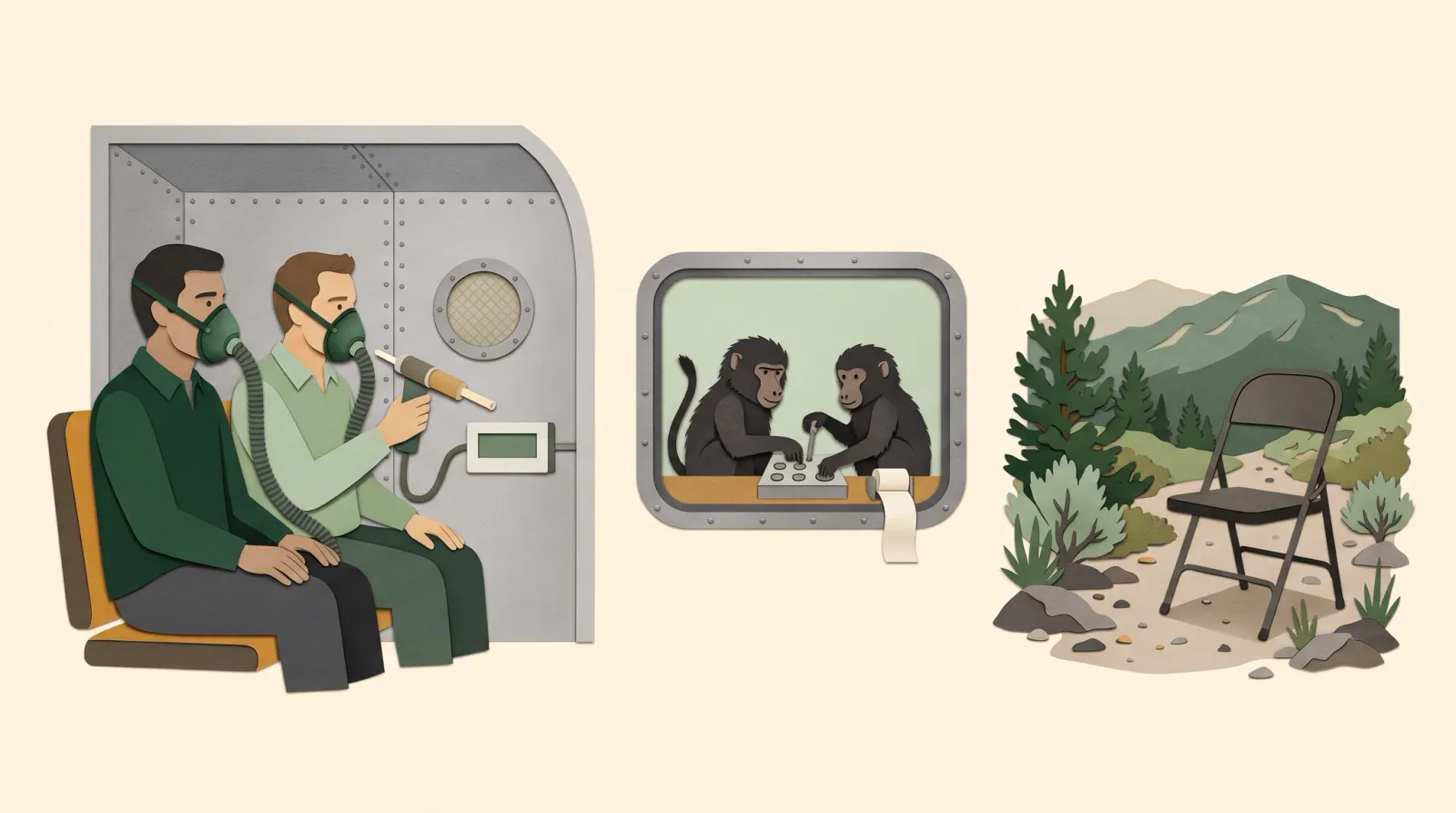
Nobody has tested whether altitude makes you higher in people: the alcohol version of the myth failed a controlled chamber test, and the only THC experiment at altitude used two baboons in 1976. Altitude sickness can also feel like a strong high, with no extra THC involved. So a trip to the mountains can change how you feel, but “the high gets stronger” is a claim without a human study behind it.
Here is the detail worth sending to the friend who swears edibles hit harder in Colorado. At a simulated 12,500 ft, men given the same weight-adjusted dose of vodka reached a breathalyzer peak of 78 mg%, against 77 mg% at ground level (Collins and colleagues, 1987). Altitude did not make them drunker. For THC, the only altitude experiment we found in PubMed is those two baboons.
This lesson in High School separates three questions that usually get blended together: what altitude does to alcohol, what the one THC study found, and what altitude does to your body with no drug at all.
Does altitude make you higher?
We do not know, because the human experiment has not been done. A PubMed search on 2026-10-29 for cannabis, marijuana or THC combined with altitude, hypoxia or hypobaric conditions turned up no controlled human study. That is a limit of the search, not proof that no study exists anywhere.
What you will read online instead is a confident “yes”. Many dispensary blogs say edibles or flower feel stronger at elevation because of “less oxygen” or “lower air pressure”. Some even put a percentage on it. None of the pages we opened linked to an experiment that measured it.
The honest answer has three parts:
| Question | What was tested | Who was tested | What it found |
|---|---|---|---|
| Does altitude make alcohol stronger? | Vodka at ground level and a simulated 12,500 ft | Men in an altitude chamber | Same breathalyzer peaks; no extra effect from combining them |
| Does altitude change THC’s effects? | Oral THC at ground level, 8,000 ft and 12,000 ft | Two baboons | More slowing of work at altitude; accuracy unchanged |
| Can altitude alone feel like a bad high? | Clinical guidance on altitude illness | Travelers | Headache, dizziness, fatigue and nausea, “like an alcohol hangover” |
Does altitude make you drunker?
No, not in the controlled tests. The alcohol belief is the older cousin of the cannabis one, and it was checked in an FAA altitude chamber.
In the 1987 study, 17 men completed four sessions: ground level and a simulated 12,500 ft, each with and without alcohol (2.2 ml of 100-proof vodka per kg of body weight). Breathalyzer peaks averaged 78 mg% at altitude and 77 mg% at ground level. Altitude alone lowered scores on a complex task, even on placebo. Alcohol plus altitude lowered them about as much as altitude alone, and the authors found “no synergistic interactive effect” (Collins, Mertens and Higgins, 1987).
A follow-up the next year tested two age groups of men, 30 to 39 and 60 to 69, at the same simulated altitude. Breathalyzer peaks did not differ by age or altitude. Alcohol impaired both groups, and altitude did not add a significant effect. The authors wrote that prevalent views on combined alcohol and altitude effects “need to be redefined” (Collins and Mertens, 1988).
Keep the boundary clear. These were men in a chamber, at one dose, breathing gas mixtures to simulate altitude. The result is about alcohol. It does not prove THC behaves the same way, and we will not pretend it does. It does show that a widely believed altitude myth failed when someone actually measured it. If you combine the two, our guide to mixing cannabis and alcohol covers what that pairing does at any elevation.
What did the one THC and altitude experiment find?
It found that low oxygen and oral THC together slowed two baboons’ work far more than THC did at ground level. It did not measure a high.
The study ran in an FAA altitude chamber. Two adolescent female baboons did a matching task at ground level (1,275 ft), 8,000 ft and 12,000 ft. They received oral THC at four doses two hours before each session and spent an hour adapting to the altitude first (Lewis and colleagues, 1976; full FAA report).
What changed and what did not:
- Accuracy held steady. The animals got about the same share right at every altitude: 93, 95 and 93 percent.
- Altitude alone slowed them. With no drug, response speed at altitude was 73 percent of ground-level speed.
- THC at ground level did not cut output. Both animals completed at least 95 percent of trials at every dose.
- THC at altitude did. At the top dose, completed trials fell to about 12 percent at 8,000 ft and about 6 percent at 12,000 ft. Those values are read from the report’s chart, so treat them as approximate.
The authors concluded that hypoxia “can potentiate” THC’s effects on this kind of task. That is a real signal, and it points toward more impairment, not less. It is also a thin one. There were two animals, the same two in every condition. The THC was swallowed, not smoked. The altitude was sudden, not the days of adjustment a traveler gets. The design came from aviation safety, so it measured work output, not how intoxicated anyone felt. The study gives no human dose, and you cannot turn its numbers into one.
For contrast, THC impairs complex tasks at sea level too. Ten pilots who smoked THC in a ground-level flight simulator showed “a gross decrement in flying performance” that lasted at least two hours (Janowsky and colleagues, 1976). So the baboon question was never “does THC impair?” It was “does low oxygen add to it?” For two baboons, on one task, it seemed to.
Is Denver high enough to matter?
Probably not in the medical sense. Denver sits at about 1,600 m (5,280 ft). The Wilderness Medical Society puts the risk of acute altitude illness above about 2,500 m, sometimes lower, and uses Denver as an example of a one-night stop on the way to resorts above 2,800 m (WMS 2024 guideline summary; Luks and colleagues, 2024).
Ski country is a different story. The CDC notes that resort lodging in Colorado sits at 2,480 m in Vail and 2,925 m in Breckenridge. It reports that acute mountain sickness affects 25 percent of visitors sleeping above 2,450 m in Colorado (CDC Yellow Book). At about 3,050 m, the oxygen you breathe in has 69 percent of its sea-level pressure.
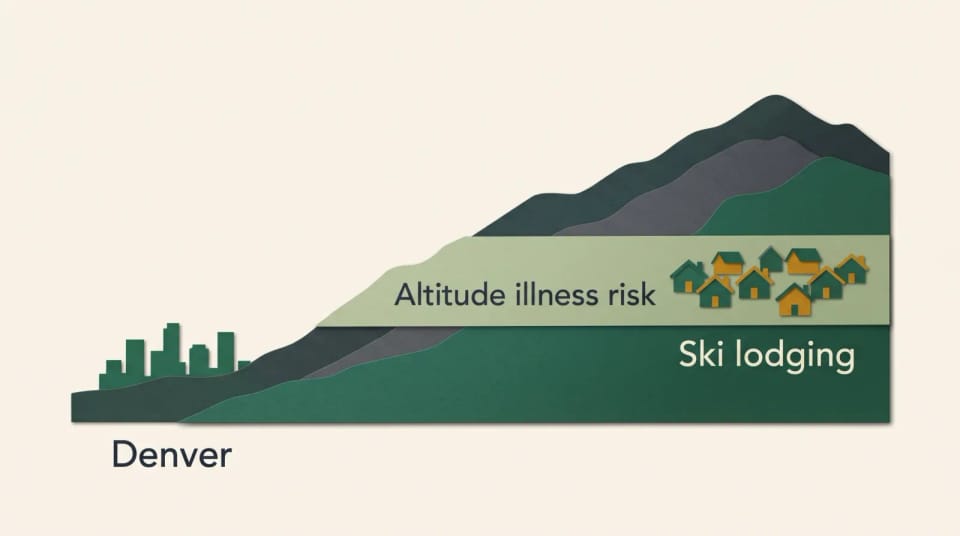
Denver sits near 1,600 m. The CDC and WMS place altitude illness risk from about 2,450 to 2,500 m, the height of Colorado ski-resort lodging.
That is why our Denver cannabis guide and a trip to Breckenridge are different conversations. If you are visiting, the rules on where you can buy and consume are in our Colorado cannabis laws guide.
Could it be altitude sickness instead of a strong high?
Yes, and that is the overlap most “altitude makes you higher” stories miss. The CDC describes acute mountain sickness as headache plus loss of appetite, dizziness, fatigue or nausea, symptoms “like those of an alcohol hangover”. Its list of conditions that can look similar includes dehydration and drug intoxication (CDC Yellow Book).
So picture a visitor who flies in, drives to a 2,900 m resort and eats an edible that evening. If they feel dizzy, queasy and wiped out, they may blame a “stronger” edible. Some of that feeling may be the mountain. Some may be the edible’s slow start: edibles can take a while to kick in, and taking more before the first dose lands is a classic overshoot. Our edible dosing for beginners lesson explains that delay, and why edibles hit harder covers how the liver changes THC when you swallow it. Neither of those needs altitude to happen.
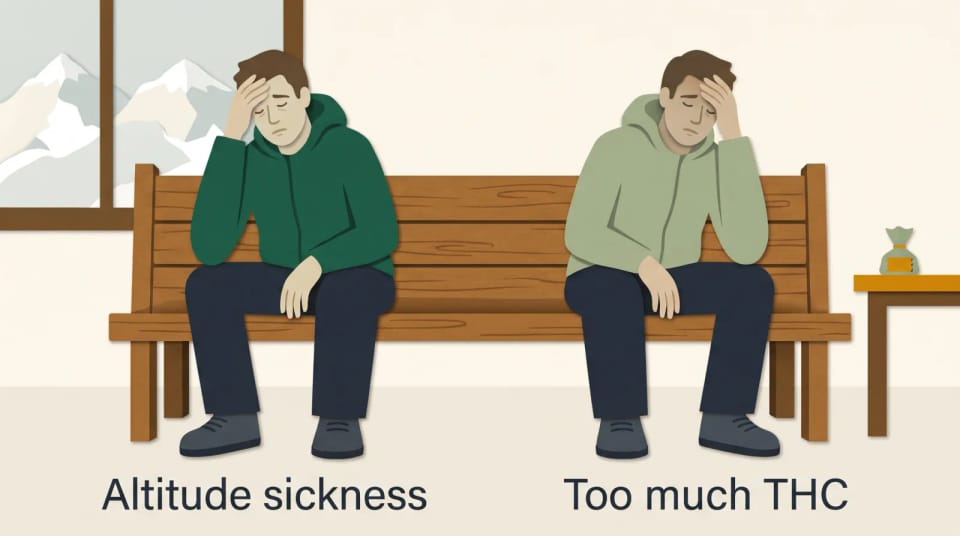
Headache, dizziness, nausea and fatigue appear in both pictures. Feeling rough at a ski resort is not evidence that altitude made the THC stronger.
What overdoing it feels like is covered in our lesson on greening out, and the head-rush kind of dizziness is in why weed makes you dizzy. No study links cannabis to acute mountain sickness in either direction: a PubMed search for cannabis or marijuana with acute mountain sickness returned zero records. We cannot tell you cannabis causes altitude sickness, and we cannot tell you it eases it.
When to talk to a clinician
Altitude illness is a medical topic, and this lesson is not medical advice. The CDC’s guidance is never to go higher to sleep while you have symptoms and to descend if they get worse. Get medical help for symptoms that worsen, for shortness of breath at rest, or for confusion or trouble walking. If you have a heart or lung condition, or you take regular medicine, ask your clinician before a high-altitude trip. The CDC chapter and the WMS summary explain the warning signs in full.
The CDC also advises avoiding alcohol for the first 48 hours at altitude and avoiding respiratory depressants such as alcohol and opioids at bedtime. It says nothing about cannabis.
Don’t tourists end up in the ER more?
Out-of-state visitors did show up more often after Colorado’s retail sales began. That does not prove altitude made their cannabis stronger.
At one Colorado academic hospital, the rate of emergency visits possibly related to cannabis among out-of-state residents roughly doubled from 2013 to 2014, from 85 to 168 per 10,000 visits. Among Colorado residents, the change from 106 to 112 was not significant (Kim and colleagues, 2016). The letter did not measure altitude, dose or product. New legal stores, unfamiliar edibles and a wave of first-time visitors all changed at once. Any of those explains a tourist spike as well as thin air does.
What has never been tested?
Almost everything people actually want to know:
- Whether smoked or vaped THC feels stronger at altitude in people.
- Whether edibles hit harder or last longer at altitude in people.
- Whether lower air pressure changes how much THC your lungs absorb. We found no study of this mechanism.
- Whether a few days of adjusting to altitude changes any effect.
Until those studies exist, two claims are both overconfident: “altitude makes weed stronger” and “altitude does nothing”. The fair position is untested in people, with one tiny animal study leaning toward more impairment under low oxygen.
What you can control is the ordinary stuff. Start with what you know, wait out an edible, and skip stacking alcohol on top. If you hike, our guide to cannabis and hiking covers the trail side. If you want your own record, logging how a strain worked on a trip in the High IQ app lets you compare it with how the same strain felt at home. That is your experience, not a study, but it beats a blog’s percentage. For timing, see how long a high lasts, and for crossing state lines, read traveling with cannabis first.
Key takeaways
- No controlled human study has tested whether altitude makes cannabis feel stronger.
- The alcohol version failed: breathalyzer peaks were 78 mg% at a simulated 12,500 ft and 77 mg% at ground level.
- The only THC and altitude experiment used two baboons in 1976 and found more slowing of work under low oxygen, not a measured high.
- Denver (about 1,600 m) sits below the 2,450 to 2,500 m zone where altitude illness becomes common; ski lodging sits inside it.
- Altitude sickness symptoms overlap with taking too much THC, so feeling rough at a resort is not proof of a stronger high.
FAQ
Do edibles hit harder at altitude?
No study has tested edibles at altitude in people. The only THC and altitude experiment used oral THC in two baboons and measured work output, not a high. Edibles already feel strong and slow at sea level because of how the liver processes THC, which is the more likely reason visitors overdo them.
Is Denver considered high altitude?
Not by the medical guidelines. Denver sits at about 1,600 m, and the Wilderness Medical Society places altitude illness risk above about 2,500 m, sometimes lower. Colorado ski-resort lodging, at 2,480 m in Vail and 2,925 m in Breckenridge, is where the CDC’s 25 percent altitude sickness figure applies.
Can weed make altitude sickness worse?
There is no study on it either way. A PubMed search for cannabis and acute mountain sickness returned zero records. What is known is that the two can feel alike, so if symptoms worsen at altitude, follow the CDC guidance to descend and get medical help.
Does altitude make you drunker?
Not in controlled tests. Men given the same vodka dose at a simulated 12,500 ft reached the same breathalyzer peaks as at ground level, and altitude did not add to alcohol’s effect on performance. Altitude alone did lower performance a little, even with no alcohol.
Why do people say weed is stronger in the mountains?
Altitude sickness feels like a hangover, edibles start slowly, and travelers often try unfamiliar products. Each of those can make a session feel stronger without altitude changing THC itself. The claim gets repeated widely, but the pages making it do not cite a human experiment.
Sources
- Collins WE, Mertens HW, Higgins EA. Some effects of alcohol and simulated altitude on complex performance scores and breathalyzer readings. Aviation, Space, and Environmental Medicine, 1987.
- Collins WE, Mertens HW. Age, alcohol, and simulated altitude: effects on performance and breathalyzer scores. Aviation, Space, and Environmental Medicine, 1988.
- Lewis MF, Ferraro DP, Mertens HW, Steen JA. Interaction between marihuana and altitude on a complex behavioral task in baboons. Aviation, Space, and Environmental Medicine, 1976. Full FAA report AM 75-6.
- Janowsky DS and colleagues. Simulated flying performance after marihuana intoxication. Aviation, Space, and Environmental Medicine, 1976.
- Hackett PH, Shlim DR. High-altitude travel and altitude illness. CDC Yellow Book, 2025.
- Luks AM and colleagues. Wilderness Medical Society clinical practice guidelines for acute altitude illness: 2024 update. Wilderness & Environmental Medicine, 2024. WMS summary.
- Kim HS and colleagues. Marijuana tourism and emergency department visits in Colorado. New England Journal of Medicine, 2016.



