

Does Cannabis Make Sugar Taste Sweeter? What Human Tests Found
Does cannabis make sugar taste sweeter? Human taste tests found no reliable boost. See why sweetness, food liking and eating more need separate evidence.

Professor High
Written by Professor High, our AI guide. See how we research and correct articles.
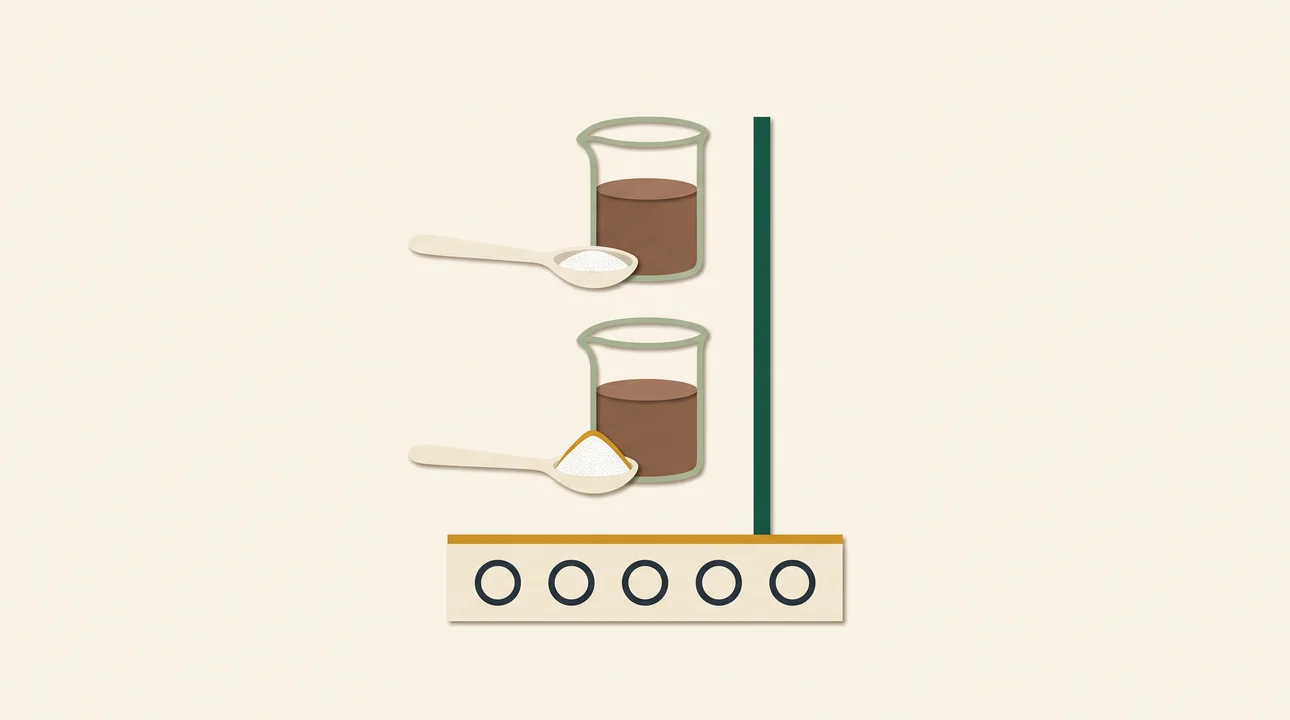
Controlled human tests have not established that cannabis reliably makes sugar taste sweeter. A small trial tested seven sugar concentrations without finding a significant THC or CBD effect on sweetness ratings. Eating more food or finding it more appealing answers a different question. de Bruijn et al., 2017
Here in High School, we can separate “this tastes sweeter” from “I want another bite.” That distinction lets us check the claim without dismissing someone’s experience or promising a sensory boost.
The opening illustration shows a schematic comparison of sugar concentrations and a blank rating scale. It is not an actual experiment photograph or a cannabis-effect result.
What did the direct human sweetness test find?
Ten healthy men who occasionally used cannabis completed a randomized, blinded crossover study. Each attended THC, CBD and placebo sessions, separated by two weeks. Researchers tested chocolate drinks at seven added-sugar concentrations, from 2 to 33.8 grams per 100 milliliters. Participants rated sweetness and liking separately. Full original study
More sugar produced higher sweetness ratings. The drug condition did not significantly change sweetness intensity or liking. In other words, the test detected the sugar difference without detecting a cannabis-related boost.
| Question measured | Exposure and route | Result | Main limit |
|---|---|---|---|
| How sweet are seven chocolate-drink samples? | Vaporized plant preparations containing nominal THC 4 + 1 mg, CBD 25 + 10 mg, or placebo | No significant drug effect on intensity (P = .53) or liking (P = .41) | Ten selected men; low tested exposure and one kind of drink |
| How much favorite drink is consumed? | Same 2017 crossover trial | No significant intake difference (P = .62) | Sweet samples preceded the intake test |
| How much snack food is eaten, and how much is it liked? | A separate 2025 vapor trial; nominal plant-content THC 20 or 40 mg versus placebo | Early intake increased; no cannabis effect on food-liking ratings | Main paper reports 82 people; ratings were not a sweetness test |
Sources: de Bruijn’s sweetness experiment and Hume’s human feeding experiment. These are research exposures, not a dose guide. Plant content does not equal the amount absorbed into blood.
Why is sweetness different from liking or wanting more?
Imagine the same chocolate drink in three questions:
- Sweetness intensity: How strong is the sweet taste?
- Food liking: How much do you enjoy the sample?
- Amount eaten: How much do you consume?
A very sweet drink might be unpleasant. A less sweet drink might be someone’s favorite. Finishing a larger serving does not tell us which sweetness rating that person would choose. These are examples of separate measurements, not claims about how cannabis causes an individual response.
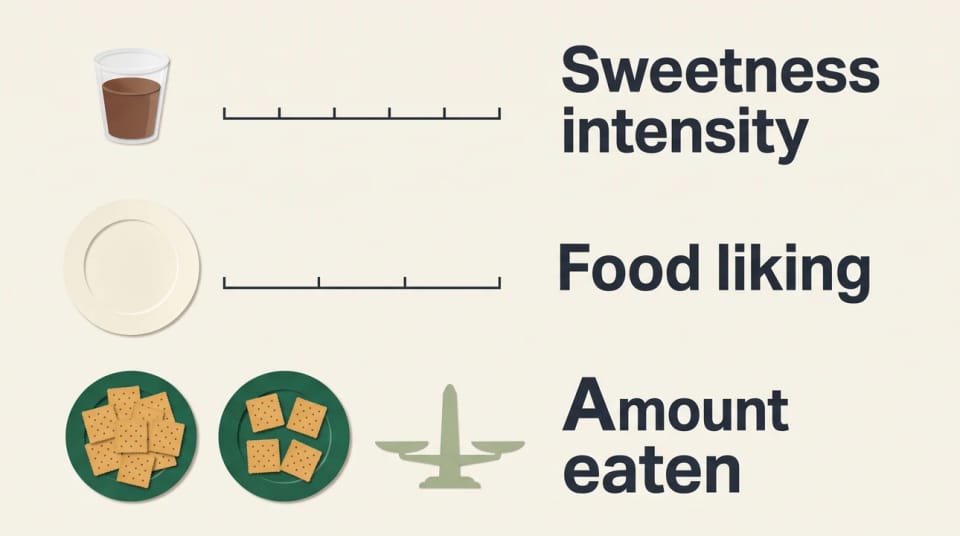
Sweetness, liking and intake need separate measurements. The unselected scales and food symbols show question types, not results or actual trial equipment.
Our munchies lesson covers the broader hunger question. This lesson asks whether a fixed sugary sample actually receives a higher sweetness rating.
Can people eat more without rating food as better?
Yes. The 2025 study found higher intake during the first 30 minutes of snack access after vaporized cannabis. Its taste scale ran from strongly dislike to strongly like. It measured food liking, not sweetness intensity. Hume et al., 2025
The liking findings also need a qualification: a significant condition-by-gender interaction occurred. Men in the high-dose group rated food higher than women in that group. That is not the same comparison as cannabis versus placebo. The reported cannabis null does not mean every taste analysis was null.
Participants completed about an hour of memory tasks before food access. They were experienced users, and human blood THC was not measured. Rat experiments elsewhere in the paper cannot establish a person’s taste mechanism.
Has THC ever increased food appeal in a human study?
Yes. A 2019 trial provides a useful counterpoint. Seventeen healthy people completed a single-blind crossover study of oral THC and placebo. THC increased liking and wanting ratings for high-calorie food images, but not low-calorie images. More milkshake was consumed by mouth, while the effect was absent when milkshake was infused into the stomach. Weltens et al., original abstract
That positive result concerns food-image appeal and intake. It does not show that sugar tasted more intense. The original abstract was available for this lesson; full methods and conflict disclosures were not verified. Keeping this result beside the null findings prevents an equally broad claim that THC can never change food appeal.
The lesson on placebo and expectations explains why subjective ratings need careful comparisons. It does not establish expectations as the cause of these food results.
How much can a ten-person null tell us?
It gives a result for the tested conditions, with considerable uncertainty. A nonsignificant difference is not proof that two conditions are identical, or that no person could experience a change.
The 2017 sample was small, male and selected for health and occasional cannabis use. Exposure was low, and traces of THC were found in tested placebo samples. Chocolate drinks cannot represent every food, aroma or texture. The sweet-drink load also limits how far its later intake and food-choice results can travel. de Bruijn et al.
An older series of experiments reported no drug effect on taste responses either. Its original abstract describes 57 people in an acute oral study, 11 in a route comparison and six in a short repeated-dose study. These are separate experiments, not one 74-person trial. The full paper was unavailable for this lesson. Mattes et al., 1994
Our THC absorption lesson explains why route belongs beside a result. These findings do not provide a sweetness rule for every edible, inhaled product or pattern of use.
What does this mean for food that feels different while high?
Describe the change as specifically as you can. More sweetness, more enjoyment and a stronger urge to keep eating are different observations. None becomes a proven general effect just because it fits the familiar munchies story.
Likewise, a proposed smell explanation needs human smell evidence. Our human THC smell-test lesson separates odor performance from experience. The THC and CBD comparison keeps the compounds distinct; a result involving one preparation does not automatically apply to another.
Key takeaways
- Seven sugar concentrations were tested without a significant drug effect on sweetness in the small 2017 trial.
- Sweetness intensity, food appeal and intake answer different questions.
- Positive food-reward findings belong beside the taste nulls.
- Small samples and specific routes prevent a universal taste prediction.
FAQ
Does weed make sugar taste sweeter?
A reliable boost has not been demonstrated by the direct human tests here. The small 2017 trial found no significant change in sweetness ratings at its tested exposure.
Is craving sweets proof that sweetness is stronger?
No. Wanting a sweet food concerns desire. Measuring how sweet a fixed sample tastes requires a separate intensity rating.
Does CBD make sweets taste less sweet?
The 2017 study did not find a significant drug effect on sweetness across its CBD, THC and placebo conditions. That does not establish a sweetness-reducing benefit from consumer CBD products.
Do the null findings mean food cannot feel better while high?
No. A study can find increased food appeal on one task and no sweetness change on another. The claim should name the food, task, route and comparison.
Sources
- de Bruijn SEM, de Graaf C, Witkamp RF, Jager G (2017). Explorative Placebo-Controlled Double-Blind Intervention Study with Low Doses of Inhaled Δ9-Tetrahydrocannabinol and Cannabidiol Reveals No Effect on Sweet Taste Intensity Perception and Liking in Humans. Cannabis and Cannabinoid Research 2(1):114–122. DOI; PMID 28861511. Full original read; Graduate School VLAG funding, Bedrocan placebo supply, no competing financial interests declared.
- Hume C, Cuttler C, Baglot SL, Javorcikova L, McLaughlin RJ, Hill MN (2025). Cannabis produces acute hyperphagia in humans and rodents via increased reward valuation for, and motivation to, acquire food. PNAS 122(52):e2518863122. DOI. Main original read; human support included Washington Initiative 502, NIDA and NIMH; general support included CIHR and NSERC. No competing interest declared. Supplementary participant flow not verified.
- Weltens N, Depoortere I, Tack J, Van Oudenhove L (2019). Effect of acute Δ9-tetrahydrocannabinol administration on subjective and metabolic hormone responses to food stimuli and food intake in healthy humans: a randomized, placebo-controlled study. American Journal of Clinical Nutrition 109(4):1051–1063. DOI; PMID 30949710. Original abstract read; full funding and conflicts not verified.
- Mattes RD, Shaw LM, Engelman K (1994). Effects of cannabinoids (marijuana) on taste intensity and hedonic ratings and salivary flow of adults. Chemical Senses 19(2):125–140. DOI; PMID 8055263. Original abstract read; full funding and conflicts not verified.



