Does THC Improve Your Sense of Smell? What Human Tests Found
Does THC improve your sense of smell? A small human trial found poorer detection and discrimination, while mouse findings answer a different question.

Human evidence does not establish that THC reliably improves smell; a small controlled trial found worse odor detection and discrimination at its tested oral dose. Mouse findings about smell and hunger answer a different question. Walter et al., 2014
“This smells amazing” and “I can detect a fainter odor” sound similar in conversation. In an experiment, they require different measurements. Here in High School, that distinction helps us read the claim without dismissing someone’s experience or turning it into a proven sensory upgrade.
What did human smell tests actually find?
Researchers tested 15 healthy adults in a randomized, blinded crossover trial. Each received 20 mg oral THC and placebo on separate visits, at least four weeks apart. Smell testing occurred before dosing and two hours afterward. The dose describes the experiment, not a recommendation. Full human study
| Endpoint | Oral dose and route | Finding | Main limit |
|---|---|---|---|
| Detection of a faint odor | 20 mg swallowed THC | Worse threshold performance | 15 adults; measured at two hours |
| Telling odors apart | Same trial | Worse discrimination | One dose and test setting |
| Naming an odor | Same trial | No significant change | A null result does not prove identical performance |
| Rated intensity and pleasantness | Same trial | No significant change | Ratings differ from detection ability |
Source: Walter’s Sniffin’ Sticks experiment.
The human result was poorer detection and discrimination, rather than uniformly “stronger smells.” Identification and ratings did not show significant changes. Keeping those null findings matters: “smell got worse” also oversimplifies the experiment.
Why isn’t a more vivid smell proof of better detection?
Think of a smell test as several questions:
- Detection: Is there an odor here at all?
- Discrimination: Which sample smells different from the others?
- Identification: Which name matches this odor?
- Experience: How strong or pleasant does it seem?
These are examples of different tasks, not a home test or a diagnosis. A person might describe a familiar smell as compelling without demonstrating that they can find a weaker concentration. Conversely, failing an odd-one-out task does not tell us how much they enjoy a favorite meal.
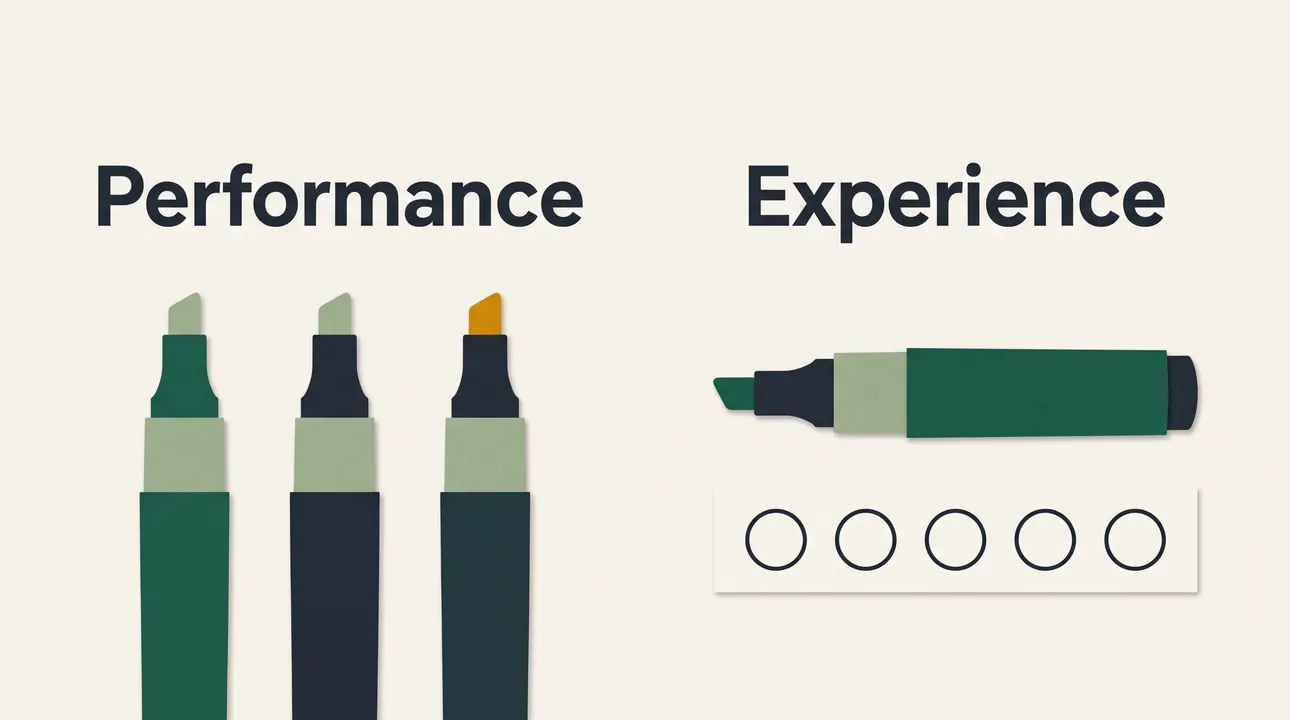
Performance tasks and experience ratings ask different questions. Colors distinguish symbols, not cues in an actual smell test; the empty circles show no result.
This is why the endpoint belongs beside the claim. “THC changes smell” leaves too many possibilities open. “The participants needed a stronger odor to detect it in this test” tells us what was actually measured.
Did the study show a percentage loss of smell?
No. Its combined threshold, discrimination and identification score, called TDI, fell from 37.7 to 32.2 after THC. The placebo-adjusted difference in change was −4.9 points, with a 95% confidence interval from −7.8 to −2.0. Those are test-score points, not a percentage of smell lost. Walter et al., 2014
A score combines the tasks it contains. Dividing a change by the starting score does not convert it into a biological percentage. It would not establish that the nose lost that fraction of its receptors, that every scent weakened equally, or that every participant had the same response.
That distinction matters when illustrating a before-and-after claim. A fading cloud of aroma could imply a measured reduction in real-world odor intensity. That was a separate rating endpoint, and it did not change significantly in this trial.
Why do mouse studies suggest better smell?
In a 2014 mouse study, researchers linked CB1 cannabinoid signaling in olfactory circuits to odor detection and food intake during fasting. Pharmacological and genetic manipulations helped test the circuit’s role. The work supports a mechanism in those animals under those conditions. It does not measure a person’s smell after cannabis. Soria-Gómez et al., 2014
That is a meaningful finding. The error comes when a headline drops the species and state, leaving “THC improves smell” as a claim about everyone. A fasted mouse in a circuit experiment and an adult taking an oral capsule are not interchangeable study conditions.
Our munchies lesson covers the broader appetite question. A proposed smell pathway can contribute to that discussion without establishing improved human odor detection. Hunger, food appeal and smell-test performance each need their own evidence.
Did later brain imaging confirm an improvement?
A 2017 report tested olfactory brain responses in 15 adults given 20 mg oral THC or placebo. Vanillin became less pleasant, with reduced activity in certain brain regions; hydrogen sulfide showed no corresponding effect. These were stimulus-specific findings, not evidence of a general smell boost. Walter et al., 2017
The publisher identifies the earlier smell paper as another report from the same complex project. We should treat this as follow-up evidence, rather than count two publications as two independent replications. Its vanillin task also differs from rating the earlier battery of odors.
The lesson is not that one pleasantness result cancels the other. A precise summary names the stimulus, method and endpoint. “No significant change in these ratings” is narrower than “THC can never affect pleasantness.”
What does this leave unanswered?
The small human trial cannot settle lower doses, inhaled products, long-term use or smell disorders. Drowsiness and tiredness increased; vomiting, paranoia and dizziness also occurred. Psychoactive effects could reveal which session contained THC despite blinding. Public research funding and no relevant conflicts were disclosed. Walter et al., 2014
These limits leave room for further work. They do not turn the tested impairment into evidence of enhancement. Nor do animal mechanisms establish a treatment for a lost or altered sense of smell.
Other smell questions belong in separate lessons. Why you cannot smell cannabis on yourself concerns adaptation to an odor around you. Cannabis aroma chemistry concerns the plant’s odor. The terpene smell test concerns what aroma can tell you about a product. None is a substitute for testing a drug’s effect on sensory ability. Our THC and CBD comparison also keeps the compounds distinct; these THC findings cannot simply be assigned to CBD.
Key takeaways
- Smell performance and smell experience are different endpoints.
- The tested human dose worsened detection and discrimination.
- Null results and untested conditions are different kinds of uncertainty.
- Mouse mechanisms do not establish improved human smell or a smell treatment.
FAQ
Does cannabis make your sense of smell stronger?
That broad claim is not established by the evidence here. A feeling of vividness does not measure detection, and the controlled human trial did not show improved detection at its tested dose.
Why might food smell better when someone is high?
“Better” could mean more appealing rather than easier to detect. The mouse appetite mechanism does not identify the cause of an individual person’s experience. The question needs a measurement that matches the claim.
Does THC make you nose-blind?
This trial did not test adaptation to cannabis odor on clothing or in a room. Its laboratory smell tasks address a different question from becoming used to a persistent smell.
Can THC restore a lost sense of smell?
These studies do not establish that treatment. Results in healthy adults and fasted mice cannot supply a clinical benefit that was not tested.
Sources
- Walter C, Oertel BG, Ludyga D, Ultsch A, Hummel T, Lötsch J. Effects of 20 mg oral Δ9-tetrahydrocannabinol on the olfactory function of healthy volunteers. British Journal of Clinical Pharmacology. 2014;78(5):961–969. DOI: 10.1111/bcp.12415. PMID: 24802974.
- Soria-Gómez E, et al. The endocannabinoid system controls food intake via olfactory processes. Nature Neuroscience. 2014;17(3):407–415. DOI: 10.1038/nn.3647. PMID: 24509429.
- Walter C, Oertel BG, Felden L, Nöth U, Vermehren J, Deichmann R, Lötsch J. Effects of oral Δ9-tetrahydrocannabinol on the cerebral processing of olfactory input in healthy non-addicted subjects. European Journal of Clinical Pharmacology. 2017;73(12):1579–1587. DOI: 10.1007/s00228-017-2331-2. PMID: 28866743.





